
UK fire safety signage is a legal requirement, not a discretionary measure. Two pieces of legislation set the framework: the Regulatory Reform (Fire Safety) Order 2005 and the Health and Safety (Safety Signs and Signals) Regulations 1996. Together, they define what signs you must display, what they must look like, and who is responsible for keeping them in place. The design standards that sit behind both laws are BS EN ISO 7010 for graphical symbols and BS 5499-10 for application, size, and siting guidance.
Key obligations at a glance:
- The Responsible Person (employer, owner, or occupier) must carry out a fire risk assessment and provide signage wherever risks cannot be controlled by other means.
- Signs must use standardised pictograms. Text-only signs have been non-compliant since 24 december 1998 and must be replaced or supplemented with pictograms.
- Colour coding is mandatory: red for firefighting equipment, green for escape routes, blue for mandatory actions, and yellow for warnings.
- Signage must be maintained in a clean, legible, and unobstructed condition at all times.
- Staff must receive training on the meaning of every sign displayed on the premises.
- The enforcing authority for fire safety signs is typically the local fire authority, not the HSE, except in specific premises categories.
Table of Contents
What are the main fire safety sign types and what do they mean?
Fire safety signs fall into five distinct categories, each with a defined colour, shape, and purpose under the 1996 Regulations.
- Fire action notices (white text on red or combined format): Posted next to break-glass call points, these tell occupants what to do when the alarm sounds. They are mandatory in any premises fitted with a fire alarm system.
- Fire exit signs (green background, white pictogram): Mark escape routes, final exit doors, and directional arrows along evacuation paths. The running-man pictogram is the internationally recognised symbol under BS EN ISO 7010.
- Firefighting equipment signs (red background): Identify the location of extinguishers, hose reels, and fire blankets. The red background or red-coloured location signboard is the legal identifier; the sign must be large enough to be seen from a reasonable distance.
- Warning signs (yellow/amber triangle, black symbol): Alert people to fire hazards such as flammable materials or high-voltage risks that could contribute to fire. These follow the same triangular format as general hazard signs.
- Prohibition signs (red circle with diagonal bar): Communicate what must not be done, for example “No smoking” or “No naked flames.” Circular with a red border and bar over a black symbol on a white background.
Combining text with a pictogram is permitted and can add clarity, particularly where staff or visitors may have limited familiarity with symbols. What is not permitted is a pictogram-free, text-only sign used in isolation. A sign reading “Fire Exit” with no running-man symbol has been non-compliant for over two decades. The 1996 Regulations guidance is explicit on this point.
Where should you place fire safety signs in your premises?
Placement is as legally significant as the sign itself. A correctly designed sign in the wrong location fails its purpose and may constitute a compliance breach.
- Fire action notices must be positioned immediately next to each break-glass alarm call point, at eye level and unobstructed.
- Fire exit signs should be mounted directly above the exit opening wherever possible. Where that is not practical, choose the nearest position with a clear line of sight and the least risk of obstruction by smoke.
- Directional signs along escape routes are required wherever a person evacuating could be in doubt about which way to go. In warehouses, open-plan offices, or large retail spaces, intermediate signs at corridor junctions are standard practice.
- Assembly point signs belong outside the building at the designated gathering area, visible from the exit doors.
- Firefighting equipment signs must be placed at or near the equipment itself, at a height and angle that allows the location to be identified quickly from across the room.
- Large or complex buildings require a more detailed approach: signs at every decision point along an escape route, with illuminated versions where natural or artificial light may be insufficient.
In small premises where escape routes are obvious, the fire risk assessment may conclude that exit signs are unnecessary. That judgement must be documented. Blanket coverage is not the legal standard; proportionate, risk-assessed placement is.
Pro Tip: Position fire exit signs so they remain visible at low level. In a smoke-filled corridor, a sign mounted at 2.5 metres may be obscured well before a sign at 1.5 metres.

How do you keep fire safety signage compliant over time?
Maintenance is a legal duty under the 1996 Regulations, not a best-practice recommendation. Signs that are faded, dirty, damaged, or obscured by shelving or new partitions are legally equivalent to no sign at all.
- Carry out regular inspections to check that every sign is clean, legible, and unobstructed. The frequency should reflect the premises type and footfall.
- Replace faded or damaged signs promptly. Photoluminescent signs, which absorb ambient light and glow in darkness, require particular attention: check that they are not covered by paint, film, or furniture that blocks their charging.
- Update signage whenever the building layout changes. A new partition wall, a relocated fire extinguisher, or a changed evacuation route all trigger a signage review.
- Integrate signage checks into your formal fire risk assessment cycle. Record findings and corrective actions. This documentation is what an enforcing authority will ask to see.
- Ensure that any new or replacement sign still meets BS EN ISO 7010 pictogram requirements. Sourcing a cheaper, non-standard sign to replace a damaged one is a common and costly mistake.
Poor maintenance does not just create a safety risk. It exposes the Responsible Person to enforcement action, improvement notices, and in serious cases, prosecution. For a practical overview of signage compliance obligations, the legal duties are clear and the consequences of ignoring them are significant.

What standards and design rules apply to UK fire safety signs?
The design of fire safety signs is governed by two complementary standards. BS EN ISO 7010 specifies the graphical symbols themselves, ensuring that a fire exit sign in a London office carries the same meaning as one in a Berlin factory. BS 5499-10 provides practical guidance on application, sizing, and siting within UK premises.
Key design requirements:
- Colour: Red for firefighting, green for escape, blue for mandatory, yellow for warning. These are not stylistic choices; they are legally defined.
- Shape: Prohibition signs are circular; warning signs are triangular; mandatory signs are circular with a blue background; escape and firefighting signs are rectangular or square.
- Size: The sign must be large enough to be legible from the furthest point at which a person needs to read it. BS 5499-10 provides a formula linking viewing distance to minimum sign height.
- Material: Signs in damp or outdoor locations require weatherproof materials. Photoluminescent signs are required in certain high-rise residential buildings over 11 metres under the Fire Safety (England) Regulations 2022.
- Illuminated signs: Required where ambient lighting cannot guarantee visibility, particularly in escape routes used at night or in windowless areas.
One common mistake is signage clutter. Placing too many signs in a single area reduces the impact of each one. The 1996 Regulations guidance explicitly warns against using too many signs, which can cause confusion rather than clarity. Another frequent error is retaining legacy text-only signs alongside new pictogram signs without removing the old ones, creating contradictory messages.
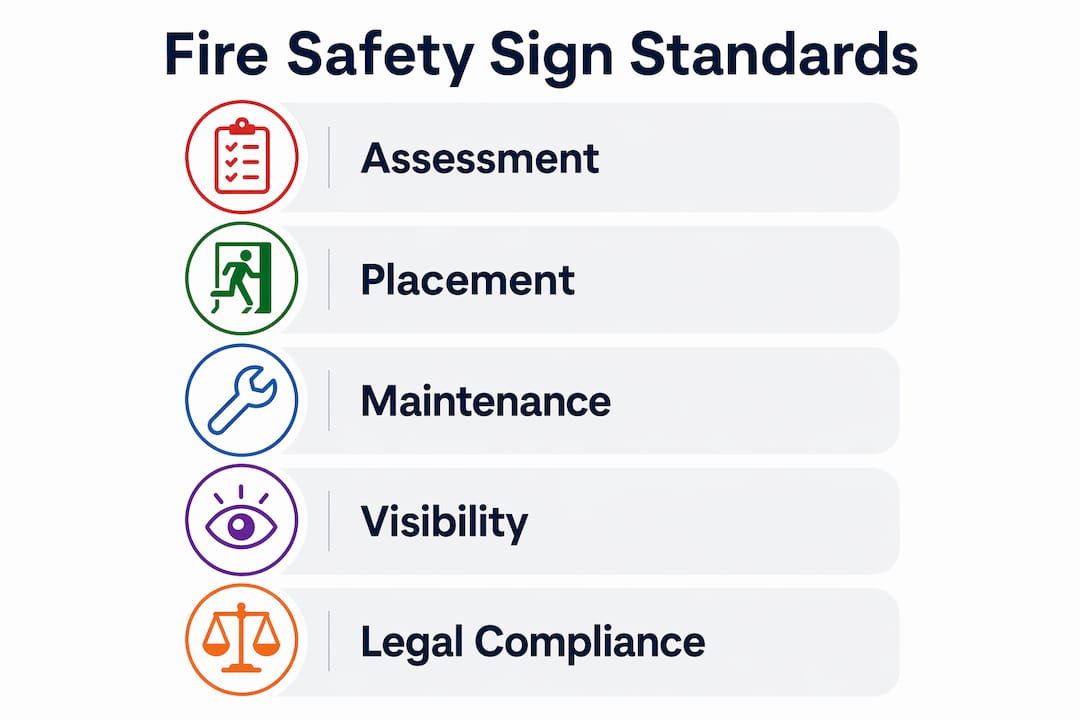
How Promosigns helps London businesses get fire safety signage right
Choosing the right signage provider matters as much as choosing the right sign. A supplier who understands UK fire safety legislation, London building types, and the practical demands of compliance inspections will save you time and reduce risk.
- Legislation knowledge: Your provider should be familiar with the Regulatory Reform (Fire Safety) Order 2005, the 1996 Regulations, and the Fire Safety (England) Regulations 2022. Signs that look correct but use non-compliant colours, shapes, or symbols will not satisfy an enforcing authority.
- Material quality: Durable, UV-stable materials matter for signs in high-traffic or outdoor locations. Photoluminescent substrates must meet the performance requirements for the premises type.
- Installation expertise: Correct height, angle, and fixings are part of compliance. A sign installed behind a door or above a suspended ceiling tile is useless in an emergency.
- Ongoing support: Signage needs change as buildings change. A provider offering maintenance reviews and replacement services keeps your compliance current without requiring you to manage every detail yourself.
Promosigns designs, manufactures, and installs bespoke interior signage across London, working with business owners, property managers, and safety officers to deliver compliant, durable solutions. Whether you manage a single retail unit or a multi-floor commercial building, the approach is the same: signs that meet the standard, installed correctly, and built to last.

For businesses across London requiring compliant fire safety signage with professional installation, Promosigns’ signage solutions cover design, manufacture, and fitting as a single end-to-end service.
Pro Tip: Ask any prospective signage provider to confirm which BS EN ISO 7010 symbols they use and whether their photoluminescent products meet the performance criteria in BS 5499-10. A provider who cannot answer that question confidently is not the right choice for compliance-critical work.
How did COVID-19 affect fire safety signage in UK workplaces?
The pandemic created a specific and underappreciated tension in fire safety signage management. From 2020 onwards, businesses across the UK added large volumes of social distancing, one-way system, and hygiene instruction signs to their premises. Many of these were applied quickly, using temporary vinyl graphics, printed notices, and floor markings.
The problem was placement. Temporary COVID-19 signs were frequently positioned over or adjacent to fire exit signs, fire action notices, and firefighting equipment markers. In some cases, one-way system arrows directly contradicted the directional arrows on fire exit signs. The Health and Safety Executive guidance on avoiding signage clutter became particularly relevant during this period, as premises that had previously maintained clean, unambiguous fire signage found their layouts visually cluttered overnight.
The practical lesson from that period is durable: any temporary signage campaign, whether for COVID-19, a promotional event, or a building refurbishment, must be audited against existing fire safety signage before installation. Temporary signs that obscure or contradict fire safety information create a compliance breach regardless of their purpose.
Visibility requirements across different types of premises
The visibility standard for fire safety signs is not uniform. It scales with the complexity, size, and occupancy profile of the building.
| Premises type | Key visibility requirement |
|---|---|
| Small office or retail unit | Signs visible from all occupied areas; exit signs above final doors |
| Open-plan warehouse or factory | Intermediate directional signs at decision points; illuminated signs where natural light is low |
| High-rise residential (over 11m) | Photoluminescent floor and flat identification markings visible in low light and by torchlight |
| Licensed premises or hospitality | Exit signs visible from all seating and standing areas; signs not obscured by décor or temporary fittings |
| Healthcare or care settings | Signs at low level as well as standard height to assist wheelchair users and those with limited mobility |
The Fire Safety (England) Regulations 2022 introduced specific wayfinding signage duties for high-rise residential buildings, requiring floor identification and flat identification markings on each landing within stairways and lift lobbies, visible in low-level lighting conditions or when illuminated with a torch. This is a meaningful shift toward visibility standards that account for the conditions of an actual emergency, not just normal operating conditions.
Signage must also complement emergency lighting. A sign that is perfectly legible under normal lighting may be invisible if the mains power fails and the emergency lighting circuit does not illuminate it. For premises where this is a risk, illuminated signage options that operate on a maintained or non-maintained circuit provide the most reliable solution. The UK signage regulations covering illuminated signs set out the minimum performance requirements in detail.
The case for getting fire safety signage right from the start
There is a tendency among business owners to treat fire safety signage as a box-ticking exercise: buy a set of standard signs, put them up, and move on. That approach misses the point of the legislation and, more practically, it tends to create problems at the worst possible moment.
The Regulatory Reform (Fire Safety) Order 2005 places the legal burden squarely on the Responsible Person. That individual, whether an employer, a building owner, or a managing agent, is accountable not just for having signs in place but for ensuring they are correct, maintained, and understood by everyone on the premises. A fire risk assessment that identifies a need for signage and then fails to deliver compliant signs is not a partial pass. It is a documented failure.
What I find most businesses underestimate is the cumulative effect of small signage decisions. A fire exit sign mounted six inches too low. A fire action notice that has not been updated since the alarm system was upgraded. A photoluminescent strip that has been painted over during a refurbishment. None of these feels significant in isolation. Together, they can mean that in an actual emergency, the signage system fails at precisely the moment it is needed most.
The most effective approach is to treat signage as part of a broader safety system, not a standalone product purchase. Signs work alongside emergency lighting, staff training, and clear evacuation procedures. Remove any one of those elements and the others are weakened. The health and safety signage guide for UK businesses covers this integrated approach in practical terms.
Proportionality also matters. Excessive signage creates visual noise that reduces the impact of critical messages. The fire risk assessment should drive the number and placement of signs, not a desire for comprehensive coverage. A well-signed premises is one where every sign earns its position.
Recommended
- Health and Safety Signage: Essential Guide for UK Businesses 2025 – PromoSigns.co.uk
- Signage Safety Considerations: Complete Guide for UK Businesses – PromoSigns.co.uk
- What is Hoarding Signage? UK Guide – PromoSigns.co.uk
- Outdoor Signage Regulations UK (2026) – Planning & Compliance
