
Ordering a business sign can seem straightforward and most people focus on colours or logos first. Yet the real magic happens before any design begins. Your sign is more than just a visual marker — it’s a powerful communication tool that represents your business’s first impression. Shockingly, it is this early planning that decides whether your sign attracts attention or fades into the background. Ignore the urge to jump straight into design choices, because how you define your signage requirements will either set you up for stunning success or silent failure.
Table of Contents
Quick Summary
| Key Point | Explanation |
|---|---|
| 1. Define Your Signage Requirements Clearly | Assess your business needs and objectives to create a comprehensive signage brief before choosing materials or designs. |
| 2. Select Appropriate Materials and Design | Choose materials that suit environmental conditions, while designing to reflect brand identity and enhance visibility. |
| 3. Research and Choose a Reputable Supplier | Ensure the supplier has proven expertise, strong portfolios, and transparent pricing to guarantee quality production. |
| 4. Compile Precise Specifications Before Ordering | Document all details meticulously, including colours, dimensions, and installation requirements, to avoid miscommunication. |
| 5. Conduct a Thorough Final Inspection | Inspect the delivered sign carefully for adherence to specifications, quality, and accuracy to ensure brand representation. |
Table of Contents
- Step 1: Define Your Signage Requirements
- Step 2: Choose The Right Material And Design
- Step 3: Select A Reputable Sign Supplier
- Step 4: Place Your Order With Clear Specifications
- Step 5: Review The Proof And Approve Design
- Step 6: Inspect The Final Sign Upon Delivery
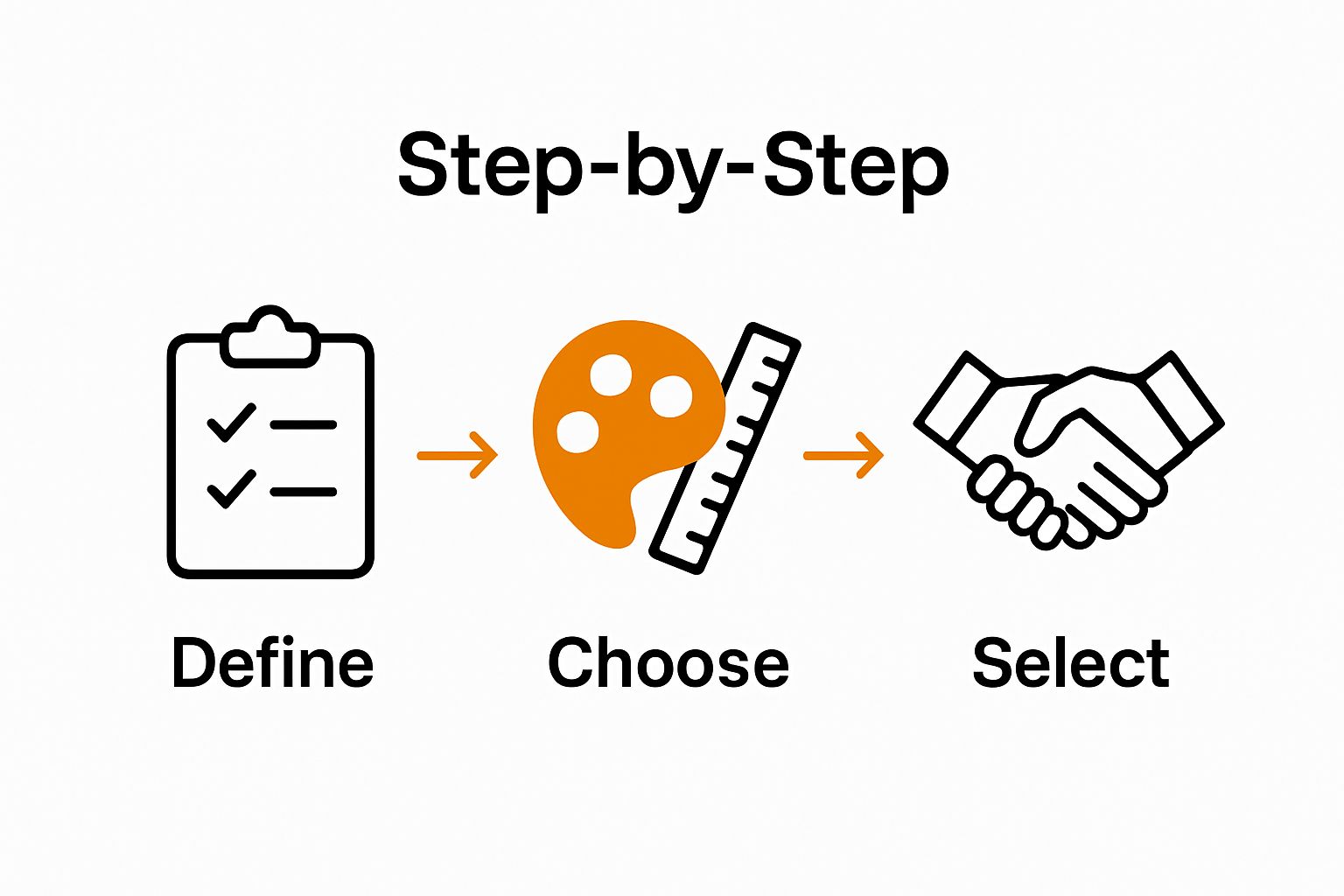
Step 1: Define Your Signage Requirements
When ordering business signs, the first critical step involves clearly defining your signage requirements. This foundational stage determines the success and effectiveness of your entire signage project. Before selecting materials, colours, or design elements, you need a comprehensive understanding of your specific business needs and communication objectives.
Begin by conducting a thorough assessment of your business environment and branding goals. Consider the primary purpose of your sign: are you aiming to attract new customers, reinforce brand identity, provide directional information, or create a memorable visual statement? Each objective requires a nuanced approach to signage design and placement. Your sign is more than just a visual marker — it is a powerful communication tool that represents your business’s first impression.
Carefully evaluate your physical location and architectural constraints. Measure the available space where you plan to install the sign, noting dimensions, lighting conditions, viewing angles, and potential obstructions. Take photographs of the installation area to help designers understand the context. Some businesses might benefit from exploring professional signage planning resources to ensure precise measurements and strategic positioning.
Next, document your branding guidelines meticulously. Compile your brand’s colour palette, typography preferences, logo specifications, and any specific visual elements that must be incorporated. Professional signage companies London require precise specifications to translate your brand vision accurately.
Consider practical requirements such as durability, visibility, and compliance with local regulations. Different environments demand different signage solutions — an outdoor sign for a bustling high street requires different materials and design considerations compared to an indoor office reception sign.
By the conclusion of this step, you should have a comprehensive brief that includes:
- Precise measurements of installation area
- Clear branding guidelines
- Intended sign purpose
- Environmental considerations
- Budget parameters
Step 2: Choose the Right Material and Design
Selecting the appropriate material and design for your business sign is a crucial decision that directly impacts your brand’s visual communication and long-term durability. This step transforms your initial requirements into a tangible visual representation that speaks volumes about your business identity.
Material selection goes far beyond aesthetic preferences — it involves understanding environmental conditions, budget constraints, and functional requirements. Consider the primary location of your sign: an outdoor storefront sign requires different materials compared to an indoor office directory. Aluminium offers excellent weather resistance and lightweight properties, making it ideal for exterior applications. Acrylic provides a sleek, modern appearance perfect for contemporary indoor environments, while wooden signs can create a warm, traditional atmosphere for certain business types.
Your design must harmonise technical considerations with brand storytelling. Explore inspiring high street shop sign design ideas to understand how successful businesses communicate their unique identity through signage. Colour psychology plays a significant role — choose colours that not only align with your brand guidelines but also evoke the right emotional response from potential customers.
Consider the viewing distance and lighting conditions when finalising your design. Signs viewed from a distance require larger fonts and high-contrast colour schemes. Illuminated shop signs London using LED technology can dramatically enhance visibility during evening hours, ensuring your business remains prominent around the clock.
| Material | Best Suited For | Key Characteristics |
|---|---|---|
| Aluminium | Outdoor signage | Weather-resistant, lightweight, durable |
| Acrylic | Indoor signage | Modern appearance, sleek, versatile |
| Wood | Indoor or sheltered outdoor | Traditional look, warm, customisable |
| PVC/Foam Board | Indoor temporary signs | Economical, lightweight, easy to mount |
| Stainless Steel | Prestige/branding outdoors | High durability, professional finish |
| Illuminated (LED) | Visibility at night | Enhanced visibility, energy-efficient |
By the end of this step, you should have:
- A selected sign material matching your environment
- A design that reflects your brand identity
- Precise measurements and technical specifications
- An understanding of colour and visibility requirements
Step 3: Select a Reputable Sign Supplier
Choosing the right sign supplier is a pivotal moment in your signage journey, representing the difference between a mediocre sign and a transformative business communication tool. Your sign supplier is not just a vendor, but a strategic partner in bringing your brand vision to life.
Initiate your search by thoroughly researching potential suppliers with proven expertise in your specific signage requirements. Look beyond glossy marketing materials and dig deep into their portfolio, customer testimonials, and industry reputation. A reputable supplier should demonstrate versatility across different sign types, materials, and business sectors. Check out our comprehensive guide to professional commercial sign installation to understand the critical factors in selecting the right partner.
Evaluate potential suppliers through multiple lenses. Technical capabilities matter immensely — assess their design software, manufacturing equipment, and production techniques. Modern sign makers should offer digital proofing, 3D mockups, and detailed technical specifications that allow you to visualise the final product before manufacturing.
Financial stability and customer service are equally crucial considerations. A reliable sign supplier offers transparent pricing, clear communication channels, and robust after-sales support. Request detailed quotes that break down all costs, including design, materials, manufacturing, and installation. Be wary of suppliers offering significantly lower prices, as this might indicate compromised quality or hidden additional charges.
By the conclusion of this step, you should have:
- A shortlist of 3–5 potential sign suppliers
- Comprehensive portfolios demonstrating their capabilities
- Detailed quotes and transparent pricing structures
- Verified professional credentials and customer testimonials
Step 4: Place Your Order with Clear Specifications
Placing an order for your business signs London requires meticulous attention to detail and comprehensive communication with your chosen sign supplier. Precision in your specifications is the fundamental difference between an acceptable sign and an exceptional brand representation.
Begin by compiling a comprehensive brief that consolidates all previous research and design decisions. This document should function as a complete blueprint, leaving no room for misinterpretation. Include exact measurements, precise colour codes using standard colour matching systems like Pantone, and high-resolution digital files of your logo and branding elements. Learn more about creating impactful design specifications to ensure your vision is accurately translated.
When communicating your requirements, adopt a systematic approach that covers every potential aspect of the sign. Describe not just the visual elements, but also functional specifications such as mounting requirements, environmental considerations, and any specific installation constraints. Professional sign makers appreciate clients who provide comprehensive context, including photographs of the installation location, detailed site measurements, and potential environmental challenges.
Request a detailed proof or digital mockup before final production. This crucial step allows you to visualise the sign exactly as it will appear and provides an opportunity to make minor adjustments. Financial and contractual clarity is equally important — ensure your order documentation includes precise pricing, expected production timeline, delivery method, and installation details.
By the conclusion of this step, you should have:
- A comprehensive design brief with all technical specifications
- Approved digital proofs matching your exact requirements
- Clear contractual agreement covering production and delivery
- Confirmed timeline and financial terms
Step 5: Review the Proof and Approve Design
Reviewing and approving your business sign’s design proof represents a critical checkpoint in the sign production process. This is your final opportunity to catch potential errors and ensure the sign perfectly captures your brand’s visual identity before manufacturing begins.
Approach the design proof with a systematic and meticulous mindset. Explore professional design verification techniques to enhance your review process. Begin by comparing the digital proof against your original design specifications with forensic attention to detail. Examine every element — from colour accuracy and font consistency to logo placement and overall visual balance.
Consider the proof from multiple perspectives, simulating how potential customers will perceive your sign. Assess the design’s readability from various distances and angles, ensuring that text remains clear and imagery remains sharp. Pay particular attention to how the sign will appear under different lighting conditions.
When identifying potential modifications, communicate changes concisely and professionally. Provide specific, actionable feedback using exact references — such as specifying exact pixel measurements, colour code variations, or font kerning requirements.
For businesses requiring multiple panels or large-scale graphics, pairing your bespoke sign design with large format printing London ensures every element is reproduced at full scale with consistent colour and sharpness before final approval.
By the conclusion of this step, you should have:
- Thoroughly examined the digital design proof
- Verified colour and design accuracy
- Confirmed readability and visual impact
- Documented any necessary revisions
- Prepared for final design approval
Step 6: Inspect the Final Sign Upon Delivery
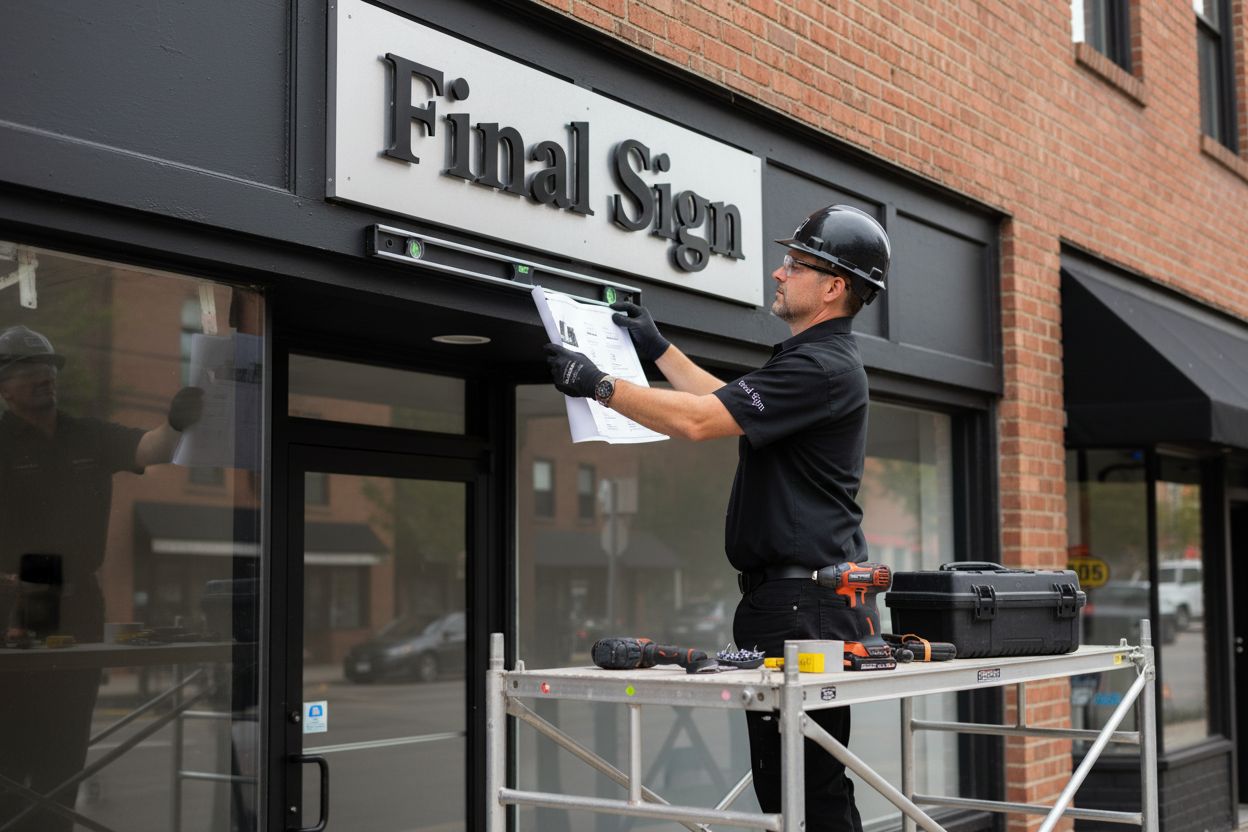
The arrival of your business sign marks the culmination of a meticulous design and production process, making the final inspection a crucial moment that demands your full attention. Your thorough examination ensures that the sign meets every specification and represents your brand with absolute precision.
Upon delivery, create a controlled environment for inspection that allows comprehensive assessment of the sign’s quality. Learn professional techniques for sign installation and verification to guide your review process. Begin by comparing the physical sign against the approved digital proof, checking every minute detail with a systematic approach.
| Inspection Point | What to Look For |
|---|---|
| Visual Accuracy | Colours match approved proof, branding elements correct |
| Surface Condition | No scratches, chips, blemishes, or uneven paint |
| Material & Structural Quality | Sturdy construction, secure welds, no warping or damage |
| Mounting Mechanisms | All hardware included, correct size, matches installation need |
| Dimensional Precision | Width, height, depth as per specifications |
| Edge & Join Quality | Smooth edges, clean joins, no visible seams |
| Lighting/Illumination Check | LEDs/illumination function as intended, no faulty sections |
For custom signs London with bespoke fabrication, pay particular attention to weld points, material joins, and any CNC-cut details — these are the areas most likely to show production variance and should be checked against your approved proof before signing off delivery.
By the conclusion of this step, you should have:
- Completed a comprehensive visual inspection
- Verified colour and design accuracy
- Checked material quality and structural integrity
- Confirmed dimensional precision
- Prepared documentation for potential adjustments
Ready to Order a Business Sign Without the Guesswork?
If you have ever felt overwhelmed by the process of ordering a business sign, you are not alone. Many business owners worry about making mistakes in design briefs, measuring spaces, or selecting the best material for their brand. At PromoSigns, we help you avoid these common pitfalls. We bring deep expertise in shop signage, illuminated signs, and large format printing, supporting you from defining your signage requirements through to final installation. Our step-by-step approach matches every stage from your research to your finished sign, so there are no costly surprises or confusion.
If your business is based in London, Essex, or Kent, it is time to turn your vision into reality without the hassle. Let the professionals at PromoSigns translate your brief into a sign that works for your needs. For inspiration or more help with planning your project, explore our expert advice on planning a signage project or see real success stories in high street shop sign ideas. Visit our site now for a free consultation and discover how our experience puts your business ahead today.
Frequently Asked Questions
What are the first steps to take when ordering business signs?
Begin by defining your signage requirements. Assess your business environment, understand your branding goals, and document details like installation area measurements and intended sign purpose.
How should I choose the right materials for my business signs?
Selecting materials requires consideration of environmental factors and design aesthetics. Evaluate options based on where the sign will be placed — outdoor signs may need weather-resistant materials, while indoor signs might focus more on appearance.
What specifications should I include when placing my order for business signs?
Your order should include precise measurements, exact colour codes, and any logos or branding elements in high resolution. Compile these specifications in a detailed brief to avoid misunderstandings during production.
How can I ensure that the final sign design meets my expectations?
Request a detailed proof or digital mockup of the sign before production begins. Review this carefully, checking for colour accuracy and font consistency to ensure it aligns with your branding requirements.
What should I do if there is an issue with the sign upon delivery?
Perform a thorough inspection of the sign comparing it to your approved proof. If any discrepancies or quality issues arise, document them with photographs and measurements to address with your supplier promptly.
How long does the entire business sign ordering process typically take?
The timeline can vary but expect the entire process from initial planning to final delivery to take approximately 4–6 weeks. Include time for design proofs, adjustments, and any potential permitting if necessary.
Recommended
- A Step-by-Step Guide to Professional Commercial Sign Installation – PromoSigns.co.uk
- How to Choose the Right Commercial Sign for Your Business – PromoSigns.co.uk
- Planning a Signage Project: Elevate Your Business Identity – PromoSigns.co.uk
- How to Install Wall Signs for Your Business Effectively – PromoSigns.co.uk
