
Installing Signs in Heritage Buildings: A Complete Guide to Legal Compliance
Heritage buildings stand as testaments to architectural excellence, yet maintaining them presents unique challenges—particularly when installing modern signage. Whether you’re operating a business in a listed building or managing a historic property, understanding the legal requirements for signage installation is essential.
This comprehensive guide walks you through the regulations, best practices, and expert solutions for installing signs in heritage buildings while preserving their historical integrity.
Table of Contents
Understanding Heritage Building Classifications
Listed Buildings in the UK
The UK categorises heritage buildings into three grades:
- Grade I: Buildings of exceptional interest (approximately 2.5% of listed buildings)
- Grade II*: Particularly important buildings of more than special interest (5.8% of listings)
- Grade II: Buildings of special interest (91.7% of listings)
Each classification level determines the stringency of regulations governing modifications, including signage installation.
Conservation Areas
Properties within conservation areas face additional restrictions, even if not individually listed. Local planning authorities maintain strict oversight of any external changes, including commercial signage and directional signs.

Understanding Heritage Building Classifications
Listed Buildings in the UK
The UK categorises heritage buildings into three grades:
- Grade I: Buildings of exceptional interest (approximately 2.5% of listed buildings)
- Grade II*: Particularly important buildings of more than special interest (5.8% of listings)
- Grade II: Buildings of special interest (91.7% of listings)
Each classification level determines the stringency of regulations governing modifications, including signage installation.
Conservation Areas
Properties within conservation areas face additional restrictions, even if not individually listed. Local planning authorities maintain strict oversight of any external changes, including commercial signage and directional signs.
Legal Requirements for Sign Installation
Listed Building Consent
Installing signs on listed buildings typically requires Listed Building Consent (LBC). This applies to:
- External signage of any type
- Illuminated signs
- Fixings that penetrate the building’s fabric
- Changes affecting the building’s character
Penalties for non-compliance can include:
- Fines up to £20,000
- Imprisonment for up to two years
- Mandatory removal of unauthorised signage
- Restoration costs
Planning Permission
Beyond LBC, you may need planning permission for:
- Illuminated signage exceeding certain dimensions
- Signs displaying advertisements
- Projecting signs extending from the building
- Changes to the building’s façade
Building Regulations Compliance
Sign installations must meet Building Regulations standards for:
- Structural safety
- Fire safety (particularly for illuminated signs)
- Accessibility requirements
- Electrical safety for LED signs and lit signage
| Stakeholder | Primary Role | Key Contribution |
|---|---|---|
| Conservation Officer | Regulatory guidance | Ensures compliance with law |
| Building Owner | Final approval, responsibility | Confirms installation rights |
| Heritage Trust | Preservation advocacy | Reviews for historical merit |
| Architectural Board | Design oversight | Reviews visual harmony |
| Community Group | Local interest and feedback | Offers cultural perspective |
| Specialist Sign Maker | Technical expertise | Provides bespoke solutions |
Step 3: Select Suitable Signage Materials and Methods
Choosing the right materials for signage in heritage buildings demands a delicate balance between preservation, functionality, and aesthetic sensitivity. Your selection process must prioritise materials that complement the building’s historical character while meeting contemporary performance standards.
Carefully evaluate materials that offer minimal visual disruption and maximum durability. Traditional materials like bronze, cast metal, and hand carved wooden signs often work best in heritage contexts. Selecting appropriate commercial sign materials requires considering factors such as weathering potential, colour compatibility, and structural integrity. Consider lightweight aluminium with heritage finish treatments, precision laser cut brass lettering, or sympathetically designed acrylic panels that can be virtually invisible when mounted correctly.
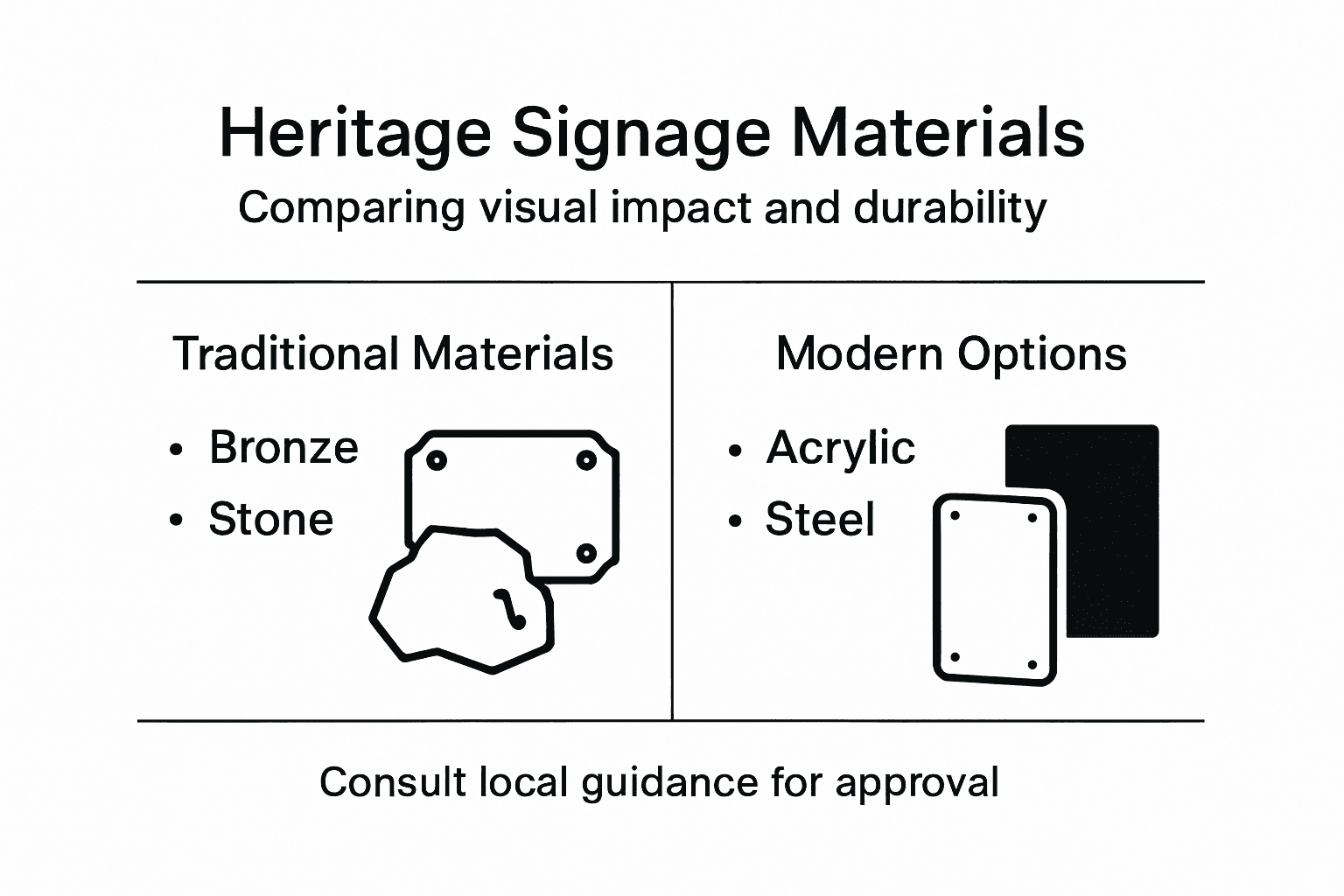
Each material selection demands nuanced consideration of mounting techniques that preserve the original building fabric. Minimal invasive fixing methods such as discreet pin mounts, concealed brackets, and non destructive adhesive systems will help protect historical surfaces. Engage specialist heritage sign makers who understand the delicate requirements of working with irreplaceable architectural environments and can provide bespoke solutions that respect the building’s architectural integrity.
Expert Tip: Request material samples and create full scale mounting prototypes to test visual impact and installation methods before final implementation.
Here is a comparison of common signage materials suitable for heritage properties:
| Material | Visual Impact on Heritage | Durability | Typical Applications |
|---|---|---|---|
| Bronze | Subtle, classic | Highly weather-resistant | Plaques, official notices |
| Cast Metal | Traditional appearance | Long-lasting, strong | Directional signage, entryways |
| Hand-carved Wood | Warm, historical feel | Needs regular treatment | Shopfronts, nameplates |
| Heritage-finish Aluminium | Low visual intrusion | Corrosion-resistant | Discreet identification signs |
| Brass Lettering | Elegant, timeless | Tarnish-proof when coated | Address panels, commemorations |
| Sympathetic Acrylic | Nearly invisible option | Moderately durable | Informational, internal signs |
Assessment and Planning Process
Professional Heritage Assessment
Before proceeding, commission a heritage impact assessment that evaluates:
- Building significance: Historical, architectural, and cultural value
- Proposed signage impact: Visual and physical effects
- Alternative solutions: Less invasive options
- Reversibility: Ability to remove signs without permanent damage
Working with Conservation Officers
Early consultation with local conservation officers proves invaluable. They provide:
- Guidance on acceptable signage types
- Insights into successful local precedents
- Preliminary feedback before formal applications
- Recommendations for heritage-appropriate signage
Documentation Requirements
Prepare comprehensive documentation including:
- Detailed drawings and specifications
- Photographs of the proposed location
- Heritage statements
- Design rationale
- Installation methodology
- Materials specifications
Approved Installation Methods
Non-Invasive Fixing Techniques
Modern sign installation can minimise building damage through:
Reversible Fixings
- Magnetic mounting systems
- Removable adhesive technologies
- Hook-and-loop fastening
- Tension-based systems
Minimal Intervention
- Utilising existing fixing points
- Installing into mortar joints rather than historic brickwork
- Freestanding sign solutions
- Window graphics and vinyl lettering
Sympathetic Mounting Solutions
When fixings prove necessary:
- Use stainless steel or brass fixings that won’t corrode
- Install at mortar joints to preserve historic masonry
- Employ spacing washers to allow wall breathing
- Consider vibration dampening for projecting signs
Illumination Considerations
Lighting solutions for heritage buildings should:
- Use LED technology for energy efficiency and minimal heat
- Employ indirect or halo lighting effects
- Integrate discreetly with architectural features
- Avoid harsh spotlighting that damages historic fabric

Material Selection for Heritage Settings
Traditional Materials
Heritage buildings often demand traditional signage materials:
Wood
- Hand-carved timber signs
- Traditional painted signs
- Sympathetic to historic aesthetics
- Requires regular maintenance
Metal
- Cast bronze or brass plaques
- Wrought iron hanging signs
- Patinated finishes
- Excellent longevity
Stone
- Carved stone lettering
- Integrated with building fabric
- Permanent solutions
- Requires specialist installation
Contemporary Alternatives
Modern materials can complement heritage settings when sensitively applied:
- Acrylic signs with subdued finishes
- Powder-coated aluminium in heritage colours
- Digital printing on traditional substrates
- Conservation-approved adhesive vinyl graphics
Design Principles for Heritage Signage
Proportionality and Scale
Signage design should respect building proportions:
- Size signs appropriately to architectural features
- Avoid overwhelming historic façades
- Consider viewing distances and readability
- Maintain balance with surrounding elements
Colour Coordination
Select colours that:
- Complement existing building palette
- Reference historical colour schemes
- Provide adequate contrast for accessibility
- Weather gracefully over time
Typography Considerations
Choose typefaces that:
- Reflect the building’s historical period
- Ensure excellent legibility
- Avoid anachronistic modern fonts
- Work effectively at required viewing distances
Case Studies: Successful Heritage Signage
Georgian Townhouse Conversion
Challenge: Installing business signage on Grade II listed townhouse
Solution: Hand-painted timber sign using traditional techniques, mounted with reversible brass fixings
Outcome: Full consent granted; enhanced building character
Victorian Warehouse Retail Space
Challenge: Wayfinding signage for multi-tenant heritage building
Solution: Internally illuminated acrylic panels with bronze-effect frames, using existing fixing points
Outcome: Improved visitor experience whilst respecting historic fabric
Medieval Building Restaurant
Challenge: Creating visible restaurant signage within strict conservation area
Solution: Projecting wrought iron bracket with hand-carved wooden sign, traditional oil-based paint
Outcome: Landmark signage enhancing street scene
Common Pitfalls and How to Avoid Them
Application Errors
Insufficient Detail
- Provide comprehensive technical specifications
- Include multiple photographic perspectives
- Submit detailed installation drawings
- Document all materials thoroughly
Poor Timing
- Allow 8-12 weeks minimum for consent processes
- Plan for potential resubmissions
- Consider seasonal restrictions on work
- Schedule around building usage
Installation Mistakes
Inappropriate Fixings
- Never drill into decorative stonework
- Avoid damage to historic brickwork
- Don’t use incompatible metals that cause corrosion
- Never compromise weatherproofing
Design Insensitivity
- Avoid modern materials that clash with heritage aesthetic
- Don’t install oversized commercial signage
- Never use inappropriate illumination
- Ensure design respects architectural hierarchy
Maintenance and Long-term Considerations
Regular Inspection Requirements
Heritage building signage requires ongoing maintenance:
- Quarterly visual inspections
- Annual detailed assessments
- Immediate attention to weather damage
- Professional cleaning using appropriate methods
Cleaning and Conservation
Maintain signage without damaging historic fabric:
- Use gentle, conservation-approved cleaning products
- Avoid high-pressure washing near heritage features
- Employ specialist conservators for delicate materials
- Document all maintenance work
Adaptation and Removal
Plan for future changes:
- Maintain records of all fixing locations
- Use reversible installation methods
- Consider long-term building plans
- Document removal procedures
Working with Professional Signage Specialists
Selecting Qualified Contractors
Choose professional signage providers with:
Heritage Experience
- Demonstrated track record with listed buildings
- Understanding of conservation principles
- Relationships with local authorities
- Portfolio of successful heritage projects
Technical Capabilities
- Traditional craftsmanship skills
- Modern conservation techniques
- Appropriate insurance and certifications
- Installation expertise
Collaborative Approach
Effective heritage signage projects require collaboration between:
- Signage specialists (experienced signage company)
- Conservation officers
- Building owners
- Planning authorities
- Heritage consultants
Future-Proofing Heritage Signage
Technological Advances
Emerging technologies offer heritage-friendly solutions:
- Solar-powered LED lighting systems
- Projection mapping for temporary signage
- Smart materials responding to environmental conditions
- Digital displays in sympathetic housings
Sustainable Practices
Modern heritage signage increasingly incorporates:
- Recyclable materials
- Energy-efficient illumination
- Long-life components reducing replacement frequency
- Low-impact installation methods
Conclusion
Installing signage in heritage buildings demands careful balance between functional requirements and conservation responsibilities. Success requires thorough understanding of regulations, sensitive design, appropriate materials, and expert installation.
By following this guide’s principles and working with qualified professionals, you can achieve compliant, effective signage that enhances rather than compromises your heritage building’s character.
Professional guidance proves invaluable throughout this process—from initial concept through to final installation and ongoing maintenance.
Recommended
- Retail Signage Compliance Guide 2025 for London Businesses – PromoSigns.co.uk
- A Step-by-Step Guide to Professional Commercial Sign Installation – PromoSigns.co.uk
- How to Design Building Signage: A 2025 Guide for London Businesses – PromoSigns.co.uk
- Illuminated Sign Regulations: Key Rules for Businesses in 2025 – PromoSigns.co.uk
- Timelapse in Architettura: La Bellezza del Processo Costruttivo
