

Printing decisions can make or break your brand’s first impression. Here’s a surprise. Large format printing starts at over 609 millimetres wide, dwarfing the modest limits of small format options. Yet, that massive scale is not always the ticket to the best results. In some cases, those vibrant mammoth displays might cost less per piece than a stack of business cards depending on your project size. The smartest choice is rarely just about size—it is about matching your message to the format that carries it the furthest.
Table of Contents
Table of Contents
- Understanding Large And Small Format Printing
- Benefits For Shops, Offices And Events
- Choosing The Right Printing For Your Business
- Cost Considerations And Practical Tips
Quick Summary
| Takeaway | Explanation |
|---|---|
| Understand the Distinction | Large format printing is ideal for expansive visuals, while small format is suited for compact materials. Choosing the right format depends on the project’s visual impact and detail requirements. |
| Evaluate Cost Dynamics | Large format printing can be more cost-effective for high volumes due to economies of scale, whereas small format printing is better for smaller print runs. |
| Strategic Decision-Making | Select printing formats based on specific industry needs and marketing goals, considering factors such as budget constraints, quantity, and visual complexity. |
| Leverage Technology | Modern printing techniques provide flexibility in materials and print quality, allowing businesses to create eye-catching displays that align with their communication objectives. |
| Focus on Long-Term Value | Assess printing solutions not just on immediate costs but also on their potential to enhance brand perception and customer engagement in the long run. |
Understanding Large and Small Format Printing
Printing technologies have evolved dramatically, offering businesses and creatives unprecedented flexibility in visual communication. Large and small format printing represent two distinct approaches to transforming digital designs into tangible materials, each serving unique purposes across various industries.
The Technical Distinctions of Printing Formats
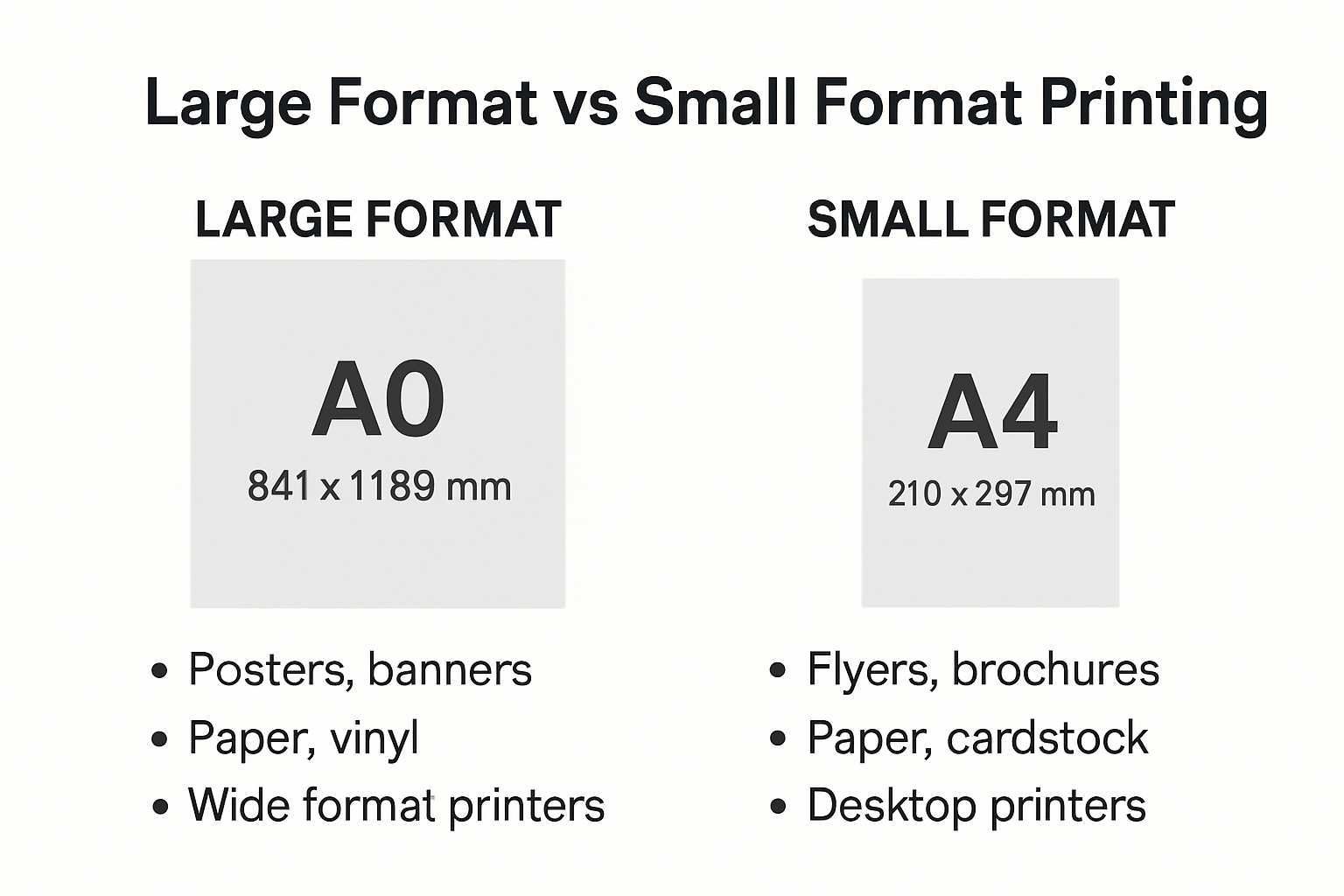
Large format printing, often referred to as wide-format printing, encompasses projects exceeding 609.6 millimetres in width. This printing method allows for creating expansive visual materials such as banners, posters, window graphics, and exhibition displays. Explore our guide on large format printing solutions that can transform your visual communication strategy.
According to research from PrintInTheBag, large format printing typically utilises advanced inkjet technology, which enables direct ink application onto diverse substrates. This technique ensures high-resolution images with vibrant, crisp colours that maintain exceptional visual clarity even at significantly larger scales.
Small format printing, conversely, covers standard sizes up to 304.8 x 457.2 millimetres. This format is ideal for producing essential business materials like brochures, business cards, flyers, and compact marketing collateral. These print jobs often employ offset or digital printing techniques, each offering distinctive advantages in terms of cost-effectiveness and print quality.
Choosing the Right Printing Format
Selecting between large and small format printing depends on several critical factors. Large format printing excels when visual impact, scale, and detailed graphics are paramount. It provides remarkable versatility for architectural plans, retail displays, event signage, and artistic presentations. The technology allows for printing on multiple materials including vinyl, canvas, fabric, and rigid substrates like aluminium and foam board.
Small format printing, while more compact, remains crucial for precise, detailed communication. It offers superior efficiency for documents requiring intricate design work, such as corporate stationery, product catalogues, and compact marketing materials. Digital printing techniques in this format enable quick turnaround times and cost-effective production for smaller quantities.
Understanding the nuanced differences between large and small format printing empowers businesses to make informed decisions. Whether you require expansive visual displays or precise, compact documentation, each printing format offers unique capabilities to bring your creative vision to life. The key lies in matching your specific communication objectives with the most appropriate printing technology.
As PrintInTheBag’s comprehensive analysis suggests, modern printing technologies continue to blur traditional boundaries, offering increasingly sophisticated solutions for diverse visual communication needs.
To help clarify the distinctions between large and small format printing, the following table compares their main characteristics and ideal uses:
| Feature/Characteristic | Large Format Printing | Small Format Printing |
|---|---|---|
| Typical Width | >609.6 mm | ≤304.8 x 457.2 mm |
| Common Uses | Banners, posters, window graphics, displays | Brochures, business cards, flyers, catalogues |
| Technologies | Advanced inkjet | Offset, digital |
| Material Options | Vinyl, canvas, fabric, aluminium, foam board | Paper, card stock |
| Visual Impact | Expansive, eye-catching | Precise, detailed |
| Suitable For | Events, exhibitions, retail, architecture | Business stationery, compact marketing |
| Cost-Effectiveness | Best for high volume/large scale | Best for low to moderate runs |
Benefits for Shops, Offices and Events
Large and small format printing technologies offer transformative solutions for businesses across diverse sectors, providing strategic visual communication tools that enhance brand presence, marketing effectiveness, and operational efficiency.
Visual Communication and Brand Enhancement
For shops and retail environments, large format printing delivers powerful visual marketing capabilities. Explore our comprehensive event signage solutions that can revolutionise your brand communication strategy. According to research from HP, large format prints significantly increase brand visibility by capturing attention in high-traffic areas, making them exceptionally effective for promotional displays, window graphics, and in-store marketing materials.
Offices can leverage both large and small format printing to create professional, engaging environments. Large format prints enable the production of architectural plans, comprehensive infographics, motivational wall art, and wayfinding signage that communicates corporate identity and improves workplace navigation. Small format printing remains crucial for producing high-quality business documents, presentation materials, and compact marketing collateral.
Strategic Marketing and Cost-Effectiveness
Event organisers find immense value in large and small format printing technologies. Large format prints are ideal for creating expansive exhibition backdrops, conference banners, and directional signage that guide and impress attendees. As Eisbrecher World research indicates, these printing solutions offer a higher return on investment compared to traditional advertising methods, reaching broader audiences at a fraction of the cost.
Small format printing complements large format strategies by providing detailed event programmes, name badges, informational brochures, and compact promotional materials. This versatility allows businesses to maintain consistent branding across different scale communication tools.
Technological Flexibility and Material Diversity
Modern printing technologies provide unprecedented flexibility in material selection and print quality. Large format printing supports printing on diverse substrates including vinyl, canvas, fabric, aluminium, and foam board, enabling businesses to create unique, eye-catching visual experiences. Small format printing excels in producing precise, detailed materials with exceptional colour accuracy and resolution.
For shops, this means creating stunning window displays, product information panels, and promotional posters. Offices can develop professional architectural visualisations, corporate communication materials, and innovative workspace design elements. Event organisers can craft immersive experiences through large-scale graphics and detailed informational materials.
The strategic selection between large and small format printing depends on specific communication objectives, target audience, and desired visual impact. By understanding these technologies’ unique capabilities, businesses can develop more effective, engaging, and memorable visual communication strategies that resonate with their audience and elevate their brand presence.
The following table summarises the key benefits of large and small format printing for various business environments:
| Environment | Large Format Printing Benefits | Small Format Printing Benefits |
|---|---|---|
| Shops/Retail | High-visibility displays, window graphics | Price tags, loyalty cards, compact marketing materials |
| Offices | Architectural plans, infographics, wall art | Business cards, stationery, presentations |
| Events | Exhibition backdrops, banners, signage | Name badges, brochures, event programmes |
Choosing the Right Printing for Your Business
Selecting the appropriate printing format is a strategic decision that can significantly impact your business’s visual communication, marketing effectiveness, and overall brand perception. Understanding the nuanced requirements of your specific industry and communication objectives is crucial in making an informed choice between large and small format printing technologies.
Strategic Considerations for Print Selection
Every business has unique visual communication needs that demand careful assessment. Learn more about advanced printing solutions that can transform your marketing approach. According to research from Science Direct, print size can substantially influence audience perception and engagement, with larger print sizes potentially enhancing subjective comprehension and attitudes towards advertised products.
The legibility of printed materials plays a critical role in communication effectiveness. Research from ResearchGate reveals a fascinating “fluent range” in text readability, spanning angular print sizes from 0.2° to 2°, where text can be read at maximum speed. This scientific insight underscores the importance of selecting the right print format to ensure optimal visual communication.
Industry-Specific Printing Requirements
Different sectors demand distinct printing approaches. In the architecture, engineering, and construction (AEC) industry, Geospatial World research highlights how large format printing facilitates crucial communication by enabling rapid dissemination of design changes and blueprints among professionals.
Retail businesses might prioritise large format printing for window displays and promotional materials that capture immediate attention. Professional services like law firms or consultancies may lean towards small format printing for precise, detailed documents that convey precision and professionalism.
Practical Decision-Making Factors
When choosing between large and small format printing, consider several key factors:
- Budget Constraints: Large format printing typically involves higher per-unit costs but can provide more significant visual impact.
- Quantity Requirements: Small format printing offers cost-effectiveness for larger print runs.
- Visual Complexity: Intricate designs might benefit from small format precision, while bold graphics excel in large format.
- Intended Use: Exhibition backdrops require different specifications compared to business cards.
- Material Compatibility: Different printing formats support various substrates and material types.
The optimal printing strategy often involves a thoughtful combination of both large and small format techniques. By carefully assessing your specific communication goals, target audience, and budgetary considerations, you can develop a printing approach that effectively communicates your brand message and achieves your marketing objectives.
Remember that technological advances continue to blur traditional boundaries between print formats, offering increasingly sophisticated solutions for diverse visual communication needs. Consulting with printing professionals can provide tailored advice specific to your business requirements.
Cost Considerations and Practical Tips
Navigating the financial landscape of large and small format printing requires strategic planning and informed decision-making. Businesses must carefully balance quality, quantity, and budget to achieve optimal printing results that deliver maximum value and impact.
Understanding Printing Cost Dynamics
Explore our budget-friendly printing solutions that can help manage your printing expenses effectively. According to VSL Print research, large format printing becomes increasingly cost-effective for high-volume projects due to economies of scale. As print quantities increase, the cost per unit significantly decreases, making bulk printing an attractive option for businesses with substantial marketing or communication needs.
Cleveland Clinic’s printing guidelines emphasise the importance of selecting the appropriate printing method. Offset lithography proves most economical for large quantities, while digital printing offers more flexibility and cost-effectiveness for smaller print runs. This nuanced approach allows businesses to optimise both expenses and turnaround times.
Strategic Cost-Saving Techniques
Professional printing strategies can substantially reduce overall expenses. AlphaGraphics research highlights several practical approaches to minimising printing costs:
- Template Utilisation: Developing reusable design templates can dramatically reduce design expenses and preparation time.
- Material Selection: Choosing cost-effective substrates without compromising quality can significantly lower overall printing expenses.
- Bulk Ordering: Consolidating print jobs and ordering in larger quantities can unlock substantial volume discounts.
- Digital Proofing: Leveraging digital proofing technologies eliminates costly physical prototype iterations.
Long-Term Investment Perspectives
Beyond immediate cost considerations, businesses should evaluate printing investments from a strategic perspective. High-quality printing represents more than an expense—it’s a critical component of brand communication and marketing effectiveness. Investing in professional printing solutions can yield significant returns through enhanced brand perception, improved customer engagement, and more impactful visual communication.
Consider the total value proposition rather than focusing solely on upfront costs. A slightly more expensive printing solution might deliver superior durability, better colour accuracy, or more versatile application, ultimately providing greater long-term value for your business.
Effective cost management in printing requires a holistic approach. By understanding market dynamics, leveraging technological innovations, and making informed material and method selections, businesses can develop printing strategies that balance financial prudence with communication excellence. Regular consultation with printing professionals can provide ongoing insights into emerging technologies and cost-optimisation techniques tailored to your specific business needs.
Frequently Asked Questions
What is the difference between large format and small format printing?
Large format printing typically starts at over 609 millimetres wide and is ideal for expansive visuals like banners and displays. Small format printing is for standard sizes up to 304.8 x 457.2 millimetres and is used for items like brochures and business cards.
When should I choose large format printing over small format printing?
Choose large format printing when you need impactful visuals that are eye-catching and suitable for high traffic areas, such as events or retail spaces. Opt for small format printing when you require detailed, compact materials for professional communication or marketing.
How does the cost differ between large format and small format printing?
Large format printing can be more cost-effective for high volumes due to economies of scale, while small format printing is better suited for lower quantity runs. The overall cost depends on the project size, materials, and printing techniques used.
What materials can be used for large format and small format printing?
Large format printing supports diverse materials such as vinyl, canvas, and rigid substrates like foam board, whereas small format printing mainly uses paper and card stock for items like business cards and flyers.
Unlock the Power of Impactful Visuals for Your Business in 2025
Are you struggling to choose between large or small format printing for your next business project in London? This guide highlights a key challenge: balancing the need for high-impact branding with cost-effectiveness and fine detail. Many businesses worry about missing out on visibility or wasting money on the wrong print format. With terms like high-visibility displays, cost-effective production, and material versatility clearly defining your decision-making, making the right choice could elevate your shop, event, or office brand presence.

Let your brand make a lasting impression. As a leading signage specialist, PromoSigns offers custom large format printing solutions designed for businesses across London, Essex, and Kent. Whether you want stunning shop signs, illuminated displays, or eye-catching event graphics, our expert team provides consultation, design, and installation. Contact us today to find the right print format for your unique goals and see how our professional solutions help you attract more attention and build credibility. Take action now and visit our homepage to get started with a free consultation.
Recommended
- Large Format Printing London | Trade Prices UK | Fast Turnaround
- What Is Vinyl Printing? 2025 Guide for London Businesses – PromoSigns.co.uk
- Printing Companies London | Print Company Promo Signs LTD
- Direct To Media Printing in London | UV Printing | Promo Signs LTD
- Poster Printing London | Large Poster Printing | PromoSigns.co.uk
- Backlit Film Printing in UK | Backlit Posters London | Promo Signs
