
TL;DR:
- Local SEO helps London shops attract nearby customers by optimizing their Google Business Profile and local content. Consistent reviews, location-specific pages, and signage reinforce relevance and improve search rankings. Regular profile management and community engagement are essential for sustained visibility and foot traffic.
Local SEO for London shops is the practice of tailoring your online presence to attract nearby customers by optimising your Google Business Profile (GBP), embedding precise location details, and building community connections that signal authenticity to search engines. 76% of mobile users who search for a nearby business visit within 24 hours, and 28% of those searches lead to a purchase. That conversion speed makes local search one of the most direct routes from online visibility to physical footfall. For London shop owners competing across dozens of boroughs and postcodes, the standard industry term for this discipline is local search optimisation, and getting it right means far more than simply appearing on Google Maps.
Table of Contents
What is local SEO for London shops and why does it matter?
Local search optimisation is defined as the process of improving your shop’s visibility in geographically relevant search results, primarily Google’s Map Pack and the organic listings beneath it. 51% of all Google searches carry local intent. That figure means the majority of searches happening right now in Hackney, Brixton, or Islington include a location signal, whether typed explicitly or inferred from the user’s device.
The Map Pack, the three business listings that appear above organic results, receives 44% of all clicks on a local search results page. Appearing there is not a bonus; it is the primary battleground for London retail visibility. A shop in Peckham competing against one in Camberwell needs to signal to Google that it is the most relevant, trustworthy, and active business for a given search query in that specific area.
60%–75% of local searches occur on mobile devices. Speed and mobile-friendliness are therefore not optional technical details. They directly affect whether a potential customer stays on your page or bounces to a competitor.
How to optimise your Google Business Profile for London shops
Your Google Business Profile is the single most impactful asset in local search. Active GBP management, including accurate pin placement, up-to-date hours, and regular posts, is the primary driver of Map Pack rankings in competitive London markets. A neglected profile is effectively invisible.
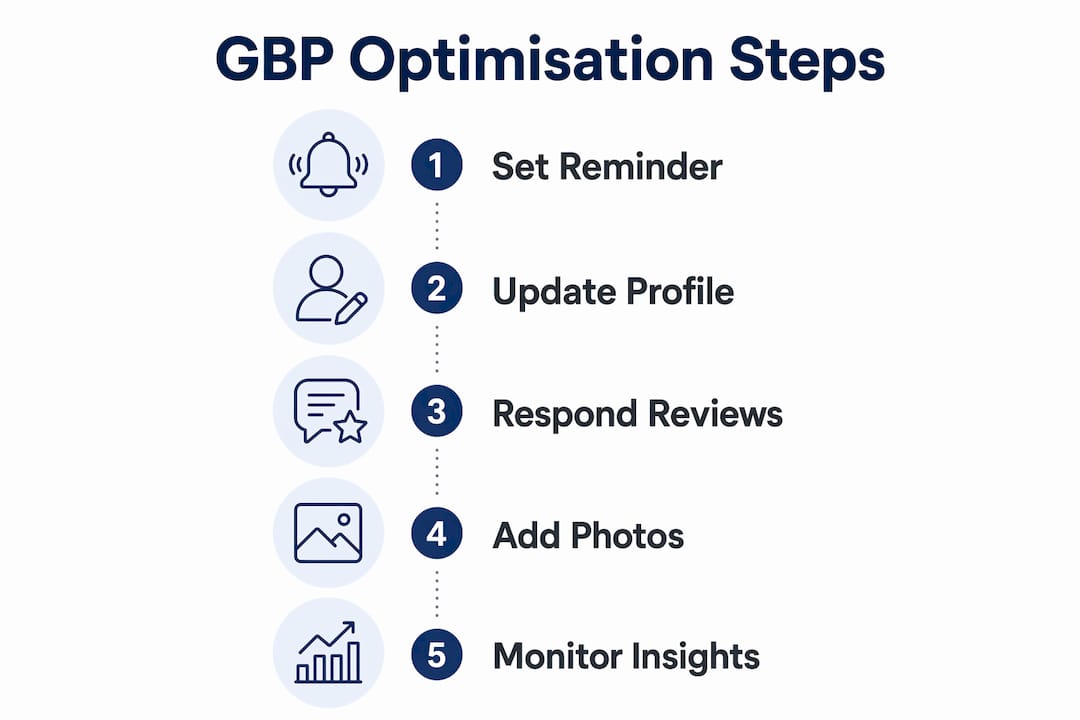
Follow these steps to get the most from your profile:
- Claim and verify your listing. An unverified profile cannot rank competitively. Complete the verification process via postcard, phone, or video as Google instructs.
- Select the most specific primary category. “Florist” outperforms “Shop” every time. Add secondary categories where genuinely relevant, but do not pad the list.
- Complete every field. Business description, opening hours, special hours for bank holidays, products, services, and attributes all contribute to relevance signals.
- Set your pin to the exact doorway. In dense London boroughs, a pin placed on the wrong side of a building can suppress your ranking for nearby searches. Drag the pin to your actual entrance.
- Add structured data to your website. LocalBusiness schema improves GBP click-through rates by 14%, and FAQ schema adds a further 9% uplift. These are measurable gains from a one-time technical task.
- Upload photos consistently. Profiles with 30 or more photos receive 2.7 times more clicks than those without. Add interior shots, product images, and staff photos on a regular schedule.
- Post weekly updates. Offers, events, and new products keep your profile active and signal to Google that your business is current.
Pro Tip: Set a recurring calendar reminder every Monday to post one GBP update and respond to any new reviews. Fifteen minutes a week compounds into a significant ranking advantage over six months.
Why location-specific content outperforms broad London targeting
Targeting the keyword “London” across your entire website is the most common mistake London shop owners make. Postcode-level specificity, such as Shoreditch EC2A or Dalston E8, reduces competition scope and increases ranking relevance dramatically. A bakery in Stoke Newington should not be competing for the same terms as one in Chelsea.

Unique, substantive location pages are the foundation of this approach. Thin or duplicated location pages are one of the most common errors in multi-location retail SEO, and Google penalises them by simply not ranking them. Each page must earn its place.
Strong location-specific content includes:
- Local landmarks and reference points. Mention the nearest tube station, a well-known market, or a community space. This tells Google and your readers exactly where you are.
- Neighbourhood context. A brief description of the area, its character, and who shops there builds topical relevance without keyword stuffing.
- Community events and local news. A page that references the Brixton Village market or the Columbia Road Flower Market signals genuine local knowledge.
- Alignment with your GBP service area. Your website’s location pages and your GBP service area settings must match. Inconsistency confuses search engines and dilutes your signals.
- Unique calls to action per location. If you have multiple shops, each page should reflect that specific branch’s offer, team, or speciality.
Pro Tip: Write each location page as if you are describing the shop to a friend who has never visited the area. If the page could belong to any city in the UK, it is not local enough.
How do reviews, photos, and citations affect local rankings?
Reviews are the primary trust signal for local customers. Recent, product-specific reviews outperform older bulk reviews in both consumer trust and ranking signals. A shop with 12 detailed reviews from the past three months will outrank one with 200 generic reviews from three years ago.
The data on photos and reviews is direct. Profiles with 50 or more reviews see 4.4 times more clicks from the Map Pack. That is not a marginal improvement. It is the difference between a customer choosing your shop or walking past it.
Building a review strategy that works
Responding to every review, positive or negative, signals to Google that your business is active and engaged. A thoughtful response to a critical review often converts a hesitant browser into a customer. Ask for reviews at the point of purchase, in follow-up emails, or via a printed card at the till. Never incentivise reviews; Google’s guidelines prohibit it and the risk is not worth taking.
Citations and NAP consistency
A citation is any online mention of your business name, address, and phone number (NAP). Consistent NAP across top directories gives businesses 2.4 times higher average rankings. Yet 64% of small businesses have NAP inconsistencies across the web. That is a straightforward problem with a straightforward fix.
| Citation type | Examples | Impact on local SEO |
|---|---|---|
| General directories | Yell, Thomson Local, Yelp UK | Baseline trust signals |
| London-specific directories | Time Out London, Visit London | Strong local relevance |
| Industry directories | FreeIndex, Checkatrade | Niche authority signals |
| Chamber of Commerce | London Chamber of Commerce | High-authority local link |
Audit your existing citations using a manual search of your business name. Correct any inconsistencies in address format, phone number, or trading name. Even a difference between “St.” and “Street” can create a mismatch that suppresses your ranking.
Strategic content and link-building tactics for London shops
Entity authority is the concept that search engines now evaluate whether your business is a verifiable, real-world entity with a consistent presence across the web. Building it requires more than a well-optimised website. It demands a unified identity across every platform where your shop appears.
Practical tactics that build entity authority and local backlinks include:
- Hyper-local blog content. Write posts about local events, seasonal guides to your neighbourhood, or collaborations with nearby businesses. A post titled “The best independent shops near Old Street” earns local relevance and often attracts links from community sites.
- Sponsorships and community involvement. Sponsoring a local football team, a school fair, or a charity event in your borough typically earns a mention and a link from the organiser’s website. These links carry strong local signals.
- Partnerships with complementary businesses. A florist and a wedding venue in the same postcode can link to each other naturally. These reciprocal relationships build topical clusters that reinforce your location.
- Press mentions in local publications. Reach out to local newspapers such as the Hackney Gazette or the South London Press with a genuine story. A feature or even a brief mention earns a high-authority local backlink.
- Consistent branding across all platforms. Your logo, colour palette, and business name must appear identically on your website, GBP, social media profiles, and directory listings. Inconsistency fragments your entity signals and weakens your authority. Explore storefront sign visibility as part of this unified brand approach.
The underlying principle is that Google rewards businesses that behave like real, active members of their local community. Every piece of content, every link, and every citation is evidence of that membership.
What working with London shops has taught me about local SEO
The most persistent mistake I see is shop owners targeting “London” as if it were a single market. London is 33 boroughs, hundreds of postcodes, and thousands of distinct neighbourhoods. A gift shop in Notting Hill and a gift shop in Walthamstow are not competing for the same customer. Treating them as if they are wastes budget and dilutes every signal you send to Google.
The second lesson is that GBP is not a set-and-forget task. The shops I see ranking consistently in the Map Pack treat their profile like a social media account. They post updates, respond to reviews within 24 hours, and refresh their photos seasonally. The ones who set up their profile once and never return are invisible within six months.
Reviews that mention specific products or services carry disproportionate weight. A review that says “the custom window graphics were ready in three days and look brilliant” does more for your ranking than ten reviews that simply say “great service.” Train your staff to prompt customers for specific feedback, not just a star rating.
Physical branding and local SEO are more connected than most shop owners realise. A well-designed shop front sign increases the number of people who search for your business by name after walking past. Branded search volume is a direct ranking signal. Your signage is not separate from your SEO strategy. It is part of it.
— Promo
How Promosigns supports your local SEO investment
Your local SEO strategy drives customers to your door. Your signage is what converts them when they arrive. Promosigns designs, manufactures, and installs bespoke shop signs in Barnet and across London, including Kings Cross, Old Street, and Putney, helping retailers present a consistent, professional identity that reinforces their online presence.

A strong shop front increases branded search volume, which feeds directly back into your local rankings. Promosigns offers shop signs in Kings Cross and across the capital, with fast turnaround times and professional installation. Whether you need illuminated fascia signage, 3D lettering, or window graphics, the team at Promosigns delivers signage that makes your business visible both on the street and in search results. Contact Promosigns to discuss your requirements.
FAQ
What is local SEO and why do London shops need it?
Local SEO is the process of optimising your online presence to appear in geographically relevant search results. London shops need it because 51% of Google searches carry local intent, making it the most direct route to attracting nearby customers.
How does Google Business Profile affect my Map Pack ranking?
Your GBP is the primary signal Google uses to rank businesses in the Map Pack. Profiles with complete information, regular posts, and consistent reviews rank significantly higher than inactive or incomplete profiles.
How many reviews does my London shop need to compete?
Profiles with 50 or more reviews see 4.4 times more clicks than those with fewer. Prioritise recent, detailed reviews that mention specific products or services over accumulating large volumes of generic ratings.
Should I target “London” or specific boroughs in my content?
Target specific boroughs and postcodes. Postcode-level targeting reduces competition and increases ranking relevance far more effectively than broad city-level terms.
What is NAP consistency and why does it matter?
NAP stands for Name, Address, and Phone number. Consistent NAP across directories gives businesses 2.4 times higher average rankings. Audit your listings regularly and correct any discrepancies in formatting or contact details.
Recommended
- Retail Sign Design Tips 2025: Essential Guide for London Businesses – PromoSigns.co.uk
- Types of Shop Signs for London Businesses: The 2025 Guide – PromoSigns.co.uk
- Shop Graphics Inspiration Ideas for 2025: London Guide – PromoSigns.co.uk
- Top Storefront Sign Visibility Tips for London Businesses 2025 – PromoSigns.co.uk
