
Modular sign systems deliver exceptional flexibility, cost-effective updates, brand consistency, and scalable expansion through standardized components, interchangeable elements, systematic design, and professional implementation. Strategic modular signage investment enables evolutionary adaptation, minimizes replacement costs, accommodates business growth, and maintains contemporary relevance through component-based construction and systematic lifecycle management.
This comprehensive guide explores modular signage systems, covering design principles, component standardization, update mechanisms, expansion strategies, cost optimization, installation approaches, and maintenance benefits that enable businesses to implement adaptive signage infrastructure supporting long-term operational objectives through intelligent system architecture.
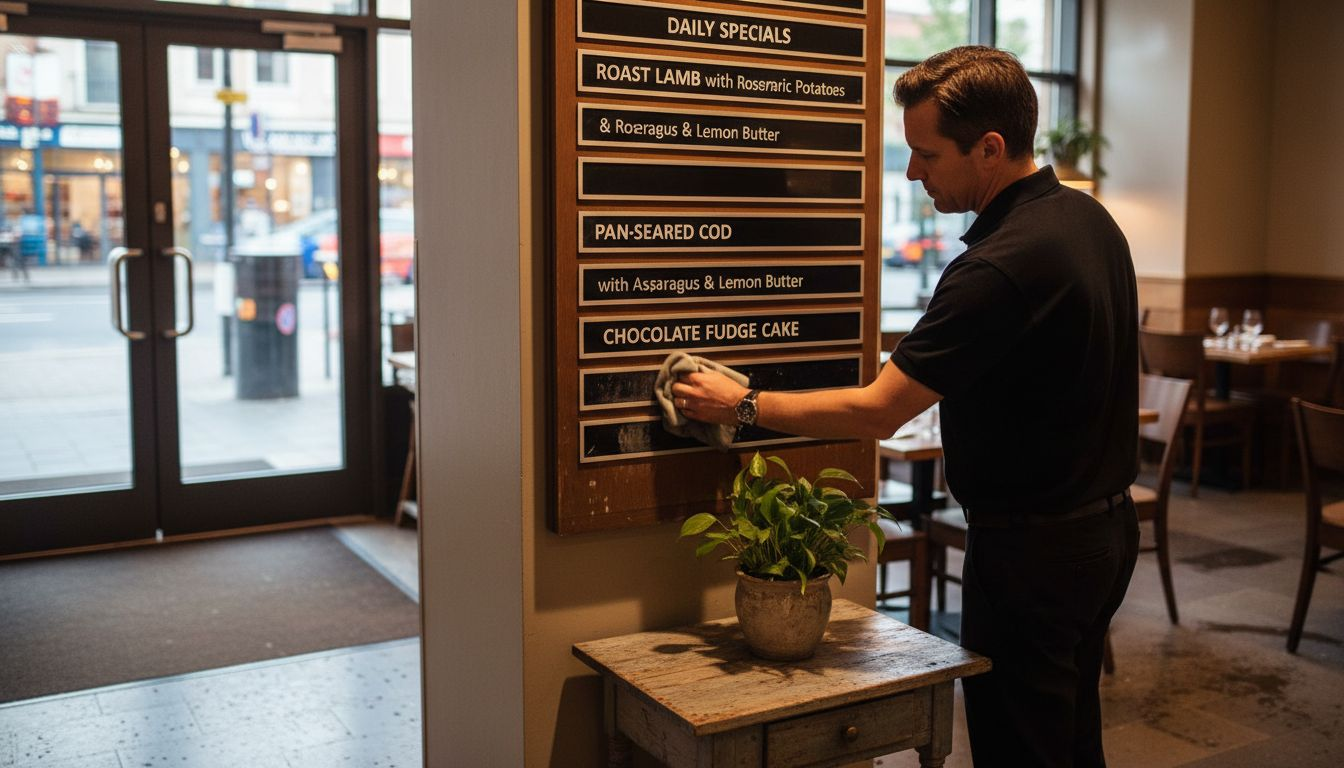
Here is a summary of how modular sign systems benefit different business types:
| Business Type | Primary Benefit | Typical Usage |
|---|---|---|
| Retail | Agile campaign adjustments | Window promos, product panels |
| Hospitality | Adaptable themed experiences | Event signage, wayfinding |
| Offices | Scalable internal branding | Directory boards, door signs |
| Leisure Venues | Rapid rebranding opportunities | Seasonal décor, display walls |
Pro tip: Design your modular sign system with standardised mounting mechanisms to ensure maximum future flexibility and ease of reconfiguration.
Table of Contents
What Are Modular Sign Systems?
Core Concept
Component-Based Construction: Interchangeable elements vs. monolithic design:
Traditional Signage:
- Single-piece construction (integrated elements, permanent configuration)
- Fixed design (no alteration without replacement)
- Complete replacement (total reconstruction for changes)
- High update costs (£3,000-£30,000+ full replacement)
Modular Systems:
- Component-based (separable elements, independent replacement)
- Reconfigurable design (add/remove/swap components)
- Selective updates (replace only changed elements)
- Cost-effective evolution (£200-£3,000 component updates)
Analogy: Traditional = built-in furniture (permanent, inflexible, complete replacement) Modular = IKEA system (components, reconfigurable, piece replacement)
Key Components
Standard Modular Elements:
Frame/Structure:
- Permanent mounting (building attachment, structural foundation, long-term investment)
- Expandable design (additional panel accommodation, growth capability)
- Standard interfaces (component compatibility, universal mounting)
- Lifespan: 20-25+ years (durable construction, minimal obsolescence)
Panels/Faces:
- Removable units (tool-free or simple release, service access)
- Standard sizing (replacement availability, component sourcing, competitive pricing)
- Interchangeable materials (acrylic, metal, vinyl, technology options)
- Lifespan: 7-15 years (periodic refresh, appearance maintenance)
Graphics:
- Vinyl application (printed adhesive, full-color capability, cost-effective)
- Replaceable prints (panel removal, graphic swap, content updates)
- Digital displays (screen integration, dynamic content, technology upgrade)
- Lifespan: 3-7 years (campaign refresh, brand evolution, content updates)
Illumination:
- Modular LED strips (individual replacement, technology upgrade, efficiency improvement)
- Removable drivers (component service, electrical updates, maintenance simplification)
- Accessible wiring (service panels, expansion capacity, future-proofing)
- Lifespan: 5-15 years (technology advancement, efficiency evolution)
Why Choose Modular Systems?
Cost-Effective Updates
Selective Replacement: Updating specific elements vs. complete reconstruction:
Example Scenario: Rebranding with new colors/logo:
- Complete replacement: £8,000
- Installation: £1,500
- Disposal: £300
- Planning consent: £132
- Total: £9,932
Modular System:
- New vinyl graphics: £400
- Installation (vinyl swap): £200
- Total: £600
Saving: £9,332 (94% cost reduction)
ROI Analysis:
- Initial modular premium: 15-25% higher upfront (£9,000 vs. £8,000 traditional)
- First update savings: £9,000+ (single rebranding recovery)
- Lifecycle savings: £20,000-£50,000+ (multiple updates, 20-year period)
Business Growth Accommodation
Scalable Expansion: Progressive system growth:
Growth Scenarios:
Single Location Start:
- Initial: Single fascia panel (£3,000, minimal investment, operational start)
- Year 2: Add projecting sign module (£2,500, visibility enhancement, proven location)
- Year 5: Expand fascia (additional panels, £3,000, growth signal, market presence)
- Total investment: £8,500 over 5 years (phased, cash flow friendly, risk mitigation)
Multi-Location Expansion:
- Location 1 template: Full system design (£12,000, comprehensive, brand foundation)
- Locations 2-10: Replicate modules (£8,000 each, standardization discount, efficiency)
- Component reuse: Design amortization (one-time design, multiple applications, economy of scale)
- Per-location cost reduction: 30-40% (template efficiency, bulk purchasing, installation learning)
Brand Consistency
Standardized Components: Multi-location uniformity:
Franchise/Chain Benefits:
- Identical construction (manufacturing consistency, appearance uniformity, quality assurance)
- Central specification (design control, brand protection, standard enforcement)
- Supplier efficiency (bulk purchasing, volume pricing, consistent sourcing)
- Installation streamlining (repetition learning, process optimization, predictable timelines)
Update Synchronization:
- Simultaneous refresh (all locations updated, brand consistency, coordinated campaigns)
- Centralized procurement (volume discounts, quality control, logistics efficiency)
- Consistent execution (identical appearance, professional standards, market impact)
Future-Proofing
Technology Adaptation: Evolutionary capability without reconstruction:
Technology Integration:
Digital Display Addition:
- Replace panel with screen (same mounting, electrical infrastructure, minimal disruption)
- Retain brand elements (logo panels permanent, digital supplementary, hybrid approach)
- Progressive adoption (test location, proven ROI, phased rollout, risk management)
LED Upgrade:
- Swap fluorescent modules (component replacement, efficiency gain, brightness improvement)
- Retain frame/panels (structural preservation, appearance continuity, cost reduction)
- Technology advancement (current generation, competitive performance, energy savings)
Smart Controls:
- Add controller module (existing electrical, network connectivity, automation capability)
- Sensor integration (occupancy, daylight, weather, optimization)
- IoT connectivity (cloud management, data analytics, remote control)
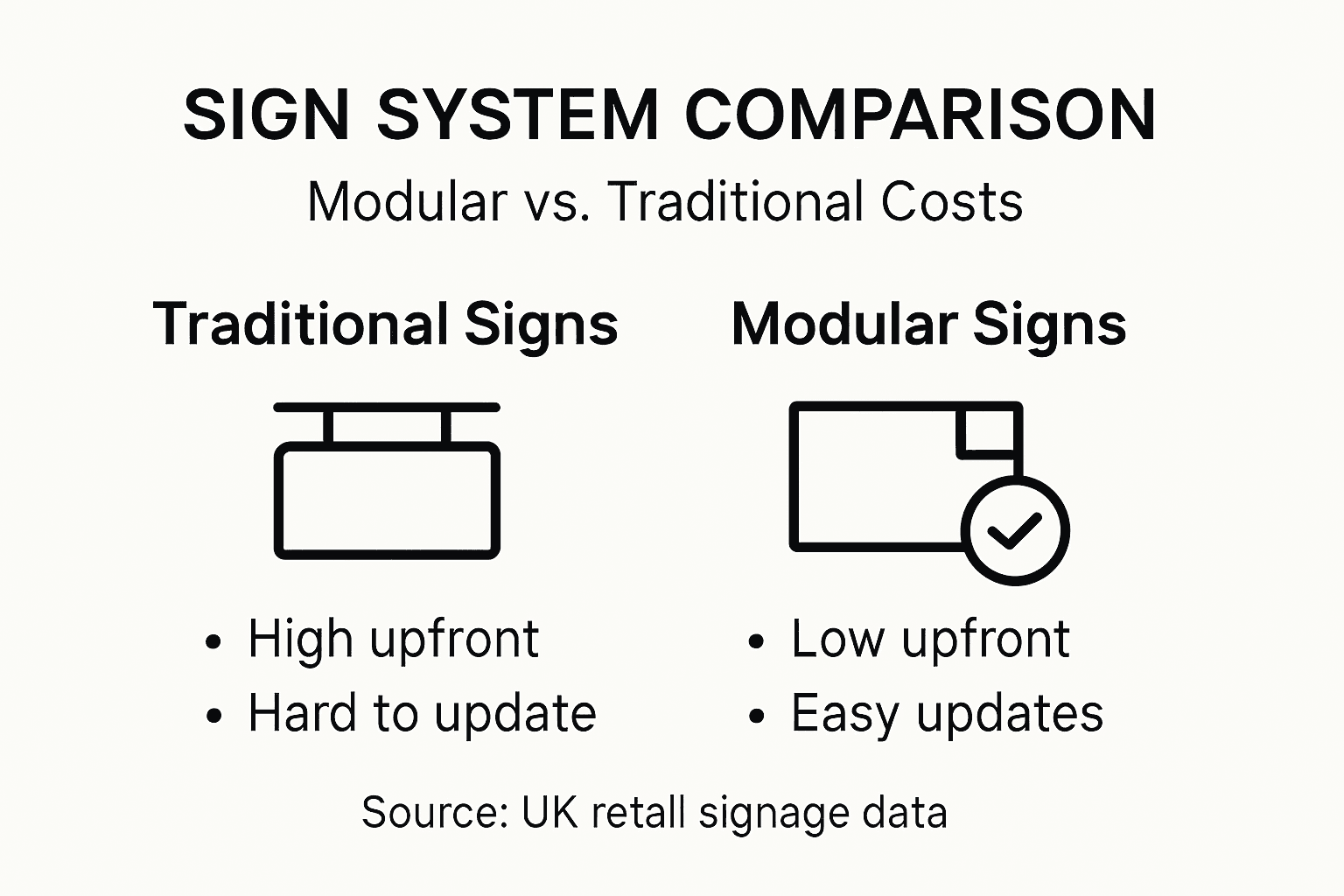
Consider these key differences between traditional and modular signage:
| Aspect | Traditional Signage | Modular Signage |
|---|---|---|
| Upfront Cost | Lower initial outlay | Higher, with future savings |
| Update Flexibility | Costly and time-consuming | Quick and simple to alter |
| Scalability | Fixed dimensions/design | Easily expanded/reduced |
| Sustainability | Often requires full discard | Reusable, less material waste |
Pro tip: Create a comprehensive maintenance schedule and allocate a specific budget for modular sign system upkeep to prevent unexpected repair costs.
System Design Principles
Standardization
Component Uniformity: Interchangeability and availability:
Standard Dimensions:
- Panel sizes: Industry standards (600mm, 1200mm, metric/imperial, manufacturing efficiency)
- Mounting interfaces: Universal brackets (compatibility, sourcing flexibility, competitive market)
- Electrical connectors: Standard specifications (component availability, electrician familiarity, service simplification)
Benefits:
- Replacement sourcing (multiple suppliers, competitive pricing, availability assurance)
- Installation efficiency (familiar systems, reduced labor, predictable outcomes)
- Emergency service (off-the-shelf components, rapid repair, minimal downtime)
Modularity Levels
System Hierarchy:
Macro Modularity: Large component units:
- Complete panels (600×1200mm typical, comprehensive units, major changes)
- Illumination sections (meter-length LED strips, substantial replacement, technology upgrade)
- Frame extensions (additional bays, expansion modules, growth accommodation)
Micro Modularity: Detailed component flexibility:
- Individual LEDs (single point replacement, maintenance granularity, cost efficiency)
- Graphic layers (vinyl over permanent, content updates, tactical campaigns)
- Trim pieces (cosmetic updates, detail refresh, appearance enhancement)
Strategic Balance:
- Macro: Structural changes (expansion, reconfiguration, major updates)
- Micro: Tactical updates (campaigns, maintenance, content refresh)
Design Flexibility
Adaptable Architecture: Multiple configuration options:
Layout Variations:
- Horizontal expansion (additional panels laterally, width increase, visibility enhancement)
- Vertical stacking (height addition, prominence increase, landmark presence)
- Corner wrapping (multi-facade coverage, comprehensive visibility, building integration)
- Projection addition (perpendicular elements, direction signaling, sightline optimization)
Content Variation:
- Panel substitution (vinyl, digital, lightbox, material diversity, functional variation)
- Illumination selection (backlit, spotlit, non-illuminated, atmospheric control)
- Message rotation (seasonal panels, campaign swaps, content diversity)
Component Types and Applications
Frame Systems
Structural Foundation: Permanent mounting infrastructure:
Aluminum Extrusion Systems:
Advantages:
- Lightweight (installation ease, structural load minimization, handling simplicity)
- Corrosion-resistant (longevity, coastal suitable, low maintenance)
- Modular connections (snap-together, expandable, reconfigurable)
- Professional finish (powder-coated, color-matched, architectural quality)
Applications:
- Restaurant Signs (fascia mounting, window systems, entrance identification)
- Interior directories (wayfinding, multi-tenant, information displays)
- Exhibition systems (portable, reconfigurable, event signage)
Cost: £100-£300 per linear meter (complexity, finish-dependent)
Steel Frame Systems:
Advantages:
- Structural strength (large spans, heavy loads, wind resistance)
- Rigidity (dimensional stability, precision mounting, minimal deflection)
- Security (vandal resistance, tamper-proof, high-value protection)
Applications:
- Large-scale fascias (10m+ widths, substantial structures, commercial)
- Freestanding totems (height, exposure, structural demands)
- High-security locations (protection requirements, restricted access)
Cost: £150-£400 per linear meter (engineering, coating-dependent)
Interchangeable Panels
Swappable Faces: Graphic/content replacement:
Acrylic Panels:
- Standard thicknesses (3mm, 5mm, 10mm, structural requirements)
- Opal/clear options (light diffusion, transparency, application-appropriate)
- Edge-lit capability (contemporary aesthetic, thin profile, technology integration)
- UV-stable formulations (fade resistance, longevity, appearance retention)
Cost: £40-£120 per sqm (thickness, quality-dependent)
Metal Panels:
- Aluminum composite (flat, rigid, printable, cost-effective)
- Dibond/ACM (premium finish, weather-resistant, architectural quality)
- Perforated options (ventilation, weight reduction, aesthetic variation)
Cost: £60-£150 per sqm (material, finish-dependent)
Digital Screen Panels:
- LCD displays (indoor, image quality, interactive capability)
- LED screens (outdoor, brightness, weather resistance)
- Standard sizes (fitting modular bays, direct replacement, upgrade pathway)
- Weatherproof housing (IP65+, temperature management, longevity)
Cost: £1,000-£10,000+ per panel (size, technology, resolution-dependent)
Graphic Systems
Content Application:
Vinyl Graphics: Most flexible, cost-effective:
- Digital printing (full-color, photographic, brand-accurate)
- Easy application (internal/external, professional/DIY, accessibility)
- Clean removal (rental-friendly, campaign rotation, no damage)
- Rapid production (days turnaround, responsive, agile)
Cost: £30-£80 per sqm (quality, complexity-dependent) Lifespan: 3-7 years (exposure, quality-dependent)
Direct Print: Permanent integration:
- UV printing (acrylic face, permanent graphics, durable)
- No delamination (integrated, weatherproof, superior longevity)
- Premium durability (10+ years, scratch-resistant, fade-resistant)
Cost: £80-£200 per sqm (setup, complexity-dependent) Lifespan: 10+ years
Magnetic Panels: Ultimate flexibility:
- Snap-on graphics (instant change, no tools, daily rotation)
- Reusable (campaign storage, seasonal return, cost efficiency)
- Perfect alignment (registration system, professional appearance, consistency)
Cost: £100-£250 per sqm (system, graphics separate) Application: Menu boards, pricing, promotional, high-rotation content
Illumination Modules
Lighting Components:
LED Strip Modules:
- Meter lengths (standard sizing, replacement availability, competitive sourcing)
- Removable connectors (service access, individual replacement, maintenance simplification)
- Driver separation (component isolation, fault containment, repair efficiency)
- Color options (warm/neutral/cool white, RGB, tunable, atmospheric)
Cost: £50-£150 per meter (quality, specification-dependent) Lifespan: 50,000-100,000 hours (5-20 years usage-dependent)
Spotlights/Floods:
- External illumination (building-mounted, architectural, retrofit-friendly)
- Adjustable (beam angle, direction, intensity, optimization)
- Replaceable lamps (LED, maintenance simplicity, ongoing efficiency)
Cost: £100-£500 per fixture (quality, specification-dependent)
Implementation Strategies
Phased Installation
Budget-Friendly Rollout: Progressive system completion:
Phase 1: Foundation (Year 1):
- Frame installation (structural foundation, expansion-ready, long-term investment)
- Basic panels (operational signage, minimal investment, functional presence)
- Essential graphics (business identification, regulatory compliance, market entry)
- Investment: £3,000-£8,000 (foundation, operational minimum)
Phase 2: Enhancement (Year 2-3):
- Illumination addition (LED modules, nighttime visibility, competitive parity)
- Graphic upgrade (professional design, brand refinement, market maturity)
- Additional panels (expansion, comprehensive coverage, prominence increase)
- Investment: £2,000-£5,000 (proven location, revenue generation, confidence)
Phase 3: Optimization (Year 3-5):
- Digital integration (screen addition, dynamic capability, technology leadership)
- Smart controls (automation, energy efficiency, operational optimization)
- Projecting elements (perpendicular visibility, landmark presence, market dominance)
- Investment: £3,000-£10,000 (established business, strategic investment, competitive advantage)
Total 5-Year Investment: £8,000-£23,000 (phased, cash flow managed, risk-distributed)
vs. Comprehensive Day-1: £15,000-£35,000 (capital intensive, single commitment, higher risk)
Multi-Location Deployment
Systematic Rollout: Franchise/chain implementation:
Template Development:
- Location 1: Full design (comprehensive specification, component selection, installation methodology)
- Documentation: Complete specifications (materials, dimensions, mounting, electrical, graphics)
- Supplier coordination: Centralized procurement (volume pricing, quality control, logistics)
Replication Strategy:
- Locations 2-10: Template deployment (identical systems, standardization, efficiency)
- Bulk purchasing: Component economies (volume discounts, 20-40% savings, cost control)
- Installation learning: Process optimization (reduced labor, predictable timelines, quality consistency)
Central Management:
- Design control: Brand consistency (corporate standards, quality assurance, market uniformity)
- Update coordination: Synchronized campaigns (simultaneous refresh, market impact, operational efficiency)
- Supplier relationships: Volume leverage (preferential pricing, priority service, partnership benefits)
Maintenance and Updates
Routine Service
Component-Focused Maintenance: Targeted intervention vs. system-wide:
Predictive Replacement:
- LED modules (50,000 hours = 5-10 years typical, scheduled refresh, brightness restoration)
- Vinyl graphics (3-5 years standard, planned update, appearance maintenance)
- Panel faces (7-10 years, clarity restoration, material upgrade)
- Drivers/transformers (5-10 years, electrical component lifecycle, reliability assurance)
Cost Advantage:
- Individual component: £200-£1,500 (targeted replacement, minimal disruption)
- Complete signage: £8,000-£30,000 (comprehensive reconstruction, business interruption)
- Savings: 80-95% (component replacement vs. full system)
Update Flexibility
Content Evolution: Responsive adaptation:
Graphic Updates:
- Seasonal campaigns (quarterly rotation, timely messaging, market responsiveness)
- Promotional events (sale announcements, limited-time offers, urgency creation)
- Menu changes (restaurants, regular updates, operational necessity)
- Pricing updates (retail, market response, competitive adjustment)
Technology Refresh:
- LED efficiency upgrade (newer generation, energy savings, brightness improvement)
- Digital screen addition (analog to digital, capability enhancement, market expectation)
- Smart control integration (automation, IoT, optimization, contemporary functionality)
Cost-Benefit Analysis
Initial Investment
Premium Positioning: Modular systems cost more upfront:
Price Comparison:
Traditional Fascia (3m × 0.6m):
- Design: £500
- Production: £3,500
- Installation: £1,000
- Total: £5,000
Modular Fascia (Equivalent):
- Design: £600 (system specification, additional complexity)
- Frame system: £1,500 (expandable infrastructure, long-term foundation)
- Panels (3×): £2,400 (interchangeable units, premium construction)
- Graphics: £600 (vinyl application, replaceable content)
- Installation: £1,200 (systematic assembly, precision mounting)
- Total: £6,300
Premium: £1,300 (26% higher initial investment)
Lifecycle Savings
20-Year Analysis:
Traditional Signage:
- Initial: £5,000
- Replacement 1 (Year 10): £5,500 (inflation-adjusted)
- Replacement 2 (Year 20): £6,000
- Rebranding update (Year 5): £5,200 (complete replacement, design change)
- Rebranding update (Year 15): £5,700
- Total: £27,400
Modular System:
- Initial: £6,300
- Vinyl refresh (Years 3,6,9,12,15,18): £500 each (£3,000 total, content updates)
- Panel replacement (Year 10): £2,800 (acrylic refresh, appearance restoration)
- LED upgrade (Year 12): £1,800 (technology advancement, efficiency)
- Rebranding (Years 5,15): £600 each (vinyl only, £1,200 total, graphic swap)
- Total: £15,100
20-Year Saving: £12,300 (45% cost reduction)
Conclusion
Modular sign systems deliver exceptional flexibility, cost-effective updates, brand consistency, and scalable expansion through component-based construction, standardized interfaces, and systematic design enabling evolutionary adaptation without comprehensive reconstruction. From Shop Front Signs through comprehensive Business Signs installations and Wayfinding Signs systems, strategic modular implementation protects long-term investment while supporting business growth and technological advancement.
Success requires understanding modular design principles, selecting appropriate component standards, planning phased implementation, budgeting lifecycle costs, and maintaining systematic service that maximizes component lifespan while minimizing replacement frequency. Whether implementing single-location systems or multi-site programs, modular signage represents intelligent infrastructure investment delivering sustained operational flexibility through architectural adaptability.
For businesses seeking optimal signage flexibility, partnering with experienced modular system specialists ensures access to design expertise, component knowledge, implementation planning, and maintenance program development that transforms signage from fixed asset into adaptive marketing infrastructure supporting long-term business objectives through systematic evolution.
Recommended
- The Modern Age Visual Displays For Branding – PromoSigns.co.uk
- Types of Shop Signage for Business Success in 2025 – PromoSigns.co.uk
- Shop Sign Types Explained for UK Businesses in 2025 – PromoSigns.co.uk
- How to Design Shop Signs: Expert Tips for 2025 – PromoSigns.co.uk
