
UK outdoor signage regulations protect public safety, preserve visual amenity, prevent environmental degradation, and ensure orderly development through comprehensive advertisement consent procedures, planning controls, highway authority requirements, and enforcement mechanisms. Understanding regulatory frameworks prevents costly non-compliance, enables successful applications, and protects business investment through informed navigation of complex planning systems.
This comprehensive guide explores UK outdoor signage regulations, covering advertisement consent requirements, deemed consent provisions, express consent procedures, conservation area restrictions, highway safety considerations, enforcement consequences, and compliance strategies that transform regulatory challenges into manageable processes delivering lawful outdoor business signage.
Table of Contents
Key Takeaways
| Point | Details |
|---|---|
| Understanding Regulations | Businesses must navigate intricate outdoor signage regulations to ensure compliance with local planning authorities and national guidelines. |
| Approval Process | Obtaining planning permission or advertisement consent is often mandatory, especially for significant signage in conservation areas or historic districts. |
| Compliance Obligations | Continuous adherence to local authority guidelines and regulations is essential, including maintaining the proper visual impact and obtaining necessary consents. |
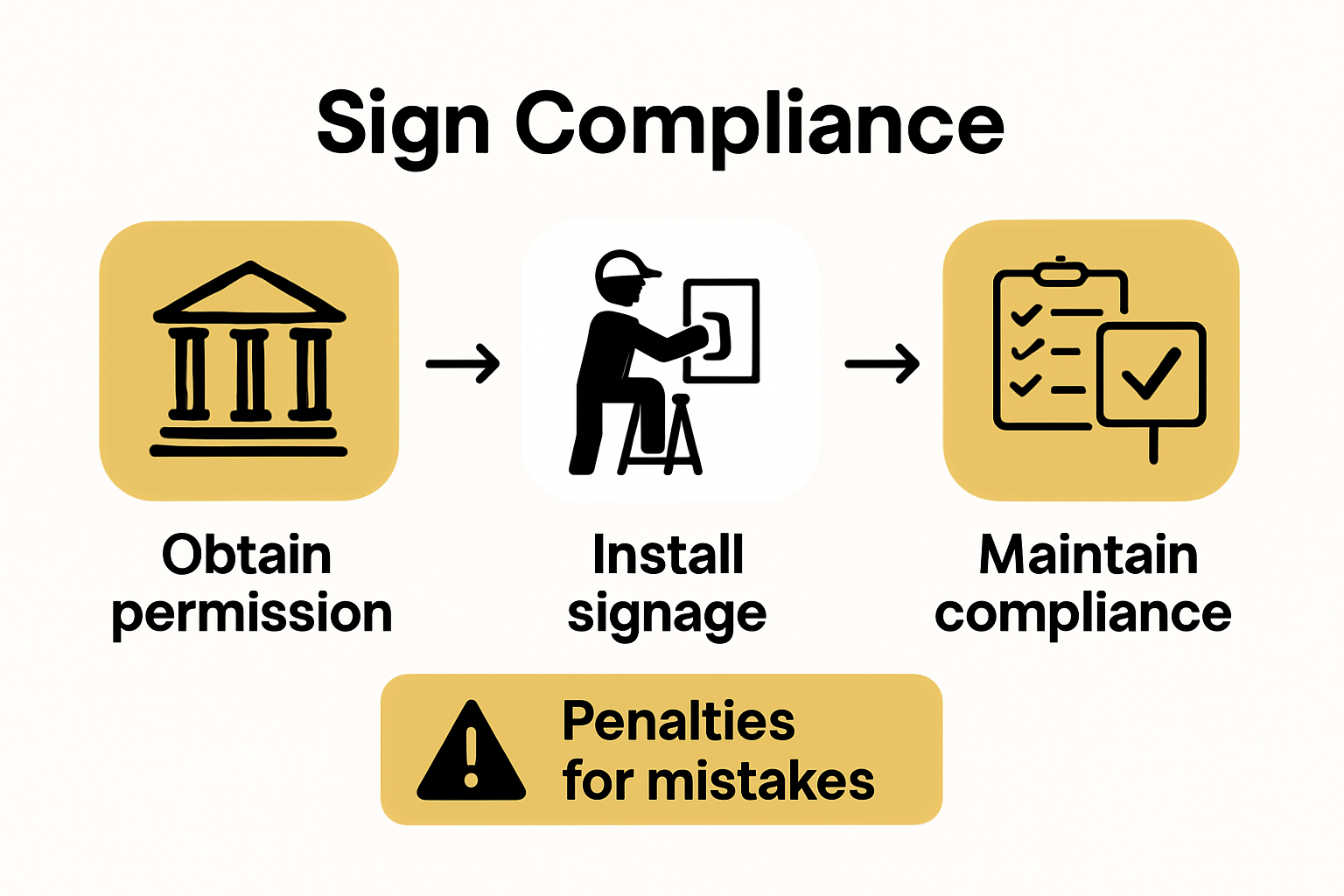
| Penalties for Non-Compliance | Non-compliance can result in severe penalties, including fines, enforcement notices for immediate sign removal, and potential legal prosecution. |
Why Outdoor Signage Regulations Matter
Legal Compliance Imperative
Regulatory Framework: Outdoor signage faces stricter control than indoor:
Control Systems:
- Advertisement Regulations 2007 (England primary legislation)
- Town and Country Planning Act 1990 (planning framework)
- Highways Act 1980 (road safety, obstruction)
- Building Regulations (structural safety)
- Listed Building consent (heritage structures)
- Conservation Area controls (enhanced restrictions)
Non-Compliance Consequences:
Immediate Risks:
- Enforcement notices (28-day removal typical)
- Stop notices (immediate cessation for serious breaches)
- Fines (£1,000-£5,000+ magistrates; unlimited crown court)
- Prosecution (criminal offense continued breach)
- Direct action (council removal, cost recovery: £2,000-£10,000+)
- Legal costs (defense, appeals: £5,000-£50,000+)
Business Impact:
- Loss of outdoor visibility (marketing disruption)
- Wasted investment (£3,000-£30,000+ typical outdoor signage)
- Reputation damage (enforcement publicity)
- Planning record (future application prejudice)
- Insurance complications (unauthorized structure exclusions)
Public Interest Protection
Regulatory Objectives: Balancing commercial needs with community welfare:
Protected Interests:
- Visual amenity (neighborhood character preservation)
- Highway safety (driver distraction prevention)
- Public safety (structural integrity, obstruction)
- Environmental protection (light pollution, sky glow)
- Heritage conservation (historic setting protection)
Investment Protection
Strategic Value: Regulatory understanding protects expenditure:
Cost Avoidance:
- Prevented enforcement (removal costs)
- Avoided legal fees (compliance prevents disputes)
- Reduced delays (correct applications first time)
- Optimized design (regulation-informed specifications)
Strategic Benefits:
- Accurate budgeting (consent costs included: £132+ application fees)
- Realistic timelines (8-week determination factored)
- Design confidence (compliant creativity)
- Installation certainty (lawful operation assured)
Advertisement Consent System
What Constitutes Advertisement
Regulatory Definition: Broad interpretation captures most outdoor signage:
Included:
- Business identification (Shop Signs London fascia, projecting, freestanding)
- Promotional displays (sales, offers, products)
- Directional signs (location indication)
- Estate agent boards (property marketing)
- Event signage (festival, exhibition promotion)
- Construction site hoardings (development marketing)
Excluded (Generally):
- Traffic signs (statutory authority)
- Statutory notices (legal requirements)
- Religious signs (places of worship identification)
- Commemorative plaques (historical marking)
- Security notices (trespass warnings, CCTV minimal)
Deemed Consent Provisions
Automatic Permission: Certain outdoor signage permitted without application:
Common Deemed Consent Categories:
Business Premises Signs: On-site identification:
Criteria:
- Display at business premises (where activity conducted)
- Single fascia sign per elevation (one per building side)
- Maximum area: 0.75 sqm (small retail) to 4.6 sqm (large buildings/warehouses)
- Non-illuminated or static internal illumination only
- Appropriate intensity (not excessive brightness)
- Projection: Typically 200-300mm maximum (if perpendicular)
Important Note: Commercial Building Signs often fall within deemed consent if meeting all criteria.
Forecourt Signs: Limited on-site advertising:
Criteria:
- Within business curtilage (site boundary)
- Single sign typically (quantity restriction)
- Maximum 1.5-2 sqm area
- Height restrictions (varies: 4.6m typical maximum)
- Functional purpose (directional, identification)
Temporary Signs: Short-duration displays:
Criteria:
- Maximum 28 days display (per calendar year per site)
- Specific purposes (property sales, construction, events)
- Size limitations (purpose-dependent: 0.6 sqm residential sale boards)
- Removal obligation (timely takedown mandatory)
- No return same site (typically 14 days minimum gap)
Critical Limitations Withdrawing Deemed Consent:
- Conservation areas: Deemed consent often withdrawn (express consent required)
- Listed buildings: Excluded (separate Listed Building Consent)
- Article 4 Directions: Remove deemed consent (local authority restrictions)
- Residential areas: Stricter limits (some locations exclude commercial advertising)
- Sensitive locations: National Parks, AONBs (additional restrictions)
Express Consent Requirements
When Application Mandatory:
Size Exceeding Deemed Limits:
- Fascia signs above deemed consent area thresholds
- Projecting signs (most require express consent)
- Multiple signs (cumulative area considerations)
- Ground-mounted signs exceeding limits
Illumination:
- Most Illuminated Signs require express consent (LED, neon, external lighting)
- Moving/changing content (digital displays, scrolling)
- Flashing/intermittent (animation, effects)
- High brightness (intensity concerns, dazzle risk)
Location:
- Conservation areas (enhanced control, typically all signs need consent)
- Listed buildings (heritage protection, always requires consent)
- Highway projection (over public land)
- Residential proximity (amenity protection stricter)
Projection:
- Signs extending over highway (licensing plus planning)
- Perpendicular mounting exceeding limits
- Height/projection combinations (cumulative impact)

Application Process
Submission Requirements
Standard Documents:
Mandatory:
- Application form (local authority specific, online portal)
- Site location plan (1:1250 or 1:2500 scale, north arrow, site boundary red-edged)
- Existing building elevations (context showing)
- Proposed sign drawings (accurate scale, dimensions clearly marked)
- Sign specifications (materials, colors, illumination details, finishes)
- Photographs (existing site, context showing surrounding area)
- Fee (£132 per site standard; £264 for 2+ sites)
Additional Documents (Context-Dependent):
- Supporting statement (justification, policy compliance demonstration)
- Heritage statement (listed buildings, conservation areas: significance assessment)
- Visual impact assessment (large signs, sensitive locations: photomontages)
- Lighting assessment (illuminated signs: spillage analysis, brightness specifications)
- Design and access statement (significant schemes)
- Highway authority consultation response (if affecting traffic)
Assessment Period
Statutory Timeline:
Determination Process:
- 8 weeks standard (statutory period from validation)
- Consultation period (21 days minimum for public/neighbor comments)
- Neighbor notification (adjacent properties written notification)
- Statutory consultees (highway authority, conservation officer where relevant)
- Parish/town council (consultation in parished areas)
- Site visit (planning officer assessment typically)
Possible Outcomes:
- Approval unconditional (no restrictions)
- Approval with conditions (e.g., brightness limits, operating hours, maintenance requirements)
- Refusal (with stated reasons referencing policy)
- Request for additional information (stops clock, timeline extension)
Conditions Examples:
- Operating hours (e.g., “Illumination only between 0700-2300 hours”)
- Brightness limits (e.g., “Maximum 300 cd/m² measured at night”)
- Maintenance requirements (e.g., “Sign maintained in good condition, repainted every 5 years”)
- Removal triggers (e.g., “Removed if business ceases trading”)
Conservation Areas and Listed Buildings
Enhanced Controls
Heritage Protection Priority: Stricter standards preserve character:
Conservation Areas: Designated for special architectural/historic interest:
Restrictions:
- Deemed consent typically withdrawn (express consent required for most/all signs)
- Greater scrutiny (character preservation paramount)
- Design sensitivity essential (materials, scale, design appropriateness)
- Historical appropriateness (context harmony, traditional methods preferred)
- Community consultation (objection likelihood higher, residents engaged)
- Illumination resistance (often refused or heavily conditioned)
Assessment Factors:
- Character harm evaluation (impact on special interest)
- Cumulative effect (proliferation concern)
- Precedent risk (other applications encouraged)
- Reversibility (fabric protection preference)
Design Expectations:
- Traditional materials (timber, hand-painted preferred)
- Hanging signs (historic precedent in many areas)
- Subdued colors (heritage palette)
- Non-illuminated or subtle (halo lighting maximum)
- Hand-crafted (artisan quality)
Listed Buildings
Statutory Protection: Buildings of special architectural/historic interest:
Requirements:
- Listed Building Consent (separate application, separate fee: £132)
- Heritage impact assessment (significance evaluation mandatory)
- Conservation officer consultation (specialist input)
- Historic England consultation (Grade I, II* buildings: statutory consultee)
- Minimal intervention principle (reversibility strongly preferred)
- Like-for-like replacement (traditional approach)
Grades:
- Grade I: Exceptional interest (2.5% of listed buildings)
- Grade II*: Particularly important (5.8%)
- Grade II: National importance (91.7%)
Assessment:
- Significance impact (harm to heritage asset evaluation)
- Fabric integrity (building protection, no permanent damage)
- Setting consideration (visual context, views)
- Public benefit (economic, social justification if harm identified)
Design Expectations:
- Traditional methods (heritage craftsmanship)
- Reversible fixings (future removal capability)
- Appropriate materials (historic palette: timber, iron, brass)
- Hand-painted (not vinyl graphics typically)
- Minimal intervention (discrete, sympathetic)
Highway Safety Considerations
Highway Authority Role
Traffic Safety Assessment: Separate statutory consultee:
Safety Concerns:
- Driver distraction (moving elements, brightness, complexity)
- Traffic sign obscurity (regulatory sign confusion/obstruction)
- Sightline interference (junction visibility reduction)
- Pedestrian safety (pavement obstruction, headstrike)
- Forward visibility (sight-line splays at junctions)
Approval Factors:
- Static display (no animation, scrolling, flashing preferred)
- Appropriate brightness (non-dazzling, photocell dimming)
- Clear sightlines maintained (visibility preservation)
- Adequate setback (obstruction avoided)
- Mounting height (headstrike prevention: 2.3m minimum pedestrian clearance)
- Color avoidance (red/green combinations resembling traffic signals)
Highway Projection License
Signs Over Public Highway: Additional consent beyond planning:
Requirements:
- Highway authority license (separate from planning/advertisement consent)
- Height clearance (2.5m minimum pedestrian; 5.3m vehicular if appropriate)
- Projection limit (typically 1m maximum from building)
- Structural certification (engineer’s calculations, wind loading)
- Insurance (£5-£10 million public liability minimum)
- License fee (£100-£500+ annually, varies by authority)
- Regular inspection (structural safety maintenance obligation)
Application:
- Submit to Highways Department (county/unitary authority)
- Engineering details (structural calculations)
- Insurance proof (policy documentation)
- Fee payment (annual or multi-year options)
Enforcement and Penalties
Enforcement Process
Local Authority Powers: Systematic approach:
Investigation:
- Complaint received (public report, officer patrol)
- Site visit (breach verification, photographic evidence)
- Breach assessment (consent checking, planning history review)
- Owner contact (informal resolution attempt, 7-10 days typical response period)
Formal Action:
- Enforcement notice (specified breach, compliance period: 28 days typical)
- Stop notice (immediate cessation for serious cases: safety, significant harm)
- Prosecution (continued non-compliance: magistrates/crown court)
- Direct action (council removal, cost recovery plus admin: £2,000-£10,000+)
- Injunction (persistent breaches, court order for compliance)
Penalty Severity
Financial Consequences:
- Magistrates Court: £1,000-£5,000 per offense
- Crown Court: Unlimited fines (serious/persistent breaches)
- Daily penalties: £100-£1,000 per day (continued after notice non-compliance)
- Cost recovery: Removal costs, legal expenses, admin charges
- Court costs: Defense/prosecution expenses (£5,000-£50,000+ complex cases)
Criminal Record: Prosecution creates criminal conviction with implications for:
- Business reputation (public record)
- Professional standing (directors, regulated industries)
- Future consents (planning authority skepticism)
Appeals Process
Challenging Refusals:
Appeal Rights:
- 6 months from decision (appeal window)
- Planning Inspectorate (independent assessment)
- Written representations (standard route: paper-based, cost-effective)
- Hearing (complex cases: discussion-based, inspector-led)
- Public inquiry (major schemes: formal, witness cross-examination)
Grounds:
- Policy interpretation (disagreement on application)
- Precedent (similar approvals elsewhere)
- Public benefit (economic, employment justification)
- Technical errors (procedural problems)
Professional Support:
- Planning consultant (£2,000-£10,000+ depending complexity)
- Barrister (inquiry cases: £5,000-£50,000+)
- Expert witnesses (lighting engineer, heritage consultant, traffic: £1,000-£5,000 each)
Success Rates:
- Written representations: 30-35% allowed
- Hearings: 35-40% allowed
- Inquiries: 40-45% allowed
Specific Sign Type Regulations
Illuminated Signs and Digital Displays
Enhanced Scrutiny: Modern technology faces regulatory resistance:
Concerns:
- Distraction potential (moving content, brightness)
- Amenity harm (light pollution, residential intrusion)
- Energy consumption (sustainability policy)
- Visual clutter (proliferation concern)
- Precedent setting (other applications encouraged)
Approval Strategies:
- Static content only (no animation, scrolling, video)
- Brightness controls (automatic dimming: photocells, timers)
- Content dwell time (minimum 10 seconds per message if changing)
- Operating hours (e.g., off 23:00-07:00 in residential proximity)
- Demonstrable need (business case justification)
- Mitigation measures (directional lighting, hoods, brightness limits)
Projecting Signs
Perpendicular Mounting: Highway projection implications:
Requirements:
- Express advertisement consent (rarely deemed consent)
- Highway license (if over public land)
- Height clearance (2.5m pedestrian minimum)
- Projection limit (building line extension: 1m typical maximum)
- Structural approval (wind loading, building attachment)
- Double-sided design (both directions visible)
Design Considerations:
- Appropriate scale (street width proportion)
- Traditional or contemporary (context appropriate)
- Lighting (internal, halo, or spotlit)
Building Signs and Freestanding
Ground-Mounted Signage: Monument, post, totem styles:
Consent Requirements:
- Express consent typically (exceeds deemed size/projection)
- Planning permission sometimes (permanent structure, significant size)
- Highway visibility (sightline assessment)
- Structural foundation (building regulations possibly)
Assessment:
- Size appropriateness (site scale)
- Location (setback from highway, pedestrian routes)
- Landscaping integration (planting, context)
- Illumination (if proposed)
Regional Variations
Devolved Administrations
Scotland:
- Town and Country Planning (Control of Advertisements) (Scotland) Regulations 1984
- Similar principles (different specific rules)
- Planning authority variations (32 authorities, local interpretation)
Wales:
- Advertisement regulations similar to England
- Bilingual requirements (Welsh/English: Welsh Language Act, Welsh Language Standards)
- Cymraeg prominence (Welsh first or equal in many areas)
- Local authority interpretation (22 authorities)
Northern Ireland:
- Planning (Control of Advertisements) Regulations (Northern Ireland) 2015
- Department for Infrastructure (central control, less local variation than GB)
- Similar framework (broad UK alignment)
- 11 councils (local consultation, central decision)
Compliance Strategy
Pre-Application Research
Essential Checks:
Planning Policy Review:
- Local Plan policies (advertising, design, conservation)
- Conservation area status (enhanced restrictions)
- Listed building designation (heritage constraints)
- Article 4 Directions (deemed consent withdrawal)
- Neighborhood plans (community policies)
- Planning history (precedent decisions, appeals)
Site Assessment:
- Photograph existing (context documentation)
- Identify constraints (trees, sightlines, adjacent properties)
- Measure dimensions (available space, mounting surface)
- Check utilities (electrical supply if illuminated)
Pre-Application Consultation
Council Engagement: Informal guidance benefits:
Process:
- Request pre-application meeting (planning officer discussion)
- Present proposals (sketch designs, photographs)
- Receive feedback (approval likelihood, concerns, suggestions)
- Clarify requirements (documents needed, consultations)
- Understand timelines (determination periods)
Benefits:
- Identify issues early (design stage correction)
- Build officer rapport (relationship positive)
- Improve approval prospects (informed submission)
- Reduce delays (complete application first time)
Cost: £50-£500+ (depending authority, proposal complexity)
Design Optimization
Approval Maximization:
Conservative Approach:
- Appropriate scale (building/site proportion)
- Sympathetic materials (context harmony)
- Moderate illumination (amenity protection)
- Static content (distraction avoidance)
- Traditional where appropriate (heritage contexts)
Supporting Evidence:
- Precedent examples (similar local approvals)
- Policy compliance (specific policy reference)
- Community benefit (employment, economic contribution)
- Technical assessments (lighting reports, visual impact)
Conclusion
UK outdoor signage regulations demand comprehensive understanding of advertisement consent procedures, deemed consent provisions, highway authority requirements, and heritage controls that balance commercial visibility needs with public interest protection. From standard Custom signs installations through Acrylic Signs and Illuminated Signs, regulatory compliance protects investment while ensuring lawful outdoor operation.
Success requires proactive research, informed design, thorough application preparation, professional consultation, and realistic assessment of approval prospects within specific location contexts. Strategic regulatory navigation transforms complex outdoor signage requirements into manageable processes delivering compliant, effective business signage that serves commercial objectives while satisfying legal obligations.
For businesses seeking expert guidance on outdoor signage regulations, partnering with experienced providers ensures access to regulatory knowledge, application expertise, design optimization, and compliance strategies that maximize approval prospects while protecting investment and minimizing legal risk throughout outdoor signage planning, installation, and operation.
Recommended
- Retail Signage Compliance Guide 2025 for London Businesses – PromoSigns.co.uk
- How to Design Building Signage: A 2025 Guide for London Businesses – PromoSigns.co.uk
- Illuminated Sign Regulations: Key Rules for Businesses in 2025 – PromoSigns.co.uk
- Signage Size Guidelines 2025: The Essential Guide for London Businesses – PromoSigns.co.uk
- Food Safety Signs Required: Guide for Canadian Restaurants and Schools 2025 – Probe IT
- International Moving Process: UK Guide for 2025 Moves | Schott Removals
