
Compliance signs are everywhere in UK businesses and you might think they are just another regulatory box to tick. Yet did you know that failure to display the right signage could lead to fines of up to £20,000 or even force a business to shut down. Surprisingly, the real benefit of proper signage is not just dodging penalties but creating safer, more confident workplaces where accidents and confusion are actually reduced before they happen.
Table of Contents
Table of Contents
- Understanding Legal Requirements For Compliance Signs
- Choosing The Right Compliance Signage For Your Business
- Key Locations And Best Practices For Installation
- Custom Solutions For Unique Spaces And Events
Quick Summary
| Takeaway | Explanation |
|---|---|
| Understand legal sign requirements | Compliance signage is legally mandated and must meet specific regulatory standards based on industry. |
| Choose durable materials for signage | Select signage materials that withstand unique environmental conditions to ensure long-term visibility and compliance. |
| Strategically position signs | Install signs at critical locations for maximum visibility and immediate comprehension of safety information. |
| Maintain and review signs regularly | Regular inspections ensure compliance signs remain legible, relevant, and correctly positioned to mitigate risks. |
| Consider custom solutions for unique needs | Tailored signage designs address specific operational requirements, enhancing communication and regulatory compliance effectively. |
Understanding Legal Requirements for Compliance Signs
Compliance signage represents a critical legal responsibility for businesses in 2025, requiring meticulous attention to various regulatory frameworks and safety standards. Understanding these legal requirements is not merely about avoiding penalties but ensuring workplace safety, public protection, and organisational integrity.
Safety Signage Regulatory Framework
The legal landscape for compliance signs is complex and multifaceted. According to the Health and Safety Executive, businesses must adhere to specific regulations that dictate the design, placement, and content of safety signage. These regulations are designed to communicate potential hazards, provide clear instructions, and minimise workplace risks.
Occupational safety standards mandate that businesses implement clear and standardised signage across different environments. The Occupational Safety and Health Administration (OSHA) provides detailed guidelines about safety sign requirements, which include specific colour codes, text sizes, and placement strategies. While OSHA is a US-based organisation, many of its principles are internationally recognised and serve as a benchmark for safety signage standards.
Legal Compliance and Mandatory Sign Requirements
Business owners must understand that compliance signs are not optional accessories but legally mandated communication tools. Different industries have specific signage requirements tailored to their unique operational environments. For instance, construction sites, healthcare facilities, and manufacturing plants each have distinct signage regulations.
The Health and Safety at Work Act 1974 provides a comprehensive framework for workplace safety signage in the United Kingdom. This legislation requires employers to provide clear, visible, and comprehensible signs that effectively communicate potential risks, emergency procedures, and mandatory protective actions.
Key legal requirements for compliance signs include:
- Visibility and Legibility: Signs must be easily visible from appropriate distances and written in clear, readable text.
- Consistent Color Coding: Specific colours must represent different types of hazards or instructions.
- Accurate Hazard Communication: Signs must precisely describe potential risks and necessary precautions.
Consequences of Non-Compliance
Failure to implement appropriate compliance signage can result in significant legal and financial repercussions. Businesses may face substantial fines, legal action, and potential shutdowns if they do not meet regulatory standards. Moreover, inadequate signage can compromise employee safety and expose organisations to potential liability claims.
To ensure comprehensive compliance, businesses should consult our detailed retail signage compliance guide which provides in-depth insights into current regulatory requirements and best practices for 2025.
Beyond legal obligations, well-designed compliance signs demonstrate an organisation’s commitment to safety, professionalism, and responsible business practices. They serve not just as legal requirements but as critical communication tools that protect people, assets, and organisational reputation.
To help clarify the main legal compliance obligations for signage, see the following summary table of key requirements and their purposes:
| Legal Requirement | Description | Purpose |
|---|---|---|
| Visibility and Legibility | Signs must be visible and written in clear, readable text | Ensures workers can quickly understand risks |
| Consistent Colour Coding | Specific colours for different hazards/instructions | Standardises messages and prompts correct response |
| Accurate Hazard Communication | Precise description of risks and necessary precautions | Minimises accidents and misunderstandings |
| Placement Near Hazards | Signs must be located near relevant risks or instructions | Ensures warnings are given at point of danger |
| Regular Updates and Maintenance | Keep signage current and in good condition | Maintains compliance and safety over time |
Choosing the Right Compliance Signage for Your Business
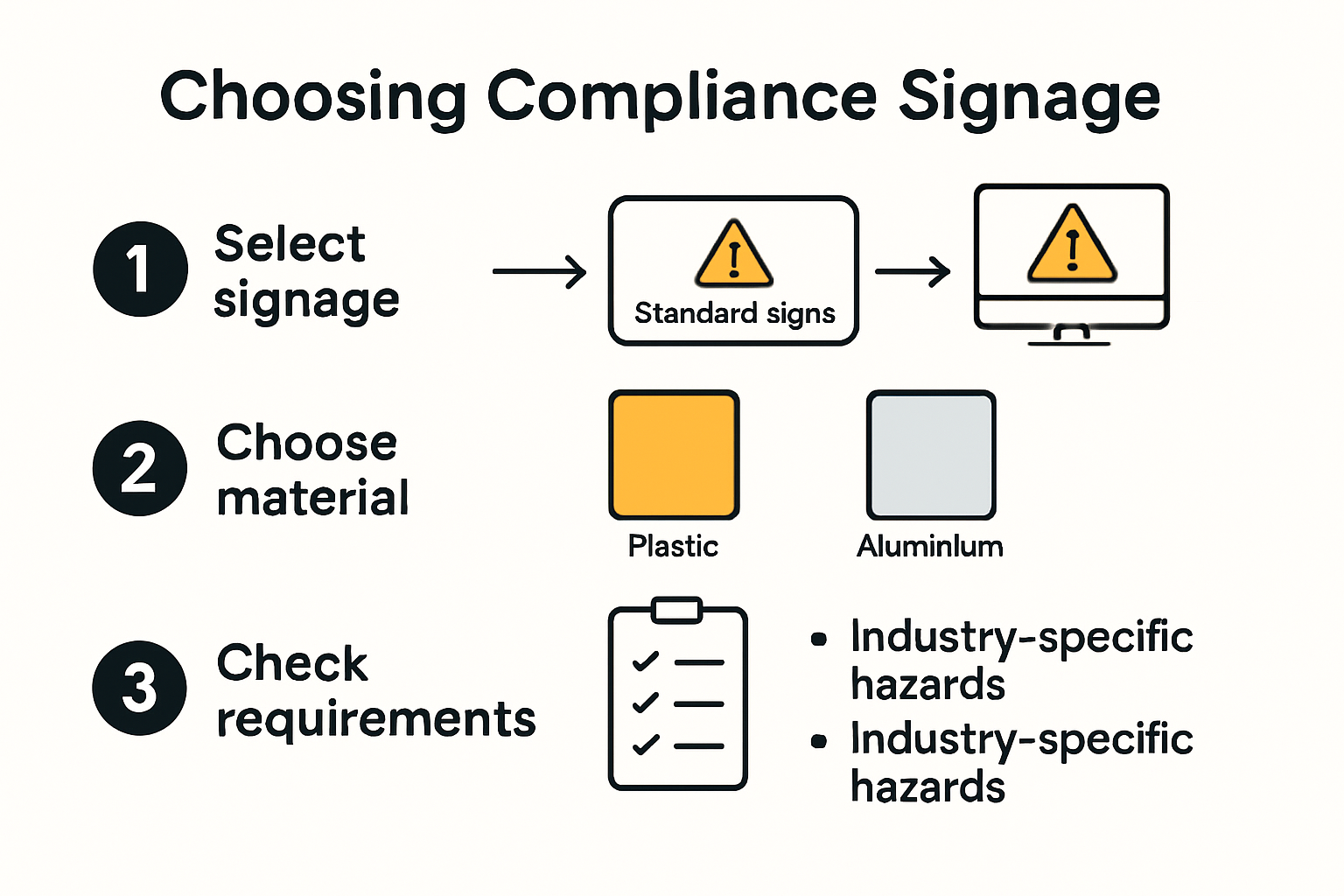
Selecting appropriate compliance signage requires a strategic approach that goes beyond mere regulatory checkbox ticking. Businesses must carefully consider multiple factors to ensure their signage effectively communicates critical information while meeting legal standards and organisational needs.
Material and Design Considerations
The selection of compliance signage materials plays a crucial role in their effectiveness and durability. According to ANSI Z535 standards, signs must be constructed to withstand the specific environmental conditions of their intended location. For industrial settings, this might mean selecting materials resistant to chemical exposure, extreme temperatures, or high humidity.
Different business environments demand unique signage solutions. Outdoor construction sites require robust, weatherproof signs, while healthcare facilities need signs that can be easily sanitised and maintain clarity over time. Material durability becomes a critical factor in ensuring long-term compliance and visibility.
Key material considerations include:
- Corrosion Resistance: Essential for marine or chemical environments
- UV Stability: Crucial for outdoor signage exposed to direct sunlight
- Impact Resistance: Important in high-traffic or industrial areas
Visibility and Communication Effectiveness
The Occupational Safety and Health Administration emphasises that compliance signs must be immediately comprehensible. This goes beyond simple text placement, involving strategic use of colour, size, and visual design to ensure rapid information absorption.
Businesses must consider factors such as viewing distance, lighting conditions, and potential visual obstructions. Signs should be large enough to be read from appropriate distances and use high-contrast colour schemes that ensure readability. The goal is not just compliance, but effective communication of critical safety information.
Customisation and Industry-Specific Requirements
No single compliance signage solution fits all businesses. Each industry has unique regulatory requirements and communication needs. Our comprehensive guide to commercial signage provides detailed insights into industry-specific considerations.
Manufacturing facilities might require complex safety instruction signs, while retail environments need a different approach to compliance communication. Healthcare settings demand signs that balance critical safety information with patient comfort and clarity.
Effective compliance signage should:
- Clearly Communicate Specific Risks
- Provide Actionable Instructions
- Meet Industry-Specific Regulatory Standards
Beyond legal requirements, well-designed compliance signage reflects an organisation’s commitment to safety and professionalism. It serves as a critical communication tool that protects employees, customers, and the business itself.
Businesses should approach compliance signage as a strategic investment rather than a mere regulatory requirement. The right signage not only prevents potential legal issues but also demonstrates a proactive approach to workplace safety and risk management.
To compare the different material and design considerations for various business environments, refer to the following table:
| Environment | Key Material Feature | Design Consideration | Example Concern |
|---|---|---|---|
| Outdoor Construction | Weatherproof, UV Stability | High-visibility, robust | Rain, sunlight, damage |
| Manufacturing | Impact & Chemical Resistance | Clear icons, durable mount | Chemical spills, collisions |
| Healthcare | Easy to sanitise, legible | Calming colours, clarity | Infection risk, patient comfort |
| Retail | Fade-resistant, aesthetic | Brand integration, readability | Heavy footfall, appearance |
| Marine/Chemical | Corrosion resistance | Simplified layout, resilience | Saltwater, harsh chemicals |
Key Locations and Best Practices for Installation
Effective compliance signage transcends mere design and material selection. The strategic placement and installation of signs play a critical role in ensuring workplace safety, regulatory adherence, and clear communication across diverse business environments.
Strategic Positioning for Maximum Impact
Precise sign placement is fundamental to compliance effectiveness. According to the UK Health and Safety Executive’s Approved Code of Practice, signs must be installed at specific locations where risks cannot be adequately mitigated through alternative means. Visibility and accessibility become paramount considerations in this strategic positioning.
The Occupational Safety and Health Administration (OSHA) recommends installing compliance signs at critical decision points and high-risk areas. This includes machinery zones, potential hazard locations, emergency exits, electrical panels, and areas requiring specific protective equipment.
Key strategic positioning principles include:
- Line of Sight: Signs must be directly in workers’ visual field
- Proximity to Hazard: Located immediately near potential risk areas
- Unobstructed View: Ensuring no physical barriers block sign visibility
Installation Technical Considerations
Technical installation requires meticulous attention to detail beyond simple placement. The National Institute for Occupational Safety and Health (NIOSH) emphasises that sign mounting height, angle, and illumination are crucial factors in ensuring effective communication.
Businesses must consider environmental factors such as lighting conditions, potential physical obstructions, and workplace dynamics. Signs in manufacturing environments might require robust mounting solutions, while office settings demand more aesthetically integrated approaches. Our comprehensive commercial signage guide provides detailed insights into these nuanced installation requirements.
Maintenance and Ongoing Compliance
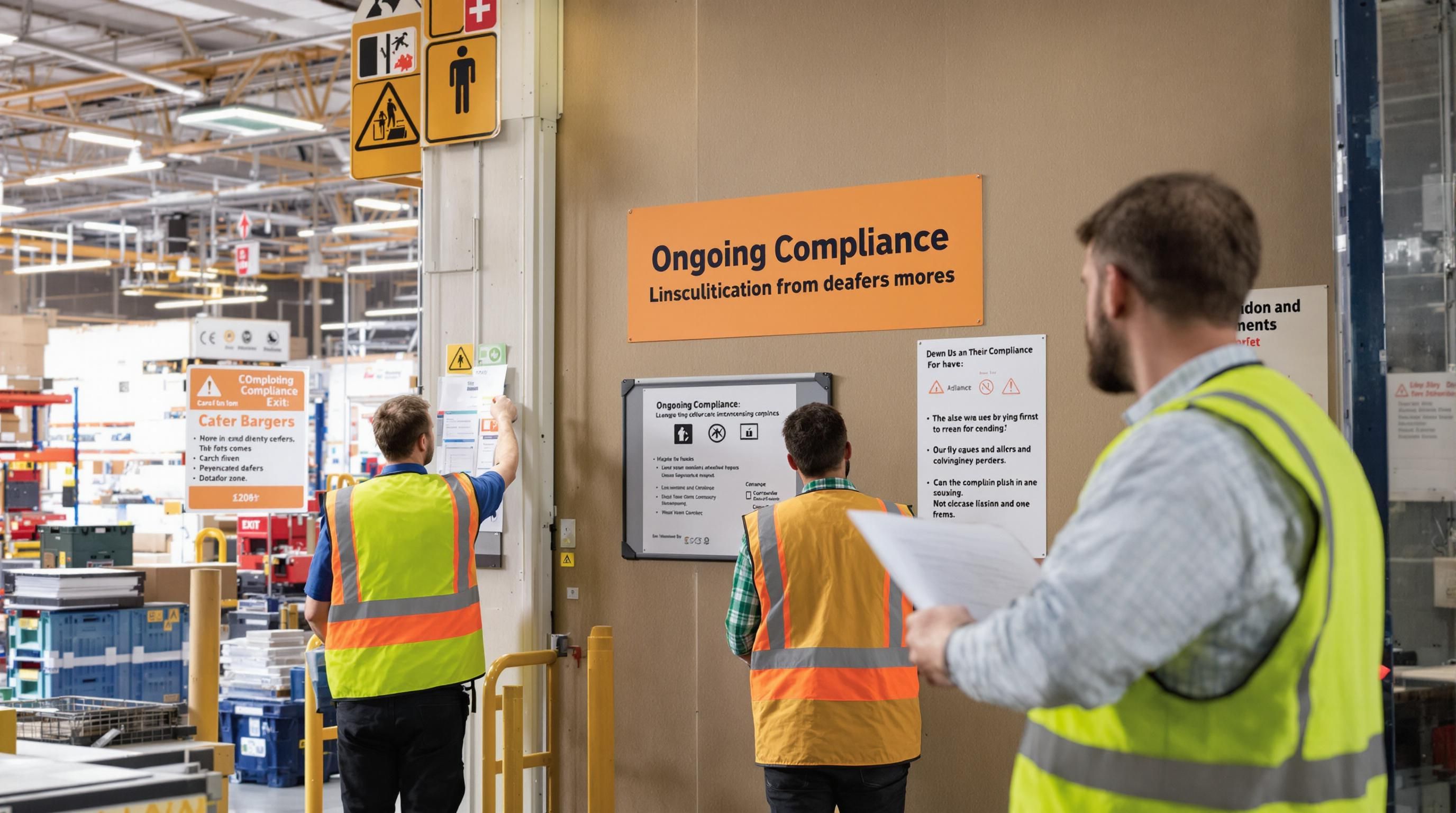
Compliance signage is not a one-time installation task but a continuous process of maintenance and verification. Regular inspections ensure signs remain legible, undamaged, and accurately reflecting current workplace conditions. This involves checking for:
- Physical Integrity: No cracks, fading, or structural damage
- Continued Relevance: Updating signs to reflect current workplace regulations
- Visibility: Ensuring signs remain unobstructed and clearly readable
Businesses should implement a systematic review process, conducting periodic assessments of existing signage to maintain regulatory compliance and workplace safety standards.
The investment in proper compliance signage installation goes beyond mere regulatory requirement. It represents a critical communication strategy that protects employees, demonstrates organisational commitment to safety, and mitigates potential legal and operational risks.
By approaching compliance signage as a dynamic, strategic element of workplace management, businesses can create safer, more informed, and more responsive working environments. The right signs, installed correctly and maintained diligently, become powerful tools of communication and protection.
For a quick overview, the following checklist table summarises best practice considerations for compliance sign installation and maintenance:
| Task | Status to Check | Frequency/Action |
|---|---|---|
| Proper line of sight | Yes/No | On installation, periodic |
| Close proximity to hazard | Yes/No | On installation, periodic |
| No visual obstructions | Yes/No | Regular inspection |
| Secure mounting | Yes/No | On installation, when moved |
| Adequate lighting | Yes/No | When workplace lighting changes |
| No cracks/fading/damage | Yes/No | Regular inspection |
| Up-to-date information | Yes/No | At every regulatory update |
Custom Solutions for Unique Spaces and Events
Custom compliance signage represents a critical solution for businesses navigating complex and varied environments. Unlike standard signage, custom solutions offer tailored approaches that address specific spatial challenges, regulatory requirements, and unique operational contexts.
Designing for Specific Spatial Requirements
Every business environment presents distinctive signage challenges that demand nuanced, purpose-built solutions. According to Boise State University’s Signage Policy, effective custom signage must balance functional communication with aesthetic integration.
Industrial settings might require heavy-duty signs resistant to chemical exposure, while healthcare facilities need signs that maintain sterility and comply with medical regulations. Event spaces demand flexible, temporary signage solutions that can be quickly installed and removed without compromising safety standards.
Key considerations for custom spatial signage include:
- Environmental Resilience: Materials suited to specific workplace conditions
- Adaptive Design: Signs that can be modified or repositioned
- Comprehensive Risk Communication: Addressing unique spatial hazards
Temporary and Event-Specific Signage Strategies
Temporary events and dynamic business environments require sophisticated signage approaches. The National Institute for Occupational Safety and Health emphasises the importance of clear, immediate communication in transient settings.
Event organisers and businesses must develop signage strategies that can be rapidly deployed, provide clear guidance, and meet regulatory compliance standards. This might involve modular sign systems, digital displays, or strategically placed temporary signage that can be quickly installed and removed.
Our comprehensive guide to event signage solutions offers detailed insights into creating effective temporary signage strategies that balance regulatory requirements with practical implementation.
Technological Integration and Advanced Signage Solutions
Modern compliance signage transcends traditional static approaches. Innovative businesses are integrating digital technologies, interactive displays, and smart signage solutions that provide real-time information and adaptive communication.
Advanced custom signage might incorporate:
- Digital Displays: Allowing instant updates and dynamic information
- QR Code Integration: Providing additional safety information
- Multilingual Options: Ensuring accessibility for diverse workforce
These technological solutions enable businesses to create more responsive, intelligent compliance communication systems that adapt to changing workplace environments and regulatory landscapes.
Custom signage solutions represent more than mere regulatory compliance. They demonstrate a sophisticated approach to workplace safety, communication, and organisational professionalism. By investing in tailored signage strategies, businesses can create safer, more informed, and more adaptable working environments that protect both employees and organisational interests.
Frequently Asked Questions
What are the legal requirements for compliance signage in the UK?
In the UK, compliance signage must adhere to specific regulations, including visibility and legibility, consistent colour coding, and accurate hazard communication as outlined in the Health and Safety at Work Act 1974.
What consequences can businesses face for failing to use proper compliance signage?
Businesses that fail to implement proper compliance signage may face fines of up to £20,000, legal action, and potential shutdowns. Additionally, inadequate signage can compromise employee safety and increase liability risks.
How should compliance signage be installed for maximum effectiveness?
Compliance signage should be strategically positioned at critical locations, ensuring they are in the line of sight, near hazards, and unobstructed. Proper mounting height and angle are also essential for effective communication.
What materials are recommended for durability in compliance signage?
For durability, compliance signage materials should be resistant to environmental conditions such as chemicals, UV radiation, and extreme temperatures. Common choices include weatherproof plastics or metal that can withstand outdoor elements.
Ready to Make Compliance Simple and Stress-Free?
Many UK businesses struggle to keep up with ever-changing legal requirements for compliance signage. You want to avoid hefty fines and keep your team safe, but figuring out which signs to display, where to place them, and how to keep them visible can be challenging. This article highlights how vital it is to have signs that are not only legally compliant but also durable and clearly positioned. Mistakes in these areas can put your company at risk and create uncertainty among staff or customers.
For peace of mind, trust a team that specialises in custom compliance signage for businesses in London, Essex, and Kent. With Promosigns, you get more than just shop signs or illuminated displays. You benefit from expert guidance on regulatory standards along with full in-house design, production, and installation services. For added support, explore our advice on choosing the right commercial sign for your business to discover options tailored to your industry and space.
Take the hassle out of 2025 compliance requirements. Give your business the advantage of proven solutions and a safer, smarter workplace. Visit https://promosigns.co.uk today to request a quote or book a free consultation.
Recommended
- Retail Signage Compliance Guide 2025 for London Businesses – PromoSigns.co.uk
- Signage for Office Interiors: 2025 Guide for London Businesses – PromoSigns.co.uk
- Illuminated Sign Regulations: Key Rules for Businesses in 2025 – PromoSigns.co.uk
- Signage Size Guidelines 2025: The Essential Guide for London Businesses – PromoSigns.co.uk
