
Signage is often seen as just labels on walls or doors in new buildings. Yet these signs play a far bigger role than most realise. In fact, some UK regulations now require specific wayfinding signage in multi-occupied buildings to assist emergency services, which means signage can actually save lives. Surprisingly, the real power of signage is not just about following rules. When used right, it transforms bland spaces into safe, intuitive environments where both people and brands thrive.
Table of Contents
- What Is Signage For New Builds?
- Understanding The Core Purpose
- Regulatory And Functional Considerations
- Why Signage Is Essential For New Buildings
- Safety And Regulatory Compliance
- Functional And Branding Significance
- Types Of Signage Used In New Builds
- Structural And Identification Signage
- Functional Navigation And Safety Signage
- How Signage Influences Branding And Communication
- Visual Brand Language
- Communication And Psychological Impact
- Best Practices For Effective New Build Signage
- Design And Accessibility Principles
- Technical And Strategic Considerations
Table of Contents
Quick Summary
| Takeaway | Explanation |
|---|---|
| Ensure signage clarity and legibility | Signs must be easily readable to effectively guide users and enhance navigation. |
| Prioritise safety compliance in signage | Regulatory guidelines often dictate necessary signage for emergency wayfinding and hazard identification. |
| Incorporate innovative technology in signage | Use digital displays and interactive elements to engage users and provide real-time information. |
| Align signage with brand identity | Design signage to reflect your organisation’s visual language, culture, and values to create a cohesive narrative. |
| Focus on inclusive design principles | Ensure accessibility by using clear fonts and intuitive placements to cater to all users, including those with disabilities. |
What is Signage for New Builds?
Signage for new builds represents a comprehensive communication system designed to provide visual guidance, identification, and information within newly constructed environments. These strategically placed visual markers serve multiple critical functions beyond mere aesthetic decoration, acting as essential navigational tools that enhance both functionality and user experience.
Understanding the Core Purpose
At its fundamental level, signage for new builds functions as a critical interface between architectural spaces and human interaction. These signs communicate vital information, direct foot traffic, identify specific areas, comply with safety regulations, and create a cohesive visual identity for the building or development. For more insights into designing effective building signage, businesses and architects must consider multiple strategic elements.
Key characteristics of effective signage for new builds include:
- Clarity and Legibility: Signs must be easily readable from appropriate distances
- Durability: Constructed to withstand environmental conditions and regular usage
- Consistent Design Language: Matching the architectural style and branding of the space
Regulatory and Functional Considerations
Signage for new builds is not merely a design choice but often a legal requirement. Certain multi-occupied residential buildings must install specific wayfinding signage to assist emergency services. This mandates that signs are not only visually informative but potentially life-saving.
Beyond regulatory compliance, modern signage integrates technological advancements. Contemporary solutions might incorporate digital displays, interactive elements, and adaptive information systems that can update in real time. These innovations transform signage from static markers to dynamic communication platforms that enhance user engagement and provide seamless navigational experiences.
Whether for commercial complexes, residential developments, or public infrastructure, signage for new builds represents a sophisticated blend of design, functionality, and strategic communication. It bridges architectural spaces with human movement, creating intuitive environments that guide, inform, and inspire. For developers and contractors commissioning signage across multiple buildings or phases, working with established signage companies London ensures consistency of quality, compliance, and brand alignment throughout the entire development.
Straipsnis apie: signage for new builds — paskirtis, teisiniai reikalavimai, tipai, prekės ženklo komunikacija, geriausios praktikos.
Išorinės nuorodos kurias reikia pašalinti:
gov.uk— išorinėun.org— išorinėsigns.org— išorinėsustainability.mit.edu— išorinė
5 tinkamiausios vidinės nuorodos pagal temą:
- shop signs London → /shop-signs-london/
- large format printing London → /large-format-printing-london/
- custom signs London → /custom-signs-london/
- signage companies London → /signage-companies-london/
- business signs London → /business-signs-london/
Signage is often seen as just labels on walls or doors in new buildings. Yet these signs play a far bigger role than most realise. In fact, some UK regulations now require specific wayfinding signage in multi-occupied buildings to assist emergency services, which means signage can actually save lives. Surprisingly, the real power of signage is not just about following rules. When used right, it transforms bland spaces into safe, intuitive environments where both people and brands thrive.
Table of Contents
- What Is Signage For New Builds?
- Understanding The Core Purpose
- Regulatory And Functional Considerations
- Why Signage Is Essential For New Buildings
- Safety And Regulatory Compliance
- Functional And Branding Significance
- Types Of Signage Used In New Builds
- Structural And Identification Signage
- Functional Navigation And Safety Signage
- How Signage Influences Branding And Communication
- Visual Brand Language
- Communication And Psychological Impact
- Best Practices For Effective New Build Signage
- Design And Accessibility Principles
- Technical And Strategic Considerations
Quick Summary
| Takeaway | Explanation |
|---|---|
| Ensure signage clarity and legibility | Signs must be easily readable to effectively guide users and enhance navigation. |
| Prioritise safety compliance in signage | Regulatory guidelines often dictate necessary signage for emergency wayfinding and hazard identification. |
| Incorporate innovative technology in signage | Use digital displays and interactive elements to engage users and provide real-time information. |
| Align signage with brand identity | Design signage to reflect your organisation’s visual language, culture, and values to create a cohesive narrative. |
| Focus on inclusive design principles | Ensure accessibility by using clear fonts and intuitive placements to cater to all users, including those with disabilities. |
What is Signage for New Builds?
Signage for new builds represents a comprehensive communication system designed to provide visual guidance, identification, and information within newly constructed environments. These strategically placed visual markers serve multiple critical functions beyond mere aesthetic decoration, acting as essential navigational tools that enhance both functionality and user experience.
Understanding the Core Purpose
At its fundamental level, signage for new builds functions as a critical interface between architectural spaces and human interaction. These signs communicate vital information, direct foot traffic, identify specific areas, comply with safety regulations, and create a cohesive visual identity for the building or development. For more insights into designing effective building signage, businesses and architects must consider multiple strategic elements.
Key characteristics of effective signage for new builds include:
- Clarity and Legibility: Signs must be easily readable from appropriate distances
- Durability: Constructed to withstand environmental conditions and regular usage
- Consistent Design Language: Matching the architectural style and branding of the space
Regulatory and Functional Considerations
Signage for new builds is not merely a design choice but often a legal requirement. Certain multi-occupied residential buildings must install specific wayfinding signage to assist emergency services. This mandates that signs are not only visually informative but potentially life-saving.
Beyond regulatory compliance, modern signage integrates technological advancements. Contemporary solutions might incorporate digital displays, interactive elements, and adaptive information systems that can update in real time. These innovations transform signage from static markers to dynamic communication platforms that enhance user engagement and provide seamless navigational experiences.
Whether for commercial complexes, residential developments, or public infrastructure, signage for new builds represents a sophisticated blend of design, functionality, and strategic communication. It bridges architectural spaces with human movement, creating intuitive environments that guide, inform, and inspire. For developers and contractors commissioning signage across multiple buildings or phases, working with established signage companies London ensures consistency of quality, compliance, and brand alignment throughout the entire development.
Why Signage is Essential for New Buildings
Signage represents a fundamental communication infrastructure in modern architectural environments, serving far more than a decorative purpose. For new buildings, these visual communication systems become critical elements that transform spaces from mere physical structures into intuitive, navigable, and safe environments.
Safety and Regulatory Compliance
At the core of signage importance lies its role in ensuring public safety. Our comprehensive guide on office interior signage highlights how strategic signage can prevent potential hazards and guide human movement. Effective signage is crucial for facilitating orientation, particularly for individuals with disabilities.
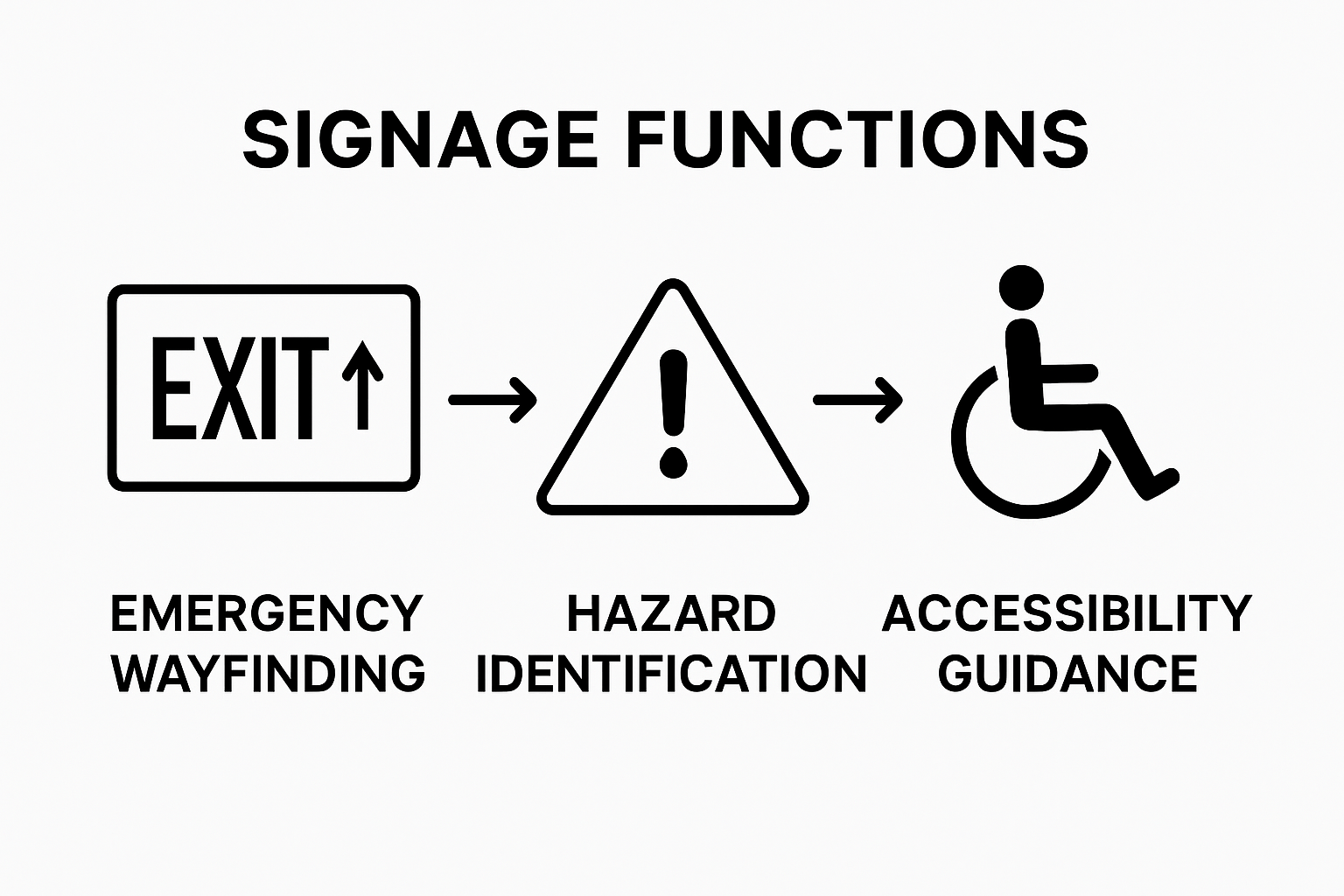
Key safety considerations include:
- Emergency Wayfinding: Providing clear evacuation routes
- Hazard Identification: Marking potential risk areas
- Accessibility Guidance: Ensuring navigation for all individuals
Functional and Branding Significance
Beyond safety, signage plays a pivotal role in organisational communication and brand representation. New buildings are not just physical spaces but narrative environments that communicate institutional identity, culture, and purpose. Strategically designed signs transform architectural spaces into coherent, meaningful experiences.
Signage contributes to functional efficiency by:
- Directing Traffic Flow: Managing human movement through complex environments
- Providing Information: Communicating essential details about spaces and services
- Creating Visual Hierarchy: Establishing spatial understanding and orientation
Modern signage integrates technological innovations, moving beyond traditional static markers. Digital displays, interactive information systems, and adaptive communication platforms are revolutionising how buildings interact with their occupants, creating dynamic, responsive environments that enhance user experience and engagement. Businesses moving into newly constructed commercial spaces can reinforce this communication from their very first day by commissioning business signs London that align with both the building’s design and their own brand identity.
Types of Signage Used in New Builds
Signage for new builds encompasses a diverse range of visual communication systems designed to address specific architectural and functional requirements. Understanding these varied types enables architects, designers, and building managers to create comprehensive, intuitive environments that effectively guide, inform, and protect occupants.
Structural and Identification Signage
For detailed insights into designing effective building signage, professionals must first understand fundamental sign categories. Building-mounted signs serve multiple critical purposes:
- Parapet Signs: Mounted along roof edges, providing visibility from a distance
- Wall or Fascia Signs: Attached directly to exterior building surfaces
- Projecting Signs: Extending perpendicularly from buildings for enhanced visibility
These sign types not only identify buildings but also contribute to architectural aesthetics and brand communication. Architectural integration becomes paramount, ensuring signs complement the building’s design language while fulfilling functional requirements. For exterior wall and fascia applications where scale matters, large format printing London delivers the production quality and panel precision that large commercial and residential developments demand.
Functional Navigation and Safety Signage
Navigation signage represents a crucial subset of building sign systems, addressing movement, orientation, and emergency protocols. These signs go beyond mere directional guidance, serving critical safety and accessibility functions.
Key functional sign categories include:
- Wayfinding Signs: Guiding occupants through complex spatial environments
- Emergency Exit Signs: Providing clear evacuation route information
- Accessibility Signs: Supporting navigation for individuals with diverse mobility needs
Modern functional signage increasingly incorporates digital technologies, transforming static markers into interactive, adaptive communication platforms. Smart display systems can now provide real-time information, dynamically update directional guidance, and integrate with building management systems.
| Signage Category | Primary Function | Key Characteristics |
|---|---|---|
| Parapet Signs | Building identification from a distance | High visibility, mounted on roof edges |
| Wall or Fascia Signs | Display building or company identity | Attached to exterior surfaces, complements façade |
| Projecting Signs | Enhance visibility from multiple directions | Extends perpendicularly, architectural integration |
| Wayfinding Signs | Guide occupants through complex environments | Clear navigation, positioned at decision points |
| Emergency Exit Signs | Indicate safe evacuation routes | Illuminated, easy to locate in emergencies |
| Accessibility Signs | Aid navigation for all, especially disabled users | Inclusive design, uses symbols and clear language |

How Signage Influences Branding and Communication
Signage transcends mere visual information, emerging as a powerful strategic tool that communicates organisational identity, values, and professional ethos. In new builds, signage becomes an integral component of brand storytelling, transforming physical spaces into narrative environments that engage and resonate with occupants and visitors.
Visual Brand Language
Our comprehensive guide on brand recognition through signage highlights how visual elements communicate complex organisational messages. Signage serves as a critical brand touchpoint, representing an organisation’s visual DNA through strategic design choices:
- Colour Palette: Reflecting brand identity and emotional resonance
- Typography: Communicating personality and professional character
- Material Selection: Conveying quality, innovation, and corporate values
These design elements work synergistically to create a cohesive visual narrative that extends beyond traditional marketing materials, embedding brand messaging directly into architectural experiences. When brand guidelines need to be applied consistently across every surface — from lobby walls to exterior hoardings — custom signs London specialists ensure that every element is designed and manufactured to exact brand specifications.
Communication and Psychological Impact
Signage operates as a sophisticated communication medium that influences human perception and behaviour. Beyond aesthetic considerations, signs create psychological landscapes that shape spatial experiences and organisational interactions.
Key communication dimensions include:
- Spatial Orientation: Providing psychological comfort through clear navigation
- Emotional Engagement: Creating positive first impressions and brand connections
- Cultural Representation: Reflecting organisational values and professional ethos
Modern signage integrates advanced communication technologies, transforming static visual markers into dynamic, interactive brand experiences. Digital displays, adaptive information systems, and intelligent signage platforms enable real-time communication, creating immersive environments that respond dynamically to user interactions.
Best Practices for Effective New Build Signage
Designing signage for new builds requires a strategic approach that balances aesthetic appeal, functional clarity, and regulatory compliance. Successful signage implementation goes beyond mere visual communication, creating comprehensive environments that guide, inform, and enhance user experiences.
Design and Accessibility Principles
Our comprehensive guide on signage design principles emphasises the critical importance of universal design. Effective signage must prioritise accessibility and clarity:
- Visual Contrast: Ensuring readability for individuals with visual impairments
- Consistent Typography: Using clear, legible fonts across all signage
- Intuitive Placement: Positioning signs at natural eye levels and decision points
Inclusive design transforms signage from a functional requirement into a user-centric communication tool that accommodates diverse user needs and abilities.
Technical and Strategic Considerations
Successful signage implementation requires a holistic approach that integrates technical precision with strategic communication objectives. Modern signage systems must balance multiple complex requirements:
- Material Durability: Selecting materials resistant to environmental conditions
- Technology Integration: Incorporating digital interfaces and adaptive technologies
- Scalability: Designing systems that can evolve with organisational changes
Technical considerations extend beyond physical design, encompassing digital infrastructure, maintenance protocols, and future adaptability. For retail and commercial units within a new development, complementing the building’s wayfinding system with high-visibility shop signs London ensures individual businesses stand out within the development while maintaining overall visual coherence.
| Principle | Design Focus | Intended Benefit |
|---|---|---|
| Visual Contrast | Colour and luminosity | Improved readability for visually impaired users |
| Consistent Typography | Font choice and size | Maintains legibility and cohesive appearance |
| Intuitive Placement | Signage location | Easy detection at natural eye level or decision points |
| Material Durability | Surface and material quality | Longevity and resistance to environmental factors |
| Technology Integration | Digital and interactive elements | Real-time updates, enhanced user engagement |
| Scalability | System expansion capability | Allows adaptation to organisational growth |
Ready to Transform Your New Build with Professional Signage?
Navigating the regulations and demands of modern new builds can feel overwhelming. This article highlights the critical roles of clarity, consistency, and compliance in building signage. You want signage that is not only visually stunning but also effective in guiding, informing, and protecting people as they interact with your space. Perhaps you are facing challenges in choosing the right materials, achieving cohesive branding, or integrating accessibility features as discussed in the guide. Let us take those worries away and show you what experienced professionals can deliver.
Work with a UK signage partner trusted by businesses across London, Essex, and Kent. Our team at PromoSigns helps new developments ensure compliance, boost brand impact, and create seamless visitor experiences from day one. Ready to create intelligent signage that makes your new build stand out? Visit https://promosigns.co.uk today and see how our custom solutions can bring your project to life without delays. Act now to secure your expert consultation and set your development apart.
Frequently Asked Questions
What is the primary purpose of signage for new builds?
Signage for new builds serves to provide visual guidance, identification, and critical information within newly constructed environments. It enhances navigational efficiency, ensures safety, and contributes to the overall user experience.
How does signage ensure safety in new builds?
Signage plays a crucial role in safety by providing emergency wayfinding, identifying hazard areas, and ensuring accessibility for all individuals. It often complies with legal requirements, helping to guide occupants and emergency services during critical situations.
What types of signage are commonly used in new buildings?
Common types of signage in new buildings include identification signs (e.g., wall signs, parapet signs), functional navigation signs (e.g., wayfinding and emergency exit signs), and safety signage that communicates essential information about hazards and accessibility.
How can signage improve branding in newly constructed buildings?
Signage enhances branding by serving as a visual representation of an organisation’s identity and values. Effective signage incorporates design elements such as colour, typography, and material selection to weave the brand narrative directly into the architectural environment.
Recommended
- How to Design Building Signage
- How to Choose Signage
- Planning a Signage Project
- Signage Design Principles for London Businesses in 2025
