

Every London business wants its storefront to stand out on the high street. People are surprised to learn that store signs occupying just 30 to 50 percent of the shop’s width are far more visible and effective than oversized designs. Here is the twist – it is not size alone that matters, your choice of colour, lighting and careful compliance with local regulations can make your sign the talk of the town.
Table of Contents
Table of Contents
- Choosing The Right Size And Location
- Colour And Font Choices That Stand Out
- Lighting Solutions For Day And Night
- Compliance And Local London Regulations
Quick Summary
| Takeaway | Explanation |
|---|---|
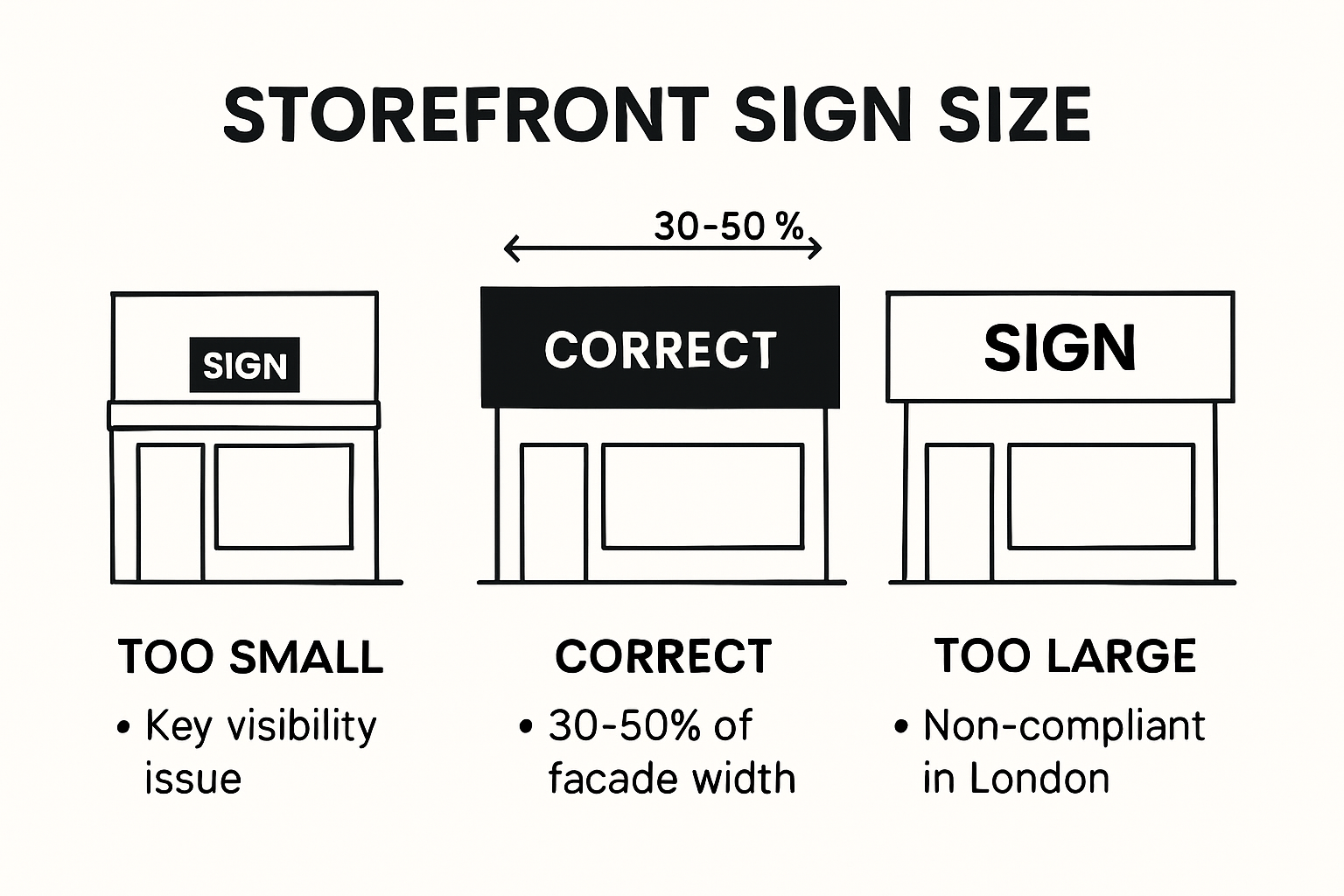
| Optimal Size Matters | Storefront signs should occupy 30% to 50% of the available width to ensure visibility without overwhelming the facade; signs larger than 0.3 square metres require advertisement consent. |
| Colour and Font Selection | High-contrast colours and legible fonts are essential for attracting attention; choose colours that align with your brand and evoke the desired emotional response. |
| Importance of Lighting | Internally illuminated signs provide significantly higher visibility; modern LED solutions offer energy efficiency and adaptability for both day and night. |
| Navigating Regulations | Businesses must understand local planning regulations and obtain necessary consents for outdoor signage to avoid legal issues and ensure compliance with safety standards. |
Choosing the Right Size and Location
Storefront sign visibility goes far beyond simple aesthetics. Strategic placement and appropriate sizing can dramatically transform how potential customers perceive and interact with your business. Getting these elements right requires careful consideration of multiple factors that impact visual communication and regulatory compliance.
Understanding Storefront Sign Dimensions
Selecting the optimal sign dimensions requires a nuanced approach. According to the UK Planning Portal, advertisement consent becomes mandatory for signs larger than 0.3 square metres or any illuminated signage on a property’s front. This regulatory guideline means businesses must balance their visibility goals with legal requirements.
The size of your storefront sign should proportionally relate to your building’s facade. A sign that overwhelms the architectural space can appear visually jarring, while an undersized sign risks being overlooked. Professional designers recommend that storefront signs occupy approximately 30% to 50% of the available frontage width, ensuring maximum readability without dominating the architectural aesthetic.
Strategic Sign Placement Considerations
Location plays a critical role in sign effectiveness. The Lake District National Park Authority advises that shopfront signs should not extend higher than the windowsills of the floor above, creating a visual harmony with the building’s existing architectural lines.
Key placement factors include:
- Visibility from Street Level: Position signs where they can be easily seen by pedestrians and passing traffic
- Natural Eye Line: Align signs with average human eye height (typically 1.5 to 1.8 metres)
- Architectural Compatibility: Ensure the sign complements rather than competes with the building’s design

Regulatory and Safety Compliance
Navigation of legal requirements is paramount. The UK Government’s guide on outdoor advertisements emphasizes that all outdoor signs must remain clean, safe, and must not obstruct official road, rail, waterway, or aircraft signage. This means businesses must consider not just their marketing objectives but also broader public safety and urban design principles.
Businesses should consult local planning authorities to understand specific requirements for their area. Some urban districts have strict conservation zones with additional restrictions on signage design, material, and placement. Engaging with these regulations proactively can prevent potential legal complications and costly redesigns.
Effective storefront sign visibility is a sophisticated blend of creative design, strategic placement, and regulatory compliance. By carefully considering dimensions, location, and legal frameworks, businesses can create signs that not only attract attention but also communicate professionalism and respect for their urban environment.
Colour and Font Choices That Stand Out
In the competitive visual marketplace, storefront sign visibility hinges critically on colour and font selection. These design elements are more than aesthetic choices they are strategic communication tools that can dramatically influence customer perception and engagement.
Colour Psychology and Visibility
Colour selection represents a powerful psychological trigger for attracting potential customers. According to research from ISA Sign, high-contrast colour combinations play a pivotal role in enhancing sign legibility. Black text on yellow backgrounds or white text on black backgrounds emerge as particularly effective strategies for maximising visual impact.
Professional designers understand that different colours evoke specific emotional responses. Blue communicates trust and professionalism, red signals urgency and excitement, while green suggests calm and environmental consciousness. Selecting a colour palette that aligns with your brand identity while maintaining high visibility becomes crucial for effective storefront communication.
Below is a table summarising the effects of common colours and recommended contrast combinations for sign visibility.
| Colour | Psychological Effect | Recommended High-Contrast Pair |
|---|---|---|
| Blue | Trust, Professionalism | White text/Blue background |
| Red | Urgency, Excitement | White text/Red background |
| Green | Calm, Environmental | White text/Green background |
| Yellow | Attention, Positivity | Black text/Yellow background |
| Black | Authority, Sophistication | White text/Black background |
Strategic Font Selection
Font choice goes beyond mere aesthetics it determines readability and brand personality. Research from ResearchGate highlights that font placement and size significantly influence consumer attention. Specifically, red fonts positioned on the right side of displays in larger sizes tend to capture viewer attention more effectively.
Key font selection principles include:
- Readability: Choose clean, sans-serif fonts for maximum clarity
- Brand Consistency: Ensure font style reflects your business identity
- Size Variation: Use different font sizes to create visual hierarchy
Technical Considerations for Sign Design
Technical considerations extend beyond aesthetic choices. Factors like viewing distance, lighting conditions, and urban environment complexity must inform design decisions. Bold, sans-serif fonts with strong contrast work best for signs viewed from varying distances and angles.
For businesses seeking comprehensive design strategies, our expert guide on marketing visibility offers deeper insights into creating impactful visual communication.
Ultimately, successful storefront sign design requires a sophisticated balance between artistic creativity and strategic communication. By understanding colour psychology, font dynamics, and technical design principles, businesses can create signs that not only attract attention but also effectively communicate their brand story.
Lighting Solutions for Day and Night
Storefront sign visibility transforms dramatically between daylight and nighttime hours. Effective lighting solutions are critical for maintaining consistent brand communication and attracting potential customers across varying environmental conditions.
Illumination Technologies and Performance
According to research published in transportation studies, internally illuminated signs offer 40% to 60% greater visibility compared to externally illuminated alternatives. This significant improvement highlights the importance of sophisticated lighting strategies for businesses seeking maximum visual impact.
Modern illumination technologies provide multiple options for storefront signs. LED lighting emerges as a premier choice, offering energy efficiency, long-term durability, and exceptional brightness. These systems can be programmed to adjust intensity based on ambient light conditions, ensuring optimal visibility throughout different times of day.
The following table provides a comparison of key storefront sign lighting technologies discussed in the section.
| Lighting Technology | Visibility | Energy Efficiency | Lifespan | Notable Features |
|---|---|---|---|---|
| Internal Illumination | 40-60% better | High | Long-term | Consistent, programmable, bright |
| External Illumination | Lower | Medium | Moderate | May have uneven coverage |
| LED Lighting | Excellent | Very High | Very long | Programmable, energy saving |
Design Considerations for Effective Lighting
Lighting design extends beyond simple illumination. Research from urban design studies demonstrates that sign legibility depends on multiple factors including ambient illumination, colour combinations, sign height, and observation angles. Professional designers must carefully balance these elements to create visually compelling and readable signage.
Key lighting design principles include:
- Uniform Illumination: Ensure consistent light distribution across the entire sign
- Glare Reduction: Use diffusion techniques to prevent harsh reflections
- Color Temperature: Select lighting that complements your brand’s colour palette
Environmental and Economic Factors
Retail environment studies reveal that appropriate lighting design significantly influences customer perception, affecting store experience and product interpretation. This psychological dimension makes lighting an essential consideration beyond mere technical performance.
For businesses seeking comprehensive insights into modern signage solutions, our illuminated signs guide provides detailed strategies for maximising visual communication.
Economic considerations also play a crucial role. LED technologies offer substantial long-term savings through reduced energy consumption and minimal maintenance requirements. Modern systems can integrate smart controls, allowing remote management and programmable lighting sequences that adapt to changing environmental conditions.
Effective storefront lighting represents a sophisticated blend of technical innovation, design psychology, and strategic communication. By understanding and implementing advanced illumination solutions, businesses can create signs that not only capture attention but also communicate brand identity with remarkable clarity and impact.
Compliance and Local London Regulations
Navigating the complex landscape of storefront sign regulations requires a strategic and informed approach. London’s urban environment presents unique challenges and specific legal requirements that businesses must carefully understand and implement to ensure their signage is both effective and legally compliant.
Regulatory Framework for Outdoor Advertisements
The UK government’s guide on outdoor advertisements provides a comprehensive overview of the regulatory landscape. Under the Town and Country Planning (Control of Advertisements) (England) Regulations 2007, displaying an outdoor advertisement without proper consent is considered a criminal offense. This underscores the critical importance of understanding and adhering to local planning regulations.
Key aspects of advertisement control include:
- Consent Requirements: Certain signs require express permission from local planning authorities
- Size and Placement Restrictions: Specific limitations on sign dimensions and positioning
- Historical Area Considerations: Additional regulations for conservation zones and listed buildings
Building Safety and Signage Regulations
Recent legislative changes have further complicated the signage landscape. The Building Safety Act 2022 introduced significant modifications to building safety regulations, extending beyond traditional construction considerations to encompass design elements like signage.
Businesses must now consider multiple layers of compliance, including:
- Structural integrity of sign mounting
- Fire safety considerations
- Accessibility requirements
- Historical preservation guidelines
Practical Compliance Strategies
Successful navigation of these complex regulations requires a proactive and informed approach. Our comprehensive retail signage compliance guide offers in-depth insights into managing these intricate requirements.
Practical steps for ensuring compliance include:
- Conducting thorough pre-installation consultations with local planning authorities
- Documenting all design and installation processes
- Maintaining up-to-date knowledge of changing regulatory landscapes
- Working with professional signage providers familiar with local regulations
Below is a checklist table to help businesses track critical compliance steps before installing signage in London.
| Compliance Step | Required? (Yes/No) | Status/Notes |
|---|---|---|
| Consult local planning authority | Yes | |
| Obtain advertisement consent (if over 0.3m²) | Yes for most signs | |
| Check conservation area/listed building status | Yes if applicable | |
| Ensure structural and fire safety compliance | Yes | |
| Maintain documentation of design/install process | Yes | |
| Use a professional sign provider | Recommended |
Compliance is not merely about avoiding legal penalties but represents a commitment to professional standards and community integration. By understanding and respecting local regulations, businesses demonstrate their dedication to creating harmonious urban environments that balance individual commercial interests with broader community aesthetic and safety considerations.
Ultimately, successful storefront signage in London requires a nuanced approach that combines creative design, technical expertise, and a deep understanding of the complex regulatory framework governing urban commercial spaces.
Frequently Asked Questions
What is the optimal size for a storefront sign in London?
Storefront signs should occupy 30% to 50% of the available width to ensure visibility without overwhelming the facade, with signs larger than 0.3 square metres requiring advertisement consent.
How can colour choice impact the visibility of my storefront sign?
High-contrast colour combinations enhance legibility. Colours like black on yellow or white on black are particularly effective. Additionally, colours can evoke specific emotional responses that align with your brand identity.
What lighting solutions work best for storefront signs?
Internally illuminated signs offer 40% to 60% greater visibility than externally illuminated ones. LED solutions are recommended for their energy efficiency and ability to adapt brightness based on ambient light conditions.
Are there specific regulations I need to comply with for outdoor signs in London?
Yes, businesses must understand local planning regulations concerning size, placement, and safety. Most signs over 0.3 square metres require consent, and there are additional regulations in conservation zones and for listed buildings.
Unlock Maximum Storefront Impact with Professionally Designed Signage
Are you worried your shopfront sign is getting lost in the busy streets of London? Many business owners find it tough to balance eye-catching design, precise size, and strict local rules. As highlighted in this article, achieving the right mix of optimal sign dimensions, striking colour and lighting, and full compliance is not just about style. It is a matter of grabbing attention and boosting footfall while avoiding costly regulatory mistakes.

Now is the perfect time to see the difference a truly professional approach can make. At PromoSigns, our experts specialise in custom shop signs and modern illuminated solutions. We help you get noticed and stay compliant, from design through to installation. Ready to transform the visibility of your storefront and see real results? Start today by discovering more at our website or read our expert illuminated signs guide for proven strategies that work. Let us help you stand out for all the right reasons.
Recommended
- Retail Sign Design Tips 2025: Essential Guide for London Businesses – PromoSigns.co.uk
- Types of Shop Signs for London Businesses: The 2025 Guide – PromoSigns.co.uk
- Illuminated Shop Sign Benefits for London Businesses 2025 – PromoSigns.co.uk
- Pop Up Shop Sign Strategies for London Businesses 2025 – PromoSigns.co.uk
- Projecting Sign Benefits for London Businesses in 2025 – PromoSigns.co.uk
- Illuminated Signs Explained: A 2025 Guide for London Businesses – PromoSigns.co.uk
