
Temporary signs go up everywhere from pop-up events to busy construction sites, and the choices you make really shape how people respond. Yet, most people treat signage like a last-minute box-tick, without realising the stakes. In fact, the placement and design of signage can directly influence audience engagement and perception, proving that well-planned temporary signs are anything but an afterthought.
Table of Contents
- Step 1: Assess Your Project Needs And Objectives
- Step 2: Choose The Right Materials And Sizes
- Step 3: Design Eye-Catching Signage Layouts
- Step 4: Print And Prepare Your Temporary Signage
- Step 5: Install Signage Effectively At Your Project Site
- Step 6: Evaluate Signage Impact And Make Adjustments
Table of Contents
Quick Summary
| Key Point | Explanation |
|---|---|
| 1. Assess project needs thoroughly | Evaluate specific objectives and environmental factors to inform your temporary signage requirements. |
| 2. Select appropriate materials and sizes | Choose materials and sizes based on location and intended viewing distance for effective communication. |
| 3. Design with clarity and hierarchy | Establish a clear visual hierarchy and ensure legibility through careful layout and colour choices. |
| 4. Conduct meticulous installation | Ensure proper mounting and alignment to enhance visibility and maintain safety. |
| 5. Evaluate and adjust signage impact | Measure effectiveness through observation and be prepared to make changes for optimal performance. |
Step 1: Assess Your Project Needs and Objectives
Successful temporary signage begins with a comprehensive understanding of your project’s unique requirements. This crucial first step involves a strategic evaluation of your specific objectives, environmental constraints, and communication goals. Thoroughly assessing your project needs will determine the effectiveness and impact of your temporary signage solution.
Begin by conducting a detailed project scope analysis that examines the specific context and purpose of your temporary signage. Consider the physical location where the signs will be displayed, potential environmental challenges, and the primary message you want to communicate. Signage placement and design are not mere afterthoughts but strategic decisions that directly influence audience perception and engagement.
The assessment process requires careful consideration of several key factors. First, determine the precise duration of your signage requirement. Will you need signs for a short-term event, a construction project, or a temporary marketing campaign? Each scenario demands a different approach to material selection, design complexity, and installation method. Construction sites might require robust, weather-resistant signs with clear safety instructions, while event organisers might prioritise visually striking graphics that capture attendees’ attention.
Next, evaluate the specific environmental conditions where your temporary signage will be located. Urban environments with high foot traffic will need different design considerations compared to rural or industrial settings. Factors such as wind exposure, potential moisture, direct sunlight, and potential physical interference must inform your signage strategy. Learn more about planning your signage project to ensure comprehensive preparation.
For large-scale construction and hoarding projects, advertising construction hoardings London solutions cover both the compliance and branding objectives of your site from the outset — making them an ideal starting point for the assessment stage.
Key verification criteria for completing this assessment stage include:
- A clear, written document outlining project signage objectives
- Detailed mapping of potential sign locations
- Comprehensive list of environmental and logistical constraints
- Preliminary sketches or concept designs reflecting your communication goals
| Verification Step | Description |
|---|---|
| Project objectives documented | A clear, written summary detailing what your signage must achieve |
| Sign locations mapped | Visual and written mapping of all intended signage placements |
| Environmental/logistical constraints listed | Complete list of challenges specific to the project environment |
| Preliminary concept designs prepared | Initial sketches or outlines illustrating intended communication |
Pašalintinos external nuorodos:
- osha.gov — pašalinti (US reguliacija, nerelevanti UK kontekstui)
5 internal linkų pasirinkimas (tema: temporary signage/project signage):
- banner printing London → /banner-printing-london/
- large format printing London → /large-format-printing-london/
- advertising construction hoardings London → /advertising-construction-hoardings-london/
- mesh banner printing London → /mesh-banner-printing-london/
- foamex signs printing London → /foamex-signs-printing-london/
Mastering Temporary Signage: A 6-Step Project Guide
Temporary signs go up everywhere from pop-up events to busy construction sites, and the choices you make really shape how people respond. Yet, most people treat signage like a last-minute box-tick, without realising the stakes. In fact, the placement and design of signage can directly influence audience engagement and perception, proving that well-planned temporary signs are anything but an afterthought.
Table of Contents
- Step 1: Assess Your Project Needs And Objectives
- Step 2: Choose The Right Materials And Sizes
- Step 3: Design Eye-Catching Signage Layouts
- Step 4: Print And Prepare Your Temporary Signage
- Step 5: Install Signage Effectively At Your Project Site
- Step 6: Evaluate Signage Impact And Make Adjustments
Quick Summary
| Key Point | Explanation |
|---|---|
| 1. Assess project needs thoroughly | Evaluate specific objectives and environmental factors to inform your temporary signage requirements. |
| 2. Select appropriate materials and sizes | Choose materials and sizes based on location and intended viewing distance for effective communication. |
| 3. Design with clarity and hierarchy | Establish a clear visual hierarchy and ensure legibility through careful layout and colour choices. |
| 4. Conduct meticulous installation | Ensure proper mounting and alignment to enhance visibility and maintain safety. |
| 5. Evaluate and adjust signage impact | Measure effectiveness through observation and be prepared to make changes for optimal performance. |
Step 1: Assess Your Project Needs and Objectives
Successful temporary signage begins with a comprehensive understanding of your project’s unique requirements. This crucial first step involves a strategic evaluation of your specific objectives, environmental constraints, and communication goals. Thoroughly assessing your project needs will determine the effectiveness and impact of your temporary signage solution.
Begin by conducting a detailed project scope analysis that examines the specific context and purpose of your temporary signage. Consider the physical location where the signs will be displayed, potential environmental challenges, and the primary message you want to communicate. Signage placement and design are not mere afterthoughts but strategic decisions that directly influence audience perception and engagement.
The assessment process requires careful consideration of several key factors. First, determine the precise duration of your signage requirement. Will you need signs for a short-term event, a construction project, or a temporary marketing campaign? Each scenario demands a different approach to material selection, design complexity, and installation method. Construction sites might require robust, weather-resistant signs with clear safety instructions, while event organisers might prioritise visually striking graphics that capture attendees’ attention.
Next, evaluate the specific environmental conditions where your temporary signage will be located. Urban environments with high foot traffic will need different design considerations compared to rural or industrial settings. Factors such as wind exposure, potential moisture, direct sunlight, and potential physical interference must inform your signage strategy. Learn more about planning your signage project to ensure comprehensive preparation.
For large-scale construction and hoarding projects, advertising construction hoardings London solutions cover both the compliance and branding objectives of your site from the outset — making them an ideal starting point for the assessment stage.
Key verification criteria for completing this assessment stage include:
- A clear, written document outlining project signage objectives
- Detailed mapping of potential sign locations
- Comprehensive list of environmental and logistical constraints
- Preliminary sketches or concept designs reflecting your communication goals
| Verification Step | Description |
|---|---|
| Project objectives documented | A clear, written summary detailing what your signage must achieve |
| Sign locations mapped | Visual and written mapping of all intended signage placements |
| Environmental/logistical constraints listed | Complete list of challenges specific to the project environment |
| Preliminary concept designs prepared | Initial sketches or outlines illustrating intended communication |
Step 2: Choose the Right Materials and Sizes
Selecting appropriate materials and sizes represents a critical junction in your temporary signage project. This step transforms your initial assessment into tangible design choices that directly impact visual communication, durability, and overall effectiveness. Material selection is not merely technical but a strategic decision that influences perception, longevity, and project success.
The material selection process demands a nuanced understanding of your specific project environment and communication objectives. Different temporary signage scenarios require unique material properties. For outdoor construction sites, you might need robust weatherproof materials like treated PVC or aluminium composite panels that withstand extreme conditions. Indoor exhibition displays, conversely, could benefit from lightweight materials such as foamex signs printing London — a rigid, lightweight board that delivers crisp graphics and easy transportation for indoor temporary installations.
Size considerations extend beyond simple dimensional measurements. They encompass visual hierarchy, readability, and spatial context. A sign must be proportional to its intended viewing distance and environment.
| Material Type | Durability | Best Suited For | Notable Features |
|---|---|---|---|
| Treated PVC | High | Outdoor construction sites | Weather-resistant, sturdy |
| Aluminium Composite | High | Long-term outdoor projects | Robust, handles physical stress |
| Foam Board | Medium | Indoor exhibitions/displays | Lightweight, crisp graphics |
| Printed Vinyl | Medium | Indoor and short-term outdoor | Flexible, vibrant colours |
Explore our comprehensive guide on understanding materials for signs to make informed decisions. Consider factors like UV resistance, moisture protection, potential physical stress, and expected lifespan.
Key verification criteria for material and size selection include:
- Detailed material specification matching environmental conditions
- Precise measurements accounting for viewing distance and context
- Sample material tests demonstrating required durability
- Cost-effectiveness analysis of selected materials
Step 3: Design Eye-Catching Signage Layouts
Designing compelling temporary signage layouts transforms technical requirements into powerful visual communication. This critical step bridges your project objectives with graphic design principles, creating signs that capture attention and convey messages with clarity and impact. Effective layout design is a strategic blend of aesthetics, readability, and purposeful communication.
Begin by establishing a clear visual hierarchy that guides the viewer’s eye through the most important information. Your primary message should be immediately apparent, with secondary details supporting but not overwhelming the core communication. Typography plays a crucial role in this process. Select fonts that are legible from expected viewing distances, ensuring that text remains readable even in challenging environmental conditions. Sans serif fonts often work best for temporary signage, offering clean lines and excellent visibility across various distances and lighting conditions.
Colour selection is more than aesthetic preference. It serves as a powerful communication tool that can evoke emotional responses and improve information retention. Consider the psychological impact of colour choices and their visibility against potential backgrounds. High contrast combinations ensure readability, while maintaining a cohesive colour palette that aligns with your project’s professional identity. Check out our graphic design tips for creating impactful signage to refine your visual strategy.
Visual balance and negative space are often overlooked but critical design elements. Avoid cluttering your layout with excessive information. Each graphic element should serve a specific purpose, whether communicating critical instructions, providing directional guidance, or reinforcing project branding.
Key verification criteria for your signage layout design include:
- Clear legibility from anticipated viewing distances
- Logical information hierarchy
- Consistent colour and typographic styling
- Alignment with project communication objectives
Step 4: Print and Prepare Your Temporary Signage
The printing and preparation stage transforms your design concepts into tangible communication tools. This critical phase demands precision, technical expertise, and careful quality control to ensure your temporary signage meets the high standards established in previous design stages. Printing is not just a technical process but the moment where your project vision becomes a physical reality.
Choosing the right printing technology is paramount to achieving optimal results. For outdoor temporary signage, large format printing London offers superior colour reproduction and durability across all common substrate types — from aluminium composite to PVC and vinyl — ensuring your graphics remain sharp and vibrant for the full duration of your project.
Preparing your signage for installation requires meticulous attention to detail beyond the printing process. This involves carefully inspecting each printed piece for colour accuracy, cutting precision, and potential imperfections. Dimensional accuracy is crucial, ensuring your signs fit exactly as designed in their intended locations. Depending on your project requirements, you might need additional treatments such as lamination for weather protection, mounting hardware preparation, or special edge finishing to enhance durability and aesthetic appeal. Learn more about professional sign installation techniques to understand the nuanced requirements of different signage types.
Key verification criteria for printing and preparation include:
- Precise colour matching to original design
- Accurate dimensional specifications
- Appropriate material treatment for environment
- Comprehensive quality inspection of printed materials
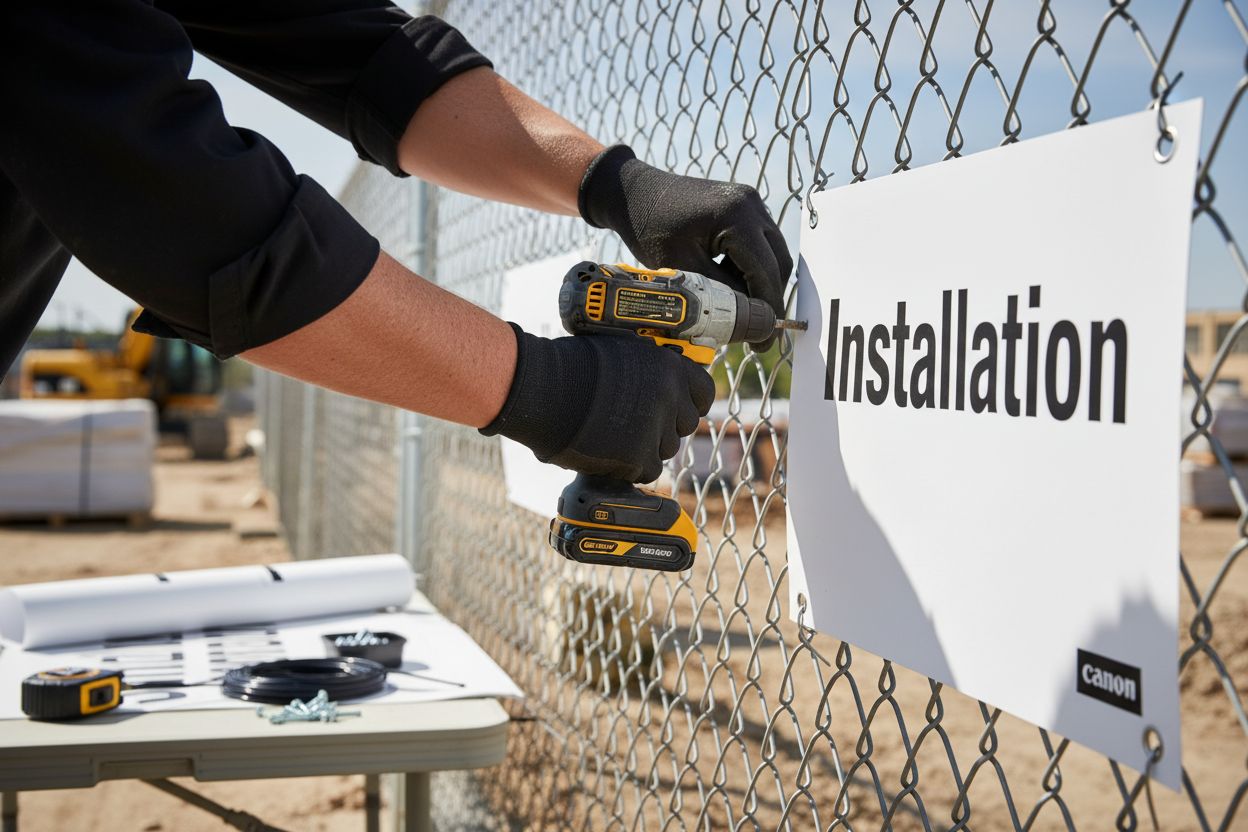
Step 5: Install Signage Effectively at Your Project Site
The installation phase represents the critical moment where your meticulously designed temporary signage transforms from concept to functional communication tool. This step demands precision, safety awareness, and strategic positioning to maximise visual impact and information transmission. Successful installation is about more than physical placement — it requires understanding environmental dynamics and project-specific requirements.
Begin by conducting a thorough site assessment before any installation occurs. Carefully evaluate surface conditions, potential mounting points, and environmental challenges that might affect sign stability and visibility. Different surfaces require unique mounting approaches — wooden surfaces demand different techniques compared to concrete or metal structures. Consider factors like wind exposure, potential foot traffic interference, and line of sight for viewers.
Safety becomes paramount during the installation process. Explore our comprehensive guide on installing wall signs effectively to understand best practices. Wear appropriate personal protective equipment, use stable ladders or scaffolding, and always work with a partner when handling larger signage pieces. In the UK, safety signage must be maintained to remain visible and legible throughout the project duration — which means secure, professional installation is non-negotiable.
For exposed outdoor locations where wind loading is a concern, mesh banner printing London produces perforated panels specifically designed to allow air to pass through, dramatically reducing wind resistance and the risk of fixings failing on hoarding frames and fencing.
| Installation Verification Step | Description |
|---|---|
| Level and aligned positioning | Signs are perfectly straight and visually consistent |
| Secure mounting hardware | Appropriate fixings used for material/surface |
| Unobstructed visibility | No objects blocking viewer line of sight |
| Surface integrity maintained | Installation does not damage mounting surface |
Step 6: Evaluate Signage Impact and Make Adjustments
The final stage of temporary signage management involves a comprehensive evaluation of your installation’s effectiveness, transforming initial design into a dynamic communication strategy. This critical assessment determines whether your signage truly accomplishes its intended communication objectives. Effective evaluation goes beyond visual inspection, requiring a systematic approach to measuring real world performance and audience interaction.
Begin by establishing clear metrics for success before your signage is installed. These might include visibility from specific distances, comprehension rates among target audiences, or specific behavioural responses you aim to trigger. Observation becomes your primary research tool. Document how people interact with your signs observe viewing patterns, interaction duration, and apparent levels of understanding. Some projects might benefit from discreet video recording or manual tracking to gather comprehensive insights about signage performance.
Technical assessment is equally crucial. Learn more about choosing effective outdoor signage strategies to refine your evaluation approach. Examine your signs for physical wear, colour degradation, and structural integrity. Environmental factors like sunlight exposure, moisture, and temperature fluctuations can rapidly impact signage quality. Check mounting points for stability, inspect edges and surfaces for potential damage, and assess whether the signs remain legible under various lighting conditions.
Adjustment strategies should be flexible and responsive. If your initial assessment reveals communication gaps or performance issues, be prepared to make swift modifications. This might involve repositioning signs for better visibility, updating graphic elements to improve comprehension, or replacing materials that have degraded faster than anticipated. Continuous improvement is the hallmark of professional temporary signage management.
Key verification criteria for signage evaluation include:
- Documented audience interaction and comprehension
- Physical condition assessment of sign materials
- Comparison between expected and actual communication outcomes
- Identification of potential improvement areas
By approaching evaluation as an ongoing process rather than a one time check, you ensure that your temporary signage remains a dynamic, effective communication tool throughout your project’s lifecycle.
Step 6: Evaluate Signage Impact and Make Adjustments
The final stage of temporary signage management involves a comprehensive evaluation of your installation’s effectiveness, transforming initial design into a dynamic communication strategy. This critical assessment determines whether your signage truly accomplishes its intended communication objectives.
Begin by establishing clear metrics for success before your signage is installed. These might include visibility from specific distances, comprehension rates among target audiences, or specific behavioural responses you aim to trigger. Observation becomes your primary research tool — document how people interact with your signs, observe viewing patterns, interaction duration, and apparent levels of understanding.
Technical assessment is equally crucial. Learn more about choosing effective outdoor signage strategies to refine your evaluation approach. Examine your signs for physical wear, colour degradation, and structural integrity. Environmental factors like sunlight exposure, moisture, and temperature fluctuations can rapidly impact signage quality. Check mounting points for stability, inspect edges and surfaces for potential damage, and assess whether the signs remain legible under various lighting conditions.
For campaigns where banner printing London is part of your signage mix, the evaluation stage is also an opportunity to assess which banner positions delivered the strongest audience response — informing smarter placement decisions on the next phase of the project.
Key verification criteria for signage evaluation include:
- Documented audience interaction and comprehension
- Physical condition assessment of sign materials
- Comparison between expected and actual communication outcomes
- Identification of potential improvement areas
Bring Your Project Signage Vision to Life with Proven Experts
Struggling to get your temporary signage noticed or experiencing frustration because your current signs are not holding up to changing environments? This guide makes it clear that the right materials, professional installation, and design strategy can make all the difference. Whether you are organising a short-term event or managing a construction site, you need signage that is both eye-catching and effective.
Ready to master your next project’s signage? Let PromoSigns take the uncertainty out of your project. Visit PromoSigns now to see why top businesses rely on us for temporary and permanent solutions. For more insights into planning a signage project and expert sign installation, explore our resources and contact our team for a personalised consultation. Your project deserves signage that works as hard as you do.
Frequently Asked Questions
What factors should I consider when assessing my project needs for temporary signage?
Assess your project’s specific objectives, environmental conditions, and communication goals. Conduct a detailed analysis to map potential sign locations and identify any logistical constraints, ensuring you create signage that meets your distinct requirements.
How do I select the right materials for my temporary signage?
Choose materials based on the specific environment where your signs will be displayed. For instance, use weather-resistant materials like treated PVC for outdoor signs, while opting for lighter options like foam board for indoor displays to maximise durability and visual impact.
What are the key elements of an effective signage layout design?
An effective signage layout includes a clear visual hierarchy, legible typography, and cohesive colour schemes. Ensure primary messages are prominent, and use sufficient negative space to avoid clutter, making your signage easy to read and comprehend from typical viewing distances.
How can I ensure the successful installation of my temporary signage?
Conduct a thorough site assessment to evaluate surface conditions and mounting options. Use appropriate mounting hardware to secure the signage and ensure it is level and aligned properly for optimal visibility and stability.
What steps should I take to evaluate the impact of my temporary signage?
Establish clear metrics for success, such as visibility and audience comprehension rates, and observe how viewers interact with your signs. Regularly check for wear and tear, making adjustments as necessary to improve effectiveness throughout your project duration.
How can I manage the costs associated with temporary signage?
Evaluate materials and design options based on their cost-effectiveness while ensuring they meet your project’s durability needs. Consider creating a detailed budget that accounts for all aspects of the signage process, from design and printing to installation and maintenance.
Recommended
- Top Temporary Signage Uses for London Businesses in 2025 – PromoSigns.co.uk
- What is a Projecting Sign? Guide for UK Businesses 2025 – PromoSigns.co.uk
- Projecting Sign Benefits for London Businesses in 2025 – PromoSigns.co.uk
- How to Design Building Signage: A 2025 Guide for London Businesses – PromoSigns.co.uk
