
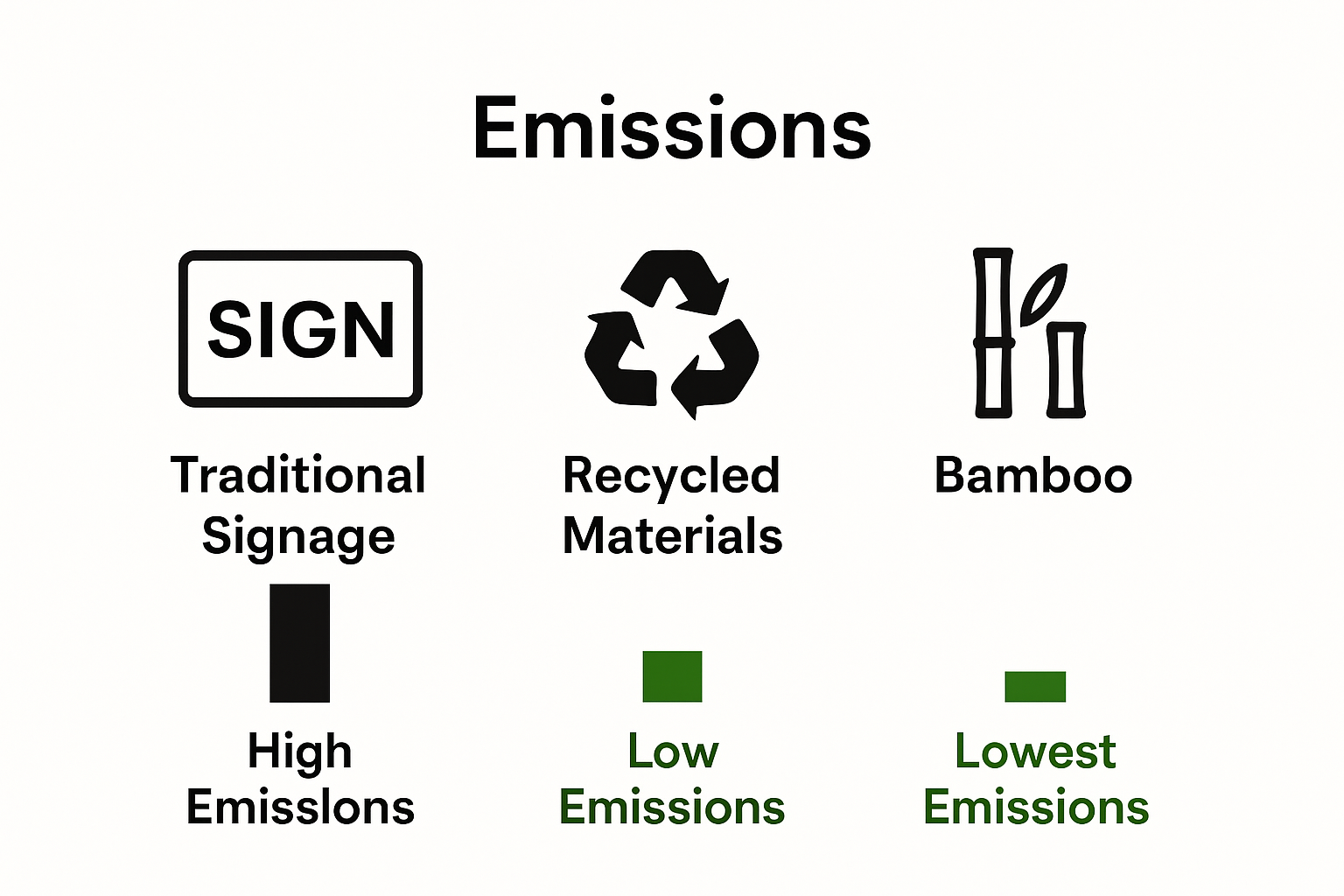
Eco friendly signage is changing the way businesses communicate. Sustainable sign materials can cut carbon emissions dramatically compared to traditional plastics. Most people expect a green sign to look dull or cost more, but new technologies have flipped those old ideas upside down and the real surprise is how eco friendly signage now delivers stunning style and lasting performance while also slashing your environmental impact.
Table of Contents
- What Are Eco Friendly Signage Solutions?
- Material Selection And Sustainability
- Green Manufacturing And Installation Processes
- Why Eco Friendly Signage Matters For Businesses
- Brand Reputation And Consumer Perception
- Financial And Operational Advantages
- Materials And Technologies In Eco Friendly Signage
- Sustainable Material Innovations
- Advanced Manufacturing And Production Technologies
- Sustainable Signage: Essential Signage Considerations
- Functional And Aesthetic Sustainability
- Environmental Performance Metrics
- Real-World Examples Of Eco Friendly Signage Solutions
- Commercial And Retail Applications
- Public Infrastructure And Educational Institutions
Table of Contents
Quick Summary
| Takeaway | Explanation |
|---|---|
| Utilise sustainable materials | Choose recycled, renewable, or biodegradable materials to create eco friendly signage, reducing the ecological footprint. |
| Adopt green manufacturing practices | Implement energy-efficient production methods and circular economy principles to minimise waste and resource consumption. |
| Enhance brand reputation | Eco friendly signage attracts environmentally conscious consumers and promotes a responsible corporate image, improving brand perception. |
| Realise financial benefits | Long-term cost savings can be achieved through reduced material costs, energy efficiency, and potential tax incentives linked to sustainability. |
| Design for functionality and environment | Ensure signage is aesthetically pleasing while maintaining clarity and durability, plus assess environmental impact at every design stage. |
What are Eco Friendly Signage Solutions?
Eco friendly signage solutions represent an innovative approach to creating visual communication materials that minimise environmental impact while maintaining high performance and aesthetic standards. These solutions encompass comprehensive strategies for designing, manufacturing, and implementing signs using sustainable materials, energy efficient technologies, and environmentally responsible production methods.
Material Selection and Sustainability
At the core of eco friendly signage solutions are carefully selected materials that reduce ecological footprint. Businesses can now choose from an array of sustainable alternatives that replace traditional petroleum based plastics and non recyclable components. According to research from Sustainability journal, these innovative materials can significantly lower carbon emissions associated with signage production.
Key sustainable material characteristics include:
- Made from recycled or renewable resources
- Biodegradable or easily recyclable
- Produced with minimal energy consumption
- Low volatile organic compound (VOC) emissions
Green Manufacturing and Installation Processes
Beyond material selection, eco friendly signage solutions integrate environmentally conscious manufacturing techniques. This involves reducing waste, minimising energy consumption, and implementing circular economy principles throughout the production lifecycle. Learn more about sustainable signage technologies.
Companies are increasingly adopting practices such as:
- Using renewable energy in production facilities
- Implementing water conservation methods
- Reducing transportation related carbon emissions
- Designing signs for extended lifecycle and eventual recycling
By prioritising sustainability without compromising visual communication effectiveness, eco friendly signage solutions represent a forward thinking approach that meets both environmental responsibilities and business communication needs.
Why Eco Friendly Signage Matters for Businesses
Eco friendly signage has evolved from a niche environmental consideration to a strategic business imperative. Modern businesses recognise that sustainable signage solutions are not just about reducing environmental impact, but also about creating compelling brand narratives, attracting conscientious consumers, and demonstrating corporate responsibility.
Brand Reputation and Consumer Perception
Today’s consumers are increasingly environmentally aware and actively seek out businesses that demonstrate genuine commitment to sustainability. According to research on green advertising, environmental knowledge significantly influences purchasing decisions, making eco friendly signage a powerful communication tool.
Key benefits for brand reputation include:
- Enhanced corporate social responsibility image
- Differentiation from competitors
- Attraction of environmentally conscious customers
- Positive perception among younger demographics
Financial and Operational Advantages
Contrary to common misconceptions, eco friendly signage offers substantial financial benefits. Learn more about sustainable signage technologies. These solutions often provide long term cost savings through reduced material consumption, energy efficiency, and extended product lifecycles.
Operational advantages encompass:
- Lower material procurement costs
- Reduced waste management expenses
- Potential tax incentives for sustainable practices
- Improved operational efficiency
By integrating eco friendly signage, businesses not only contribute to environmental preservation but also position themselves as forward thinking, responsible organisations capable of meeting the sophisticated expectations of modern consumers.
Materials and Technologies in Eco Friendly Signage
The landscape of eco friendly signage has transformed dramatically, driven by technological innovation and environmental consciousness. Modern sustainable signage integrates cutting edge materials and advanced manufacturing technologies that dramatically reduce ecological impact while maintaining superior visual performance and durability.
Sustainable Material Innovations
Sustainable signage materials have evolved well beyond traditional petroleum based substrates. According to research from the Environmental Protection Agency, contemporary solutions leverage innovative materials that significantly minimise environmental footprint.
Key sustainable material technologies include:
The following table compares common sustainable signage materials, highlighting their sources, eco-friendly features, and typical business applications. This helps clarify the unique advantages of each material type.
What are Eco Friendly Signage Solutions?
Eco friendly signage solutions represent an innovative approach to creating visual communication materials that minimise environmental impact while maintaining high performance and aesthetic standards. These solutions encompass comprehensive strategies for designing, manufacturing, and implementing signs using sustainable materials, energy efficient technologies, and environmentally responsible production methods.
Material Selection and Sustainability
At the core of eco friendly signage solutions are carefully selected materials that reduce ecological footprint. Businesses can now choose from an array of sustainable alternatives that replace traditional petroleum based plastics and non recyclable components. These innovative materials can significantly lower carbon emissions associated with signage production.
Key sustainable material characteristics include:
- Made from recycled or renewable resources
- Biodegradable or easily recyclable
- Produced with minimal energy consumption
- Low volatile organic compound (VOC) emissions
Green Manufacturing and Installation Processes
Beyond material selection, eco friendly signage solutions integrate environmentally conscious manufacturing techniques. This involves reducing waste, minimising energy consumption, and implementing circular economy principles throughout the production lifecycle. Learn more about sustainable signage technologies.
Companies are increasingly adopting practices such as:
- Using renewable energy in production facilities
- Implementing water conservation methods
- Reducing transportation related carbon emissions
- Designing signs for extended lifecycle and eventual recycling
By prioritising sustainability without compromising visual communication effectiveness, eco friendly signage solutions represent a forward thinking approach that meets both environmental responsibilities and business communication needs. For businesses that want eco-conscious output at scale, large format printing London suppliers increasingly offer water-based inks and recyclable substrates that reduce environmental impact without sacrificing print quality.
Why Eco Friendly Signage Matters for Businesses
Eco friendly signage has evolved from a niche environmental consideration to a strategic business imperative. Modern businesses recognise that sustainable signage solutions are not just about reducing environmental impact, but also about creating compelling brand narratives, attracting conscientious consumers, and demonstrating corporate responsibility.
Brand Reputation and Consumer Perception
Today’s consumers are increasingly environmentally aware and actively seek out businesses that demonstrate genuine commitment to sustainability. Environmental knowledge significantly influences purchasing decisions, making eco friendly signage a powerful communication tool.
Key benefits for brand reputation include:
- Enhanced corporate social responsibility image
- Differentiation from competitors
- Attraction of environmentally conscious customers
- Positive perception among younger demographics
Financial and Operational Advantages
Contrary to common misconceptions, eco friendly signage offers substantial financial benefits. Learn more about sustainable signage technologies. These solutions often provide long term cost savings through reduced material consumption, energy efficiency, and extended product lifecycles.
Operational advantages encompass:
- Lower material procurement costs
- Reduced waste management expenses
- Potential tax incentives for sustainable practices
- Improved operational efficiency
By integrating eco friendly signage, businesses not only contribute to environmental preservation but also position themselves as forward thinking, responsible organisations capable of meeting the sophisticated expectations of modern consumers. Choosing vinyl sticker printing London produced with low-VOC inks and solvent-free adhesives is a practical first step for businesses making their shopfront graphics more environmentally responsible.
Materials and Technologies in Eco Friendly Signage
The landscape of eco friendly signage has transformed dramatically, driven by technological innovation and environmental consciousness. Modern sustainable signage integrates cutting edge materials and advanced manufacturing technologies that dramatically reduce ecological impact while maintaining superior visual performance and durability.
Sustainable Material Innovations
Sustainable signage materials have evolved well beyond traditional petroleum based substrates. Contemporary solutions leverage innovative materials that significantly minimise environmental footprint.
| Material Type | Source/Composition | Eco-Friendly Features | Typical Applications |
|---|---|---|---|
| Recycled Plastics & Biopolymers | Post-consumer plastics, plant-based polymers | Reduces landfill waste, often recyclable | Sign faces, display panels |
| Bamboo & Agricultural Waste | Fast-growing bamboo, crop by-products | Rapid renewability, biodegradable | Frames, banners, freestanding signs |
| Reclaimed Wood & Timber | Salvaged wood, repurposed timber | Reuses existing resources, low energy input | Menu boards, shop signage, office signs |
| Plant-Based Resins | Resins from bio-feedstock, e.g. soy, corn | Lower carbon footprint, biodegradable | Coatings, lightweight sign components |
| Recycled Aluminium | Aluminium from recycled scrap | Infinitely recyclable, long-lasting | Storefront signage, external sign structures |
Key sustainable material technologies include:
- Recycled plastics and biopolymers
- Bamboo and agricultural waste composites
- Reclaimed wood and timber derivatives
- Plant based resin alternatives
Advanced Manufacturing and Production Technologies
Manufacturing processes now prioritise energy efficiency, waste reduction, and circular economy principles. Explore innovative signage design techniques that integrate sustainable technologies throughout production cycles.
Emerging technological approaches encompass:
- Digital fabrication with minimal material waste
- Water based and low VOC printing technologies
- Computer aided design for material optimisation
- Modular sign systems enabling component reuse
These innovative materials and technologies represent more than environmental compliance. They signify a fundamental reimagining of visual communication strategies, where sustainability becomes an integral component of design excellence and technological advancement. For event organisers and campaign managers, banner printing London on recyclable fabric or biodegradable vinyl substrates delivers high-impact temporary messaging with a significantly reduced end-of-life environmental footprint.
Sustainable Signage: Essential Signage Considerations
Designing eco friendly signage extends far beyond selecting sustainable materials. It requires a holistic approach that balances aesthetic appeal, functional effectiveness, environmental responsibility, and long term performance. Successful sustainable signage design integrates multiple strategic considerations to create visually compelling yet environmentally conscious communication tools.
Functional and Aesthetic Sustainability
Sustainable signage design demands a nuanced understanding of visual communication principles. Effective signage must remain clear, legible, and accessible while minimising environmental impact.
Key functional design considerations include:
- Maximising visibility and readability
- Creating durable designs that withstand environmental conditions
- Ensuring colour contrast and appropriate typography
- Designing for minimal maintenance requirements
Environmental Performance Metrics
Designers must evaluate sustainable signage through comprehensive environmental performance metrics. Explore advanced signage design principles that integrate ecological considerations into every design stage.
Critical environmental performance factors encompass:
- Carbon footprint of production processes
- Lifecycle durability and potential for material recycling
- Energy consumption during manufacturing
- Potential for component reuse or modular redesign
By integrating these considerations, sustainable signage design transcends traditional aesthetic approaches, creating communication tools that are simultaneously visually striking, functionally superior, and environmentally responsible.
| Metric | Description | Importance for Sustainable Signage |
|---|---|---|
| Carbon Footprint | Total greenhouse gas emissions from production and lifecycle | Lower carbon footprint reduces overall environmental impact |
| Lifecycle Durability | Longevity and resistance to weather, UV, and wear | Longer life decreases need for replacement, conserving resources |
| Energy Consumption | Amount of energy required during manufacturing | Energy efficiency leads to reduced resource use and costs |
| Recyclability/Biodegradability | Ease of recycling or natural decomposition at end-of-life | Minimises landfill waste and enables circular economy |
| Component Reusability | Potential to reuse individual sign parts in future designs | Supports modular design and waste reduction |

Real-World Examples of Eco Friendly Signage Solutions
Real world implementations of sustainable signage demonstrate how innovative companies and organisations are transforming visual communication through environmentally responsible design. These practical applications showcase the potential for reducing ecological impact while maintaining high performance and aesthetic standards.
Commercial and Retail Applications
Businesses across various sectors are increasingly adopting eco friendly signage solutions as part of their sustainability strategies. Organisations are pioneering creative approaches to reduce environmental footprint.
Notable commercial implementations include:
- Retail stores using recycled aluminium storefront signage
- Restaurants displaying menu boards made from reclaimed timber
- Fashion boutiques utilising biodegradable textile banners
- Corporate offices implementing modular signage systems with replaceable components
For retail businesses looking to make their exterior presence more sustainable without sacrificing visual impact, the full range of shop signs London now includes options using recycled aluminium structures and energy-efficient LED illumination that significantly reduce both carbon footprint and running costs.
Public Infrastructure and Educational Institutions
Public spaces and educational environments are leading the way in sustainable signage design. Discover innovative signage solutions for modern workspaces that prioritise environmental responsibility.
Innovative examples encompass:
- University campuses using solar powered directional signs
- Municipal transit systems with signs manufactured from recycled plastics
- National parks implementing biodegradable wayfinding markers
- Transportation hubs adopting low energy LED information displays
These real world examples illustrate that eco friendly signage is not a future concept but a present reality, demonstrating how businesses and institutions can effectively communicate while minimising environmental impact. For organisations that want to commission fully bespoke eco-conscious signage — from material specification through to installation — custom signs London specialists can build sustainable solutions tailored precisely to brand, location, and environmental targets.
Take Your Business Further With Truly Sustainable Signage
Are you looking for a real solution to widen your impact while minimising your carbon footprint? As discussed in the article, many businesses struggle to source signage that not only delivers lasting visual value but also reflects a genuine commitment to eco friendly practices. Choosing sustainable materials and advanced manufacturing does not have to mean settling for less compelling or effective signage. It is about making a statement that truly aligns with your values and attracts today’s conscientious customers.
Now is the perfect time to upgrade to eco friendly shop and illuminated signs designed and installed by dedicated professionals. Discover how we bring your sustainable ambitions to life with custom signage solutions across London, Essex and Kent. Ready to help your brand stand out for all the right reasons? Visit PromoSigns and send us your project details today. Choose better for your business and for the environment.
Frequently Asked Questions
What are eco friendly signage solutions?
Eco friendly signage solutions refer to visual communication materials designed to minimise environmental impact by using sustainable materials, energy-efficient technologies, and environmentally responsible production methods.
Why is eco friendly signage important for businesses?
Eco friendly signage is crucial for businesses as it enhances brand reputation, attracts environmentally conscious consumers, and demonstrates corporate responsibility, all while potentially providing long-term financial savings through reduced costs and improved operational efficiencies.
What materials are typically used in eco friendly signage?
Eco friendly signage often utilises recycled plastics, biopolymers, bamboo composites, recycled wood, and plant-based resins. These materials significantly reduce the ecological footprint associated with traditional signage.
How can businesses ensure their signage is both sustainable and effective?
Businesses can ensure their signage is sustainable and effective by focusing on functional design elements such as visibility, durability, and legibility, while also evaluating environmental performance metrics like the carbon footprint and lifecycle durability of their signage solutions.
Recommended
- LED vs. Traditional Storefront Signage
- Shop Sign Types Explained for UK Businesses in 2025
- Exhibition Signage Basics 2025
- Event Signage Best Practices 2025
