
Every business faces the challenge of grabbing attention and building a strong identity in a world filled with visual noise. Did you know that matching your signage type to your business needs can boost brand recognition and customer engagement by up to 35 percent? Many think choosing a sign is just about budgets and looks, but the real decision shapes how people see and trust your brand right from the street.
Table of Contents
- What Are Temporary and Permanent Signage?
- Defining Temporary Signage
- Understanding Permanent Signage
- The Importance of Choosing the Right Signage Type
- Strategic Business Communication
- Cost and Effectiveness Implications
- Materials and Durability: Key Differences Explained
- Temporary Signage Material Characteristics
- Permanent Signage Durability Considerations
- Applications in Business and Events: When to Use What
- Event and Short-Term Communication Scenarios
- Permanent Signage for Established Business Identity
- Cost Considerations and Return on Investment
- Initial Investment and Material Costs
- Long-Term Value and Brand Impact
Table of Contents
Quick Summary
| Takeaway | Explanation |
|---|---|
| Choose signage based on duration | Temporary signage is best for short-term use, while permanent signage supports long-term brand representation. |
| Evaluate materials for effectiveness | Use lightweight materials like vinyl for temporary signs and durable options like metal for permanent signage to enhance performance. |
| Consider cost and return on investment | Analyze both initial costs and long-term value when selecting signage to ensure a strong impact on brand visibility. |
| Align signage with business objectives | Make strategic signage choices based on messaging needs, budget constraints, and regulatory requirements for optimal impact. |
| Invest in professional design | Properly designed signage can significantly boost brand recognition and customer engagement, transforming marketing efforts. |
What Are Temporary and Permanent Signage?
Understanding the nuanced differences between temporary and permanent signage is crucial for businesses seeking effective visual communication strategies. Signage serves as a critical medium for conveying information, attracting customers, and establishing brand identity across various contexts.
Defining Temporary Signage
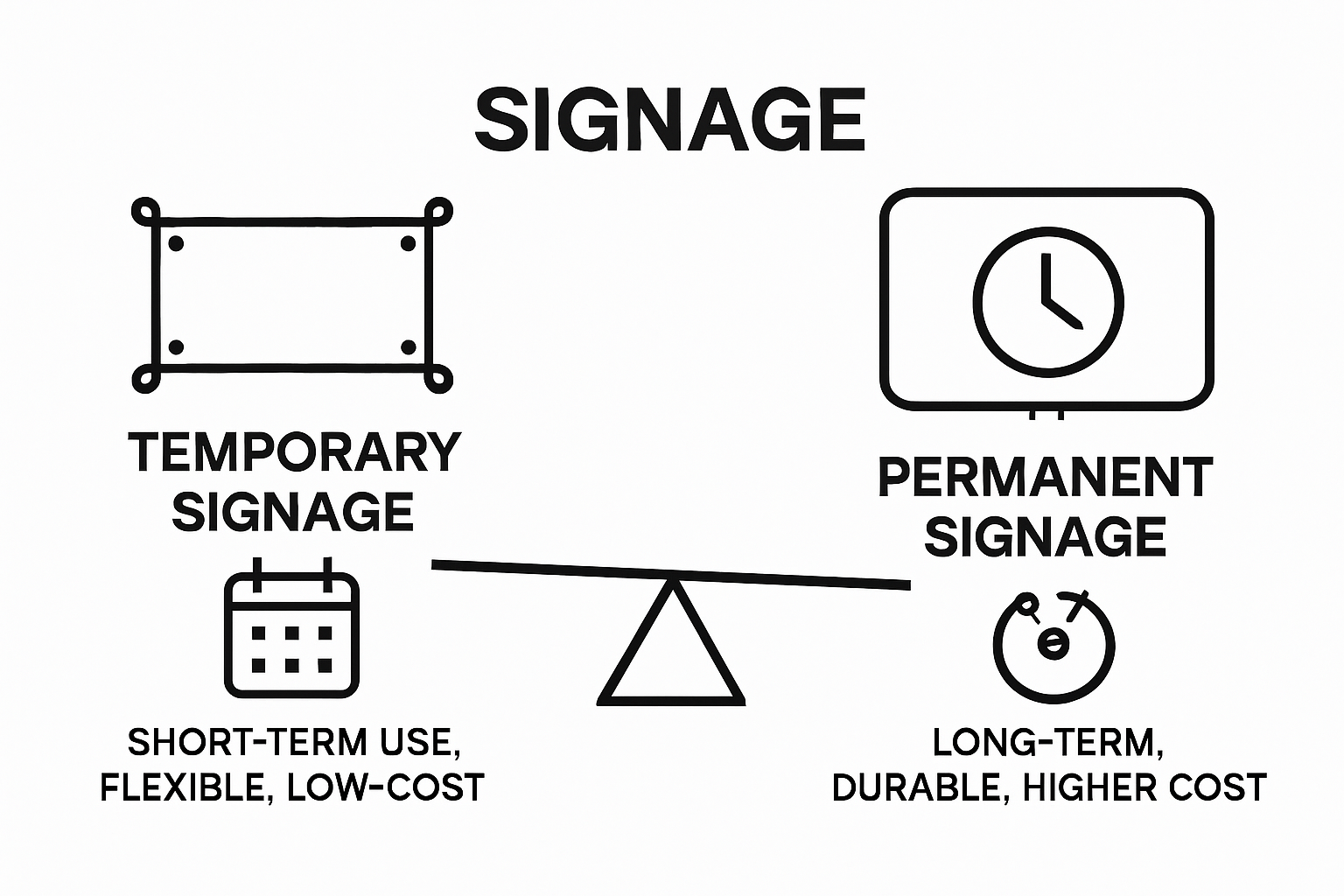
Temporary signage represents short-term visual communication solutions designed for specific, time-limited purposes. These signs are typically lightweight, portable, and easily installed or removed. Businesses commonly utilise temporary signage for:
- Announcing special promotions or events
- Providing directional guidance during construction
- Marketing seasonal offerings
- Highlighting temporary location changes
Comprised of materials like vinyl, coroplast, or lightweight plastics, temporary signs offer flexibility and cost-effectiveness for rapidly changing business environments. Learn more about strategic temporary signage applications. For high-quality temporary graphics produced quickly and affordably, banner printing London is one of the most versatile and widely used solutions available to London businesses.
Understanding Permanent Signage
Permanent signage represents long-term visual communication solutions engineered for durability and consistent brand representation. These signs are typically constructed from robust materials such as metal, acrylic, or weatherproof composites, designed to withstand environmental conditions and provide sustained visibility.
Businesses invest in permanent signage to:
- Establish consistent brand messaging
- Create lasting visual landmarks
- Provide permanent location identification
- Enhance professional corporate image
Whether mounted on building exteriors, integrated into architectural elements, or strategically positioned within business premises, permanent signs communicate stability, professionalism, and commitment to a specific location or brand identity.
| Aspect | Temporary Signage | Permanent Signage |
|---|---|---|
| Typical Duration | Short-term (days to months) | Long-term (years) |
| Common Materials | Vinyl, coroplast, lightweight plastics | Metal (aluminium, stainless steel), acrylic, weatherproof composites |
| Primary Uses | Promotions, events, construction, temporary directions | Brand identity, permanent directions, regulatory and safety information |
| Installation & Removal | Quick, easy, often portable | Professional installation, fixed, may require permits |
| Cost Implications | Lower initial cost, cost-effective for short durations | Higher upfront cost, lower replacement frequency |
| Brand Impact | Flexible messaging, less emphasis on long-term consistency | Strong, consistent brand presence and spatial identity |
| Maintenance | Rarely required, typically disposed after use | Minimal, mainly cleaning, occasional repairs |
The Importance of Choosing the Right Signage Type
Selecting the appropriate signage type is a strategic decision that can significantly impact a business’s visual communication, brand perception, and operational effectiveness. The wrong signage choice can diminish marketing efforts, while the right approach can transform how customers interact with and perceive a business.
Strategic Business Communication
Signage functions as more than a mere directional tool. It serves as a critical communication medium that conveys brand identity, professionalism, and operational context. Businesses must carefully evaluate their specific needs, environment, and communication objectives when selecting between temporary and permanent signage solutions.
Key considerations include:
- Budget constraints and long-term financial planning
- Duration of intended message or purpose
- Physical location and environmental conditions
- Regulatory compliance and permitting requirements
Discover professional guidance for sign selection to ensure your signage strategy aligns with your business goals.
Cost and Effectiveness Implications
The financial and practical implications of signage selection extend far beyond initial installation costs. Temporary signage offers remarkable flexibility for businesses experiencing frequent changes, while permanent signage represents a long-term investment in brand consistency and visual identity.
Businesses that strategically match their signage type to their operational needs can experience up to 35% improved brand recognition and customer engagement. This underscores the critical nature of making an informed signage selection.
Businesses should critically evaluate:
- Potential return on visual communication investment
- Long-term maintenance and replacement expenses
- Impact on customer perception and brand storytelling
- Adaptability to changing business landscapes
Ultimately, the right signage type transforms from a mere functional requirement to a powerful strategic asset that communicates professionalism, reliability, and brand commitment. Whether temporary or permanent, investing in professionally produced large format printing London ensures that any sign — regardless of its intended lifespan — delivers the visual impact your brand deserves.
Materials and Durability: Key Differences Explained
The selection of appropriate materials plays a pivotal role in determining the effectiveness, longevity, and performance of temporary and permanent signage. Understanding the nuanced characteristics of different materials helps businesses make informed decisions that align with their specific communication and environmental requirements.
Temporary Signage Material Characteristics
Temporary signage materials are engineered for short-term usage, prioritising flexibility, lightweight construction, and cost-effectiveness. Typical materials include vinyl, coroplast, and lightweight synthetic plastics that enable rapid production and easy installation.
Key material properties for temporary signage include:
- Quick and affordable manufacturing
- Lightweight and portable design
- Easy removal and replacement
- Versatility for various short-term applications
Explore professional insights on sign material selection to make strategic choices for your business communications. For indoor temporary displays requiring a rigid, lightweight substrate, foamex signs printing London offers an ideal solution that is easy to reposition and replace as campaigns evolve.
Permanent Signage Durability Considerations
Permanent signage demands materials with superior durability, resistance to environmental conditions, and long-term structural integrity. Businesses must carefully evaluate material composition to ensure sustained performance and minimal environmental impact.
Critical durability factors include:
- Resistance to weathering and UV exposure
- Structural stability under various environmental conditions
- Minimal maintenance requirements
- Long-term visual consistency
Materials like aluminium, stainless steel, and high-grade acrylic composites offer exceptional durability, providing businesses with reliable and professional visual communication solutions that withstand years of exposure and use.
Applications in Business and Events: When to Use What
Navigating the strategic deployment of temporary and permanent signage requires a nuanced understanding of context, purpose, and communication objectives. Businesses must carefully assess their specific requirements to select the most appropriate signage type that effectively communicates their message and supports operational goals.
Event and Short-Term Communication Scenarios
Temporary signage emerges as the optimal solution for dynamic, time-sensitive communication scenarios. These versatile visual tools excel in environments requiring rapid, adaptable messaging. Event organisers, construction managers, and businesses experiencing transitional periods find temporary signage particularly valuable.
Key applications for temporary signage include:
- Conference and exhibition wayfinding
- Construction site safety instructions
- Promotional event marketing
- Seasonal business announcements
- Temporary location or service modifications
Explore our comprehensive event signage strategies to maximise your communication effectiveness.
Permanent Signage for Established Business Identity
Permanent signage represents a critical component of long-term brand communication and spatial identity. These signs provide consistent, enduring information that supports regulatory compliance and establishes professional visual presence.
Critical permanent signage applications encompass:
- Storefront branding and business identification
- Regulatory and safety information
- Directional and wayfinding systems
- Corporate office and facility signage
- Long-term location markers
By strategically selecting between temporary and permanent signage, businesses can create comprehensive communication strategies that adapt to evolving operational needs while maintaining a coherent visual narrative. For businesses establishing a permanent brand presence on the high street, fully tailored custom signs London deliver the durability, design precision, and material quality that long-term exterior signage demands.
Cost Considerations and Return on Investment
Signage represents a crucial business investment that extends far beyond mere visual communication. Understanding the financial implications of temporary and permanent signage requires a comprehensive analysis of initial costs, long-term value, and potential business impact. Strategic decision-making involves evaluating both immediate expenses and potential returns across different signage approaches.
Initial Investment and Material Costs
The financial landscape of signage selection varies significantly between temporary and permanent solutions. Temporary signage typically offers lower upfront costs, utilising lightweight materials like vinyl and coroplast that enable rapid, affordable production. Permanent signage demands a higher initial investment, incorporating more durable materials such as aluminium, stainless steel, and high-grade composites.
Key cost factors to consider include:
- Material procurement expenses
- Design and graphic production costs
- Installation and mounting requirements
- Potential customisation fees
Long-Term Value and Brand Impact
Beyond immediate financial considerations, signage represents a strategic asset with potential for substantial brand value generation. Effective signage design can significantly enhance brand equity and customer experience, transforming a seemingly simple communication tool into a powerful marketing instrument.
Critical long-term investment considerations include:
- Brand recognition and visibility potential
- Durability and maintenance expenses
- Adaptability to business evolution
- Potential marketing and communication effectiveness
Businesses must approach signage as a strategic investment, carefully balancing immediate financial constraints with long-term brand communication objectives. When the time comes to commit to a permanent exterior sign, the full range of shop signs London — from illuminated fascias to flat channel letters — provides lasting brand presence with a return on investment that temporary solutions simply cannot match.
| Consideration | Temporary Signage | Permanent Signage |
|---|---|---|
| Initial Investment | Low | High |
| Material & Production Cost | Affordable, rapid production | Costlier, durable materials |
| Installation Requirements | Minimal, often DIY | Professional installation frequently needed |
| Maintenance Frequency | Little to none | Occasional cleaning or repairs |
| Replacement Cycle | Frequent, as needs change | Infrequent, designed for longevity |
| Brand Equity Potential | Limited, suited for short campaigns | Significant, establishes lasting presence |
Find the Perfect Signage Solution for Your Business Today
Choosing between temporary and permanent signage can feel overwhelming, especially when you want your business to stand out and communicate with clarity. Many business owners struggle with how to balance long-term brand goals and short-term promotions without wasting resources or harming visual identity. If you are worried about making the wrong choice or missing an opportunity to boost your business presence, you are not alone. The right approach can save you money, improve brand recognition, and make every message count.
Do not let uncertainty slow your progress. Speak to experts who understand the challenges of effective signage for businesses throughout London, Essex, and Kent. At Promo Signs, we specialise in both custom shop signs and short-term visual solutions, designed specifically to match your goals. See how our experience can help you achieve visibility, save costs, and make an impact. Visit our website now to request a tailored consultation and take the first step towards signage that truly works for your business.
Frequently Asked Questions
What are the main differences between temporary and permanent signage?
Temporary signage is designed for short-term use, often made from lightweight materials for easy installation and removal, while permanent signage is built for durability and long-term use, usually made from robust materials like metal or acrylic.
When should I use temporary signage for my business?
Temporary signage is ideal for announcing special promotions, providing directions during construction, or for events that require short-term communication. It’s flexible and cost-effective for situations that frequently change.
What materials are commonly used for permanent signage?
Permanent signage is typically made from durable materials such as aluminium, stainless steel, or weatherproof composites, which are designed to withstand environmental conditions and provide long-term visibility.
How can choosing the right signage impact my business’s brand communication?
Selecting the appropriate signage type enhances brand perception, improves visibility, and ensures effective communication with customers. The right signage can lead to increased brand recognition and engagement, ultimately impacting your business success.
Recommended
- Top Temporary Signage Uses for London Businesses in 2025
- LED vs. Traditional Storefront Signage
- 10 Creative Outdoor Shop Sign Ideas to Attract More Customers
- How to Choose Signage
