
Exhibition environments demand signage that captures attention, communicates brand identity, conveys product information, and drives booth traffic amid intense competition. Strategic trade show signage maximizes investment returns through visibility optimization, professional presentation, information hierarchy, and durable construction that withstands demanding exhibition conditions while creating memorable impressions.
This comprehensive guide explores effective trade show signage, covering display types, design principles, material selection, stand construction, graphics production, regulatory compliance, transportation logistics, and setup procedures that transform exhibition presence into lead generation and brand awareness opportunities.
Table of Contents
Key Takeaways
| Point | Details |
|---|---|
| Effective Signage is Crucial | Trade show booth signage should quickly convey core messages and engage visitors within seconds to create memorable brand experiences. |
| Diverse Signage Types | Various signage options such as backdrop displays, freestanding displays, and interactive digital signage each serve unique purposes in enhancing brand visibility and engagement. |
| Design Consistency Matters | Consistent branding across all signage elements is essential for strong brand recognition and coherence, ensuring that messaging aligns with established brand identity. |
| Plan for Accessibility and Safety | Compliance with legal and safety standards is critical in booth design, necessitating attention to accessibility, signage placement, and emergency protocols to create a welcoming environment. |
Why Trade Show Signage Excellence Matters
Competitive Environment Reality
Exhibition Floor Challenges: Trade shows create intense competition for attention:
Visitor Behavior:
- 3-5 second attention window (immediate impact essential)
- Overwhelming visual stimulus (hundreds of exhibitors)
- Selective attention (specific interest focus)
- Fatigue factor (information overload)
- Time constraints (limited exhibition duration)
Standing Out Statistics:
- 70% of attendees pre-plan booth visits
- 30% make decisions on exhibition floor
- Professional displays generate 40% more engagement
- Quality signage increases booth dwell time by 60%
- Clear messaging improves lead conversion by 35%
Investment Protection
Exhibition Cost Reality: Trade shows represent significant investment:
Typical Costs (UK):
- Stand space: £200-£500+ per sqm
- Stand construction: £5,000-£50,000+
- Staff time: £2,000-£10,000
- Travel/accommodation: £3,000-£15,000
- Total per exhibition: £15,000-£100,000+
Signage ROI: Quality displays maximize return:
- Lead generation efficiency
- Brand awareness amplification
- Professional credibility
- Product showcase effectiveness
- Competitive advantage

Pro Tip for Exhibitors: Create signage that tells a story about your brand in less than 3 seconds, using bold visuals and clear, memorable messaging that draws visitors in and sparks immediate curiosity.
Essential Trade Show Signage Types
Backdrop Displays
Primary Visual Element: Main stand identification uses principles from Business signs adapted for exhibition contexts:
Pop-Up Systems: Portable, quick-setup solutions:
- Curved/straight configurations (geometric variety)
- Fabric graphics (lightweight, wrinkle-resistant)
- Magnetic attachment (tool-free setup)
- Compact transport (wheeled cases)
- 3m × 2.3m typical (standard booth backdrop)
Advantages:
- Quick setup (15-30 minutes)
- One-person assembly (minimal staffing)
- Lightweight (shipping economy)
- Reusable framework (graphic replacement)
Cost: £800-£3,000
Modular Systems: Professional, expandable displays:
- Aluminum extrusion frames (robust construction)
- SEG (Silicone Edge Graphics) (premium appearance)
- LED integration (illuminated impact)
- Multiple configurations (flexibility)
- Scalable (various booth sizes)
Benefits:
- Professional appearance (quality perception)
- Reconfigurable (different booth sizes)
- Durable (long-term investment)
- Brand consistency (repeated use)
Cost: £3,000-£15,000+
Custom Built: Bespoke stand construction:
- Architectural design (unique presence)
- Multi-level structures (vertical space)
- Integrated technology (interactive elements)
- Premium materials (sophisticated impact)
Cost: £15,000-£100,000+
Banner Stands
Versatile, Portable Signage: Roll Up Banners provide flexible messaging:
Roller/Pull-Up Banners: Self-standing convenience:
- Spring-loaded mechanism (easy setup)
- Compact base (portable)
- Various widths (850mm, 1000mm, 1200mm)
- Single/double-sided options
- Height-adjustable (presentation flexibility)
Applications:
- Entrance identification (booth marking)
- Product information (feature highlighting)
- Directional guidance (traffic management)
- Promotional messaging (campaign support)
Cost: £80-£300 each
X-Banner Stands: Budget-friendly option:
- Lightweight (easy transport)
- Quick setup (seconds)
- Limited durability (short-term use)
- Cost-effective (temporary campaigns)
Cost: £30-£80 each
Counter and Desk Graphics
Interaction Point Branding: Counter identification and messaging:
Stretch Fabric Counters: Modern, professional:
- Fabric graphics (full coverage)
- Collapsible frame (transport convenience)
- Internal storage (product, literature)
- Various shapes (curved, straight, angular)
Cost: £300-£800
Promotional Counters: Product display integration:
- Graphics panels (brand visibility)
- Lockable storage (security)
- Multiple shelving (product showcase)
- Premium construction (longevity)
Cost: £500-£2,000
Overhead Signage
Visibility from Distance: Suspended displays maximize booth awareness:
Hanging Banners: Vertical space utilization:
- Fabric construction (lightweight)
- Rigging attachments (venue suspension)
- Double-sided (360° visibility)
- Various sizes (2m × 1m to 4m × 2m+)
Advantages:
- Distance visibility (across exhibition floor)
- Above competitor clutter (elevation advantage)
- Brand presence (prominent identification)
- Directional cueing (visitor navigation)
Cost: £300-£1,500 per banner
Venue Requirements:
- Rigging permission (advance booking)
- Height restrictions (safety regulations)
- Weight limits (structural capacity)
- Installation costs (venue charges: £100-£500)
Digital Displays
Dynamic Content: Technology-enhanced messaging:
LED Screens: High-impact video content:
- Product demonstrations (engaging showcase)
- Brand videos (storytelling)
- Social media feeds (live engagement)
- Animated graphics (attention capture)
Specifications:
- 43″ to 85″ typical (viewing distance dependent)
- Portrait/landscape orientation
- Mounting options (floor stands, wall mount)
- Content management (USB, networked)
Cost: £500-£5,000 (purchase) or £200-£1,000 (rental per event)
iPad/Tablet Stations: Interactive engagement:
- Product catalogs (browsing)
- Contact capture (lead generation)
- Demonstrations (app showcase)
- Customer presentations (sales tools)
Floor Graphics
Underutilized Opportunity: Floor Graphics create unexpected impact:
Applications:
- Directional arrows (booth navigation)
- Brand messaging (logo display)
- Product imagery (feature highlighting)
- Social media prompts (engagement encouragement)
Materials:
- Anti-slip vinyl (safety compliance)
- Temporary adhesive (venue-appropriate)
- Carpet graphics (specific surfaces)
Considerations:
- Venue permissions (advance approval)
- Safety compliance (slip resistance)
- Traffic patterns (wear management)
Cost: £50-£300 per graphic
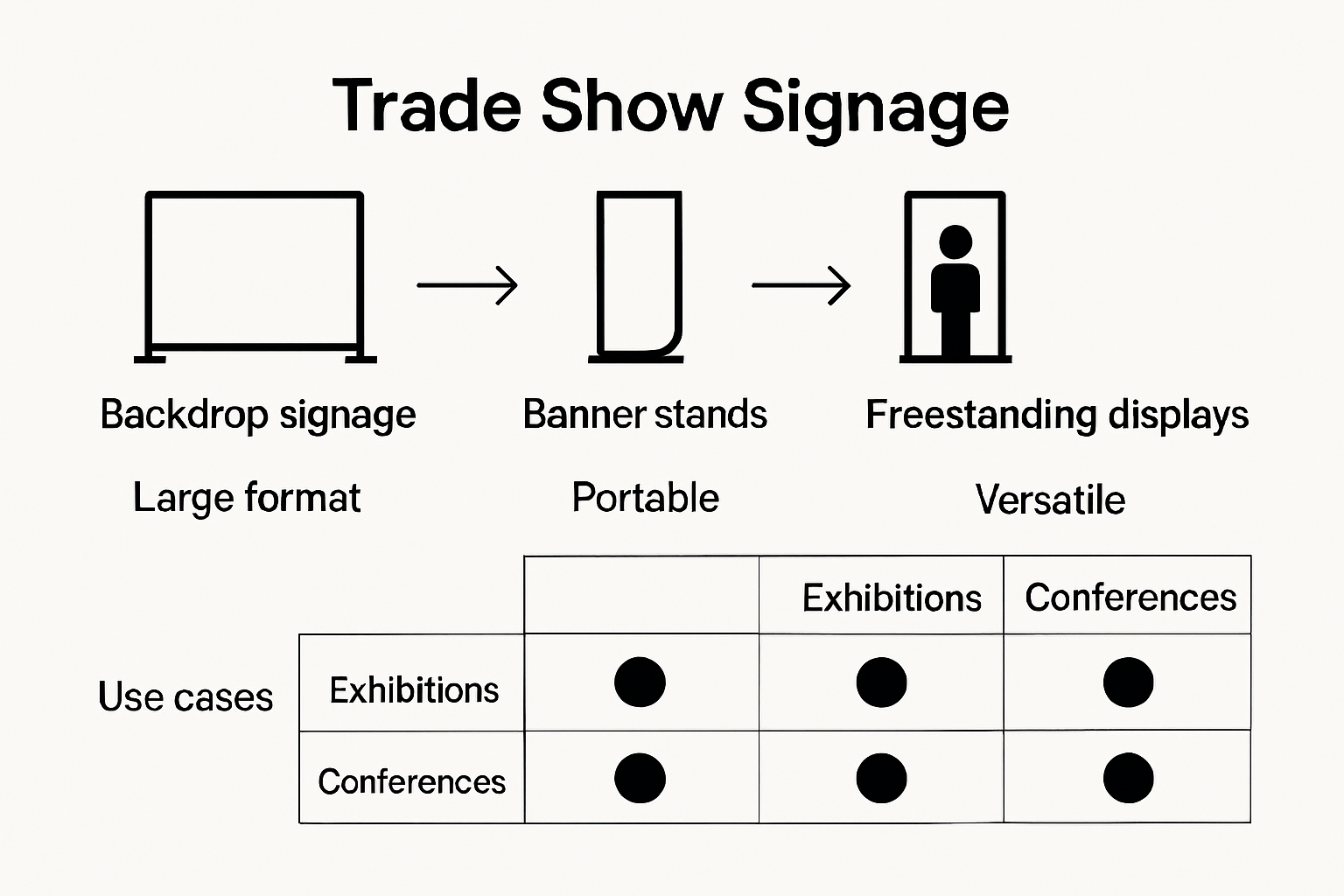
Here is a comparison of key types of exhibition stand signage and their unique advantages:
| Signage Type | Key Advantage | Typical Use Case |
|---|---|---|
| Backdrop Signage | Creates brand focal point | Main branding on rear wall |
| Freestanding Displays | Flexible repositioning | Modular storytelling |
| Banner Stands | Easy transport and setup | Temporary promotions |
| Interactive Digital Signage | Engages via technology | Demonstrations and lead capture |
Pro Tip for Exhibitors: Design your signage with a clear visual hierarchy, ensuring that key messages are visible from a distance and your brand’s core value proposition can be understood within three seconds of a visitor’s glance.
Design Principles for Exhibition Success
Visibility from Distance
Color and Contrast: Bold, high-impact combinations:
Effective Approaches:
- High-contrast (maximum visibility)
- Brand colors (identity consistency)
- Limited palette (focus clarity)
- Accent colors (attention direction)
Avoid:
- Subtle tones (visibility loss)
- Busy patterns (comprehension difficulty)
- Color clashes (unprofessional)
- Low contrast (distance illegibility)
Typography for Impact
Legibility Hierarchy: Distance-based sizing:
Headline Text:
- Minimum 200mm height (10m+ visibility)
- Bold, sans-serif fonts (clarity)
- Limited words (3-5 maximum)
- Clear spacing (readability)
Supporting Information:
- 50-100mm height (5m visibility)
- Key benefits (concise messaging)
- Product categories (classification)
Detail Text:
- 20-30mm height (1-2m reading)
- Specifications (technical information)
- Contact details (follow-up)
Message Hierarchy
3-Second Rule: Immediate comprehension essential:
Primary Message (Largest):
- Company name/logo
- Primary value proposition
- “What we do” clarity
Secondary Information (Medium):
- Key products/services
- Unique differentiators
- Main benefits
Tertiary Details (Smallest):
- Contact information
- Social media handles
- Website URL
- Stand number
Brand Consistency
Multi-Element Coordination: Cohesive visual identity:
Consistent Elements:
- Logo usage (placement, sizing)
- Color application (brand palette)
- Typography (font system)
- Imagery style (photographic/illustrative)
- Messaging tone (brand voice)
Material Selection
Fabric Graphics
Modern Standard: Textile displays dominate exhibitions:
Advantages:
- Lightweight (shipping economy)
- Wrinkle-resistant (professional appearance)
- Washable (reusability)
- Vibrant printing (dye-sublimation)
- Fire-rated (venue compliance)
Applications:
- Backdrop graphics (main displays)
- Banner stands (portable signage)
- Overhead banners (suspended displays)
- Counter wraps (interaction points)
Durability:
- 3-5 years (frequent use)
- 10+ years (occasional use)
- Graphic replacement (framework reuse)
PVC/Vinyl Materials
Traditional Durability: Robust display option:
Characteristics:
- Weather-resistant (outdoor capability)
- Rigid/flexible options (application variety)
- Cost-effective (budget-friendly)
- Heavyweight (stability)
Applications:
- Outdoor exhibitions (weather exposure)
- Budget displays (cost consciousness)
- Temporary signage (short-term use)
Limitations:
- Heavier (transport costs)
- Creasing potential (packing challenges)
- Less premium appearance (fabric comparison)
Rigid Substrates
Premium Presentation: Foamex and alternatives for mounted displays:
Materials:
- Foamex/foam board (lightweight, economical)
- Aluminum composite (premium, flat)
- Acrylic (sophisticated, illuminated)
- Corrugated plastic (budget, temporary)
Applications:
- Mounted graphics (wall displays)
- Directional signs (wayfinding)
- Product information (specification boards)
- Counter-top displays (product showcase)
Regulatory Compliance
Fire Safety Requirements
Venue Obligations: Exhibition centers enforce strict standards:
Material Certification:
- Inherently fire-retardant (preferred)
- Treated fire-retardant (acceptable)
- Certification documentation (BS 5867, Euroclass B-s1, d0)
- Proof requirement (advance submission)
Non-Compliance Consequences:
- Stand closure (immediate removal)
- Financial penalties (contract breach)
- Exhibition exclusion (reputation damage)
Electrical Safety
Power Requirements: Digital displays and illumination:
Compliance:
- PAT testing (Portable Appliance Testing)
- Qualified installation (venue electricians)
- Booking advance (power allocation)
- Safety certification (documentation)
Height and Safety Restrictions
Venue Regulations: Structural limitations:
Common Rules:
- Maximum height (shell scheme: 2.5m, open space: 4-6m typical)
- Overhang restrictions (neighboring stands)
- Suspended element permissions (rigging approval)
- Aisle obstruction (clear access)
- Emergency exit proximity (safety clearance)
Logistics and Transport
Packing and Protection
Transit Damage Prevention: Professional packing essential:
Best Practices:
- Purpose-built cases (hardware protection)
- Wheeled options (transportation ease)
- Graphic protection (crease prevention)
- Component labeling (assembly efficiency)
- Inventory lists (verification)
Shipping Considerations
Transport Methods:
Courier Services:
- Advance delivery (venue receiving)
- Stand address (exhibitor specific)
- Tracking (progress monitoring)
- Insurance (damage protection)
Road Freight:
- Large displays (substantial elements)
- Pallet shipping (secure transport)
- Multiple shows (sequential events)
International Exhibitions:
- Carnets (temporary import)
- Customs documentation (regulatory compliance)
- Advance planning (clearance timing)
Setup and Installation
Pre-Event Planning
Preparation Checklist:
1 Month Before:
- Graphics design finalized
- Production scheduled
- Venue manual reviewed
- Services booked (power, internet, rigging)
- Staff briefed
1 Week Before:
- Graphics received and inspected
- Packing verified
- Transport arranged
- Setup team confirmed
- Tools/supplies prepared
On-Site Setup
Efficient Installation:
Timeline:
- Shell scheme: 2-4 hours typical
- Modular system: 4-8 hours
- Custom build: 1-3 days
Setup Sequence:
- Backdrop/main structure
- Overhead elements (rigging coordination)
- Counter and furniture
- Banner stands
- Digital displays (electrical connection)
- Floor graphics
- Literature and products
- Final positioning and adjustment
Strike and Removal
Post-Event Dismantle:
Efficient Process:
- Systematic disassembly (reverse order)
- Careful packing (damage prevention)
- Component inventory (verification)
- Waste disposal (venue compliance)
- Shipping arrangement (return transport)
Budget Considerations
Investment Ranges (UK)
First-Time Exhibitor Package:
- Pop-up backdrop + 2 banner stands
- Basic counter
- Literature stand
- Graphics production
- Total: £2,000-£5,000
Professional Exhibition Package:
- Modular display system
- 4-6 banner stands
- Professional counter
- Digital display (rental)
- Premium graphics
- Total: £8,000-£20,000
Premium Custom Build:
- Bespoke stand design
- Multi-level structure
- Integrated technology
- Professional lighting
- Complete installation
- Total: £30,000-£100,000+
Reusable vs. One-Time
Investment Strategy:
Reusable Systems:
- Higher initial investment
- Multiple event usage (5-10+ shows)
- Graphic replacement (campaign refresh)
- Framework longevity (10+ years)
Cost Per Show:
- Amortized investment (declining per-use)
- Storage costs (consideration)
- Maintenance (replacement parts)
One-Time Graphics:
- Event-specific messaging
- Lower initial cost
- Disposal after use
- No storage requirement
Measuring Success
Key Performance Indicators
Exhibition ROI Metrics:
Lead Generation:
- Quantity (total inquiries)
- Quality (qualified prospects)
- Conversion rate (sales conversion)
- Cost per lead (investment efficiency)
Brand Awareness:
- Booth traffic (visitor count)
- Social media engagement (#hashtag tracking)
- Press coverage (media mentions)
- Award recognition (industry acknowledgment)
Competitive Analysis:
- Stand traffic comparison (competitor benchmarking)
- Design effectiveness (peer evaluation)
- Professional perception (industry feedback)
This table summarises common mistakes in signage planning and their consequences:
| Common Mistake | Business Consequence | Prevention Strategy |
|---|---|---|
| Overcrowded Designs | Visitor confusion | Focus on single clear message |
| Inconsistent Branding | Weak brand recognition | Align all visual elements |
| Inadequate Material Choice | Early wear or damage | Select durable, event-specific materials |
| Ignoring Lighting Needs | Poor visibility | Integrate lighting at design stage |
Conclusion
Professional trade show signage transforms exhibition investment into lead generation and brand awareness opportunities through strategic visibility optimization, clear message hierarchy, quality construction, and cohesive brand presentation. From backdrop banners establishing booth presence to Rollup Banners providing flexible messaging and Floor Graphics creating unexpected impact, comprehensive signage systems deliver competitive advantage in demanding exhibition environments.
Success requires understanding exhibition dynamics, designing for distance visibility, selecting appropriate materials, ensuring regulatory compliance, managing complex logistics, and executing efficient setup that maximizes limited preparation time. Whether first-time exhibitor or experienced show veteran, strategic signage investment amplifies exhibition returns through professional presentation that captures attention and communicates effectively.
For businesses seeking expert trade show signage guidance, partnering with experienced exhibition specialists ensures access to design expertise, material knowledge, production quality, and logistical support that transforms exhibition presence into measurable business results and sustained competitive advantage.
Recommended
- Exhibition Signage Basics 2025: Essential Guide for Businesses – PromoSigns.co.uk
- Key Elements to Consider in Your Next Exhibition Stand Design – PromoSigns.co.uk
- Blog Archives – Page 2 of 7 – PromoSigns.co.uk
- The Modern Age Visual Displays For Branding – PromoSigns.co.uk
