
Digital signage can shop signs London on busy UK high streets, yet many retail and hospitality businesses in London, Essex, and Kent struggle to attract customers against fierce online competition and evolving urban challenges. Effective signage serves as your silent salesperson, working around the clock to draw passersby into your premises. This guide reveals proven signage strategies, design principles, and compliance essentials tailored specifically for UK retail and hospitality businesses seeking measurable increases in foot traffic and brand visibility.
Table of Contents
Key takeaways
| Point | Details |
|---|---|
| Strategic signage increases foot traffic | Well-designed signage can boost walk-ins by up to 20% in competitive UK markets. |
| Illuminated options extend visibility | LED and lit signage capture attention during evening hours when many customers shop. |
| Design quality affects customer perception | Poor placement and cluttered messaging actively deter potential customers from entering. |
| UK compliance protects your investment | Following local regulations prevents costly fines and forced signage removal. |
| Regular updates maintain effectiveness | Fresh content and proper maintenance optimise ongoing customer engagement. |
Understanding the UK retail foot traffic landscape
UK retail environments face unprecedented pressure from changing consumer habits and digital competition. Signalling a fundamental shift in how customers discover and visit physical businesses. This trend reflects broader consumer behaviour changes, with shoppers prioritising essentials and increasingly favouring online convenience over
Understanding the UK retail foot traffic landscape
UK retail environments face unprecedented pressure from changing consumer habits and digital competition. Retail signs signage data shows a fundamental shift in how customers discover and visit physical businesses, with shoppers prioritising essentials and increasingly favouring online convenience over physical store visits.
London, Essex, and Kent present particularly competitive landscapes where businesses compete not only with each other but also with established online retailers and changing urban traffic patterns. High streets in these regions experience fluctuating foot traffic based on commuter flows, seasonal tourism, and local events. Understanding these regional dynamics helps businesses position signage where it delivers maximum impact.
Physical signage remains one of the most cost effective tools for maximising footfall in these challenging conditions. Unlike digital advertising that requires ongoing spend, quality signage works continuously once installed. It targets customers at the precise moment they can act, converting passersby into walk-ins without requiring them to remember your brand later.
Several factors influence foot traffic patterns:
- Commuter routes and peak travel times significantly affect visibility windows
- Weather conditions impact pedestrian behaviour and dwell time outdoors
- Local events and seasonal changes create traffic flow variations
- Competing businesses and their signage create visual noise that demands standout design
- Public transport access points concentrate potential customer flow at specific locations
Businesses that analyse their specific local patterns can time illuminated signage activation, adjust messaging for different audiences, and position secondary signs at strategic decision points along customer journeys.
The role of signage in customer acquisition and visibility
Your signage often serves as the first interaction potential customers have with your brand, shaping immediate perceptions about quality, professionalism, and trustworthiness. This initial visual contact happens in seconds, making clarity and impact essential. Research shows that businesses with shop window graphics consistently outperform competitors, directly translating to higher revenue and more customer opportunities.
Effective signage functions on multiple psychological levels simultaneously. It must capture attention among competing visual stimuli, communicate your business category instantly, and convey brand personality that attracts your target demographic. This complex task requires strategic design choices that balance boldness with sophistication.
Instant brand recognisability stems from consistent visual elements. Your logo, colour palette, and typographic choices create mental shortcuts that help customers identify your business from a distance. This recognition matters particularly in busy urban environments where decision windows shrink to seconds as pedestrians pass.
Quality signage transforms casual passersby into interested prospects by reducing the perceived risk of entering an unfamiliar establishment.
Consider how signage influences the customer journey:
- Awareness stage: Bold, visible signage captures attention from a distance, introducing your brand
- Interest phase: Clear messaging and professional design signal quality, building curiosity
- Evaluation moment: Complementary signage elements like window displays provide additional information
- Action trigger: Well-placed entrance signage and directional cues facilitate easy entry
- Experience enhancement: Interior signage guides navigation, encouraging exploration and purchases
Businesses applying professional signage strategies report measurably higher conversion rates from foot traffic to actual customers. The compound effect of quality signage extends beyond initial visits, creating memorable impressions that generate word-of-mouth recommendations and repeat business.
Effective signage types and design principles
Selecting appropriate signage types depends on your specific business needs, location constraints, and target audience behaviour. Each signage category offers distinct advantages for foot traffic generation.
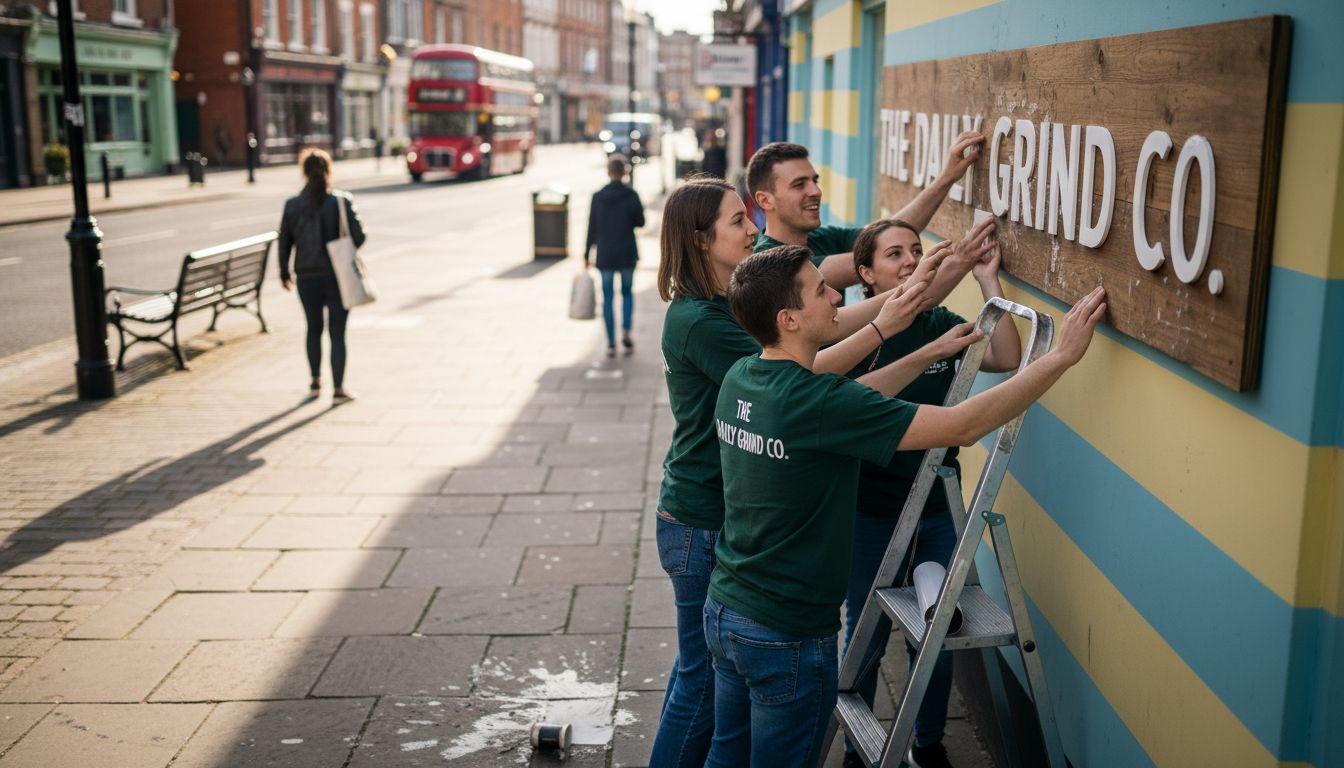
Shop front signage creates immediate visual impact as the primary identifier of your business presence. These permanent fixtures benefit from large format printing London by establishing clear brand identity and communicating your offering at a glance. Fascia signs, projecting signs, and entrance markers all contribute to this crucial first impression.
Illuminated signage extends your visibility window into evening hours when many retail and hospitality businesses see peak traffic. LED technology offers energy-efficient solutions that maintain brightness whilst reducing operating costs. Backlit letters, lightbox displays, and halo-lit dimensional signage create premium perceptions that justify higher price points.
Digital signage delivers dynamic content that captures attention through movement and changing messages. This versatility allows businesses to promote different offers throughout the day, respond to weather conditions, or highlight time-sensitive promotions. Studies demonstrate that digital displays boost foot traffic by 20% compared to static alternatives.
Neon signage experiences renewed popularity due to LED neon technology offering traditional aesthetics with modern efficiency. These signs create distinctive brand personalities, particularly effective for hospitality venues seeking to establish memorable atmospheres that drive social media sharing.
| Signage Type | Primary Benefit | Best For | Typical Lifespan |
|---|---|---|---|
| Shop Front | Brand establishment | All retail/hospitality | 10-15 years |
| Illuminated LED | Evening visibility | Extended hours businesses | 7-10 years |
| Digital Display | Dynamic messaging | High-traffic locations | 5-7 years |
| Neon (LED) | Unique identity | Hospitality/lifestyle brands | 10-12 years |
| Window Graphics | Seasonal flexibility | Fashion/promotions | 1-3 years |
Core design principles that maximise foot traffic impact include:
- Contrast optimisation: Use colour combinations that maintain legibility from 15-20 metres
- Typography hierarchy: Select fonts sized appropriately for viewing distance and reading speed
- Message brevity: Limit text to 5-7 words maximum for instant comprehension
- Brand consistency: Align signage with your broader visual identity across all touchpoints
- Sightline consideration: Design for the specific viewing angles pedestrians and drivers experience
Pro Tip: Test your signage design by viewing mock-ups from actual pedestrian positions at different times of day. What looks perfect on screen often performs differently in real-world lighting and viewing conditions.
Implementing outdoor signage best practices ensures your investment delivers sustained returns through strategic design choices that withstand changing conditions and maintain visual impact over years of service.
Common mistakes in signage design that reduce impact
Even substantial signage investments fail when fundamental errors undermine visibility and readability. Recognising these pitfalls helps businesses avoid wasted expenditure and missed opportunities.
Poor placement represents the most frequent mistake, with signs positioned behind street furniture, obscured by overhanging vegetation, or mounted at heights that miss pedestrian sightlines. Working with experienced signage companies London prevents this directly, ensuring signs align with natural eye levels for both pedestrians and passing vehicles.
Low contrast colour schemes create legibility problems that force potential customers to strain for comprehension. Dark grey text on black backgrounds or pastel combinations lack the visual punch needed to cut through urban visual noise. Effective signage employs high-contrast pairings like white on navy, yellow on black, or vibrant colours against neutral backgrounds.
Cluttered messaging attempts to communicate too much information simultaneously, overwhelming viewers who lack time to process complex content whilst moving. Successful signage follows the “glance test”, delivering its core message within 3 seconds. Every additional word increases cognitive load and reduces effectiveness.
Regulatory non-compliance creates legal and financial risks that disrupt business operations. UK planning regulations vary by local authority, with specific restrictions on illuminated signage, projection distances, and heritage area installations. Businesses operating without proper consent face enforcement action including mandatory removal and fines reaching thousands of pounds.
Neglected maintenance allows once-effective signage to degrade into liability. Faded colours, burnt-out illumination, and weathered materials signal neglect that undermines brand perceptions. Regular cleaning, bulb replacement, and surface treatment preserve your investment and maintain professional appearances.
Additional mistakes to avoid:
- Using decorative fonts that sacrifice readability for aesthetic appeal
- Ignoring surrounding architectural context and competing visual elements
- Failing to illuminate signage adequately during operating hours
- Choosing materials unsuited to local weather conditions
- Neglecting to test visibility from key approach angles before final installation
Pro Tip: Photograph your signage from various distances and angles using your smartphone. If the message isn’t instantly clear in photos, it won’t work for passing pedestrians either.
Applying signage placement best practices from the design phase prevents costly corrections and ensures your signage performs optimally from installation day.
Bridging to practical application: choosing and optimising your signage
Transforming signage theory into foot traffic results requires systematic planning and execution. Follow this framework to maximise your signage investment.
- Conduct site analysis by observing pedestrian and vehicle traffic patterns throughout your operating hours. Map primary approach routes, identify decision points where customers choose destinations, and note competing visual elements. This reconnaissance reveals optimal placement locations and messaging opportunities.
- Define specific objectives for your signage beyond general visibility. Determine whether you need to increase awareness amongst passing traffic, communicate specific offerings, differentiate from competitors, or guide customers to entrances. Clear goals inform design and placement decisions.
- Select appropriate signage types matching your operational needs and budget constraints. Evening-focused businesses benefit from illuminated options, whilst daytime retailers might prioritise bold shop front signage. Digital displays suit businesses with changing offers, traditional signs work for stable brand communication.
- Develop compliant designs by consulting signage design principles and verifying requirements with your local planning authority. London boroughs, Essex councils, and Kent authorities maintain specific guidelines, particularly for listed buildings and conservation areas. Secure necessary consents before manufacturing to avoid costly redesigns.
- Prioritise professional installation at strategic locations identified during site analysis. Mounting height, angle, and illumination direction critically affect visibility. Professional installers understand structural requirements, electrical safety, and weatherproofing essentials that ensure longevity.
- Implement monitoring systems to track signage performance through foot traffic counts, customer surveys asking how people discovered your business, and sales data correlation. Quantifiable metrics justify signage investments and guide future optimisation decisions.
- Schedule regular maintenance including quarterly cleaning, annual electrical inspections for illuminated signage, and immediate repairs for any damage. Establish relationships with signage maintenance providers to ensure rapid response when issues arise.
- Plan content refresh cycles for elements like window graphics and digital displays. Seasonal updates maintain customer interest, whilst permanent signage requires assessment every 5-7 years for potential modernisation aligning with evolving brand identities.
Businesses following this systematic approach achieve measurably higher returns from signage investments compared to those treating signage as afterthoughts. The compound benefits of strategic planning, quality design, and ongoing optimisation create sustainable competitive advantages in challenging retail environments.
Discover professional signage solutions to boost your business
Transforming your business visibility requires expertise that combines design creativity with technical precision and regulatory knowledge. PromoSigns specialises in delivering bespoke shop signs Barnet and comprehensive signage solutions for retail and hospitality businesses across London, Essex, and Kent.
Our team understands the unique challenges facing businesses in competitive urban environments. We design outdoor signs that attract customers through strategic placement, compelling visuals, and durable construction suited to UK weather conditions. From initial consultation through installation and ongoing support, we ensure your signage investment delivers measurable foot traffic increases.
Explore the advantages of illuminated signage for extending your visibility into evening hours when many customers make purchasing decisions. Our LED solutions combine energy efficiency with striking visual impact, creating professional impressions that justify premium positioning in your market.
| Signage Type | Primary Benefit | Best For | Typical Lifespan |
|---|---|---|---|
| Shop Front | Brand establishment | All retail/hospitality | 10-15 years |
| Illuminated LED | Evening visibility | Extended hours businesses | 7-10 years |
| Digital Display | Dynamic messaging | High-traffic locations | 5-7 years |
| Neon (LED) | Unique identity | Hospitality/lifestyle brands | 10-12 years |
| Window Graphics | Seasonal flexibility | Fashion/promotions | 1-3 years |
FAQ
What types of signage work best to increase foot traffic in London?
Illuminated shop front signs and digital displays deliver strongest results in busy London environments. LED-lit fascia signage extends visibility during evening commuter hours, whilst dynamic digital content captures attention amongst competing visual stimuli on high streets.
How do UK signage regulations affect my signage choices?
Local planning authorities regulate signage size, illumination, and placement, particularly in conservation areas and near listed buildings. Businesses must secure advertisement consent for most external signage, with restrictions varying by borough and specific location characteristics.
Can illuminated signs really boost visibility after dark?
Yes, illuminated signage dramatically increases visibility during evening hours when natural light fades. LED technology provides consistent brightness that helps businesses stand out, particularly important for hospitality venues and retailers with extended trading hours.
What are common mistakes to avoid in signage design?
Avoid cluttered messaging, low-contrast colour schemes, and poor placement behind obstacles. Signs should communicate core messages within 3 seconds using high-contrast colours and simple fonts, positioned at pedestrian eye level for maximum impact.
How often should I update or maintain my business signage?
Clean external signage quarterly and inspect illuminated elements annually. Replace promotional window graphics seasonally, whilst permanent shop front signage typically requires assessment every 5-7 years to ensure continued effectiveness and modern appearance.
Recommended
- Understanding How Signage Increases Footfall Effectively – PromoSigns.co.uk
- Maximising Footfall with Signage in London – PromoSigns.co.uk
- Optimising Signage for Foot Traffic Impact UK – PromoSigns.co.uk
- Clear Restaurant Signage: Complete UK Hospitality Guide
- Tips om de interne communicatie te verbeteren – DPM Signage | Narrowcasting & Digital Signage
- Bedrijf zichtbaar maken in 2026: complete gids
