
TL;DR:
- LED signage increases visibility, sales, and brand recognition through bright, dynamic displays.
- Despite higher upfront costs, LEDs offer significant savings on energy, maintenance, and rebranding.
- They are most effective in high-traffic environments but less suitable for static or low-power applications.
Businesses that switch to LED signage often see sales rise by 5% within two years, whilst saving thousands in energy and maintenance costs. Yet many UK retail and hospitality owners still rely on outdated traditional signs, missing straightforward opportunities in visibility and customer engagement. The upfront investment puts some people off, but the numbers tell a different story. This guide unpacks the real advantages of LED signage, presents evidence from UK businesses, and gives you practical guidance on making the right decision for your shop or venue.
Table of Contents
Key Takeaways
| Point | Details |
|---|---|
| Boost sales and visibility | LED signage consistently drives higher shop footfall and sales, especially in competitive UK retail. |
| Energy and maintenance savings | LED signs offer up to 80% energy savings and lower maintenance costs, recouping investment within years. |
| Smart decision factors | Not all businesses need LEDs—evaluate location, display needs, and alternatives such as e-paper for static use. |
| Real-world ROI evidence | UK case studies confirm a 2-4 year ROI and measurable uplift for retailers switching to LED signage. |
What makes LED signage stand out?
LED stands for light-emitting diode. In signage terms, it refers to displays and illuminated signs that use LED technology to produce bright, energy-efficient light. Unlike fluorescent tubes or neon signs, LEDs generate light directly from a semiconductor, which means far less heat, far less wasted energy, and a significantly longer operational lifespan.
For UK retail and hospitality businesses, shop signs London using LED illumination offer measurable advantages. A well-placed LED fascia sign or illuminated shop front can remain vivid and eye-catching in daylight, rain, or after dark, which matters greatly on a busy high street or retail park.
Here is a direct comparison to help you weigh your options:
| Feature | LED signage | Traditional signage |
|---|---|---|
| Energy consumption | Up to 80% less | High |
| Average lifespan | 50,000+ hours | 10,000–15,000 hours |
| Maintenance costs | Very low | Regular bulb/tube replacement |
| Brightness and visibility | Consistently high | Can fade or flicker |
| Dynamic content capability | Yes (digital versions) | No |
| Upfront cost | Moderate to high | Lower |
The benefits of custom LED signs extend well beyond the energy bill. Consider what makes LED signage genuinely different:
- High brightness output that remains consistent across all weather and light conditions
- Bespoke design flexibility allowing you to match your brand colours and style precisely
- Dynamic content options on digital LED displays, enabling promotions and messaging changes without reprinting
- Long operational lifespan that reduces the frequency and cost of replacements
- Lower carbon footprint supporting sustainability credentials for your brand
A concrete UK example reinforces the commercial case. The Stonegate Group implemented digital LED signage across its venues and recorded a 5% uplift in sales and a 13% improvement in partner brand performance. When you compare LED versus traditional signage on long-term cost and impact, the business case becomes difficult to ignore.
How LED signage drives more footfall and sales
Having established the technical and economic benefits, let us examine how LED signage actually translates to increased customers and sales in real-world settings.
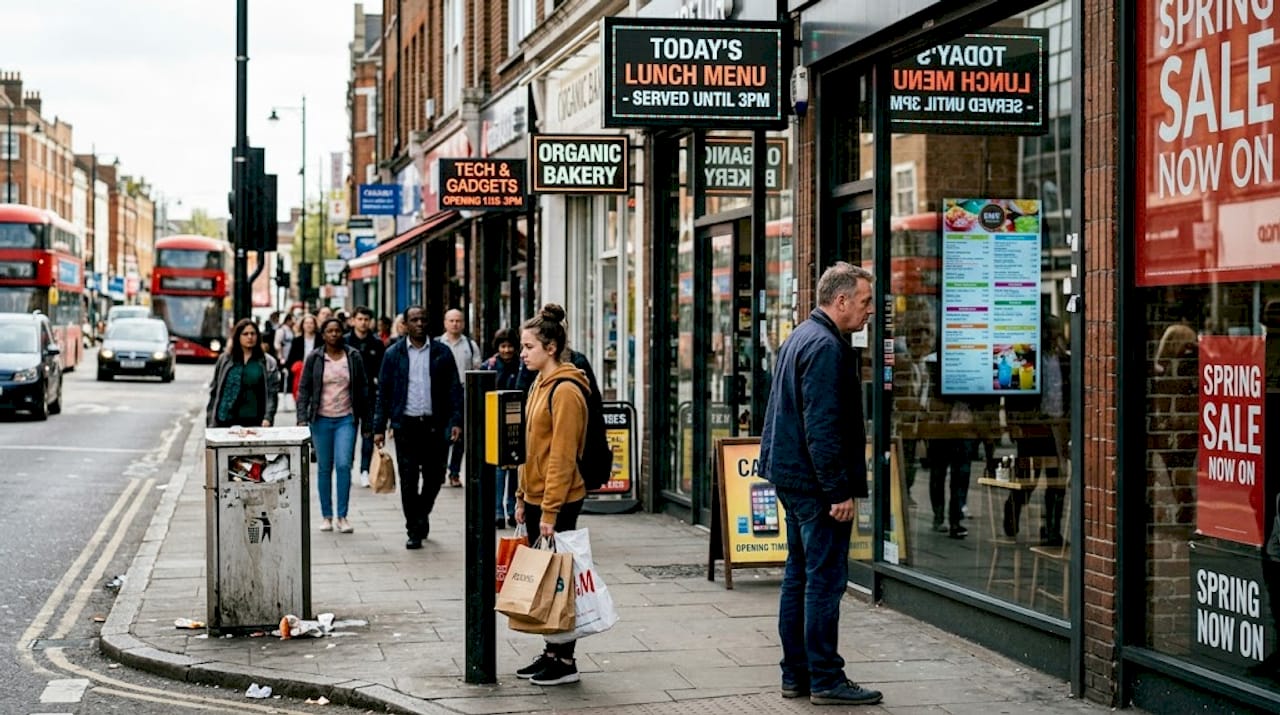
On a crowded high street or busy retail park, attention is currency. Static printed signs compete with dozens of other visual stimuli. LED signs, by contrast, draw the eye with consistent brightness and, in digital formats, with movement and changing content. The result is higher dwell time at your frontage and more passers-by becoming walk-in customers.
The commercial impact of digital signage is well-documented in UK hospitality. The Stonegate Group, one of the UK’s largest pub and bar operators, recorded a 5% sales uplift and a 13% improvement in partner brand performance following a digital LED signage rollout across its venues. These are not marginal gains.
| Metric | Before LED signage | After LED signage |
|---|---|---|
| Sales performance | Baseline | +5% uplift |
| Partner brand visibility | Baseline | +13% improvement |
| Estimated ROI timeline | N/A | 2–4 years |
The strategies that make LED signage most effective in driving footfall include:
- Dynamic promotional content: Rotate special offers, daily menus, or event announcements to keep messaging fresh and relevant
- Targeted time-based messaging: Display breakfast deals in the morning and dinner promotions in the evening
- Bold brand reinforcement: Use your logo, brand colours, and taglines consistently to build recognition among repeat passers-by
- Seasonal updates without reprinting: Change campaign visuals instantly, saving time and print costs
- Clear calls to action: Direct customers to enter, enquire, or visit a specific area of your shop
Tracking signage ROI is straightforward when you align LED installation with sales data, footfall counters, or customer surveys. Even simple before-and-after comparisons over a 30-day period can give you meaningful data.
Pro Tip: Position your LED sign at a 45-degree angle to the main pedestrian flow rather than flat against your frontage. This angle increases the visible surface area to people approaching from either direction, maximising exposure without any additional spend.
Cost, sustainability, and ROI: the real economics of LED signage
Visibility and sales improvements matter, but cost and sustainability drive decision-making for most business owners. Let us clarify the economics clearly.
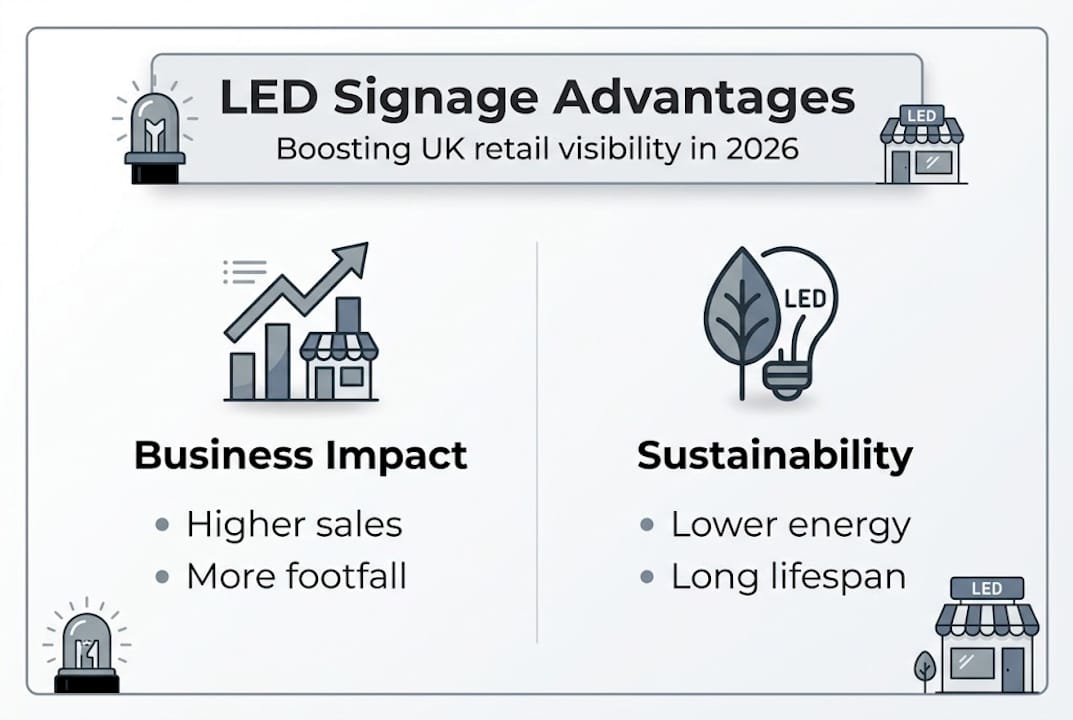
The upfront investment in LED signage is higher than a standard printed fascia. That is simply true. However, the ongoing cost picture changes the calculation entirely. LED signs consume significantly less electricity, require far fewer maintenance call-outs, and last considerably longer than fluorescent or neon alternatives.
The key cost factors, and how LED reduces each one, break down as follows:
- Energy consumption: LED signs use up to 80% less electricity than comparable fluorescent displays, reducing your monthly running costs substantially
- Maintenance and replacements: With a lifespan exceeding 50,000 hours, LED units rarely need bulb or component replacement during their working life
- Rebranding costs: Digital LED displays allow instant content updates, eliminating the cost of new printed materials for every promotion
- Downtime costs: LEDs are far less likely to fail unexpectedly, reducing the risk of your sign going dark during trading hours
- Insurance and compliance: Lower heat output reduces fire risk, which can have a positive effect on premises insurance assessments
The energy savings alone often justify the investment within a few years. The Stonegate ROI timeline of 2–4 years is consistent with what we see across retail and hospitality clients.
Business signs London operators increasingly cite sustainability as a key driver alongside cost savings. LED signage supports green branding credentials and helps demonstrate environmental responsibility to customers. Maintaining LED signs correctly will extend their lifespan further, improving your return on investment.
Pro Tip: Request an energy audit comparison from your signage supplier before committing. A reputable installer should be able to provide a projected annual energy saving based on your current signage setup and the proposed LED replacement.
Is LED signage always the best option? Important edge cases
Understanding the limits is crucial. Here are the edge cases every owner should consider before committing to LED.
LED signage excels in high-traffic environments where brightness, visibility, and dynamic content deliver a clear commercial advantage. Retail shop fronts, pub and restaurant exteriors, hotel lobbies, and entertainment venues are natural fits. In these contexts, the advantages of illuminated signage are difficult to replicate with any other technology at a comparable cost.
However, LED is not the universal answer for every situation. Consider the following factors before making your decision:
- Static, unchanging content: If your signage displays the same information indefinitely with no need for updates, the dynamic capability of LED adds cost without proportional benefit
- Low-power or off-grid locations: LED still requires a continuous power supply. In locations where power access is limited or costly, this is a practical constraint
- Historic buildings or conservation areas: Planning restrictions in some UK locations limit illuminated signage. Always check with your local authority before installation
- Budget sensitivity for very small businesses: For micro-businesses with minimal footfall ambitions, a high-quality non-illuminated sign may deliver sufficient impact at lower cost
- Menu boards with very frequent changes: In some fast-paced settings, e-paper displays can outperform LED on energy use and readability in bright ambient light
E-paper (electronic paper) technology is worth understanding as an alternative. E-paper displays are particularly well-suited to static or infrequently updated content in low-power environments, where they outperform LED on energy efficiency.
Working with experienced signage companies London who can assess your specific location, planning constraints, and content needs will ensure you invest in the right technology for your situation.
Understanding where LED fits and where it does not will help you invest more precisely and avoid overspending on capability you do not need.
The reality of LED signage: lessons UK businesses often miss
With the core advantages and exceptions understood, here is a perspective shaped by working directly with retail and hospitality businesses across London, Essex, and Kent.
Most business owners focus almost entirely on the sign itself and far too little on placement and content strategy. A beautifully manufactured LED fascia installed at the wrong angle, or running generic static content on a digital display, will underperform every time. The technology only delivers if the strategy behind it is sound.
Customisation is frequently undervalued. Businesses often opt for a standard template when a custom signs London approach aligned with their brand would generate meaningfully stronger recognition. This is not about spending more. It is about using what you have more intelligently.
Real-world customer feedback is one of the most underused tools available to you. Ask customers how they found you. Track whether walk-in rates change after new LED messaging goes live. This feedback loop allows you to fine-tune your LED content in ways that no data report can replicate.
Regulatory and planning pitfalls catch many businesses off guard. Illuminated signage in conservation areas, listed buildings, or certain high streets requires prior consent. We have seen owners invest in LED installations that then face enforcement action. Always consult your local planning authority and work with an experienced installer who understands these requirements.
Large format printing London backlit fabric panels represent a cost-effective complement to LED fascia signs, allowing businesses to extend illuminated branding across their shopfront without the full cost of fabricated LED units.
Pro Tip: Before committing to a full LED rollout, trial dynamic messaging on a single display for 30 days and measure the impact. Small-scale testing removes the guesswork and gives you real data to justify broader investment.
Ready to boost your business with LED signage?
If the evidence and practical guidance above have given you a clearer picture of what LED signage can deliver, the logical next step is exploring your options with a specialist who can turn that knowledge into results.
At PromoSigns, we design, manufacture, and install bespoke LED and illuminated signage for retail, hospitality, and commercial clients across London, Essex, and Kent. Whether you are looking at shop sign options for a new frontage or want to understand how outdoor signs can attract more customers to your premises, our team provides end-to-end support from initial design through to professional installation. Get in touch today at PromoSigns to discuss your requirements and receive a tailored proposal.
Frequently asked questions
How long does it take to see ROI from LED signage?
Most UK businesses see return on investment from LED signage within 2–4 years, driven by energy savings and measurable increases in sales performance.
Are LED signs suitable for small shops as well as large stores?
Yes, LED signs are fully scalable and deliver strong results for both small independent retailers and large multi-site chains, with bespoke options available at varying investment levels.
Is LED signage better than traditional illuminated signs?
In most commercial settings, yes. LED signage consumes significantly less energy, lasts longer, and offers dynamic display features that traditional signs cannot match.
Are there situations where LED signage is not ideal?
Yes. For static, low-power, or infrequently updated displays, e-paper technology can be a more energy-efficient and cost-effective alternative to LED.
Recommended
- Digital signage for retail: boost sales by 32% in 2026 – PromoSigns.co.uk
- Illuminated Shop Sign Benefits for London Businesses 2025 – PromoSigns.co.uk
- 7 Essential Retail Signage Ideas 2025 for UK Businesses – PromoSigns.co.uk
- 7 Essential Retail Signage Trends 2025 for UK Businesses – PromoSigns.co.uk
- LED downlights | Elite Wealth Creators
