
TL;DR:
- Effective EV charging signage requires layered systems of wayfinding, regulatory, and safety signs to ensure legal enforcement and optimal user guidance. Proper placement, durable materials, and accessibility compliance are essential to prevent misuse, support enforcement, and accommodate all users. Regular review and maintenance of signage sustain site compliance, visibility, and operational efficiency over time.
Signage for EV charging sites is a layered system of wayfinding, regulatory, and safety signs designed to guide drivers, enforce parking rules, and communicate operational instructions at electric vehicle charging locations. As the UK’s charging network expands rapidly, businesses and property managers face a practical challenge: without the right EV charging station signage, bays get misused, drivers get confused, and enforcement becomes legally unenforceable. Getting this right from the outset protects your investment, improves user experience, and keeps your site compliant with accessibility and safety standards.
Table of Contents
What are the essential types of signage for EV charging sites?
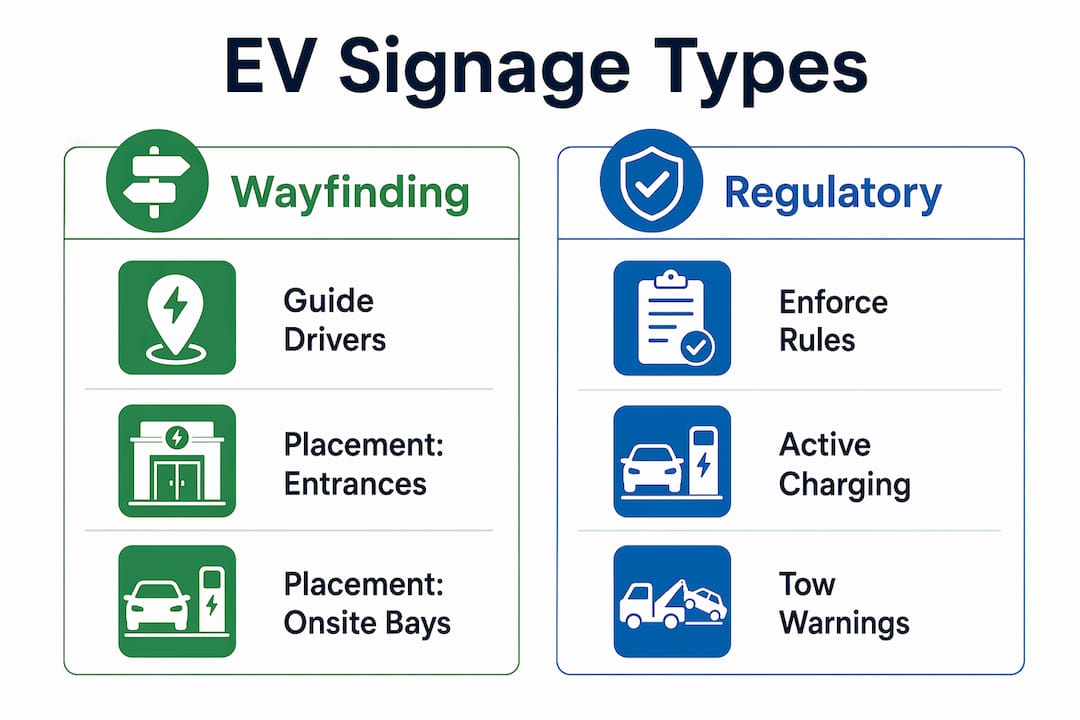
A well-structured EV site uses three distinct signage layers, each serving a specific purpose. Understanding what belongs in each layer is the foundation of any effective signage strategy.
Wayfinding signage directs drivers from the site entrance to the correct bay. This layer includes:
- Directional arrows with distance indicators
- Zone and level identifiers in multi-storey or large surface car parks
- Consistent EV plug icons for instant recognition
- Entrance-mounted panels showing charging bay locations
Regulatory and parking signage sets the rules and gives your site legal authority to enforce them. This layer covers:
- “EV Charging Only” bay markers
- Time-limit notices (e.g., “Maximum 2 hours while charging”)
- Tow-away authority statements
- “No Parking Except While Charging” signs
Safety and operational signage communicates hazards and usage instructions. This layer includes:
- Electrical hazard warnings at charger units
- Step-by-step usage instructions for unfamiliar drivers
- Emergency contact numbers and isolation procedures
| Signage layer | Primary purpose | Typical placement |
|---|---|---|
| Wayfinding | Guide drivers to bays | Entrances, junctions, overhead |
| Regulatory | Enforce rules and deter misuse | Bay-level posts, kerb-side |
| Safety and operational | Communicate hazards and instructions | Charger units, adjacent posts |
Each layer must work in concert. A site with excellent wayfinding but no regulatory signs cannot legally tow a non-charging vehicle. A site with regulatory signs but no wayfinding leaves first-time visitors circling the car park. Layering all three types as a unified system reduces driver confusion and maximises correct bay usage.
Pro Tip: Place wayfinding signs at every decision point, not just at the entrance. Drivers make navigation choices at junctions, ramps, and aisle intersections. A sign at the entrance alone is rarely sufficient.
How does effective signage improve enforcement at EV charging sites?
Clear, compliant regulatory signage is the legal backbone of any EV parking enforcement programme. Without it, your site operator has no authority to issue penalties or arrange towing, regardless of how obvious the intended use of a bay appears.
The most effective approach follows a structured sequence:
- Post “Charging Only” signs at every bay. These must be visible from the driver’s seat before the vehicle is parked. Bay-level posts at 60 to 84 inches mounting height are the standard for legibility from a vehicle window.
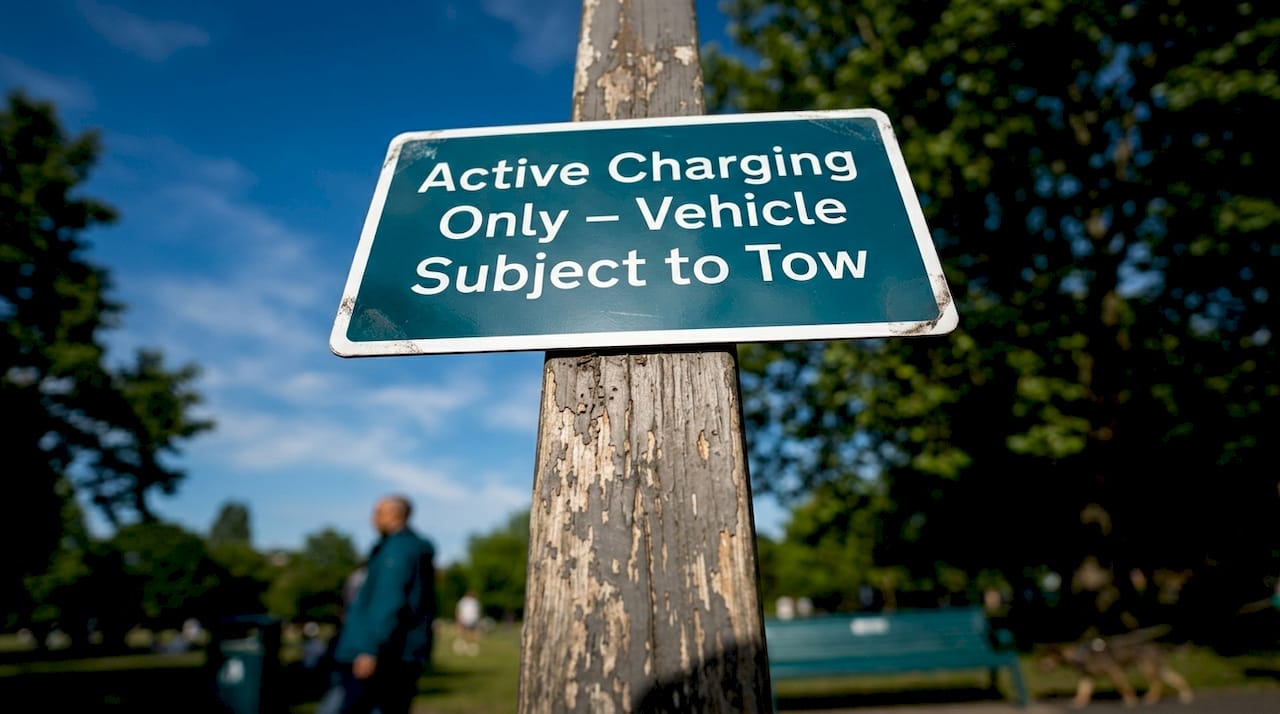
- Include explicit enforcement language. Phrases such as “Active Charging Only” and “Vehicle Subject to Tow at Owner’s Expense” provide the legal authority for towing and penalty notices. Vague wording weakens your enforcement position.
- Use MUTCD R7-8 series sign formats where applicable. These standardised formats are recognised by enforcement contractors and parking authorities, making your signage immediately legible to professionals managing your site.
- Reinforce with ground markings. Pavement stencils repeating “EV Only” or displaying a charging plug symbol support the vertical signage and reduce the “I didn’t see the sign” defence.
- Add time-limit notices where turnover matters. Sites with high demand benefit from “Maximum 4 Hours While Charging” notices, which encourage bay turnover and prevent long-stay misuse.
Regulatory signage with enforcement wording such as “Active Charging Only” is critical. Without it, towing and penalty enforcement may fail in practice, leaving site operators with no recourse against misuse.
Pro Tip: Consult your parking enforcement contractor before finalising sign wording. Some contractors require specific phrases to be present on signage before they will act on a complaint. Getting this right at installation avoids costly retrospective changes.
What accessibility considerations must be incorporated in EV charging signage?
Accessibility is frequently overlooked in EV signage planning, yet it is a legal and ethical obligation for any publicly accessible charging site. Accessible EV parking signage requires the International Symbol of Accessibility on both vertical signs and pavement markings, with mounting at a minimum of 60 inches to the bottom of the sign face.
Businesses must address the following when planning accessible charging bays:
- Symbol placement: The International Symbol of Accessibility must appear on the bay sign, the ground marking, and any associated wayfinding panels directing drivers to accessible spaces.
- Mounting height: Signs must be mounted at a minimum of 60 inches from the ground to the bottom of the sign face, ensuring visibility from a seated position in a vehicle.
- Access aisle identification: Adjacent access aisles must be clearly marked with hatching and “No Parking” text to prevent obstruction.
- Clear routing signage: Directional signs must indicate the accessible route from the accessible bay to the charger unit and site exit, accounting for kerb drops and surface gradients.
- Charger unit labelling: The charger itself should carry accessible-use instructions in a legible font size, positioned at a reachable height for wheelchair users.
Physical layout and signage must work together to ensure usability. A sign that meets mounting height requirements but is obscured by a charger unit canopy, or positioned on the wrong side of an access aisle, fails in practice even if it passes a paper audit. For detailed guidance on meeting UK accessibility standards, the accessible signage requirements resource from Promosigns covers symbol usage, mounting specifications, and inclusive design principles.
Which materials and design elements maximise EV charging sign durability?
The physical construction of your signage determines whether it remains legible and compliant for years or degrades within a single winter. Outdoor EV charging environments are demanding: signs face UV exposure, vehicle exhaust, pressure washing, and in some cases deliberate vandalism.
The most durable and visible EV charging signs use the following:
- High-intensity prismatic (HIP) reflective sheeting. This material meets federal luminosity requirements and ensures night-time sign visibility without requiring powered lighting. It is the industry standard for regulatory and wayfinding signs in outdoor car parks.
- Aluminium composite or powder-coated steel substrates. These resist corrosion in the UK’s wet climate and maintain dimensional stability. Avoid PVC-only boards for permanent outdoor installations.
- Vandal-resistant mounting hardware. Tamper-proof bolts and reinforced post brackets prevent sign rotation and theft, which are common issues at high-footfall charging sites.
- LED illuminated sign panels. For sites operating after dark, LED illuminated signage dramatically improves legibility and reduces the risk of misuse in low-light conditions. LED options also offer significant energy efficiency advantages.
- Green pavement markings. Green outlined or fully painted stalls are the de facto industry standard for EV bay identification, providing strong visual cues from a distance before a driver can read the vertical sign text.
Tesla’s approach at certain Supercharger locations illustrates how physical signage can be extended digitally. Tesla combines sandwich board signs with in-vehicle software prompts to enforce “Quiet Charging Zone” behaviour near residential areas. This integration of physical and digital instruction is a model for how larger commercial sites might evolve their signage strategy as connected vehicles become the norm.
Colour consistency matters as much as material quality. Using the same green, white, and blue palette across all EV signage on a site creates a recognisable visual language that drivers learn quickly, reducing the cognitive load of finding and using a charging bay.
How to plan and implement a signage strategy for your EV charging site
A signage strategy for a new or retrofitted EV charging site should be planned before installation begins, not added as an afterthought once chargers are in the ground. The most common failure point is what practitioners call the “last 30 feet” problem: drivers know the site has charging, but cannot locate the specific bay once they are on site.
Follow this sequence to avoid that outcome:
- Map all decision points from the site entrance to each bay. Every junction, ramp, and aisle intersection where a driver must choose a direction needs a wayfinding sign. Duplicating critical information at multiple viewing points is the most effective approach to preventing driver confusion.
- Assign signage to three zones: entrance, zone/aisle level, and bay level. Each zone requires different sign types and mounting heights. Entrance signs can be larger and higher; bay-level signs must be readable from a seated position in a vehicle.
- Integrate ground markings with vertical signage. Green pavement markings, bay numbers, and “EV Only” stencils reinforce the vertical signs and provide a second layer of instruction visible when a driver is manoeuvring into a space.
- Include accessible bay signage in the initial plan. Retrofitting accessibility signage after installation is significantly more expensive and often results in non-compliant placement due to physical constraints.
- Schedule a six-monthly signage review. Reflective coatings degrade, ground markings fade, and enforcement wording may need updating as regulations evolve. A maintenance schedule protects your compliance position and keeps the site looking professional.
Pro Tip: Before finalising your signage plan, walk the site as a first-time visitor. Drive in from the public road, follow your own signs, and attempt to locate an accessible bay. This exercise consistently reveals gaps that a desk-based plan misses entirely.
For businesses seeking guidance on wayfinding sign design, Promosigns offers practical advice on placement, hierarchy, and materials suited to outdoor commercial environments.
What we have learned from designing EV charging signage in practice
Having worked on signage projects across London, Essex, and Kent, the pattern we see most often is this: businesses invest in the charger hardware and neglect the signage until the site is already open. By that point, bays are being misused, drivers are complaining, and the retrofit costs more than a planned installation would have.
The layered approach is not optional. Wayfinding alone does not prevent misuse. Regulatory signs alone do not help a first-time visitor find the bay. Safety signage alone does not tell a driver which bay is accessible. All three layers must be present, consistent, and maintained to deliver a site that works.
Accessibility is the area where we see the most significant gaps. Many sites have a compliant accessible bay in terms of physical dimensions but carry no accessible signage whatsoever. That is not a minor oversight. It is a barrier to use for a significant proportion of EV drivers, and it creates legal exposure for the site operator.
The future direction is clearly towards integrating physical signage with digital prompts, as Tesla has demonstrated at a small scale. For most UK commercial sites, that integration is still some years away from being standard. What is available now is high-quality, durable, compliant physical signage that does the job reliably. That is where the investment should go first.
— Promo
How Promosigns can support your EV charging site signage
At Promosigns, we design, manufacture, and install bespoke signage solutions for outdoor and regulatory applications across London, Essex, and Kent. Our team works with property developers, facilities managers, and retail operators to produce EV charging station signage that meets durability, visibility, and compliance requirements from day one.

Whether you need wayfinding panels, regulatory bay signs, LED illuminated units, or a complete site signage package, we offer an end-to-end service from design through to professional installation. Our materials are selected for UK outdoor conditions, and our sign designs are built to last. To understand the full range of sign types available for your site, visit our guide to signage types and importance or contact Promosigns directly for a consultation and quote tailored to your EV charging site.
FAQ
What are the three layers of EV charging site signage?
EV charging site signage consists of wayfinding signs to direct drivers, regulatory signs to enforce parking rules, and safety or operational signs to communicate hazards and usage instructions. All three layers must be present for a site to function correctly.
What sign wording is needed to legally enforce EV bay rules?
Regulatory signs must include explicit enforcement language such as “Active Charging Only” and “Vehicle Subject to Tow at Owner’s Expense” to provide legal towing authority. Vague or incomplete wording weakens your enforcement position.
What is the minimum mounting height for accessible EV charging signs?
Accessible EV parking signs must be mounted at a minimum of 60 inches from the ground to the bottom of the sign face, and must display the International Symbol of Accessibility on both the vertical sign and the pavement marking.
What materials are best for outdoor EV charging signage?
High-intensity prismatic reflective sheeting on aluminium composite or powder-coated steel substrates offers the best combination of night-time legibility and weather resistance. Vandal-resistant mounting hardware and LED illuminated panels extend the service life and visibility of signs at high-footfall sites.
How often should EV charging site signage be reviewed?
A six-monthly review is recommended to check for faded ground markings, degraded reflective coatings, and any changes to enforcement wording required by updated regulations. Regular maintenance protects both your compliance position and the professional appearance of your site.
Recommended
- Signage for Business Parks: Complete UK Guide – PromoSigns.co.uk
- Signage for Business Parks: Complete UK Guide 202
- Signage Placement Best Practices for Maximum Impact – PromoSigns.co.uk
- Outdoor Signage Regulations UK (2026) – Planning & Compliance
