
TL;DR:
- Effective exhibitor branding strategies combine impactful booth design, targeted promotional products, and coordinated messaging to maximize trade show engagement. Proper pre-show planning, during-event activities, and prompt post-show follow-up are essential for measurable success and ROI. Ensuring compliance with venue regulations and tracking performance metrics optimizes overall brand impact and conversion potential.
Exhibitor branding strategies are comprehensive approaches that blend creative booth design, promotional tactics, and operational planning to maximise visibility and engagement at trade shows. In the exhibitions industry, these are often referred to collectively as exhibit marketing or trade show brand activation. The most effective strategies separate measurable financial return on investment (ROI) from broader return on objectives (ROO), tracking sales pipeline alongside brand awareness and meetings booked. ShowReady’s 2026 guidance confirms that aligning every branding decision to specific, measurable objectives is the single most reliable predictor of exhibition success. For event marketers and trade show organisers, getting this alignment right from the outset determines whether your stand generates genuine commercial momentum or simply occupies floor space.
Table of Contents
What are the core components of effective exhibitor branding strategies?
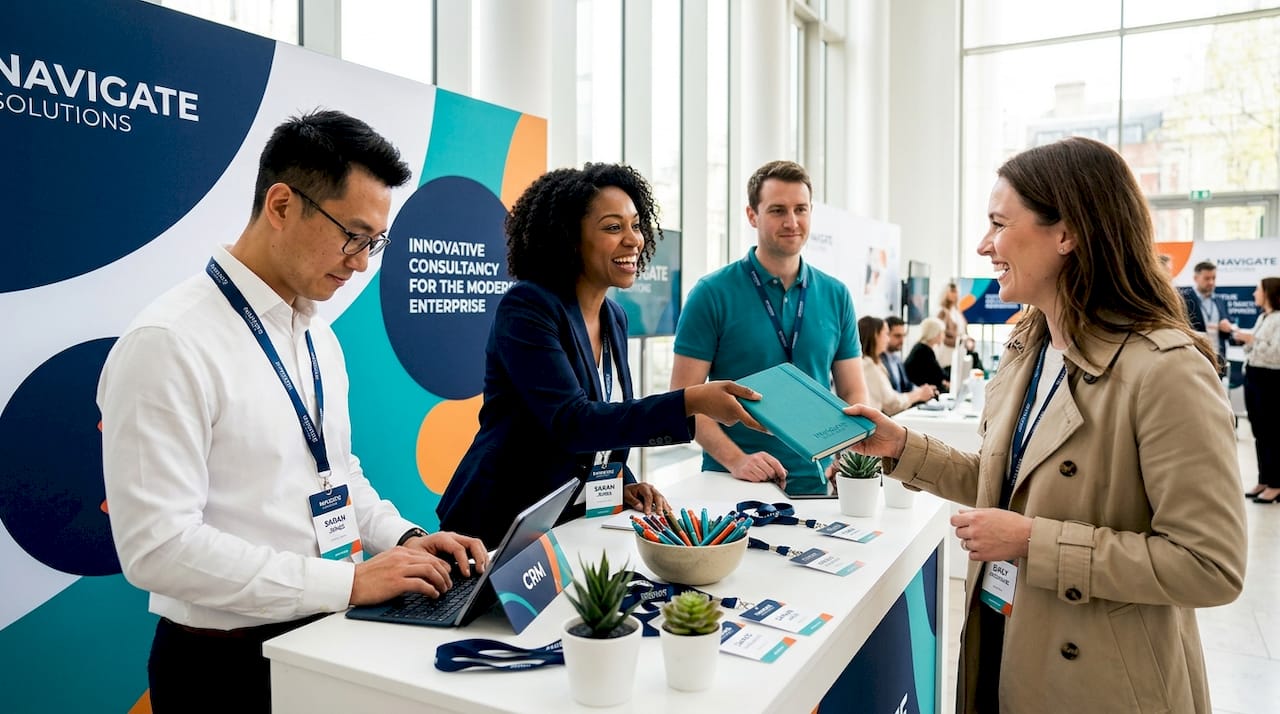
Effective exhibitor branding strategies rest on five interconnected components. Miss one and the others underperform. Get all five working together and your stand becomes a conversion asset rather than a cost centre.
- Clear, measurable objectives. Define whether you are chasing ROI (deals closed, pipeline value) or ROO (brand awareness, media coverage, meeting volume) before a single design decision is made. Aligning branding decisions to explicit event objectives ensures resource efficiency and maximises measurable outcomes.
- Booth design for maximum impact. Your stand communicates your brand positioning within seconds of an attendee walking past. Consistent use of brand colours, bold typography, and structured visitor flow all contribute to a professional, high-impact presence. Promosigns recommends reviewing your exhibition stand design elements well in advance of the event to avoid last-minute compromises.
- Branded promotional products and giveaways. 73% of recipients use trade show promotional products at least weekly, and 45% use them daily. This means a well-chosen branded item extends your visibility long after the event closes, making utility the primary selection criterion rather than novelty.
- Staff apparel and presentation. Coordinated branded apparel such as polo shirts or branded jackets turns your team into moving brand ambassadors. Visitors identify your staff instantly, which reduces friction and improves approachability throughout the day.
- Interactive elements and lead capture technology. Live demos, touchscreens, and gamified lead capture encourage deeper engagement and produce higher-quality leads than passive displays alone. Digital badge scanners, QR codes linked to landing pages, and tablet-based qualification forms all reduce manual data entry and improve post-show follow-up speed.
Pro Tip: Choose promotional giveaways that attendees will use at their desks or in meetings. A branded notebook or portable charger stays visible in professional environments for months, whereas a tote bag often disappears into a cupboard.
Branding basics for small businesses also apply here. Understanding how brand identity fundamentals translate into physical touchpoints helps exhibitors make coherent decisions across apparel, print, and digital assets.
How does pre-show, during-show, and post-show planning enhance exhibitor branding?
A three-phase marketing campaign covering pre-show, during-show, and post-show activity is the structural backbone of any serious exhibition programme. Treating the stand as a standalone event, rather than part of an end-to-end conversion system, is the most common and costly mistake exhibitors make.
- Pre-show outreach (six to eight weeks before). Contact your existing client base and warm prospects via email, LinkedIn, and targeted social media advertising. Announce your stand number, share a preview of what you will be demonstrating, and offer pre-booked meeting slots. Pre-booked appointments consistently produce higher-quality conversations than cold walk-up traffic.
- During-show engagement (event days). Activate your booth experience with scheduled demonstrations at fixed times, which creates natural crowd-gathering moments. Brief your team on qualification questions so every conversation produces a scored lead rather than a business card. Use live social media posting, including short video clips of your stand, to extend reach beyond the physical venue.
- Post-show follow-up (within 48 hours). Lead follow-up within 48 hours dramatically improves conversion rates from exhibitions. Segment your leads by qualification score and send personalised follow-up messages rather than a single broadcast email. Hot leads should receive a direct call or personalised video message within the first business day after the event closes.
- Digital integration throughout. Track UTM-tagged URLs from pre-show campaigns through to post-show landing pages. This connects your exhibition activity to your CRM and gives you accurate attribution data for the next planning cycle.
- Resource and scheduling discipline. Build a production timeline that works backwards from the event date. Signage, print materials, and apparel all have lead times. Promosigns advises clients to finalise artwork at least three weeks before an event to allow for production, quality checks, and delivery without compromising on specification.
Pro Tip: Record a short 60-second video walkthrough of your stand on the first morning of the event. Post it to LinkedIn before midday. It signals to your network that you are present and active, and it often drives additional footfall from attendees who had not planned to visit your stand.
Which compliance and operational factors must be managed for trade show branding?
Operational compliance is the least glamorous part of exhibition planning and the one most likely to derail an otherwise well-prepared branding programme. Major exhibition organisers require advance approvals for hanging signage with structural drawings, and these approvals frequently sit on the critical path for your entire production schedule.
The key compliance and operational factors to manage are:
- Venue-specific rules on signage height and projection. Most venues specify maximum stand heights and restrict signage that projects beyond your contracted floor space. Review the exhibitor manual thoroughly before briefing your designer.
- Structural and safety requirements for overhead displays. Hanging signs and suspended structures require engineer-certified drawings in most major venues. Submit these early. Approval turnaround times vary significantly between organisers.
- Coordination with official show contractors. Many venues mandate that certain installation tasks, including electrical connections and rigging, are carried out by their appointed contractors. Factor this into your budget and timeline.
- Timing for design approvals and print production. Overhead and hanging signage compliance approvals often become critical path items for exhibitor branding schedules. Late submissions result in either rejected designs or rushed production that compromises quality.
The table below summarises the most common compliance requirements and their typical lead times.
| Compliance requirement | Typical lead time | Who approves |
|---|---|---|
| Hanging sign structural drawings | 6 to 8 weeks before event | Show organiser / venue |
| Stand height variance request | 4 to 6 weeks before event | Show organiser |
| Electrical connection booking | 4 weeks before event | Official contractor |
| Graphics and branding artwork sign-off | 3 weeks before event | Internal / print supplier |
| Rigging and installation booking | 3 to 4 weeks before event | Official rigging contractor |
Understanding these timelines at the outset prevents the most common and expensive exhibitor error: discovering a compliance issue after your print materials have already been produced. Promosigns works with clients across London, Essex, and Kent to produce exhibition signage that meets venue specifications from the first proof stage.
How do you measure and optimise the effectiveness of exhibitor branding strategies?
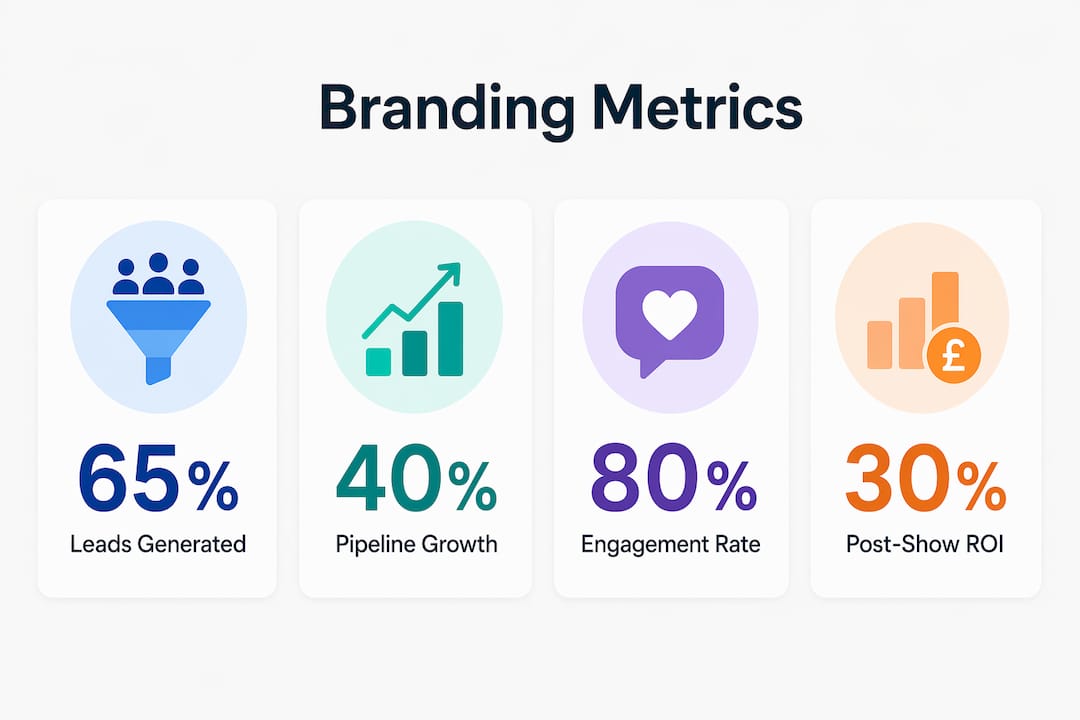
Measurement transforms exhibition activity from a cost into a managed investment. ShowReady advises multi-metric tracking that combines deal velocity indicators (ROI) with brand lift indicators (ROO), giving you a complete picture of performance rather than a single headline number.
| Metric category | Specific indicators | Measurement method |
|---|---|---|
| Sales ROI | Leads generated, pipeline value, deals closed | CRM tracking, post-event sales reports |
| Brand ROO | Web traffic uplift, social media reach, media coverage | Google Analytics, social platform insights |
| Engagement quality | Meetings booked, demo attendance, dwell time | Badge scans, calendar bookings, staff logs |
| Lead quality | Qualification score distribution, decision-maker percentage | Lead scoring framework in CRM |
| Post-show conversion | Follow-up response rate, proposal requests | Email platform reporting, CRM pipeline |
Measuring branding impact across both sales outcomes and non-sales indicators like web traffic, social media engagement, and media coverage gives you the data to justify budget and refine tactics for the next event. A single ROI figure tells you whether the event paid for itself. ROO data tells you whether your brand is gaining ground in the market.
Lead qualification scoring is the most underused tool in exhibition measurement. Assign a numerical score to each lead based on job title, budget authority, timeline, and expressed interest. Leads scoring above a defined threshold go to sales immediately. Lower-scoring leads enter a nurture sequence. This prevents your sales team from wasting time on unqualified contacts while ensuring no warm prospect is neglected.
Pro Tip: Run a brief attendee survey at your stand using a tablet-based tool. Ask three questions: how did they hear about you, what problem they are trying to solve, and how soon they expect to make a decision. The answers give you segmentation data that makes your post-show follow-up significantly more targeted.
For a detailed framework on quantifying signage and display investment, Promosigns has published a practical signage ROI guide that applies directly to exhibition contexts.
What the industry gets wrong about exhibitor branding
From our experience producing exhibition signage and large-format displays for clients across London and the South East, the most persistent mistake is treating the stand as the strategy. Exhibitors invest heavily in a visually impressive booth and then expect the design alone to do the work. It does not.
The stands that consistently outperform are the ones where the physical display is the visible tip of a much larger operational and marketing effort. Pre-show outreach, staff briefing, lead qualification protocols, and post-show follow-up workflows all determine whether a well-designed stand converts visitors into pipeline. Experiential-first booths that solve attendee problems generate authentic engagement that purely visual displays cannot replicate.
The second overlooked factor is compliance planning. We regularly speak with exhibitors who have finalised their stand design without checking venue rules on height, projection, or hanging structures. Discovering a compliance issue three weeks before an event forces rushed redesigns and compromised print quality. Starting with the venue manual and working forwards into the creative brief produces far better outcomes.
The brands that win at trade shows treat their exhibition presence as part of an integrated campaign, not a standalone event. That means consistent messaging from the first pre-show email through to the post-show follow-up call, with every physical and digital touchpoint reinforcing the same positioning. That level of integration is what separates memorable stands from forgettable ones.
— Promo
How Promosigns supports your exhibition branding
Planning a trade show presence in London or across the South East? Promosigns designs, manufactures, and installs bespoke exhibition signage and large-format print that meets venue specifications and delivers maximum on-stand visibility.

From high-impact exhibition displays and illuminated signage to printed graphics, banners, and branded booth panels, Promosigns provides an end-to-end service covering design, production, and installation. Every piece is produced to comply with standard venue requirements, with artwork reviews built into the production process. Whether you need a complete stand fit-out or targeted print materials to support a specific campaign, Promosigns delivers to tight event deadlines without compromising on quality. Contact the team to discuss your next exhibition and receive a tailored quote for large-format trade printing that makes your brand impossible to overlook.
FAQ
What are exhibitor branding strategies?
Exhibitor branding strategies are coordinated approaches combining booth design, promotional materials, staff presentation, and marketing campaigns to maximise brand visibility and lead generation at trade shows and exhibitions. They integrate pre-show, during-show, and post-show activity into a single conversion-focused programme.
How do you measure ROI from exhibition branding?
ROI from exhibition branding is measured by tracking sales pipeline value, deals closed, and lead volume generated at the event. Non-sales indicators such as web traffic uplift, social media reach, and media coverage measure brand ROO alongside financial return.
How far in advance should exhibition signage be ordered?
Exhibition signage should be ordered at least three to four weeks before the event to allow for design approval, production, quality checks, and delivery. Hanging signs requiring structural compliance drawings need six to eight weeks of lead time.
What promotional products work best at trade shows?
Utility-focused promotional products perform best at trade shows. 73% of recipients use trade show giveaways at least weekly, with items like branded notebooks, portable chargers, and quality pens delivering the longest post-event visibility.
Why is post-show follow-up timing so critical?
Post-show follow-up within 48 hours dramatically improves lead conversion rates because prospect interest is highest immediately after the event. Delayed follow-up allows competitors to engage first and reduces the likelihood of converting warm leads into sales conversations.
Recommended
- Essential exhibition branding tips for unforgettable impact – PromoSigns.co.uk
- Exhibition Signage Basics 2025: Essential Guide for Businesses – PromoSigns.co.uk
- How to Choose Event Signage for Lasting Impact – PromoSigns.co.uk
- Event Banners vs Posters: Retail Marketing Guide UK
