
Match the material to two things: how exposed the sign will be and how long it needs to last. That single rule sorts most signage decisions in seconds. A short-term poster inside a shop window has nothing in common with a fascia sign bolted to a Victorian shopfront in coastal wind, yet both get lumped together as “signage” far too often.
For anything permanent and outdoors, aluminium or premium Aluminium Composite Material (ACM, commonly known as Dibond) is the safer bet thanks to its corrosion resistance and dimensional stability. Foamex and acrylic tend to suit indoor or semi-permanent work better, where UV degradation and driving rain aren’t a daily concern. Traffic and regulatory signs sit in their own category entirely, governed by BS EN 12899-1, which sets performance classes for retroreflectivity and structural strength rather than leaving substrate choice to guesswork. Interior signage in public buildings often needs fire classification to BS EN 13501-1 as well, so the material question and the compliance question usually arrive together.
Here’s a working shortlist for the jobs we get asked about most:
| Sign type | Recommended material | One-line reason |
|---|---|---|
| Short-term poster or A-board insert | Correx (corrugated polypropylene) | Cheap, light, disposable after the campaign |
| Illuminated tray or box | Acrylic face with aluminium/ACM cabinet | Even light diffusion, weatherproof housing |
| Shop fascia | Aluminium Composite Material (Dibond) | Flat, rigid, long service life |
| Road or traffic sign | Aluminium substrate to BS EN 12899-1 | Meets legal reflectivity and durability classes |
| Temporary event sign | Foamex (PVC foam board) | Rigid enough to stand, cheap enough to discard |
If you want to move straight to a decision, do this now:
- Write down the exposure category: indoor, semi-exposed, or fully external.
- Decide the intended lifespan: weeks, a few years, or permanent.
- Ask any prospective supplier for the fire classification of interior substrates and the performance class for traffic signs.
- Request a wind-load allowance or fixing recommendation before you commit to a large or projecting panel.
Table of Contents
Choosing sign materials: a simple decision framework
The environment a sign will face and how long it needs to survive there decide almost everything else, including budget, weight, and fixing method. Get those two variables right first, and the shortlist writes itself.
Run through the framework in this order:
- Classify the environment. Indoor signs face none of the punishment that semi-exposed signs (under a canopy, in a doorway) or fully external signs face. Fully external means UV exposure, driving rain, wind loading, and in coastal or high-traffic urban areas, salt and pollution too.
- Set the lifespan. A pop-up shop opening for six weeks needs a completely different substrate to a fascia sign expected to last a decade. Experts in the sign trade are consistent on this: material choice has to start from the intended lifespan and application, not the other way round.
- Check the finish and visibility requirement. Does the sign need to be illuminated, printed in full colour, painted, or just legible from a distance? This affects which substrates are even viable candidates.
- Weigh cost against longevity. A cheaper material replaced every two years can cost more over a decade than a premium one installed once.
Before shortlisting, run through this environment checklist:
- UV exposure — south-facing or unshaded sites fade colours and embrittle plastics faster.
- Wind — open sites, tall buildings, and projecting signs all increase load on fixings.
- Salt and chemical exposure — coastal areas, or sites near industrial extraction or car parks, accelerate metal corrosion.
- Temperature swing — direct sun on dark-coloured aluminium panels can cause distortion if the substrate isn’t rigid enough.
- Human impact — street-level signs at pedestrian height need impact resistance that a first-floor fascia doesn’t.
Once you’ve scored the environment and settled on a lifespan, you’ll usually be left with two or three genuine contenders rather than eight. That’s the point where cost and finish become the tie-breaker, not the starting point.
For a deeper look at how lifespan expectations change the calculation, our guide on temporary versus permanent signage walks through the trade-offs in more detail.
Sign material options compared: a material-by-material breakdown
Each substrate below maps onto the environment and lifespan questions from the framework above; some are built for decades outdoors, others are designed to be thrown away after a single campaign.
Aluminium (solid sign-grade sheet)
Solid aluminium is the workhorse of durable outdoor signage. It doesn’t rust, holds its shape well, and takes powder coating or vinyl graphics cleanly.
- Pros: excellent corrosion resistance, long service life, accepts most finishes, recyclable.
- Cons: heavier than composite panels, can show denting on thin gauges, cost rises with thickness.
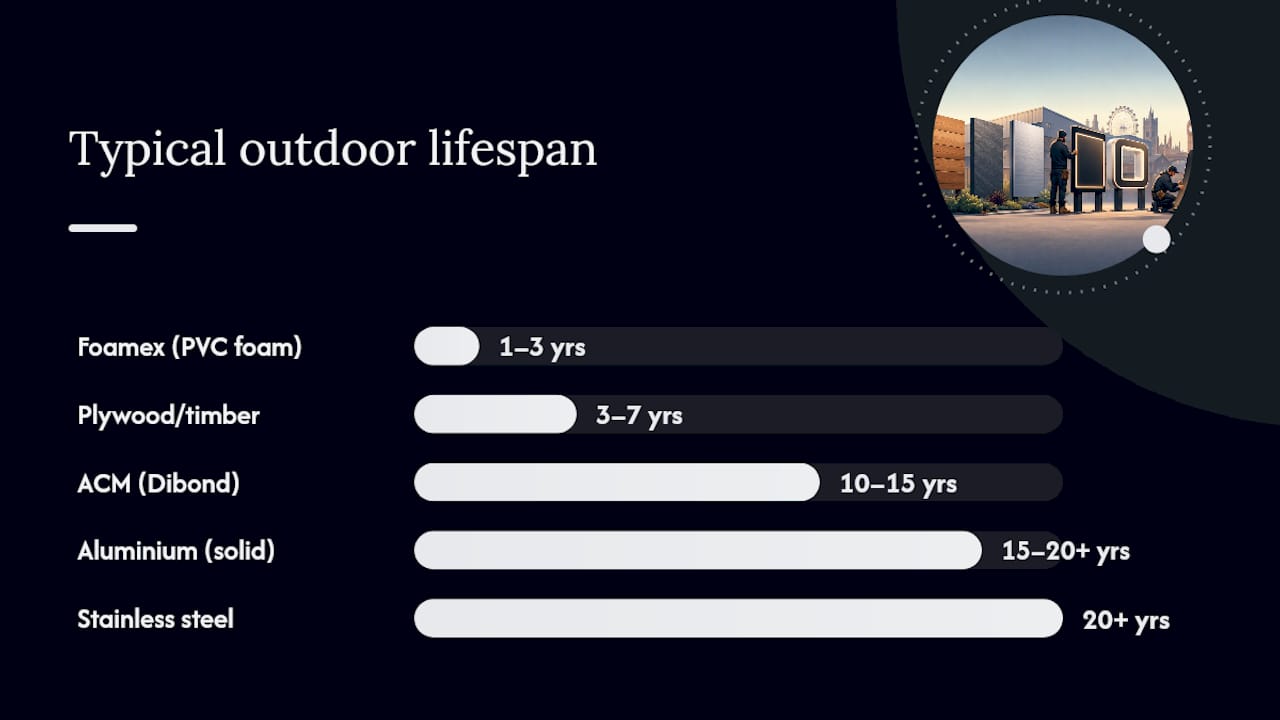
- Typical outdoor lifespan: 15 to 20 years or more with the right coating.
- Thickness and finish: commonly 1.5mm to 3mm, powder-coated, anodised, or printed with UV-cured inks.
Aluminium Composite Material (ACM / Dibond)
ACM sandwiches a plastic or fire-retardant core between two thin aluminium skins. It’s flatter and lighter than solid aluminium, which is why it dominates shop fascia work.
- Pros: exceptionally flat finish, lightweight for its rigidity, wide colour and print range.
- Cons: standard polyethylene (PE) core is combustible, so interior use in public buildings usually needs a fire-retardant (FR) core instead.
- Typical outdoor lifespan: 10 to 15 years.
- Thickness and finish: 3mm to 6mm panels, gloss or matte finishes, direct UV print or vinyl overlay.
Acrylic (PMMA)
Acrylic is the go-to for illuminated signage faces because it diffuses light evenly and holds colour well under UV exposure, particularly cast acrylic grades.
- Pros: brilliant clarity, good UV stability in cast form, premium appearance.
- Cons: more brittle than polycarbonate, can crack on impact, extruded grades are less UV-stable than cast.
- Typical outdoor lifespan: 10+ years for cast acrylic in a protected illuminated tray.
- Thickness and finish: 3mm to 10mm, clear, opal, or coloured, often paired with vinyl lettering.
PVC foam board (Foamex)
Foamex is the budget indoor and short-to-medium-term substrate. Lightweight and easy to cut, it’s a favourite for point-of-sale and temporary retail displays.
- Pros: cheap, lightweight, easy to machine and print directly.
- Cons: poor long-term UV resistance, can warp in strong heat, not suited to permanent outdoor use.
- Typical outdoor lifespan: 1 to 3 years outdoors; considerably longer indoors.
- Thickness and finish: 3mm to 19mm, direct digital print or vinyl application.
Corrugated plastic (Correx / Coroplast)
This is the material behind estate agent boards and short-run event signage. It’s built to be cheap and disposable, not durable.
- Pros: very low cost, extremely light, easy to transport in bulk.
- Cons: flimsy, poor UV resistance, not repairable if damaged.
- Typical outdoor lifespan: weeks to a few months.
- Thickness and finish: typically 4mm to 10mm fluted sheet, printed or with applied vinyl graphics.
GRP (glass-reinforced plastic)
Encapsulated GRP signs are common on construction sites and in industrial or heritage settings where a durable moulded finish is required.
- Pros: very tough, weatherproof, holds fine detail and colour well when encapsulated.
- Cons: heavier and pricier than ACM, longer lead times for bespoke shapes.
- Typical outdoor lifespan: 10 to 15 years.
- Thickness and finish: varies by application, usually smooth gel-coat or encapsulated print finish.
Stainless steel
Stainless steel is chosen where appearance and prestige matter as much as durability, think corporate reception signage or high-end retail.
- Pros: exceptional corrosion resistance, premium look, very long life.
- Cons: highest cost of the common metal options, heavier, needs skilled fabrication for 3D lettering.
- Typical outdoor lifespan: 20+ years.
- Thickness and finish: brushed, mirror-polished, or powder-coated grades.
Plywood / timber
Timber signage suits heritage sites, rustic branding, and hoardings where a natural look matters more than decades of service.
- Pros: natural aesthetic, easy to work with, relatively cheap.
- Cons: vulnerable to moisture and rot unless properly sealed and treated, shorter lifespan outdoors.
- Typical outdoor lifespan: 3 to 7 years, longer with marine-grade ply and regular resealing.
- Thickness and finish: 12mm to 18mm ply, painted, stained, or varnished.
| Material | Durability (outdoor) | Cost band | Indoor/outdoor | Rigidity | Weight | Fire performance | Printability |
|---|---|---|---|---|---|---|---|
| Aluminium (solid) | 15 to 20+ years | Medium to high | Both, excels outdoor | High | Heavy | Non-combustible | Good with coating |
| ACM (Dibond) | 10 to 15 years | Medium | Both | Very high, resists warping | Light for size | Depends on core (PE vs FR) | Excellent |
| Acrylic (PMMA) | 10+ years (cast) | Medium to high | Both, favoured for illumination | Medium | Light to medium | Combustible unless treated | Excellent, vivid colour |
| Foamex (PVC foam) | 1 to 3 years outdoor | Low | Primarily indoor | Medium | Very light | Combustible | Good |
| Correx/Coroplast | Weeks to months | Very low | Short-term outdoor/indoor | Low | Very light | Combustible | Fair |
| GRP | 10 to 15 years | Medium to high | Outdoor, industrial | High | Medium to heavy | Varies by formulation | Good, moulded detail |
| Stainless steel | 20+ years | High | Both, premium outdoor | Very high | Heavy | Non-combustible | Limited to etching/vinyl |
| Plywood/timber | 3 to 7 years | Low to medium | Primarily protected/temporary | Medium | Medium | Combustible | Good with paint/vinyl |
Pro Tip: Ask any supplier for the ACM core type by name, PE or FR, before you agree a price. A cheaper polyethylene core quoted against a fire-retardant spec is one of the most common ways buyers end up with an interior sign that fails building regulations.
For deeper detail on how UK weather conditions specifically affect substrate choice, see our guide to durability of outdoor signage.
Which sign material suits which application?
Most sign jobs fall into a handful of categories, and each one has one or two materials that consistently outperform the rest.
- Illuminated tray or lightbox — acrylic face on an aluminium or ACM cabinet. Acrylic diffuses light evenly; the metal housing keeps water out. Our guide to designing illuminated signs for shops covers the specification detail.
- Shop fascia — ACM (Dibond). Flatness, rigidity, and a decade-plus lifespan make it the default for street-level frontages; ask for an FR core if the sign sits within an interior fire compartment.
- Hoardings and hoarding panels — plywood or Correx depending on duration; plywood for multi-month construction projects, Correx for shorter promotional hoardings.
- Wayfinding and directional signage — ACM or acrylic indoors, aluminium outdoors, chosen for crisp printability and long-term legibility. Accessibility requirements often apply here too, covered in our signage accessibility guidelines.
- Traffic and regulatory signs — aluminium substrate manufactured to BS EN 12899-1 performance classes, never a generic decorative substrate.
- Temporary event signage — Correx or Foamex, chosen for low cost and easy disposal after a one-off event.
- Exhibition and point-of-sale panels — Foamex, valued for its light weight and ease of transport between venues.
- Vehicle graphics — a different material category entirely: cast vinyl films rather than rigid substrates, since the surface flexes with the vehicle body.
What UK sign standards should you specify?
Name the standard and the performance class together, never the standard alone, or a supplier can legally deliver the lowest compliant grade. The standards that matter most for UK signage are BS EN 12899-1, BS EN 13501-1, BS EN 1396, BS EN ISO 7823, and BS 559.
- BS EN 13501-1 covers reaction-to-fire classification, most relevant for interior signage in public buildings, retail units, and shared corporate spaces.
- BS EN 1396 applies to coil-coated aluminium and aluminium alloy sheet, relevant when specifying the coating quality on solid aluminium panels.
- BS EN ISO 7823 relates to acrylic sheet production standards, useful when specifying UV-stable cast acrylic for illuminated faces.
- BS 559 is the broader British Standard covering the design, construction, and installation of signs, including mechanical properties, corrosion protection, and links to fire performance.
Many specification failures trace back to citing a standard number without the actual performance value. A brief that says “BS EN 12899-1 compliant” without stating the required retroreflectivity class (R2 or R3B, for example) or wind-load pressure in N/m² leaves the door open for a manufacturer to supply whatever meets the bare legal minimum.
What to actually request from a supplier:
- The specific performance class number, not just the standard name.
- A fire classification certificate for any interior ACM, acrylic, or timber substrate.
- Confirmation of core type (PE or FR) for any ACM panel.
- Alloy grade and skin thickness for solid aluminium.
- A documented wind-load or WL class for anything mounted high, projecting, or in an exposed location.
More on the safety side of specification is covered in our guide to signage safety considerations.
What should go in your sign specification brief?
Start your brief with the four fields that decide everything else: exposure category, required lifespan, finish, and any standards that apply. Everything downstream, material grade, thickness, fixing method, follows from those four answers.
Copy this checklist into your tender document or enquiry email:
- Location and exposure category — indoor, semi-exposed, or fully external, including any coastal or industrial exposure.
- Required lifespan — temporary (weeks/months), medium-term (1 to 5 years), or permanent.
- Material type and grade — for example, “ACM, FR core” or “solid aluminium, 3mm, marine-grade coating” or “cast acrylic, UV-stable grade.”
- Coating type — powder coat, anodised finish, or printed vinyl overlay.
- Skin and core specification (ACM only) — skin thickness in mm and core type, PE or FR.
- Fire class required — state BS EN 13501-1 classification if the sign is interior or in a public building.
- Reflective class (traffic signage only) — state the required class per BS EN 12899-1, not just the standard name.
- Wind-load or WL class — provide site height, exposure, and panel dimensions so the manufacturer can size stiffeners and fixing channels correctly, rather than guessing.
- Fixing method — mechanical, adhesive, or a combination, and any structural constraints at the mounting point.
- Delivery and handling constraints — access restrictions, lift availability, or oversized panel logistics.
When it comes to wind load specifically, state the sign’s dimensions, mounting height, and site exposure rather than leaving it to the manufacturer’s default assumptions. Traffic sign procurement guidance is explicit on this point: omit wind-load and reflective class details, and the supplier will price to a generic assumption that may not match your actual site conditions at all.
If you’re weighing up a temporary campaign against a permanent installation, our guide on temporary versus permanent signage is a useful companion to this checklist.
How should signs be installed and inspected?
Correct fixing and a routine inspection schedule matter as much as the substrate itself. A premium aluminium panel fixed with the wrong hardware will fail years before a cheaper substrate installed properly.
Installation essentials:
- Mechanical fixing versus adhesive — mechanical fixings (bolts, rivets, structural brackets) suit heavier or higher-risk installations; adhesive fixing works for lighter, lower-level, sheltered applications.
- Isolation between dissimilar metals — aluminium fixed directly against steel or other dissimilar metals corrodes through galvanic action; isolating washers or barrier coatings prevent this in coastal or damp environments.
- Allowance for thermal movement — large panels need slotted fixing holes or expansion allowance so they don’t buckle as temperatures shift.
- Anchor standards — where anchors are used into masonry or structural elements, BS 8539 governs design and installation of the anchor system itself.
Maintenance and inspection cadence:
| Frequency | What to check |
|---|---|
| Monthly (visual, informal) | Obvious damage, loose panels, faded or peeling graphics |
| Annually | Fixing integrity, corrosion at fixing points, sealant condition |
| Biannually (projecting or illuminated signs) | Structural fixings, water ingress around electrical entries, electrical isolation checks |
| Every five years | Full fixing survey, installer requalification where applicable |
Installation quality and the inspection regime materially affect a sign’s lifespan. Recommended practice includes annual inspections for standard external signs and biannual checks for anything projecting or illuminated, alongside installers holding recognised competency training refreshed roughly every five years. For illuminated signs specifically, checking for water ingress and confirming electrical isolation aligns with BS 7671 requirements before any panel is opened for servicing is essential; our illuminated signage maintenance guide covers this process step by step.
What are the most common sign material mistakes?
The most expensive errors happen at the specification stage, long before installation, and they’re almost always about missing detail rather than wrong intent.
- Mistake: not specifying ACM core type. Solution: state PE or FR explicitly in writing; never assume a supplier will default to fire-retardant without being told.
- Mistake: underestimating wind load on large or high-mounted panels. Solution: provide site height, exposure, and panel size so the manufacturer can size stiffeners correctly rather than guessing.
- Mistake: fixing aluminium directly against dissimilar metal. Solution: specify isolating washers or barrier coatings at every fixing point in exposed locations.
- Mistake: choosing Foamex or Correx for an illuminated sign. Solution: illuminated faces need acrylic or a purpose-built diffusing substrate, not a foam board never designed for internal heat or light transmission.
- Mistake: leaving alloy grade and skin thickness unspecified. Solution: name the exact alloy and thickness in the brief; “aluminium” alone isn’t a specification.
- Mistake: treating installation as the finish line. Solution: build an inspection schedule into the contract from day one, not as an afterthought once a fixing has already failed.
Pro Tip: Large flat aluminium panels can develop oil-canning, a rippled, wavy distortion, if the sheet is too thin for its size or the fixing points are spaced too far apart. Specify a minimum gauge relative to panel size and ask your fabricator to confirm fixing centres before manufacture, not after.
Pro Tip: When you write a material requirement, name the grade and reject substitutions in the same sentence: “3mm ACM, FR core, no substitution without written approval” closes the loophole that lets a supplier quote a cheaper PE core and call it equivalent.
A signmaker’s perspective on getting the material right
Ask most installers what gets missed most often in a signage brief, and the answer isn’t the substrate itself. It’s the wind-load and fixing detail. Business owners will happily debate acrylic versus ACM for an afternoon, then leave the mounting height and site exposure blank on the same order form.
A few patterns recur often enough to be worth naming, kept generic here because the details vary case by case. One common scenario: a projecting fascia sign specified in standard-gauge ACM without anyone checking the building’s exposure to prevailing wind. The panel bowed within eighteen months, not because the material was wrong for a shop fascia, but because nobody sized the fixing centres for that specific wind exposure. A second recurring pattern involves interior illuminated signage specified with a PE core “because it was cheaper,” only for the fire risk assessment to flag it during a routine building inspection, forcing a costly replacement that a five-minute conversation at quote stage would have avoided entirely.
For anyone briefing a signmaker for the first time, three questions consistently separate a smooth project from an expensive one: what’s the exact wind exposure and mounting height, what fire class does the space require, and has anyone actually surveyed the site, rather than working from photos or a floor plan. If projecting height, coastal exposure, or a listed building facade is involved, request an on-site survey before agreeing final material specification. It costs less than a mid-project material swap, every time.
How Promosigns helps you choose and specify the right material
Promosigns handles the full process for London businesses, from site survey through to specification, manufacture, and compliant installation, so the material decisions covered in this guide don’t fall entirely on your shoulders.
Our team surveys the site first, checking exposure, mounting height, and structural constraints before recommending a substrate, rather than quoting blind from a floor plan. Services that support the process include:
- On-site surveys to assess wind exposure, fixing points, and structural suitability.
- Material specification advice matched to your sign’s lifespan and location.
- In-house manufacture across aluminium, ACM, acrylic, and illuminated sign cabinets.
- Mechanical fixing and installation carried out to current fixing standards.
- Ongoing illuminated sign maintenance and inspection.
If your project is a shop fascia, our Barnet shop signs team can talk you through the fixing and material options for your specific frontage. If you’re weighing up illumination for a fascia or lightbox, our guide on the advantages of illuminated signage is a useful next read. To get a site survey booked or request a quote, get in touch through the Promosigns website with your location, sign type, and rough timeline, and we’ll take it from there.
Frequently asked questions about choosing sign materials
What’s the most durable material for an outdoor sign in the UK?
Solid aluminium or premium ACM (Dibond) typically last longest outdoors, often 15 to 20 years or more, because both resist corrosion and hold their shape through UK weather cycles better than plastics or timber.
Is acrylic or Foamex better for an illuminated sign?
Acrylic is generally the better choice for illuminated faces since it diffuses light evenly and holds up better under sustained UV and heat exposure than Foamex, which isn’t designed for that kind of internal thermal load.
Do I need a fire certificate for interior signage materials?
Often, yes, particularly in public buildings or shared commercial spaces. Ask your supplier for documented reaction-to-fire classification to BS EN 13501-1 rather than assuming any interior substrate is automatically compliant.
How often should outdoor signs be inspected?
Standard external signs are typically checked annually, while projecting or illuminated signs warrant biannual inspection, with a fuller fixing survey roughly every five years.
What’s the cheapest suitable material for a short-term sign?
Correx (corrugated plastic) is usually the cheapest viable option for signage expected to last only weeks or a few months, such as event signage or temporary estate agent boards.
Can I use the same material for a shop fascia and a traffic sign?
No. Traffic and regulatory signs must meet BS EN 12899-1 performance classes for retroreflectivity and structural integrity, a legal requirement that standard fascia materials aren’t manufactured or tested to meet.
Sources
- The best materials for long‑lasting outdoor commercial signs
- Mechanical fixing guidance for signage (BSGA technical guidance PDF)
- Guidance for specifying permanent traffic signs (ARTSM update PDF)
Recommended
- Flexible sign materials: the UK business guide – PromoSigns.co.uk
- Durable sign materials: the complete UK buyer’s guide – PromoSigns.co.uk
- Signage Safety Considerations: Complete Guide for UK Businesses – PromoSigns.co.uk
- Signage Accessibility Guidelines: A Practical Guide for UK Businesses – PromoSigns.co.uk
