
LED is the practical default for most commercial signage: it uses far less energy, lasts longer, and needs less maintenance than glass neon. Traditional neon remains a defensible choice for brands chasing a specific vintage or artisan look, but the running costs and safety overheads are real. The exceptions and the numbers behind that verdict are below.
Table of Contents
LED signs vs neon signs: what each one is actually made from
The materials tell you almost everything about how a sign will behave over five years of London weather and daily switching.
Traditional glass neon is built from hand bent glass tubing filled with neon or argon gas, sealed with metal electrodes at each end and driven by a high-voltage transformer. It is a genuine craft product, and that is both its charm and its problem: glass tubes and electrode assemblies are fragile, heavy, and awkward to transport or remount once installed.
LED neon and LED-illuminated signage take a different route entirely. Discrete LEDs sit inside flexible silicone or PVC tubing, or behind acrylic panels, wired to a low-voltage driver rather than a transformer. That construction is inherently more forgiving:
- Lighter overall weight, which reduces bracket and substrate loading on fascias
- Flexible tubing that survives knocks and vibration where glass would crack
- Lower voltage components that simplify IP-rated enclosures for outdoor use
- Easier transport and remounting during a shopfront refit or rebrand
The practical upshot: LED options generally cost less to ship, mount, and repair, while glass neon demands specialist handling at every stage from workshop to wall.
How do LED signs and neon signs actually produce light?
Glass neon works through gas discharge. A high-voltage current excites the gas inside the tube, and the gas itself glows, which is why colour depends on the specific gas and coating combination baked into the tube at manufacture. LEDs work by passing current through a semiconductor chip that emits light directly, with colour and brightness set electronically rather than chemically.
That difference matters more than it sounds:
- LEDs are readily dimmable and can be sequenced, faded, or colour-cycled through RGB control; glass neon offers none of that without a full rebuild
- LED output holds up better against daylight glare, useful on a bright high street fascia
- Neon’s warmth and slight flicker under certain loads is part of its appeal for bars and heritage brands
- Failure modes differ sharply: neon tubes crack or lose gas pressure and need re-gassing by a specialist; LED failures are usually a single diode or driver fault, fixed by swapping a section
If your marketing plans include animated promotions or seasonal colour changes, only LED gives you that flexibility.
What does each sign actually cost to run?
This is where the decision usually gets made, because energy and maintenance costs compound over a sign’s lifetime.
80% less energy. Promo’s internal comparisons of sign lighting options show LED installations can use up to 80% less energy than a comparable traditional neon sign, largely because low-voltage LED drivers avoid the constant power draw of a neon transformer.
Lifespan reinforces the cost gap. LED signage is commonly rated for tens of thousands of hours (frequently quoted in the 30,000 to 50,000 hour range), which works out to roughly ten years of continuous overnight running before diodes noticeably dim. Glass neon typically needs re-gassing or electrode servicing well before that point, and each visit means scaffolding or scissor lift access, not a quick panel swap.
To estimate your own running cost gap:
- Note your sign’s wattage and daily “on” hours from the spec sheet or installer quote
- Multiply by your commercial electricity rate to get a rough annual energy cost
- Add expected service call-outs (once a year for neon is typical; LED can often go three to five years between checks)
- Compare the totals over a five-year window, not just the purchase price
Is neon or LED safer, and what about disposal?
Electrical safety profiles differ significantly. Glass neon relies on high-voltage transformers, which demand careful earthing and clearances around the tube and cabling. LED signage runs on low-voltage drivers, which is inherently gentler on installers and easier to specify against tightening wiring rules, including the draft prEN 50107-3 and prEN 60364-7-719 standards now shaping sign-specific earthing guidance.
Disposal is the overlooked risk. Some legacy neon gas mixes and electrode assemblies contain trace mercury, which brings them under UK controls on mercury-added products once they reach end of life.
- High-voltage neon transformers need certified installation and periodic inspection
- LED drivers run cool enough to reduce fire risk in busy venues with heavy footfall
- Legacy neon removal should be budgeted as controlled disposal, not routine waste
- LED components are generally easier to recycle at end of life
LED vs neon signage: which fits your brand better?
Modern LED neon reproduces the glow and tube profile of glass neon closely enough that most customers cannot tell the difference from pavement distance. Where it can fall short is in very fine script or dense logo detail, where glass tubing sometimes achieves a slightly crisper line.
- LED neon can be dimmed, colour-changed, or sequenced; glass neon is fixed at one colour and brightness once made
- Complex typefaces and small logo elements are worth mocking up in both formats before committing
- Programmable effects suit retail promotions and hospitality venues that change messaging seasonally
- Authentic glass neon remains a fair choice for bars, vintage diners, or heritage brands where craft character outweighs running costs
Pro Tip: Ask your installer for a side-by-side sample panel in LED and glass neon before signing off artwork. Under shop lighting the colour temperature difference is often more visible than on a screen mock-up.
For a fuller look at how the two options compare on a live storefront, our guide to LED versus traditional storefront signage walks through real installation scenarios.
Where should you install each type, and how do you maintain it?
Outdoor installations need weatherproofing that glass neon rarely achieves without a protective enclosure, while LED products rated IP65 or higher are built for London’s rain and temperature swings.
- Confirm the IP rating matches the location: IP65+ for anything outdoors or exposed to washdown.
- Check the substrate can carry the sign’s weight, especially for glass neon on older fascias.
- Ask for wiring diagrams and earthing details before installation day, not after.
- Agree a maintenance cadence, typically annual for neon and every three to five years for LED drivers.
- Confirm warranty terms and who has access rights for future repairs.
Our step by step maintenance guide for illuminated signage covers the inspection checklist most installers should already be running.
What should you specify before you commission a sign?
Promo has designed, manufactured, and installed illuminated signage across London, Essex, and Kent long enough to know where specifications get missed and come back as call-outs later.
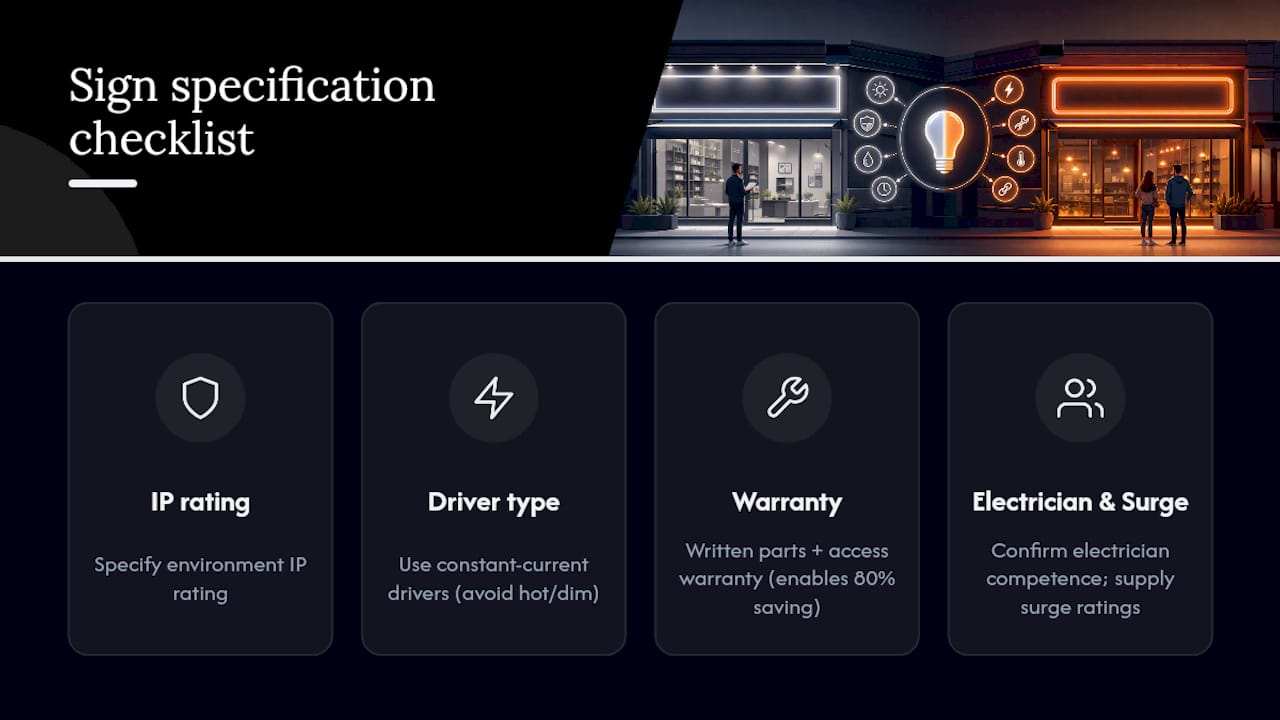
Three items belong in every brief: the IP rating for the installation environment, the driver type (constant-current drivers avoid the hot and dim patches that plague poorly speced LED neon), and a written warranty covering both parts and access for future repairs. Our 80% energy saving data on LED sign lighting reflects installations specified this way from the outset, not retrofitted after problems appear. Ask any installer to confirm electrician competence and provide surge protection ratings alongside the quote.
Our take on the LED vs neon decision
Most retail and office clients choose LED once they see the five-year running cost side by side with glass neon. Hospitality and bar clients are the exception. They often accept the higher maintenance because the warm, imperfect glow of real glass neon does something LED still cannot quite fake at close range. Either choice is defensible. What is not defensible is specifying either without asking about driver type, IP rating, and disposal plans upfront.
— Promo
How Promo can help you choose and install the right sign
Promosigns designs, manufactures, and installs both LED and glass neon signage across London, Essex, and Kent, so you get an honest recommendation rather than a sales pitch for whichever product is easier to stock.
Every installation comes with correctly specified drivers, IP-rated enclosures where needed, and compliant earthing, so you are not left chasing warranty issues six months after switch-on. We handle everything from initial design through to fitting, whether that is a single fascia sign or a full multi-site rollout for a retail chain. If you are weighing up LED against glass neon for a shopfront, our shop signage services in Barnet are a good starting point to request a quote or arrange a site survey, and we will talk you through which option actually earns its keep for your premises.
Sources
- Guidance note: earthing of illuminated signs – UKSigns (GN2018.02.02)
- Neon vs LED neon—how do they compare? – Neonplus®
Recommended
- Sign Lighting Options 2026: 80% Energy Savings with LEDs
- LED signage advantages: boost UK retail visibility in 2026
- LED vs. Traditional Storefront Signage: Which is Right for You?
- 7 Essential Signage Lighting Options for Business Success
