
Treat your rebrand as a migration, not a one-off redesign. Every URL, sign, and customer touchpoint needs a plan before it changes, not after. This business rebranding checklist sequences the work into seven phases, from audit through to a 90-day review, so you protect search visibility, keep customers oriented, and get your signage installed without costly reworks.
Table of Contents
Business rebranding checklist: the phased roadmap and who owns it
A rebrand runs cleanest as parallel workstreams under one project owner, coordinating strategy, creative, digital, and physical handoffs so nothing stalls waiting on someone else’s sign-off, a point ProfileTree’s rebranding strategy guide makes repeatedly.
- Audit (1-3 weeks) — owner: marketing lead. Pitfall: skipping low-traffic pages that still rank.
- Strategy (2-4 weeks) — owner: founder/director. Pitfall: no measurable objectives.
- Build foundations (3-5 weeks) — owner: designer/agency. Pitfall: incomplete file libraries.
- Digital migration (2-4 weeks) — owner: web developer. Pitfall: missing redirects.
- Visual and physical assets (4-10 weeks) — owner: signage supplier. Pitfall: no permit lead time.
- Rollout (1-2 weeks) — owner: operations manager. Pitfall: public launch before staff training.
- Measurement (ongoing) — owner: marketing lead. Pitfall: no review cadence.
Phase 1: brand and asset audit before you touch a logo
A rebrand must start with an inventory of every touchpoint, not the new logo. Skip this and you risk losing the recognition and search visibility you’ve already earned, which is exactly what GreenLight Digital Media’s SME rebrand checklist flags as the most common early mistake.
Log every place your current brand appears:
- Website pages, especially your top-performing landing pages by organic traffic
- Google Business Profile listings for each location
- Social media profiles and pinned content
- Signage: fascia, illuminated units, window graphics, hoardings
- Invoices, proposals, contracts, and email signatures
- Vehicle livery and fleet graphics
- Directory listings and third-party citations
Export your search rankings, top-linked pages, and existing backlinks now. You’ll need this data to build the redirect map later. For the asset register itself, keep it simple: owner, file reference, physical location, and an update priority (high, medium, low). Categorising what to protect versus what to retire, rather than replacing everything at once, is the single biggest lever for avoiding wasted spend on assets nobody will miss.
Phase 2: define your strategy and how you’ll measure success
Write a one-line positioning statement before any design work starts: “We help [audience] achieve [outcome] through [differentiator].” Pair it with three brand pillars, the values or promises every future decision gets tested against.
Set 2 to 4 measurable objectives tied specifically to the rebrand, not general marketing goals:
- Retain most of current organic traffic within the first several weeks after launch
- Grow branded search volume within several months after launch
- Hit a customer recognition benchmark in post-launch surveys
- Keep customer service queries about “where did you go” under a defined threshold
Agree who signs off on strategy changes before you start, whether that’s a single director or a small steering group, and put it in writing. Governance failures here, not creative disagreements, are what cause rebrands to stall mid-project.
Phase 3: build your brand foundations and clear the legal hurdles
Your brand book doesn’t need to be fifty pages. It needs to be usable by everyone who touches your brand, from your web developer to your signage installer.
- Logo usage rules: minimum size, clear space, colour variants, prohibited treatments
- Colour specifications in CMYK, RGB, and Pantone (signage fabricators need Pantone references)
- Typography: primary and secondary fonts with fallback web fonts
- Imagery style and two or three voice examples showing tone in practice
Designers should hand over vector files (AI or EPS), web-ready formats (SVG, PNG with transparency), and print-ready PDFs with bleed. Check contrast ratios for web accessibility and for signage visibility in daylight and after dark.
Run trademark, domain, and social-handle availability checks before you commit to a new name; these often decide your rollout date, not your creative timeline. Naming disputes and trademark clearance are exactly the kind of legal and technical change management issue covered in the Harvard Journal of Law & Technology’s discussion of technology-related brand changes.
Pro Tip: Order a Companies House name check and a trademark search on the same day. A clash on either can force a rename mid-project, and it’s far cheaper to discover that in week two than week twelve.
Phase 4: digital migration and SEO continuity
This is where rebrands quietly lose money. Changing URLs, titles, or your domain without a migration plan can wipe out years of ranking equity within weeks.
- Build a 301 redirect map covering every high-value URL, old to new, before launch day.
- Test every redirect with a crawler tool before going live, not after.
- Update metadata, canonical tags, and structured data to match new brand names and URLs.
- Re-verify your domain in Search Console and reconnect analytics tracking.
- Update third-party citations (directories, review sites, supplier listings) to match the new name.
- Monitor crawl and index coverage reports daily for the first two weeks post-launch.
SME rebrand guides consistently flag redirect mapping, Search Console re-verification, and crawl-error monitoring as the difference between a smooth migration and a traffic collapse, a point ProfileTree’s SME rebranding guide underlines directly.
Statistic callout: A single missing redirect on a high-traffic page can erase months of ranking progress in a matter of days once search engines start returning 404 errors instead of your content.
Phase 5: visual identity and the physical signage checklist
Your new logo isn’t finished until it exists in every format your physical world needs: web, large-format print, and fabricated signage each demand different file specs and colour handling.
- Update file libraries for web (SVG/PNG), print (PDF with bleed), and large-format (vector EPS/AI with Pantone references)
- Signage audit: measure existing sign sizes, illumination type, mounting method, and material condition at every location
- Confirm permit status and expected lead times with your local authority before fabrication starts
- Vet installers for insurance cover, verifiable references, and compliance with UL, CE, or BS electrical standards where illumination is involved
Detailed site surveys, permit research, and material sampling at every location are non-negotiable steps according to Sign Knights’ guide to updating storefront signs after a rebrand, and they’re the stage most SMEs underestimate. Refurbishing existing sign structures rather than replacing them outright can also cut both cost and lead time considerably; see our guide to refurbishing existing signage for modern brand appeal for what’s realistically salvageable.
Pro Tip: Ask any prospective installer for their public liability insurance certificate and one recent local reference before you sign, not after the mockup approval.
Phase 6: rollout and internal launch
Internal teams need to understand the new brand before customers see it. An internal launch pack circulated ahead of the public date, paired with a short training session, measurably improves how consistently staff represent the new identity, according to Ragan’s analysis of internal comms during rebrands.
- Build an internal launch pack: brand story, FAQ for staff, updated templates, and a one-page visual reference.
- Run a training session at least a week before public launch, covering tone of voice and common customer questions.
- Update digital anchors first (website, social profiles, email signatures) so search and social align before physical assets change.
- Batch physical installs by location, scheduling evening or overnight work where footfall makes daytime installation disruptive.
- Confirm supplier sign-offs: mockup approval, site survey completion, permit pulls, and a final inspection date for each install.
Phase 7: measure and iterate after launch
Set review points at 30, 60, and 90 days, each with an action log for anything that needs fixing, rather than waiting for a single post-mortem months later.
- Track branded search volume, organic traffic, direct traffic, conversion rate, and lead quality week on week
- Check redirect health, broken links, and directory consistency across every listing you updated
- Log customer confusion tickets (“is this still the same business?”) as a distinct category, not general support volume
Statistic callout: Guides for SME rebrands treat the 30/60/90-day cadence as standard practice specifically because migration problems (a missed redirect, an unupdated directory listing) tend to surface in that window rather than immediately at launch.
Practical timeline and ballpark costs for SMEs
A visual refresh without a name change typically runs 4 to 8 weeks. A full rebrand involving a domain change and physical signage commonly takes 3 to 6 months, largely because signage fabrication and permits run on their own clock, a range multiple SME rebranding guides converge on.
- Design and brand foundations: smallest share of budget, but sets everyone else’s pace
- Website rebuild and SEO migration: mid-range cost, higher if the domain changes
- Signage fabrication and installation: often the largest single line item once illumination and multiple locations are involved
Stage payments against milestones rather than paying upfront, and hold a contingency buffer of around 10 to 15% for permit delays or material substitutions. External signage specialists earn their fee fastest on multi-location rollouts, where site surveys and installer coordination are hard to manage in-house.
Promo’s applied signage checklist and project proof points
On-site work follows a fixed sequence: survey, mockup approval, material certification, permit confirmation, a booked install window, and a final inspection before sign-off. Skipping the certification step is where most rework claims originate.
- Colour matching held to a Delta E tolerance of 3 or below against brand Pantone references
- LED illumination specified in the 3000 to 4000K range for consistent daytime and evening appearance
- Installer insurance and UL/CE listing verified before any electrical connection work
Legal considerations and trademark updates
A new name or logo is not legally yours until you’ve checked it isn’t already someone else’s. Trademark clearance is the single most common cause of a rebrand stalling after launch, when a cease-and-desist letter arrives from a business with prior rights to a similar mark or name.
Run a trademark search covering your sector and territory before finalising any new name or logo, not after design work is complete. In the UK, that means checking the Intellectual Property Office register alongside a straightforward web and Companies House search for conflicting trading names. If your new mark clears, file the trademark application early; registration can take months, and trading under an unregistered mark during that window carries risk if a challenge appears.
Update your legal entity’s registered name with Companies House if you’re changing the company name itself, not just the trading name, and note that these are separate processes with separate timing. Contracts, leases, and supplier agreements referencing your old trading name may need formal variation letters rather than a simple email notice, particularly for property leases where the landlord’s consent might be required for signage changes to the building’s exterior.
Domain and social-handle registration should happen the moment you’re confident in the new name, well before public announcement, to prevent squatting or a competitor claiming the handle first. The legal and technical dimensions of a brand change, including how governance and documentation shape the process, are exactly the kind of issue explored in the Harvard Journal of Law & Technology’s coverage of technology-related brand transitions. Budget legal review time into your Phase 3 timeline rather than treating it as a final checkbox.

Stakeholder communication strategy: investors, partners, customers
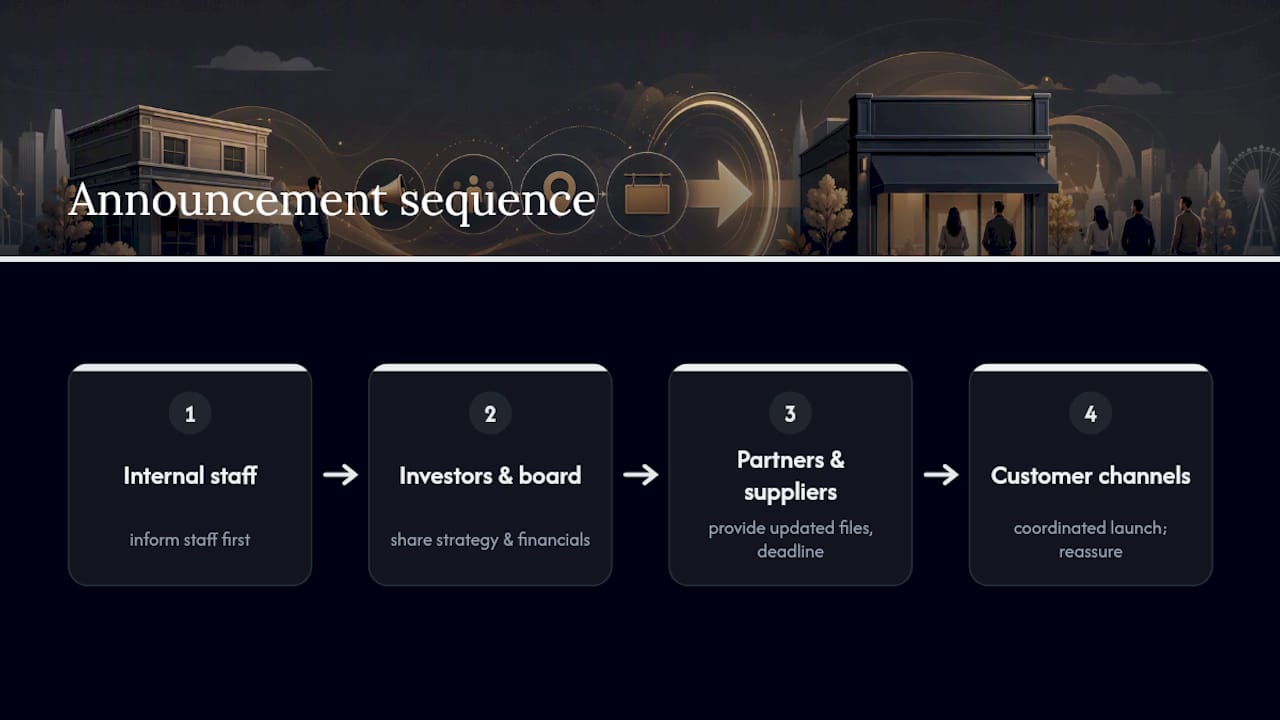
Different stakeholders need different information at different times, and treating them identically is how rebrands generate unnecessary anxiety. Investors and board members need the strategic rationale and financial implications well before anyone outside the company sees a new logo; a rebrand without a clear articulation of the business case tends to draw the most pointed questions at the next board meeting.
Partners and suppliers who reference your brand in their own materials, co-branded signage, joint marketing, distributor agreements, need enough lead time to update their own assets before your public launch date. A supplier still displaying your old logo a month after launch reflects on you, not them, so give this group a firm date and the updated files well in advance.
Customers need the simplest message of all: reassurance that nothing about the service, pricing, or relationship is changing, only the name and look. The GreenLight Digital Media checklist for SME rebrands recommends announcing changes across owned channels (email, website banner, social posts) simultaneously rather than staggered, precisely because a gap between channels invites confusion about which version is current.
Sequence your announcements: internal staff first, then key partners and suppliers with enough lead time to update their own materials, then a coordinated customer-facing announcement across every channel on the same day. Staggering the wrong way, telling customers before your own frontline staff know how to answer questions, is one of the more avoidable rebrand failures.
Crisis management and risk mitigation during a rebrand
Every rebrand carries a handful of predictable risks, and planning for them before launch is far cheaper than reacting afterwards. The most common: a delayed signage permit pushing your physical rollout past your digital launch date, leaving a location with an old sign and a new website simultaneously.
Build a contingency plan for the signage gap specifically. If a permit or fabrication slot slips, decide in advance whether you’ll delay the entire public launch or run with mismatched digital and physical branding for a defined, short window, and have a holding statement ready if customers ask about the discrepancy. Signage lead times tied to permits and fabrication slots are consistently the longest-running risk in SME rebrand timelines, a pattern Sign Knights’ rebrand signage guide identifies directly.
Prepare a short customer-facing FAQ before launch covering the questions you can predict: “Are you still the same company?”, “Do I need a new account?”, “Has pricing changed?” Publishing this proactively on your website and pinning it to social profiles heads off a wave of identical support tickets.
Assign one person as the single point of contact for anything that goes visibly wrong on launch day, a broken redirect, a delayed installation, a social media handle that hasn’t transferred, so decisions don’t wait on a committee. Keep your old social profiles and website live with a redirect or clear signpost for a transition period rather than deleting them outright; a sudden disappearance reads as the business closing, not rebranding.
What surprises SME owners most about rebranding
Clients are rarely surprised by the design work. What catches them out is scheduling: permit approvals that take longer than expected, legacy references buried in old proposals and supplier contracts, and installation windows that clash with trading hours.
If you protect one thing above all else, protect your existing customers and your search visibility. Everything else is recoverable; lost rankings and confused customers are the hardest to win back.
On launch day itself: confirm every redirect resolves, check your Google Business Profile reflects the new name, and have your internal FAQ ready for the first customer call.
— Promo
How Promosigns handles the physical side of your rebrand
Promosigns is the practical partner for the part of a rebrand you can’t do from a laptop: getting your new identity onto the street. We design, manufacture, and install fascia signs, illuminated units, 3D lettering, window graphics, and vehicle livery for businesses across London, Essex, and Kent, coordinating site surveys, permit applications, and installation scheduling so your physical rollout doesn’t become the bottleneck in your timeline.
To prepare for a quote, have your brand guidelines, target locations, and rough timeline ready. We’ll survey each site, confirm permit requirements, and give you a realistic fabrication and installation window rather than a guess. Every project includes warranty terms and dedicated project management from mockup through final inspection. If your rebrand includes shopfront signage, start with our shop signs in Barnet service page, or explore illuminated signage options to see what fits your new brand’s visibility needs, and get in touch to book a site survey.
Internal pages to consult while executing this checklist
For the signage audit in Phase 5, review refurbishing existing signage for modern brand appeal. For rollout timing, see when to rebrand office signage for better visibility. For supplier coordination, check our signage planning process.
Sources
- Rebranding strategy: a 4-step guide for UK SMEs | ProfileTree
- How do you update storefront signs after a rebrand? | Sign Knights
Recommended
- When to Rebrand Office Signage for Better Visibility in 2026
- How to Update Business Signs for Better Branding Impact
- Branding with Exterior Signs: Boost Business Visibility
- Signage and Brand Recognition: Boost Your London Business in 2025
