
Digital signage is no longer the preserve of large high-street chains with deep pockets. Independent and mid-sized UK retailers are now achieving significant sales boosts and cost reductions compared to traditional print, simply by switching to dynamic screen-based displays. If you have assumed this technology is out of reach or too complex to manage, this article will challenge that view. We will walk you through what digital signage actually is, the measurable benefits it delivers, how to place and manage content strategically, and how to calculate a genuine return on your investment.
| Point | Details |
|---|---|
| Boost sales and save costs | Digital signage can drive up to 32% more sales and save up to 35% compared to print. |
| Strategy matters | Retailers need a clear content plan and proper placement for digital signage to succeed. |
| Prove and grow ROI | Start with a focused pilot, measure sales uplift, and expand using real data. |
| Avoid common pitfalls | Refresh content weekly, use commercial-grade screens, and collect baseline data before rollout. |
Table of Contents
What is digital signage and how does it work in retail?
Digital signage refers to any screen-based display system used to communicate with customers inside or outside your shop. At its core, it combines three components: the physical screens, a content management system (CMS), and a connectivity layer (wired or wireless) that links them together.
The CMS is where the real power lies. Dynamic content delivery via a CMS allows you to schedule playlists, set time-based triggers, and even react to external conditions such as weather or footfall levels. You can update every screen across multiple locations from a single dashboard, without printing a single poster.
Here is how digital signage differs from traditional static signage in a retail context:
- Real-time updates: Change a price, promotion, or product image instantly, without reprinting.
- Targeted campaigns: Show different content at different times of day or to different customer segments.
- Sales system integration: Link screens to your EPOS so stock-aware promotions appear automatically.
- Reduced waste: No obsolete printed materials to dispose of.
- Scalability: Start with one screen and expand as you prove results.
Pairing digital displays with quality shop window graphics creates a cohesive storefront that draws customers in from the street whilst communicating your promotions from every angle.
Pro Tip: Start with a single, high-traffic zone such as your entrance or checkout area. Prove the ROI there before committing to a full-store rollout. This reduces financial risk and gives you real data to justify further investment.
Key benefits of digital signage for UK retailers
With the basics established, let us explore the measurable benefits and why retailers are making the switch.
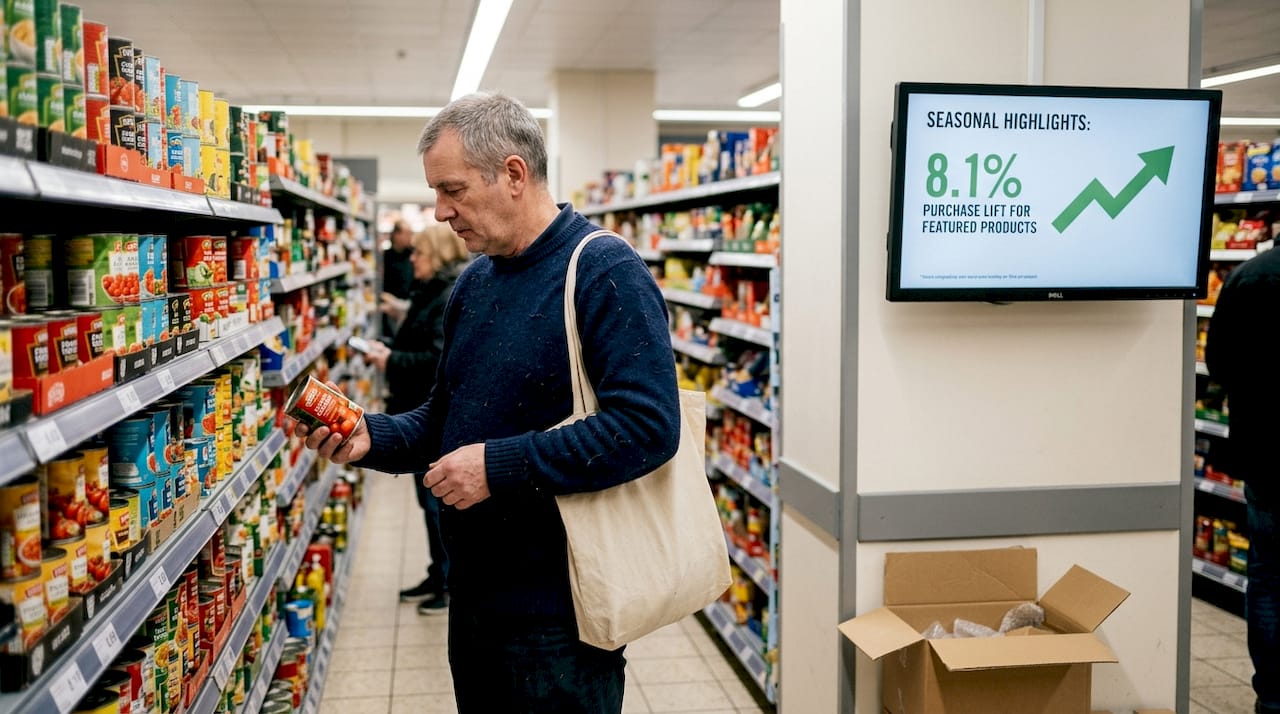
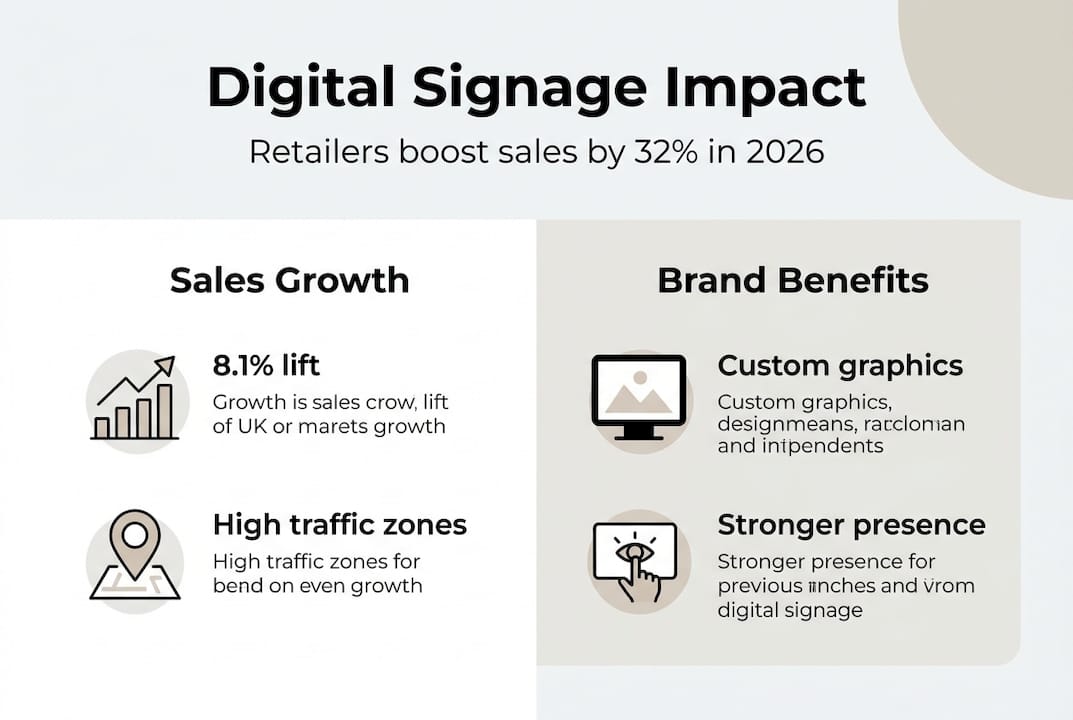
The numbers are compelling. An 8.1% purchase lift for featured products is a consistent benchmark, with some categories reporting up to 32% overall sales growth. UK retailers are already seeing this in practice across both fashion and sporting goods sectors, with enhanced customer engagement and strong ROI reported after deploying digital signage strategies tailored to their audiences.
| Benefit | Digital signage | Traditional print |
|---|---|---|
| Update speed | Instant, remote | Days to weeks |
| Cost per campaign change | Near zero | Print and labour costs |
| Personalisation | Time, weather, stock-aware | Static |
| Environmental impact | Lower over time | High (paper, ink, waste) |
| Engagement level | High (motion, colour) | Moderate |
| Benefit | Digital signage | Traditional print |
|---|---|---|
| Update speed | Instant, remote | Days to weeks |
| Cost per campaign change | Near zero | Print and labour costs |
| Personalisation | Time, weather, stock-aware | Static |
| Environmental impact | Lower over time | High (paper, ink, waste) |
| Engagement level | High (motion, colour) | Moderate |
Beyond sales, the operational efficiencies are significant:
- Remote management: Update all screens from one location, saving staff time.
- Campaign agility: React to a competitor promotion or a sudden weather change within minutes.
- Reduced print spend: Eliminate recurring costs for posters, banners, and shelf-edge labels.
- Dwell time improvement: Engaging content keeps customers in-store longer, increasing basket size.
The benefits of retail signs signage extend beyond aesthetics. When your visuals are tailored to your brand and audience, they reinforce trust and recognition at every touchpoint. Pairing digital screens with well-designed physical signage creates a cohesive, high-impact retail environment that static print simply cannot match.
Strategic placement and content: what works best?
To convert the benefits into results, screen location and content strategy are crucial. Here are the methodologies that work.
Placement drives performance. Strategic screen placement, content zoned by area, and integration with EPOS data are the foundations of a high-performing retail digital signage system. Here is a practical framework:
- Entrance screens: Use bold visuals and current promotions to attract attention and set the tone for the shopping experience.
- Aisle screens: Guide customers towards featured products or highlight complementary items to increase basket size.
- Checkout screens: Upsell with last-minute offers, loyalty programme prompts, or new product launches.
- Window-facing screens: Drive footfall with eye-catching content visible from the street, but always account for glare and brightness levels.
Content type also matters. Static images are the simplest to produce but the least engaging. Playlists rotate multiple messages and suit most retail environments. Triggered content, which reacts to time of day, weather, or stock levels, delivers the highest relevance and the strongest results.
A/B testing is underused in retail digital signage. Run two versions of a promotional message on different screens and track which drives more conversions. Over time, this builds a library of proven content formats for your specific audience.
Pro Tip: Before installing any screen, audit your foot traffic patterns and average dwell times by zone. A screen placed where customers spend only five seconds will never perform as well as one positioned where they naturally pause for thirty seconds or more. Combining digital screens with large format printing London for permanent brand elements ensures your entire store environment works together to maximise impact.
Calculating ROI: justifying digital signage investment
Once your screens are up, success hinges on measurement. Let us demystify the numbers and get ROI clarity.
The standard formula is straightforward: ROI = (Benefits minus Costs) divided by Costs, multiplied by 100. For UK SMEs, ROI can range from 47% to 124%, depending on sector, footfall, and content quality. One UK retail example showed a £5,700 investment generating £12,800 in revenue uplift, a return most traditional advertising channels cannot match.
To calculate your own ROI accurately, follow these steps:
- Capture baseline data for 8 to 12 weeks before installation. Record sales by product, category, and time of day.
- Define your cost inputs: hardware, CMS licence, installation, content creation, and ongoing maintenance.
- Track direct sales lift for featured products after launch. Compare against your baseline.
- Add print savings to your benefits column. Calculate what you previously spent on posters, banners, and seasonal graphics.
- Review at 90 days and again at six months for a reliable picture.
“Capturing pre-installation data is the single most overlooked step in retail digital signage. Without a baseline, you cannot prove what the screens actually achieved.”
For retailers who are not ready to go fully digital, a hybrid approach combining vinyl sticker printing London for static brand elements with screens for promotional content is a sensible middle ground. This allows you to phase your investment over time whilst maintaining a professional, consistent shopfront appearance.
Common pitfalls and advanced tips for UK retailers
Even with planning, many retailers slip on key details. Here is how to dodge costly errors and optimise for long-term results.
The most common issues are content fatigue, poor placement, and connectivity failures. These are avoidable with the right preparation. Expert best practices consistently point to the same set of principles:
- Update content at least weekly. Stale screens become invisible to regular customers. Automate scheduling wherever possible.
- Use commercial-grade hardware. Consumer televisions are not designed for 24/7 operation. Invest in displays rated at 500 nits or above for reliable brightness and longevity.
- Audit for glare and visibility. A screen facing a window in direct sunlight is wasted spend. Test brightness and viewing angles before finalising placement.
- Cache content locally. In multi-site environments, use wired connections or offline caching to prevent blank screens during connectivity outages.
- Apply the ‘so what?’ test. Before publishing any content, ask whether a passing customer would find it relevant and actionable. If not, revise it.
- Comply with GDPR. If you use camera-based audience analytics to personalise content, ensure your data collection and storage practices meet current UK regulations.
Pro Tip: Scale methodically. Prove your concept in one zone, document the results, and use that evidence to justify expanding to the next area. Rushing a full-store rollout before you understand what works in your specific environment is one of the most expensive mistakes a retailer can make.
“The retailers who get the best results from digital signage treat it like a media channel, not a piece of furniture. They plan content, measure performance, and iterate constantly.”
Stay informed about evolving retail signage trends to ensure your content strategy remains relevant and competitive as customer expectations continue to rise.
Should every retailer adopt digital signage?
Finally, is digital signage for everyone? Let us summarise where it excels and where it falls short, so you can make an informed decision.
The honest answer is: not always. 70% of retail signage fails due to a lack of strategy. A screen without a content plan and a measurement framework is, as one industry commentator put it, expensive wallpaper.
Digital signage delivers the strongest results when:
- Footfall is high and customers have sufficient dwell time to absorb the content.
- Promotions change frequently, making the cost of reprinting prohibitive.
- Reactive pricing or stock-aware messaging is commercially valuable.
- Multiple locations need consistent, centrally managed campaigns.
For very small shops with low footfall and infrequent promotions, the management overhead and upfront cost may not be justified. In these cases, a hybrid model combining shop signs London for permanent branding with a single digital screen for promotions is often the most practical and cost-effective approach.
“Digital signage is a tool, not a strategy. The retailers who treat it as the latter consistently outperform those who treat it as the former.”
Take your retail signage to the next level
Understanding the strategy is one thing. Executing it with the right partner makes all the difference. At PromoSigns, we provide end-to-end retail signage solutions across London, Essex, and Kent, from initial design and manufacturing through to professional installation and ongoing support.
Whether you are exploring the advantages of illuminated signage to complement your digital displays, or looking for bespoke shop signs Barnet that reflect your brand identity, our team is ready to help. We work with retail businesses of all sizes to deliver high-impact, durable signage that drives real results. Contact us today to book a free consultation or site survey and take the first step towards a more engaging, profitable retail environment.
Frequently asked questions
How much does digital signage cost for a typical UK shop?
In the UK, digital signage can start at a few hundred pounds for simple systems, but most small retailers invest £3,000 to £6,000 for a multi-screen setup with CMS and installation. A £5,700 investment has been shown to generate over £12,800 in revenue uplift in documented UK retail case studies.
What content engages shoppers on retail screens?
Featured offers, new product launches, and dynamic playlists that change with time of day or weather consistently drive the strongest engagement. Triggered content consistently outperforms static messaging when aligned with customer behaviour patterns.
Can digital signage integrate with existing EPOS or sales data?
Yes. Modern retail digital signage platforms can link to EPOS systems for stock-aware promotions, dynamic pricing, and accurate ROI tracking, making your screens genuinely responsive to what is happening in your business in real time.
How often should you update digital signage content?
Content should be refreshed at least weekly to prevent customer fatigue. Automating your schedule ensures screens always display relevant, timely messaging without requiring manual intervention every time a campaign changes.
Recommended
- Boost seasonal promotions with effective signage: 85% ROI – PromoSigns.co.uk
- Enhancing foot traffic with signage: strategies for 2026 – PromoSigns.co.uk
- Digital Signage Advantages: Essential Business Guide UK
- Build A Strong Market Presence With Digital Signage Display Options
