
TL;DR:
- Print turnaround times in the UK range from 2 to 7 working days for most digital jobs, excluding delivery. Urgent options like same-day or 24–48 hour services are available for simple projects with prompt proof approval. Delays often result from file errors, finishing processes, or courier issues, so clear communication and prepared files are essential for timely delivery.
Print turnaround time is defined as the total period from artwork submission to delivery of finished printed materials. For UK businesses and event organisers, understanding print turnaround times UK is the difference between a campaign that lands on time and one that misses its window entirely. Standard production across UK print services runs 2–7 working days, with express options compressing that to 24–48 hours. The key distinction most buyers overlook is that production time and delivery time are separate. Quoted turnaround figures from suppliers frequently cover production only, not the courier or postal transit that follows.
Table of Contents
What are standard print turnaround times in the UK?
Standard UK printing turnaround covers the period from file approval to the point your order leaves the print facility. Most print jobs complete within 2–7 working days for standard digital print, though litho printing for larger volumes typically sits at the longer end of that range. Digital printing is faster to set up and better suited to short runs, while litho requires plate preparation and is more efficient for high volumes but adds time at the front end of production.
Express and same-day services exist for genuinely urgent requirements, but they come with strict conditions:
- Express production: 24–48 hours from proof approval, with tracked courier delivery via services such as UPS, FedEx, and TNT included
- Same-day collection: Requires print-ready artwork confirmed and approved before approximately 10:00 AM on the day
- File readiness: Artwork must be supplied as a print-ready PDF with correct bleeds and crop marks. Any file that needs correction pauses the production clock entirely
- Job complexity: Same-day printing applies reliably only to simple jobs with standard sizes and minimal finishing requirements
The difference between digital and litho speed is worth understanding if you are planning a large promotional run. Digital presses start immediately once files are approved. Litho presses require physical plate-making, which adds half a day to a full day before ink touches paper. For runs under 500 units, digital is almost always faster and more cost-effective.
Pro Tip: For urgent jobs, request a dedicated printing expert rather than relying on automated order processing. A named contact will manually check your files before production begins, preventing pre-flight failures that would otherwise pause your job and push it to the following day.

How does direct mail affect total printing delivery times in the UK?
Direct mail introduces a second timeline on top of production: postal delivery. The two stages must be planned together, not separately. Production for a direct mail campaign typically takes 3–5 working days when data is clean and artwork is approved without amendments. Once dispatched, Royal Mail delivery adds further time depending on the service selected.
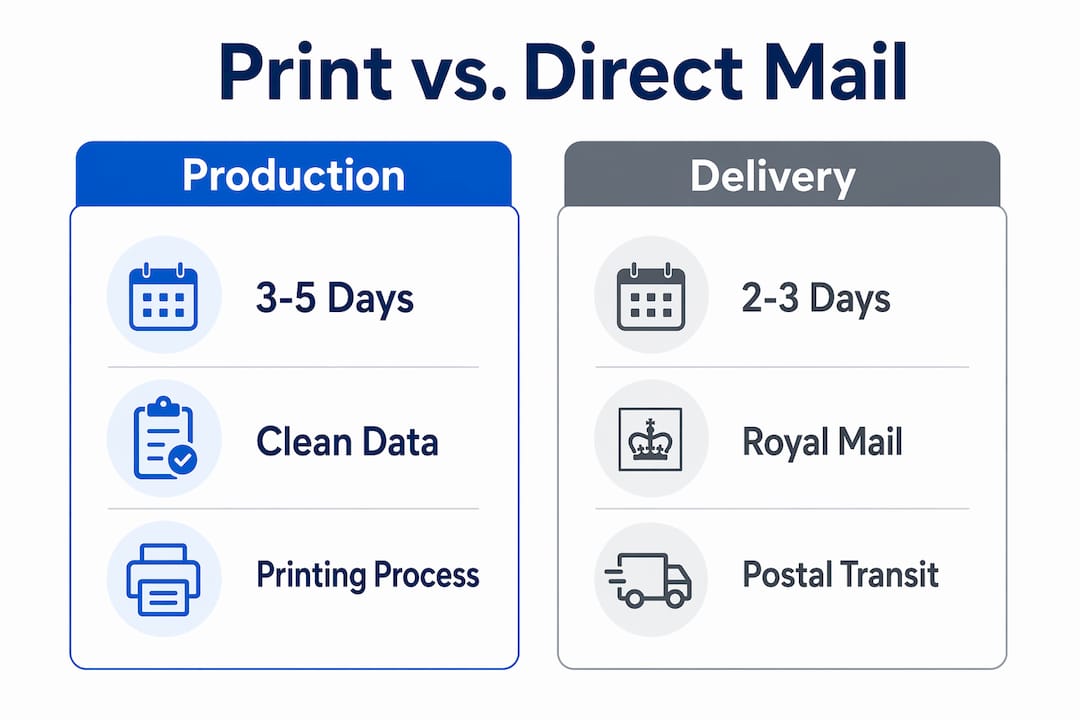
| Stage | 1st Class | 2nd Class |
|---|---|---|
| Production (clean data) | 3–5 working days | 3–5 working days |
| Royal Mail delivery | 2–3 working days | 3–5 working days |
| Estimated total | 5–8 working days | 6–10 working days |
| Large litho run (100,000+ pieces) | 14–18 working days total | 14–18 working days total |
Royal Mail 2nd Class delivery is not guaranteed within a specific timeframe, which matters significantly if you are working to a fixed event date. For campaigns with a hard deadline, 1st Class is the safer choice despite the higher postage cost.
Several factors extend direct mail timelines beyond the estimates above:
- Unclean data: Addresses requiring deduplication or formatting corrections delay the data preparation stage before printing even begins
- Artwork revisions: Any change requested after initial file submission restarts the production queue
- Cut-off timing: Same-day dispatch requires artwork approval and cleared payment before 10:00 AM. Missing that window pushes dispatch to the following working day
- Volume: Runs exceeding 100,000 pieces move to litho production, which carries a 14–18 working day total timeline from briefing to delivery
The practical implication for event organisers is clear. If your event is three weeks away and you need 50,000 mailers delivered, you are working with a comfortable margin. If your event is ten days away and you need 150,000 pieces, you are not.
Why do large-format and mounted prints take longer?
Large-format printing involves production steps that simply cannot be rushed without compromising quality. Inks applied to rigid substrates such as foamex, dibond, or plywood require curing and drying time before mounting or finishing can begin. Skipping or shortening these stages causes delamination, colour shift, and surface defects that make the finished product unusable.
Typical turnaround times for large-format printing by substrate and finish are as follows:
| Substrate / Finish | Typical Turnaround |
|---|---|
| Standard large-format print (unfinished) | 24 hours (simple jobs) |
| Foamex mounted print | 7–9 business days |
| Plywood mounted print | 14–16 business days |
| Laminated or special finish print | Add 1–3 days to base time |
The 24-hour option applies only to straightforward prints without complex finishes, non-standard sizes, or mounting requirements. As soon as lamination, specialist substrates, or bespoke dimensions enter the brief, the timeline extends. This is not a supplier inefficiency. It reflects the physical reality of working with large-format materials.
For businesses planning exhibition displays, retail hoardings, or construction site graphics, the mounting substrate choice directly determines your planning horizon. Foamex is the faster option for rigid mounted work. Plywood is more durable and weather-resistant but requires nearly twice the production time. If your installation date is fixed, work backwards from that date and select your substrate accordingly.
Pro Tip: If you need trade large-format printing on a tight schedule, specify your deadline at the point of enquiry rather than after receiving a quote. Suppliers can often prioritise production when they know the constraint upfront, rather than discovering it after the job has entered the standard queue.
Special finishes such as anti-graffiti coatings, UV varnish, and metallic laminates each add curing time. A job that would otherwise complete in five days can extend to eight or nine once a specialist finish is applied. Build that buffer into your schedule from the outset.
What factors most affect UK print order processing time?
The single most common cause of missed print deadlines is the confusion between production time and total arrival time. Production time and delivery time are distinct, yet most quoted turnaround figures cover production only. A job completing production on a Thursday afternoon may not dispatch until Friday morning, arriving the following Monday at the earliest with standard courier services.
Beyond that fundamental misunderstanding, the following factors most frequently extend print order processing time:
- File errors at submission: Incorrect colour profiles, missing bleeds, low-resolution images, and incorrect trim sizes all require correction before production can begin. Each correction round adds at least one working day.
- Finishing requirements: Setup and finishing such as trimming, binding, lamination, and folding frequently take longer than the actual press run, particularly for small batches.
- Non-standard sizes: Custom dimensions require bespoke cutting and cannot be batched with standard jobs, removing the efficiency gains that keep standard jobs fast.
- Proof approval delays: If you take 48 hours to approve a proof, those 48 hours come directly out of your available schedule. The production clock does not start until you approve.
- Courier cut-off times: Courier collection from print facilities typically occurs in the early afternoon. A job completing production at 3:00 PM may miss same-day collection and dispatch the following morning.
To protect your deadlines, follow these practices:
- Submit print-ready PDF files with correct bleeds, crop marks, and colour profiles from the outset
- Confirm whether quoted turnaround includes delivery or covers production only
- Approve proofs within the same working day whenever possible
- Ask your supplier for the courier cut-off time and plan your file submission accordingly
- For complex jobs, request a pre-production file check before the job enters the queue
Pro Tip: Build a minimum two-day buffer between your supplier’s quoted delivery date and your actual deadline. Courier delays, particularly around bank holidays and peak periods, are common and rarely covered by standard turnaround guarantees.
What we have learned about managing print deadlines
After working with businesses and event organisers across London, Essex, and Kent, the pattern we see most consistently is this: the print job itself rarely causes the delay. The delay comes from the gap between when a client thinks they submitted a ready file and when the printer actually receives one that can go straight to press.
Artwork that looks finished on screen frequently arrives with RGB colour profiles instead of CMYK, missing bleed areas, or fonts that have not been outlined. Each of those issues pauses production. The client assumes the clock is running. The printer is waiting for a corrected file. Two days disappear before anyone has noticed.
The second most common issue is treating the quoted turnaround as the arrival date. A supplier quoting five working days for production is not quoting five working days to your door. Add courier transit, and that figure becomes six or seven. For event organisers working to a venue setup date, that distinction is the difference between materials arriving on time and arriving the morning after.
Our honest advice is to build your print schedule around the worst-case timeline, not the best-case one. Express services are genuinely useful when a deadline shifts unexpectedly, but they should not be your default planning assumption. Establish a reliable relationship with your print supplier, communicate deadlines clearly at the point of enquiry, and submit files that are genuinely ready. Those three habits will eliminate the vast majority of deadline failures before they happen.
— Promo
How Promosigns supports your print and signage deadlines
Planning a campaign or event means every supplier in your chain needs to deliver on time. At Promosigns, we understand that print and signage deadlines are fixed, not flexible. Whether you need same-day printing in London for urgent promotional materials or a fully mounted large-format display for a retail launch, our team works to your schedule from the first enquiry.

Promosigns offers bespoke signage and print solutions for businesses across London, Essex, and Kent, with clear turnaround commitments and expert guidance at every stage. From shop signs in Barnet to exhibition displays and vehicle graphics, we manage production and installation end to end. Contact us today to discuss your requirements and get a clear timeline you can plan around.
FAQ
What is the standard print turnaround time in the UK?
Standard print turnaround in the UK runs from 2–7 working days for most digital print jobs. The exact time depends on job complexity, order volume, and whether delivery is included in the quoted figure.
Can i get same-day printing in the UK?
Same-day printing is available for simple jobs with standard sizes and minimal finishing, provided print-ready artwork is approved before approximately 10:00 AM. Complex jobs or those requiring mounting and special finishes cannot reliably meet a same-day turnaround.
Does quoted turnaround time include delivery?
Not always. Many UK print suppliers quote production time only, excluding courier or postal transit. Always confirm whether delivery is included, and add courier transit days to your planning schedule to avoid missing deadlines.
How long does direct mail take from print to delivery?
Direct mail typically takes 3–5 working days for production with clean data, plus 2–3 working days for Royal Mail 1st Class delivery. Large litho runs of 100,000 pieces or more carry a total timeline of 14–18 working days.
What causes print jobs to take longer than expected?
The most common causes are file errors requiring correction, finishing processes such as trimming and lamination, non-standard sizes, delayed proof approvals, and missing courier cut-off times. Submitting a print-ready PDF from the outset removes the most frequent source of delay.
Recommended
- Same Day Printing London | Urgent Print Services – PromoSigns
- Large Format Printing Basics 2025: Essential Guide for London Businesses – PromoSigns.co.uk
- Large Format Printing Explained: Essential Guide for London Businesses 2025 – PromoSigns.co.uk
- Large Format vs Small Format Printing: London 2025 Guide – PromoSigns.co.uk
