
Table of Contents
Sign Content Regulations: Essential UK Compliance Guide for Business Owners
Understanding signage content regulations ensures legal compliance, prevents costly enforcement action, and protects business reputation. UK legislation governs what businesses can display, how messages must be presented, and which claims require substantiation, creating complex obligations that demand careful attention and professional guidance.
This comprehensive guide explores UK sign content regulations, covering advertising standards, claims substantiation, prohibited content, specific sector requirements, planning permission considerations, and practical compliance strategies that protect businesses while maximizing marketing effectiveness.
Key Takeaways
| Point | Details |
|---|---|
| Understanding Regulations | Familiarise yourself with the Town and Country Planning (Control of Advertisements) Regulations 2007 to navigate signage laws effectively. |
| Engage with Local Authorities | Consult local planning authorities early in the design process to confirm specific requirements and avoid compliance issues. |
| Compliance is Crucial | Non-compliance with sign regulations can lead to hefty fines and reputational damage, making thorough understanding essential. |
| Document Everything | Maintain a comprehensive file of all sign-related documentation to demonstrate compliance if challenged. |
Why Sign Content Regulations Matter
Legal and Financial Consequences
Regulatory Framework: Multiple authorities govern signage content:
Enforcement Bodies:
- Advertising Standards Authority (ASA)
- Trading Standards (local authorities)
- Competition and Markets Authority (CMA)
- Local planning authorities
- Industry-specific regulators (FCA, MHRA, etc.)
Non-Compliance Consequences:
Financial Penalties:
- Fines: £1,000-£5,000+ (Trading Standards)
- Unlimited fines (serious breaches)
- Legal costs (defense, appeals)
- Removal costs (enforcement notices)
- Corrective advertising expenses
Operational Impact:
- Removal orders (immediate action)
- Business disruption
- Reputation damage
- Customer trust erosion
- Competitive disadvantage
Legal Proceedings:
- Criminal prosecution (severe cases)
- Civil claims (consumer harm)
- Director liability (company breaches)
Consumer Protection Imperative
Fundamental Principles: UK advertising law prioritizes consumer welfare:
Core Requirements:
- Truthful claims (accuracy obligation)
- Clear communication (no deception)
- Substantiated statements (evidence-backed)
- Fair competition (no misleading comparisons)
- Vulnerable consumer protection (children, elderly)
Advertising Standards Authority (ASA) Rules
CAP Code Fundamentals
UK Code of Non-broadcast Advertising: Comprehensive rules govern all advertising including Signage Companies and other business signage:
Core Principles:
Legal, Decent, Honest, Truthful: All advertising must be:
- Legal: Compliant with UK law
- Decent: Acceptable to society
- Honest: Transparent and fair
- Truthful: Accurate and substantiated
Misleading Advertising Prohibition: Strict rules prevent deception:
- Literal truth insufficient (overall impression matters)
- Omissions can mislead (material information)
- Ambiguity avoided (clear communication)
- Exaggeration restricted (obvious puffery only)
Common Compliance Issues
Problematic Claims:
Superlatives Without Substantiation:
- “Best in London” (requires proof)
- “Number One” (needs verification)
- “Leading” (substantiation essential)
- “Unique” (must be demonstrably true)
Unqualified Claims:
- “From £X” (must be genuinely available)
- “Up to X% off” (clear conditions)
- “Sale” (genuine reduction required)
- “Free” (no hidden costs)
Time-Limited Offers:
- Specific dates (clear display)
- “Limited time” (reasonable duration)
- Stock availability (genuine scarcity)
Specific Sector Rules
Financial Services: Financial Conduct Authority (FCA) regulations:
- Risk warnings (clear prominence)
- Representative examples (specific requirements)
- Interest rate display (APR mandatory)
- Authorized status (clear indication)
Healthcare and Medical: Medicines and Healthcare products Regulatory Agency (MHRA):
- Medicinal product claims (restrictions)
- Health benefit assertions (substantiation)
- Professional credentials (verification)
- Treatment efficacy (evidence requirements)
Food and Drink: Food Standards Agency and EU retained law:
- Nutrition claims (specific definitions)
- Health claims (authorized list only)
- Organic labeling (certification required)
- Allergen information (clear display)
Children’s Products: Enhanced protection requirements:
- No exploitation (vulnerability consideration)
- Age-appropriate (content suitability)
- Safety emphasis (harm prevention)
- Pester power avoidance (parental respect)
| Sign Type | Key Regulatory Focus | Typical Consent Required |
|---|---|---|
| Commercial | Size, placement, illumination | Express or deemed local consent |
| Safety | Colour, symbol, positioning | Mandatory compliance with standards |
| Digital/Illuminated | Light emission, location | Rigorous planning authority approval |
| Conservation Area | Materials, visual impact | Special local consent and review |
Planning Permission and Advertisement Consent
When Consent Required
Advertisement Control: Local planning authorities regulate external signage:
Generally Requires Consent:
Size Thresholds:
- Exceeding specified dimensions
- Location-specific (conservation areas)
- Building type (listed buildings)
Illumination:
- Internally lit signs
- LED signs
- Moving/animated content
- Flashing elements
Projection:
- Signs extending from buildings
- Perpendicular mounting
- Height and projection limits
Content Restrictions in Consent
Planning Authority Powers: Beyond structural approval, content may be regulated:
Common Restrictions:
Conservation Areas:
- Design and appearance standards
- Material specifications
- Color limitations
- Message appropriateness (commercial limitations)
Listed Buildings:
- Heritage sensitivity
- Character preservation
- Historic authenticity
- Content appropriateness
Residential Proximity:
- Commercial messaging limits
- Operating hours (illumination)
- Content sensitivity (appropriateness)
Prohibited and Restricted Content
Offensive and Inappropriate Material
Decency Standards: Business signs and all business signage must avoid:
Prohibited Content:
- Profanity and offensive language
- Sexual content (explicit imagery)
- Violence and gore
- Drug references (illegal substances)
- Discrimination (protected characteristics)
- Hate speech
Location Considerations: Content acceptability depends on context:
- Proximity to schools (enhanced sensitivity)
- Religious buildings (respect considerations)
- Residential areas (appropriateness)
- Family-friendly zones (content suitability)
Political and Controversial Content
Neutrality Expectations: Commercial signage restrictions:
Generally Prohibited:
- Political party endorsements
- Electoral campaigning
- Controversial social issues
- Religious proselytizing (commercial contexts)
Permitted:
- Corporate social responsibility
- Environmental commitments
- Community support
- Charitable partnerships
Intellectual Property
Copyright and Trademark: Unauthorized use creates liability:
Protected Content:
- Trademarks (registered brands)
- Copyrighted images (photography, artwork)
- Celebrity endorsements (unauthorized)
- Character licensing (fictional/real)
- Competition references (trademark infringement)
Fair Use Limitations: Limited defenses in commercial contexts:
- Parody (restricted commercial use)
- Critique (narrow application)
- Generic terms (trademark dilution avoidance)

Price and Promotion Regulations
Consumer Protection from Unfair Trading
Pricing Transparency: Clear, honest price communication:
Requirements:
Total Price Display:
- VAT inclusion (B2C mandatory)
- All mandatory charges (no hidden costs)
- Optional extras (clear identification)
- Unit pricing (specific products)
Price Reduction Claims: “Sale” and “Was/Now”:
- Previous price genuine (28-day rule typical)
- Reasonable period at higher price
- Recent date (not historical)
- Percentage calculations accurate
“From” Pricing:
- Genuinely available (stock verification)
- Significant proportion (not single example)
- Clear conditions (when lower price applies)
“Up To” Claims:
- Maximum discount available (real examples)
- Reasonable proportion (not isolated)
- Clear qualifying conditions
Promotional Offers
Terms and Conditions: Material information must be clear:
Display Requirements:
- Eligibility criteria (who qualifies)
- Time limitations (offer duration)
- Stock availability (while stocks last)
- Restrictions (exclusions, limitations)
- How to claim (redemption process)
Size and Prominence:
- Readable from intended distance
- Not contradicting main message
- Positioned close to claim
- Adequate contrast
Sector-Specific Requirements
Alcohol Advertising
Strict Content Rules: Portman Group Code and CAP:
Prohibited:
- Appealing to under-18s
- Linking to antisocial behavior
- Suggesting therapeutic properties
- Implying sexual success
- Encouraging irresponsible drinking
Mandatory:
- Social responsibility messaging (where required)
- Age restriction clarity
- Drinkaware reference (industry standards)
Gambling and Betting
Gambling Commission Rules: Stringent advertising controls:
Requirements:
- Harm minimization (responsible messaging)
- No children targeting
- Reality of winning (no false expectation)
- Licensed operator identification
- Complaint mechanisms
Healthcare and Pharmaceuticals
MHRA Regulations: Medicine advertising restrictions:
Prescription-Only Medicines (POM):
- No public advertising (professional only)
- Clear restrictions
Over-the-Counter (OTC):
- Claims substantiation (clinical evidence)
- Balanced information (risks and benefits)
- No diagnosis encouragement (professional consultation)
Comparative Advertising
Legitimate Comparisons
Permitted Conditions: Competitor references allowed when:
Requirements:
- Truthful comparison (factual accuracy)
- Fair selection (like-for-like)
- Substantiated claims (verifiable)
- Specific product identification (clear reference)
- No confusion creation (trademark respect)
- No disparagement (fair competition)
Example Acceptable: “Our prices lower than [specific competitor] on [specific product category]” (With substantiation and fair comparison)
Example Problematic: “Better than [competitor]” (Subjective, unsubstantiated)
Trademark Issues
Competitor References: Using competitor trademarks risky:
Safe Approaches:
- Generic category references (“other leading brands”)
- Factual comparisons (substantiated, specific)
- Descriptive use (comparative context)
- Proper attribution (no confusion)
Dangerous Practices:
- Logo reproduction (trademark infringement)
- Disparagement (unfair competition)
- False association (passing off)
- Dilution (reputation damage)
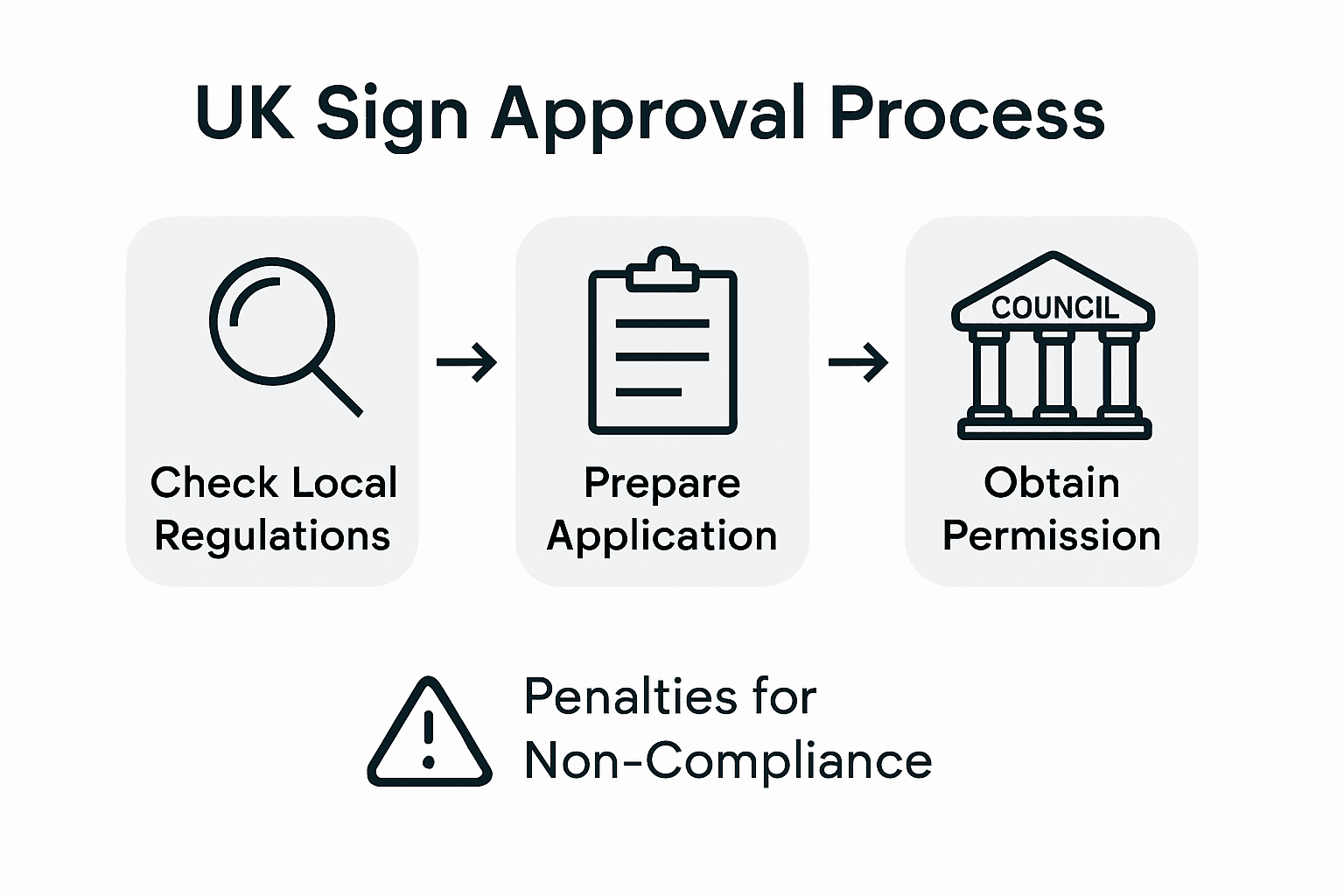
Pro Tip: Pre-Application Consultation: Always schedule a preliminary meeting with local planning officers before submitting formal sign design proposals to understand specific local requirements and increase your chances of first-time approval.
Digital and Electronic Signs
Dynamic Content Regulations
Additional Considerations: Digital displays face enhanced scrutiny:
Content Rotation:
- Each message independent compliance
- Context appropriateness (time of day)
- Frequency limits (no excessive repetition)
- Seizure safety (no flashing patterns)
Animation and Movement:
- Distraction prevention (road safety)
- Speed limitations (comprehension time)
- Brightness control (light pollution)
Interactivity:
- Data collection (GDPR compliance)
- Terms and conditions (clear access)
- Privacy policies (user information)
Compliance Strategy
Pre-Publication Review
Risk Mitigation: Proactive compliance checking:
Internal Review:
- Legal team verification (compliance check)
- Marketing approval (brand alignment)
- Management sign-off (accountability)
External Expertise: When to seek professional guidance:
- New product launches (novel claims)
- Regulated sectors (complex rules)
- Competitor comparisons (trademark issues)
- Substantial investment (risk management)
Documentation and Substantiation
Evidence Maintenance: Retain proof for claims:
Required Documentation:
- Price comparisons (previous pricing records)
- Product testing (technical specifications)
- Customer testimonials (permissions, authenticity)
- Survey results (methodology, sample size)
- Expert opinions (credentials, independence)
- Market research (independent verification)
Retention Period: Minimum 2 years (longer for specific sectors)
Monitoring and Response
Complaint Management:
ASA Investigations:
- Cooperation essential (regulatory engagement)
- Evidence provision (substantiation)
- Prompt response (deadlines compliance)
- Corrective action (swift implementation)
Trading Standards:
- Formal notices (compliance requirements)
- Rectification (agreed timelines)
- Future compliance (assurance provision)
Practical Examples
Compliant vs. Non-Compliant
Price Claims:
✅ Compliant: “Was £100, Now £70 (30% off). Offer ends 31 Jan 2026. T&Cs apply.”
❌ Non-Compliant: “MASSIVE SAVINGS! Prices slashed!” (Unsubstantiated, no specific information)
Superlative Claims:
✅ Compliant: “Winner of [Specific Award] 2025” (Verifiable, specific)
❌ Non-Compliant: “The Best Coffee in London” (Unsubstantiated superlative)
Health Claims:
✅ Compliant: “High in Vitamin C” (Authorized nutrition claim)
❌ Non-Compliant: “Boosts your immune system” (Unauthorized health claim)
The following table compares potential risks and penalties for non-compliant signage versus compliant signage:
| Compliance Status | Possible Penalties | Business Impact |
|---|---|---|
| Non-Compliant Sign | Fines, sign removal | Financial loss, reputational damage |
| Fully Compliant Sign | No penalties assessed | Smooth operation, regulatory approval |
| Repeated Violations | Increased scrutiny | Slower approvals, stricter oversight |
Working with Signage Professionals
Compliance Guidance
Professional Providers: Experienced signage companies understand regulations:
Services:
- Content review (compliance checking)
- Regulatory guidance (sector-specific knowledge)
- Approval navigation (planning authority liaison)
- Revision recommendations (compliant alternatives)
Selection Criteria:
- Regulatory knowledge (up-to-date)
- Sector experience (relevant expertise)
- Professional indemnity insurance (protection)
- ASA complaint history (track record)
Conclusion
Navigating UK sign content regulations requires understanding Advertising Standards Authority rules, planning permission requirements, sector-specific restrictions, and consumer protection legislation that govern business signage from Sign Makers storefronts through to digital displays. Compliance protects businesses from enforcement action, maintains customer trust, and ensures marketing investments deliver returns without legal complications.
Success demands proactive content review, claims substantiation, appropriate professional guidance, and systematic compliance monitoring that anticipates regulatory developments and prevents costly mistakes. Strategic compliance transforms regulatory obligations from constraints into competitive advantages through professional presentation, trustworthy messaging, and sustainable marketing practices.
For businesses seeking expert guidance on signage content compliance, partnering with experienced providers ensures access to regulatory knowledge, content review capabilities, and professional execution that maximizes marketing effectiveness while maintaining full legal compliance and protecting business reputation.
Recommended
- Retail Signage Compliance Guide 2025 for London Businesses – PromoSigns.co.uk
- Illuminated Sign Regulations: Key Rules for Businesses in 2025 – PromoSigns.co.uk
- Understanding Business Signage Regulations in London – PromoSigns.co.uk
- Sign Regulations in UK: What Businesses Must Comply With – PromoSigns.co.uk
