
Every year, accidents on construction sites lead to thousands of injuries, many of which are preventable. The right signage does more than fill a checklist — it keeps everyone safer, ensures legal compliance, and shows respect for workers and the public. With international standards like ISO 3864 shaping effective signage, these visual guides simplify communication, reduce risk, and support smooth, safe site operations for everyone who steps onto the job.
Table of Contents
Key Takeaways
| Point | Details |
|---|---|
| Importance of Signage | Construction site signage is essential for safety, legal compliance, and effective communication across dynamic work environments. |
| Categories of Signs | Signs fall into five main categories: Prohibition, Mandatory, Warning, Safe Condition, and Fire Safety, each serving distinct purposes and adhering to specific design principles. |
| Regulatory Compliance | Compliance with international standards like ISO 3864 and legal requirements ensures worker safety and reduces liability in construction operations. |
| Avoiding Common Mistakes | Proactive monitoring and proper placement of signage are critical to enhance visibility and effectiveness, minimizing workplace risks. |
Table of Contents
- Defining Construction Site Signage And Its Importance
- Key Types Of Construction Site Signs Explained
- Legal Requirements And Regulatory Compliance
- Safety, Health, And Employer Responsibilities
- Common Mistakes And How To Avoid Them
Defining Construction Site Signage and Its Importance
Construction site signage represents a critical communication system that ensures safety, provides clear guidance, and maintains legal compliance across dynamic work environments. These carefully designed visual indicators serve multiple essential purposes beyond mere information transmission.
ISO 3864 international standards establish that construction signage must adhere to specific design principles that transcend language barriers. The standards establish precise guidelines for:
- Colour coding for immediate visual recognition
- Standardised symbol design
- Universal layout principles
- Visibility requirements
Well-designed construction signage plays a pivotal role in navigational safety, providing crucial advance warnings that benefit all site users, including individuals with visual impairments in complex site environments.
Beyond safety, construction site signage serves multiple strategic functions — legal compliance, risk management, directional guidance, and establishing clear operational boundaries. For sites requiring large perimeter displays, advertising construction hoardings London combines regulatory compliance with professional branded presentation, creating a strong first impression for clients, planners and the public. A comprehensive sign installation guide can help organisations understand the nuanced requirements of effective site communication.
Effective construction signage is not just a regulatory requirement — it is a fundamental communication tool that protects workers, visitors, and the overall project ecosystem.
Key Types of Construction Site Signs Explained
Construction site signage is a complex system of visual communication designed to protect workers, visitors, and ensure smooth operational processes. Understanding the different categories of signs is crucial for maintaining safety and legal compliance across work environments.
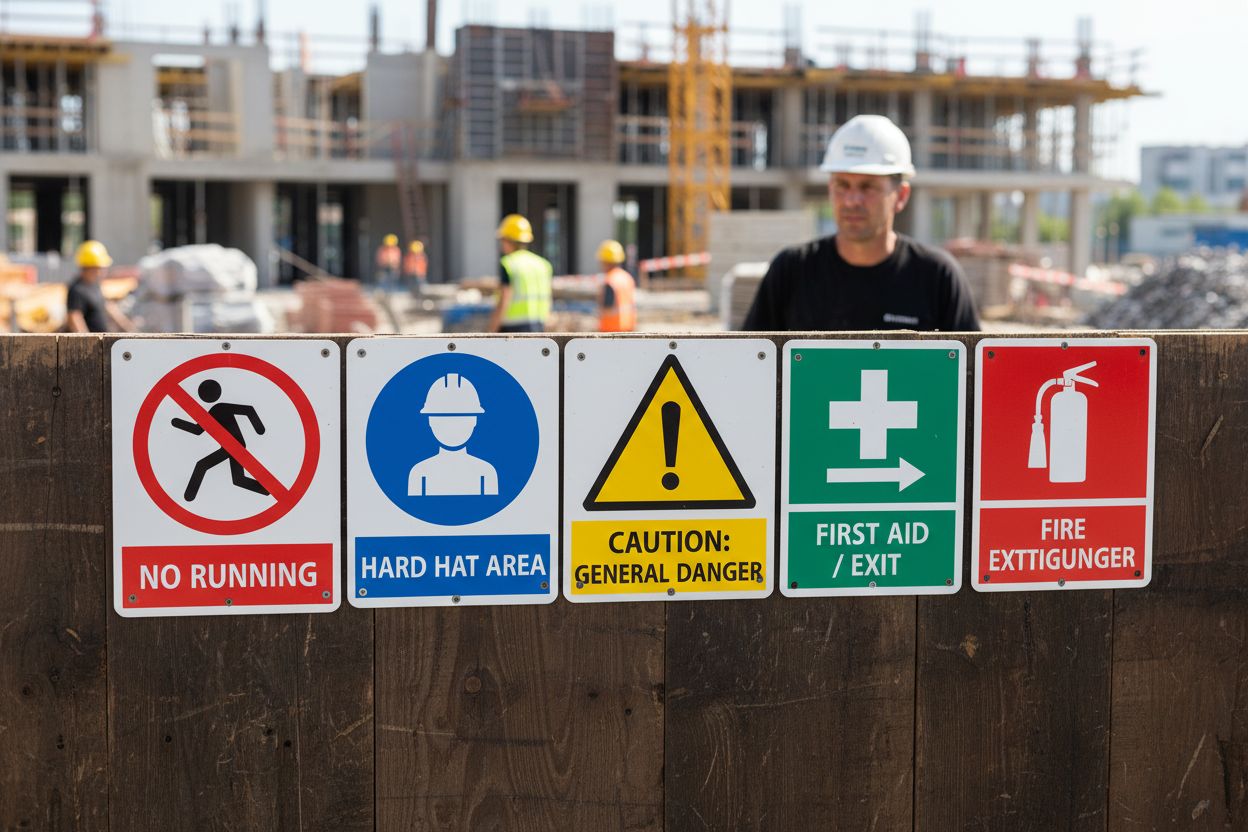
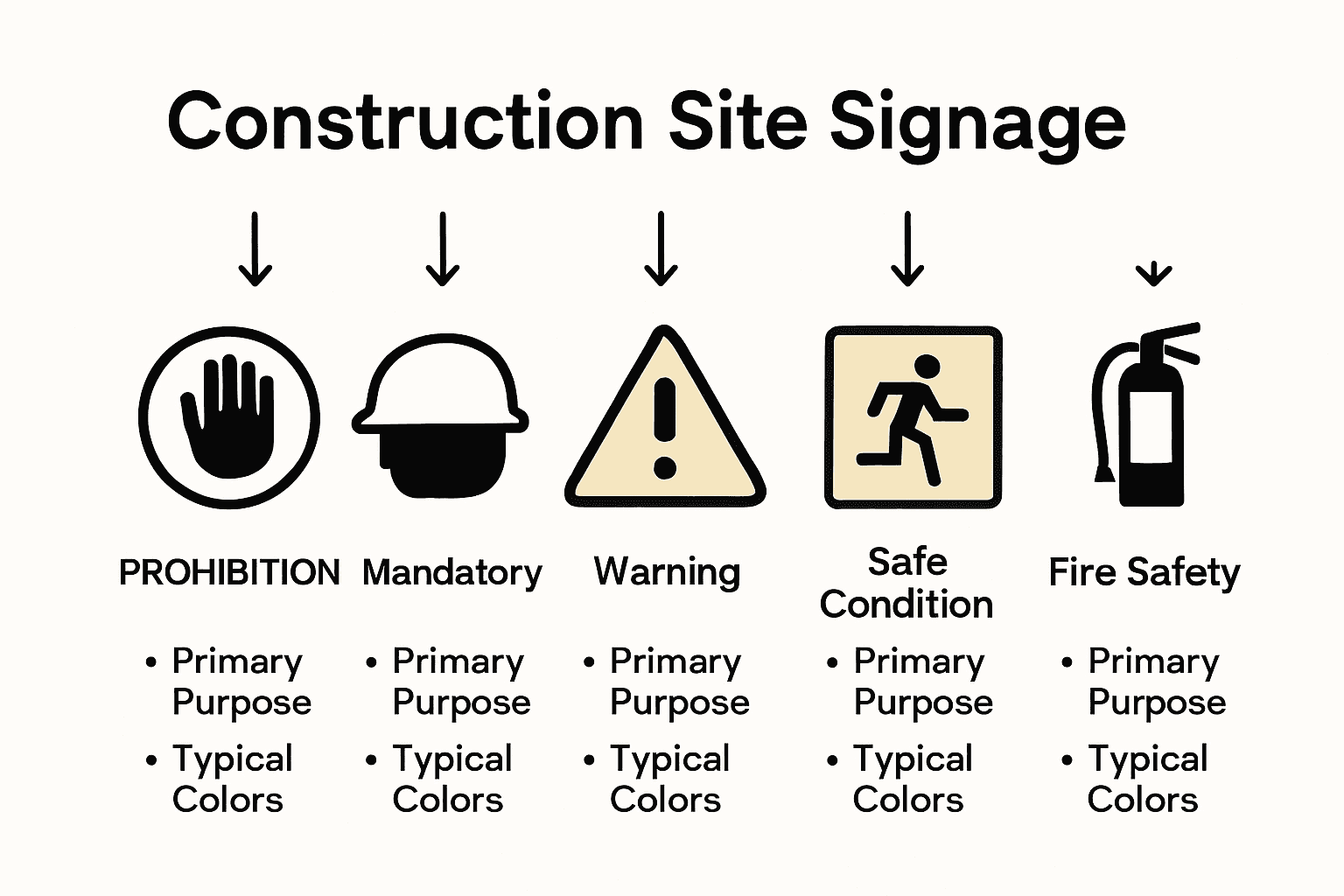
Construction signs are strategically classified into five primary categories:
- Prohibition Signs: Preventing dangerous actions
- Mandatory Signs: Enforcing required safety behaviours
- Warning Signs: Alerting to potential hazards
- Safe Condition Signs: Indicating safe routes and emergency procedures
- Fire Safety Signs: Marking fire-related equipment and escape routes
Each category follows specific design principles. Prohibition signs typically use red circles, while warning signs employ yellow triangles, ensuring immediate visual recognition across diverse workforce demographics.
| Sign Category | Main Purpose | Common Shape & Colour | Typical Examples |
|---|---|---|---|
| Prohibition Signs | Prevent dangerous actions | Red circle with line | No entry, No smoking |
| Mandatory Signs | Enforce required behaviours | Blue circle | Wear helmet, Eye protection |
| Warning Signs | Alert to potential hazards | Yellow triangle | Danger: Machinery, Asbestos present |
| Safe Condition Signs | Indicate safe procedures | Green rectangle or square | First aid, Emergency exit |
| Fire Safety Signs | Mark fire equipment/escape | Red rectangle | Fire extinguisher, Fire alarm |
International standards such as ANSI Z535 emphasise the importance of consistent colour coding, specific signal words such as “DANGER” and “WARNING”, and clear graphical representations. These standardised approaches help overcome language barriers and ensure universal comprehension of critical safety information.
For large-scale, weatherproof safety panels along site perimeters, mesh banner printing London delivers wind-resistant, high-visibility graphics that maintain legibility throughout the life of the project.
Legal Requirements and Regulatory Compliance
Construction site signage represents a critical legal obligation that extends far beyond mere visual communication. Regulatory frameworks establish stringent requirements to ensure worker safety, protect public health, and mitigate potential workplace risks through comprehensive signage standards.
EU Directive 92/58/EEC specifies that workplace safety signs must meet minimum requirements covering:
- Mandatory sign placement when hazards cannot be eliminated
- Precise colour coding standards
- Standardised symbol design
- Clear visibility and positioning guidelines
International technical standards ISO 3864 and ISO 7010 provide comprehensive global frameworks for sign design, establishing critical parameters including:
- Photometric properties of signs
- Multi-message signage protocols
- Universal symbol recognition
- Colour specifications for maximum comprehension
These regulatory frameworks are not bureaucratic formalities but essential protective mechanisms. Construction managers must understand that compliance involves more than simply displaying signs — it requires strategic implementation that addresses specific site risks, worker demographics, and potential hazard scenarios.
Working with professional signage companies London ensures your installation meets current UK planning and health and safety requirements from the outset, removing the risk of costly non-compliance notices during site inspections.
Safety, Health, and Employer Responsibilities
Construction site safety represents a comprehensive legal and moral obligation that extends far beyond simple compliance. Employers bear significant responsibility for creating and maintaining environments that protect workers, visitors, and the broader community from potential workplace hazards.
The UK Health and Safety at Work etc. Act 1974 establishes critical employer responsibilities, which include:
- Ensuring safe working systems and practices
- Providing comprehensive safety information and signage
- Maintaining safe places of work
- Guaranteeing safe means of access and egress
- Managing potential risks proactively
Key employer obligations include:
- Conducting thorough risk assessments
- Providing appropriate safety training
- Supplying necessary protective equipment
- Implementing and enforcing strict safety protocols
- Maintaining clear and visible safety signage
For welfare facilities, site offices and internal safety notices, foamex signs printing London provides a lightweight, rigid substrate that prints crisply and withstands the demands of a busy construction environment.
These responsibilities are not mere bureaucratic exercises but critical interventions that directly impact human lives. By embracing them comprehensively, employers not only meet legal requirements but also create a culture of safety that protects their most valuable asset — their workforce.
Common Mistakes and How to Avoid Them
Construction site signage requires meticulous attention to detail, with seemingly minor errors potentially compromising worker safety and legal compliance. Understanding and proactively addressing common mistakes can significantly reduce workplace risks and potential regulatory penalties.
Several critical errors that construction managers frequently encounter include:
- Using inappropriate or non-standard symbols
- Poor sign visibility and contrast
- Inadequate sign placement
- Failing to conduct regular signage audits
- Neglecting to update signs as site conditions change
Particularly problematic are placement and visibility issues. Ineffective positioning can dramatically reduce safety effectiveness. Key recommendations include:
- Positioning signs at sufficient distance before potential hazards
- Using highly reflective materials for maximum visibility
- Ensuring signs are not obscured by equipment or vegetation
- Maintaining clear sightlines from multiple approach angles
- Regularly inspecting and replacing worn or faded signage
For high-volume site graphics that need to be produced quickly and consistently across multiple boards and panels, large format printing London delivers sharp, durable output at the scale construction projects demand.
Construction managers must adopt a proactive, systematic approach to signage management — treating signs not as static objects, but as dynamic safety communication tools that require consistent evaluation, maintenance, and strategic positioning.
Upgrade Your Site Safety With Professional Construction Signage
Are you worried about unclear or outdated signage putting your project at risk? This complete guide highlights how improper placement, faded signs, and non-standard symbols can cost you more than just a fine — they threaten the safety of everyone on your site. Your commitment to legal compliance and effective site communication starts with high-impact, standards-compliant signs designed for maximum visibility and reliability.
Choose PromoSigns to eliminate signage mistakes with fully customised design, production, and installation services across London, Essex, and Kent. See how our step-by-step installation process ensures your site meets every regulatory requirement. Do not let preventable errors jeopardise your next build. Visit PromoSigns today to request your site audit or discover how we can tailor shop signs, illuminated signs, and large format solutions for your team’s safety.
Frequently Asked Questions
What are the main types of construction site signs?
The main types of construction site signs are prohibition signs, mandatory signs, warning signs, safe condition signs, and fire safety signs. Each serves a specific purpose and follows standardised design principles for effective communication.
What legal requirements must construction signage meet?
Construction signage must meet specific legal requirements, including mandatory sign placement when hazards cannot be eliminated, adherence to colour coding and symbol design standards, and compliance with visibility and positioning guidelines as outlined in regulatory frameworks like EU Directive 92/58/EEC and ISO standards.
How can construction site signage improve worker safety?
Well-designed construction signage improves worker safety by providing crucial warnings, guiding safe navigation, and ensuring clarity of communication in potentially hazardous environments, thereby reducing the risk of accidents and injuries.
What common mistakes should be avoided when placing construction signs?
Common mistakes to avoid include using non-standard symbols, poor sign visibility, inadequate placement of signs, neglecting regular signage audits, and failing to update signs as site conditions change. Proper positioning and visibility are critical for effective safety communication.
Recommended
- How to Design Building Signage: A 2025 Guide for London Businesses – PromoSigns.co.uk
- A Step-by-Step Guide to Professional Commercial Sign Installation – PromoSigns.co.uk
- How to Choose Signage: Best Tips for London Businesses 2025 – PromoSigns.co.uk
- Graphic Design Tips for Signage: 2025 Guide for London Businesses – PromoSigns.co.uk
