
- Signage for networking events is far more than colourful banners and unmissable logos. More than 60 percent of attendees say clear signage directly impacts their overall event satisfaction. Surprising, right. It is not the speeches or refreshments people remember most but the way simple signs silently orchestrate every professional interaction.
Table of Contents
- What Is Signage For Networking Events?
- The Purpose Of Networking Event Signage
- Types Of Signage For Professional Networking
- The Importance Of Effective Signage
- Communication And Participant Engagement
- Branding And Professional Perception
- Types Of Signage And Their Functions
- Informational And Directional Signage
- Branding And Interactive Signage
- Design Principles For Impactful Signage
- Visual Communication And Readability
- Contextual And Psychological Design Approaches
- Real-World Examples Of Successful Event Signage
- Technology Conferences And Innovation Showcases
- Professional Networking Summits And Industry Conferences
Table of Contents
Quick Summary
| Takeaway | Explanation |
|---|---|
| Effective signage enhances event experience | Professional signage provides clarity and structure, helping participants navigate and connect seamlessly at networking events. |
| Signage types serve unique purposes | Different signage categories, such as directional, informational, and branding displays, cater to various communication needs during an event. |
| Design principles impact readability and accessibility | High-contrast colours, clear typography, and intuitive layouts ensure signs are easily understood, reducing cognitive load for attendees. |
| Engagement through interactive signage | Incorporating technology like digital displays and wayfinding boards fosters participant interaction and keeps attendees informed in real-time. |
| Branding reflects organisational professionalism | Well-designed signage communicates an organisation’s identity and commitment to quality, enhancing the overall perception of the event. |
What is Signage for Networking Events?
Signage for networking events represents strategic visual communication tools designed to facilitate interactions, guide participants, and enhance the overall event experience. Event signage serves as critical infrastructure that transforms spaces into organised, informative environments where professionals can connect effectively.
The Purpose of Networking Event Signage
Networking event signage goes far beyond simple directional markers. These visual elements play a multifaceted role in creating structured, engaging professional environments. The primary objectives include:
- Providing clear navigational guidance through event spaces
- Establishing professional branding and event identity
- Facilitating structured interactions between participants
- Communicating essential event information and schedules
Professional signage acts as a silent communicator, helping attendees understand spatial layouts, session locations, and organisational hierarchies without constant verbal instructions. Well-designed signs can reduce confusion, minimise interruptions, and create a seamless networking experience.
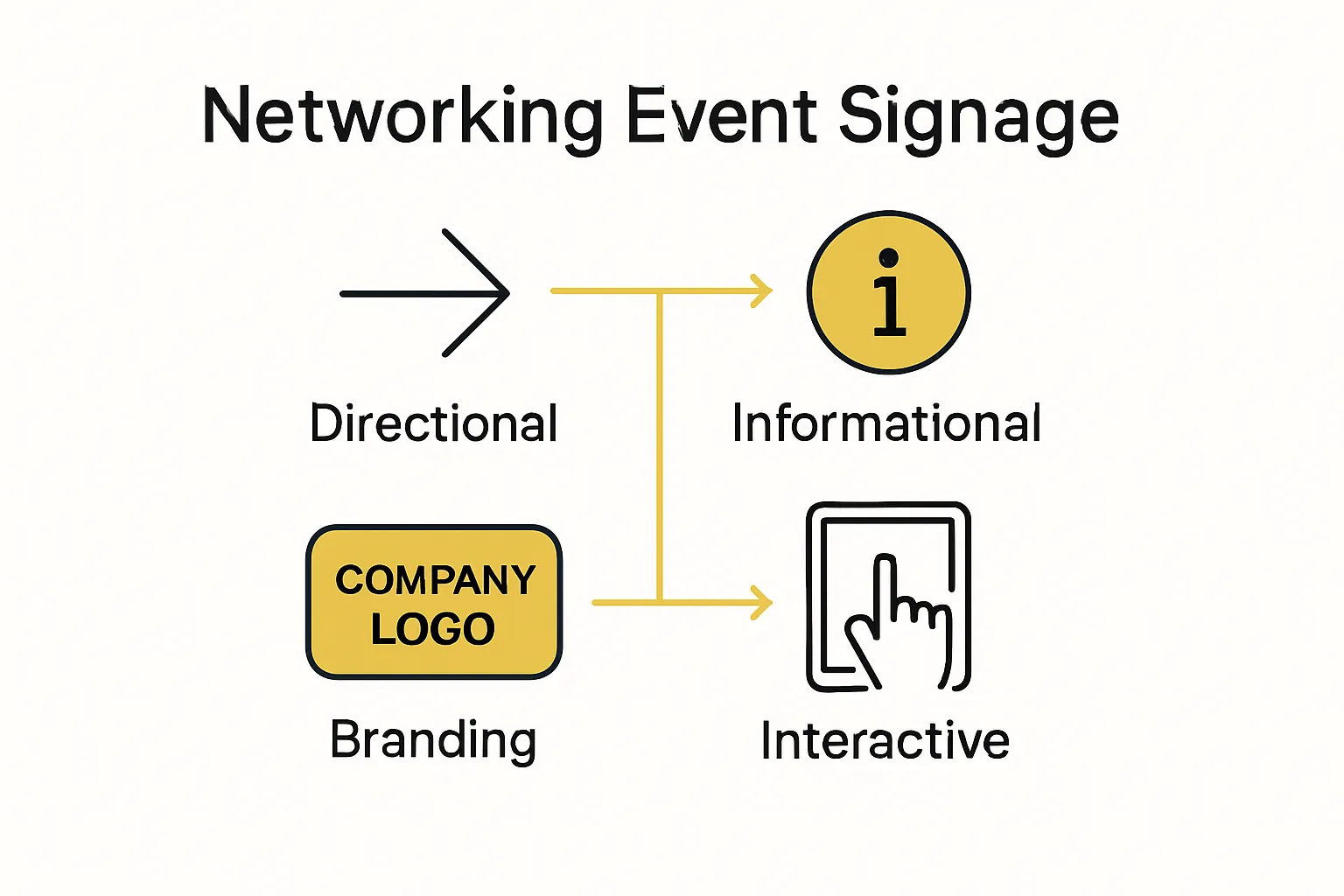
Types of Signage for Professional Networking
Networking event signage encompasses several strategic categories, each serving unique communication purposes.
These include:
- Directional Signs: Helping participants navigate venue spaces efficiently
- Information Panels: Displaying schedules, speaker details, and event logistics
- Branding Displays: Showcasing organisational logos and event themes
- Interactive Digital Signage: Offering real-time updates and engagement opportunities
By understanding these signage types, event organisers can create sophisticated communication ecosystems that enhance professional interactions.
| Signage Type | Primary Function |
|---|---|
| Directional Signs | Guide participants efficiently through the venue |
| Information Panels | Display schedules, speaker details, and event logistics |
| Branding Displays | Showcase organisational logos and event themes |
| Interactive Digital Signage | Offer real-time updates and foster attendee engagement |
The Importance of Effective Signage
Effective signage is a critical communication tool that transcends mere visual decoration, serving as a strategic instrument for professional engagement and organisational success. Research from event management experts reveals that strategic signage can significantly impact participant experience and event outcomes.
Communication and Participant Engagement
At its core, effective signage functions as a silent yet powerful communicator. Professional networking events require seamless information transmission, and well-designed signs act as immediate, non-verbal communication channels. These visual guides help participants:
- Understand event structure and layout
- Identify key areas and session locations
- Navigate complex venue spaces confidently
- Reduce cognitive load during networking interactions
By minimising confusion and providing clear, instant information, signage creates a more comfortable and productive environment for professionals seeking meaningful connections. Professionally produced event graphics London ensure your visual communication is sharp, consistent, and impactful from the moment guests arrive.
Branding and Professional Perception
Signage represents more than directional information — it is a direct reflection of an organisation’s professional identity. Signage design principles play a crucial role in shaping participants’ perceptions and establishing credibility. Thoughtfully crafted signs communicate:
- Organisational professionalism
- Event quality and attention to detail
- Brand personality and visual identity
- Commitment to participant experience
Strategic signage transforms physical spaces into sophisticated communication platforms, enabling event organisers to create memorable, impactful networking experiences that extend beyond immediate interactions.
Types of Signage and Their Functions
Networking event signage represents a sophisticated ecosystem of visual communication strategies, each type serving distinct purposes in facilitating professional interactions. Event management research highlights the critical role of strategic signage design in creating meaningful participant experiences.
Informational and Directional Signage
Informational and directional signs form the foundational infrastructure of networking event communication. These critical visual guides help participants navigate complex event spaces while providing essential context. Key characteristics include:
- Clear, legible typography
- Consistent colour schemes
- Strategic placement throughout venue
- Immediate comprehension of spatial information
From welcome boards to room allocation markers, these signs reduce participant anxiety and create a sense of organisational professionalism. They transform unfamiliar environments into structured, accessible spaces where networking can flourish naturally. For large venues, large format printing London delivers the scale and clarity needed to guide hundreds of attendees with ease.
Branding and Interactive Signage
Beyond navigation, modern networking event signage serves advanced branding and engagement purposes. Explore our comprehensive signage solutions to understand how different sign types can elevate event experiences. Interactive and brand-focused signage categories include:
- Digital Display Panels: Offering real-time event updates
- Branded Welcome Screens: Showcasing event organisers and sponsors
- Interactive Wayfinding Boards: Enabling personalised navigation
- Social Media Integration Displays: Encouraging digital participant engagement
These sophisticated signage solutions transform traditional event communication, creating immersive, technology-enhanced networking environments that engage participants on multiple sensory and informational levels.
Design Principles for Impactful Signage
Designing effective networking event signage requires a sophisticated blend of visual communication strategies, psychological understanding, and strategic information architecture. Event design experts emphasise the critical role of intentional design in creating meaningful participant experiences.
Visual Communication and Readability
Successful signage design hinges on fundamental principles of visual communication that prioritise clarity, accessibility, and immediate comprehension. Key considerations include:
- High-contrast colour schemes
- Legible typography with appropriate font sizes
- Consistent visual language across all signage
- Strategic use of white space
- Intuitive information hierarchy
These design principles ensure that participants can quickly and effortlessly extract essential information, reducing cognitive load and enhancing overall event navigation experience.
Contextual and Psychological Design Approaches
Beyond technical considerations, impactful signage design integrates psychological principles that create emotional connections and guide participant behaviour. Learn more about comprehensive signage solutions to understand nuanced design strategies. Critical psychological design elements include:
- Colour Psychology: Using colours that evoke desired emotional responses
- Spatial Awareness: Creating signs that intuitively guide movement
- Brand Alignment: Ensuring signage reflects organisational identity
- Cognitive Accessibility: Designing for diverse participant needs
By understanding the intricate relationship between visual design and human perception, event organisers can create signage that not only communicates information but also shapes participant experiences and interactions.
| Design Principle | Description |
|---|---|
| High-contrast Colour Scheme | Ensures text and graphics are easily distinguished and enhance visibility |
| Legible Typography | Utilises clear fonts and sizes for easy reading from a distance |
| Consistent Visual Language | Maintains uniform style across all signage for coherent communication |
| Strategic Use of White Space | Prevents clutter and improves information absorption |
| Intuitive Hierarchy | Organises information so the most important details are noticed first |
| Colour Psychology | Uses colours to evoke targeted emotional responses and reinforce brand perception |
| Cognitive Accessibility | Designs signage that considers diverse audience needs, reducing mental effort for comprehension |

Real-World Examples of Successful Event Signage
Successful networking event signage transforms theoretical design principles into practical, impactful communication strategies. Event management research demonstrates how strategic visual communication can significantly enhance participant experiences and event outcomes.
Technology Conferences and Innovation Showcases
Technology conferences represent pinnacle examples of sophisticated signage implementation. These high-stakes professional environments require intricate, multilayered communication strategies that support complex networking dynamics. Exemplary signage approaches include:
- Interactive digital wayfinding systems
- Real-time schedule update displays
- Personalised session recommendation panels
- Networked communication boards
These advanced signage solutions not only guide participants but also create immersive, technology-enhanced networking environments that facilitate meaningful professional interactions. Partnering with experienced exhibition stands London specialists ensures your conference environment projects the professionalism your brand demands.
Professional Networking Summits and Industry Conferences
Large-scale professional events demonstrate the transformative potential of strategic signage design. Explore comprehensive event signage strategies to understand nuanced implementation techniques. Sophisticated networking event signage typically encompasses:
- Branded Welcome Experiences: Creating immediate visual impact
- Hierarchical Information Displays: Guiding participant journeys
- Multi-language Communication Panels: Supporting international networking
- Sponsor and Partner Recognition Boards: Facilitating professional connections
These meticulously designed visual communication systems bridge informational gaps, reduce participant anxiety, and create structured environments where professional networking can flourish organically.
Transform Your Networking Event with Impactful Signage
Are you planning a professional networking event and worried about confusing layouts or missed connections? This article highlights how effective event signage relieves participant stress and ensures your spaces are welcoming, structured, and branded with confidence. Attendees expect more than just directions. Seamlessly guiding movement, delivering crucial information, and creating a powerful first impression are all critical goals when hosting in London, Essex, or Kent.
Stand out with signage that speaks for your brand and supports meaningful interactions. Custom signage solutions from our UK-based experts combine clear design with professional installation, taking every aspect from initial consultation through production and on-site setup. Whether you need event graphics or permanent business signs London, our team brings function and elegance together to reflect your organisational identity.
Ready to enhance your next event and leave a lasting impression? Visit Promosigns to explore bespoke signage for networking events tailored for your needs. Act now to avoid confusion and elevate every guest’s experience. Start shaping your professional event environment today with solutions you can trust.
Frequently Asked Questions
What is the purpose of signage at networking events?
Signage at networking events serves to provide clear navigational guidance, establish professional branding, facilitate structured interactions, and communicate essential event information, all contributing to a smooth participant experience.
What types of signage are commonly used in professional networking events?
Common types of signage include directional signs for navigation, information panels that display schedules and speaker details, branding displays showcasing logos and themes, and interactive digital signage for real-time updates.
How does effective signage enhance participant engagement at networking events?
Effective signage serves as a silent communicator that helps attendees understand the event layout, identifies key areas, reduces cognitive load, and ultimately creates a more comfortable environment for meaningful networking interactions.
What design principles should be considered for impactful event signage?
Key design principles include using high-contrast colour schemes, ensuring legible typography, maintaining a consistent visual language, employing intuitive information hierarchies, and considering psychological factors such as colour psychology and cognitive accessibility.
Recommended
- Event Signage Checklist 2025: Essential Guide for London Businesses – PromoSigns.co.uk
- Event Signage Importance in 2025: Boosting Business in London – PromoSigns.co.uk
- Event Signage Best Practices 2025: Essential Tips for London Businesses – PromoSigns.co.uk
- Event Signs London | Exhibition & Conferences Signage in UK
