
TL;DR: Effective wayfinding signs are essential for customer satisfaction, brand consistency, and operational efficiency. Proper placement, durable materials, and clear design choices ensure signs guide visitors confidently and withstand environmental conditions. Businesses that treat signage as a core part of customer experience see improved navigation, staff productivity, and brand perception.
Walk into an unfamiliar hotel, shopping centre, or retail space with no clear signage and you will feel it almost immediately: a quiet frustration that erodes the entire experience before it has even begun. Wayfinding signs for customers are not just a convenience; they are a direct driver of satisfaction, dwell time, and repeat visits. Poor navigation costs businesses more than they realise, from lost sales to overwhelmed staff fielding the same directions repeatedly. This guide covers everything you need to know: sign types, strategic placement, materials, budgeting, and maintenance, so you can make informed decisions that work for your space and your brand.
Understanding wayfinding signs and their impact
To grasp how these signs help, we must first be clear about what wayfinding signage actually is. A wayfinding sign helps people navigate spaces by showing them where to go, saving time and reducing frustration. That definition sounds simple, but the implications for retail and hospitality businesses are significant.
In a large department store, a boutique hotel, or a multi-floor restaurant complex, the difference between a customer reaching their destination confidently and wandering in confusion can be the difference between a completed purchase and an abandoned visit. Customer navigation signs function across three core roles:
- Directional signs guide people through a space, using arrows and clear text to direct movement at key junctions
- Identification signs confirm that a visitor has arrived at the right place, such as a restroom, fitting room, or reception desk
- Information signs provide context, including opening hours, accessibility details, floor maps, and emergency exits
Each type serves a distinct purpose, and effective spaces use all three in combination. Retail customers often make rapid decisions; if they cannot locate a specific department quickly, many will simply leave. Hospitality guests form their first impressions within minutes of arrival, and a clear, branded navigation system signals professionalism before a single member of staff has spoken. Understanding these needs is the foundation for any essential wayfinding signs strategy.
Operationally, the benefits extend beyond the customer. When signage handles basic navigation, staff are freed from repeatedly answering directional questions. In large hospitality venues, this alone can meaningfully reduce pressure on front-of-house teams during peak periods.
Types and strategic placement of wayfinding signs
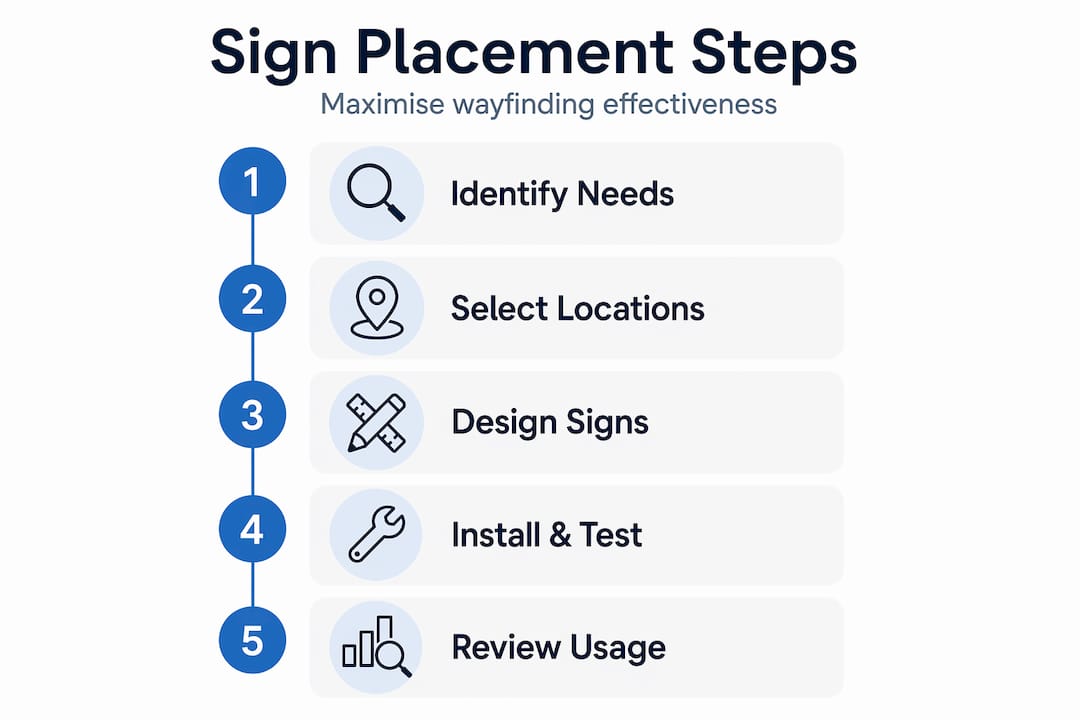
Now that we recognise the types of signs, it is important to understand where and how to place them for maximum impact. Directional signs belong at decision points: entrances, corridor junctions, lifts, and stairwells. Identification signs belong at the destination itself. Information signs work best near entrances and waiting areas, where visitors naturally pause to orient themselves.
A structured approach to placement looks like this:
- Map your decision points first. Walk your space as a first-time visitor and note every moment you had to choose a direction. Each of these is a location for a directional sign.
- Position signs before the turn, not after it. A sign placed after a junction creates confusion. Customers need information before they commit to a direction.
- Use identification signs at every key destination. Restrooms, checkouts, entrances, service desks, and departmental zones all benefit from clear identification.
- Place information boards near natural pauses. Lobby areas, waiting zones, and lift lobbies are ideal locations for floor maps and broader context.
- Maintain a visual hierarchy. Primary directional signs should be larger and higher-mounted. Secondary identification signs can be smaller and at eye level.
Consistency is equally critical. When your directional signs for visitors use the same colour palette, iconography, and font across the entire space, customers learn to recognise and trust them automatically. Inconsistency, even well-intentioned variety, undermines confidence and slows navigation. For corporate offices and professional environments, bespoke office signs London — from floor directories to door plaques — provide the same consistent, branded wayfinding experience within a business premises. Once your placement strategy is clear, reviewing wayfinding signage explained for specific environments will sharpen your approach further.
Choosing the right materials and design for durability and brand consistency
Material and design choices not only influence longevity but also communicate your brand effectively. The material you choose for each sign should be driven by three factors: location (indoor or outdoor), expected footfall and wear, and how closely the finish needs to match your wider brand identity.
Here is a practical breakdown of the most common options:
- Aluminium is the workhorse of exterior signage. Weather-resistant aluminium with powder-coating is standard for exterior signs; acrylic and aluminium suit interiors; design must reflect brand identity. For outdoor hospitality venues, car parks, and building exteriors, powder-coated aluminium is the reliable choice.
- Acrylic suits interior environments well. It is lightweight, available in a wide range of colours and finishes, and easy to cut into custom shapes. Frosted or tinted acrylic adds a premium feel to hotel lobbies and high-end retail.
- Stainless steel projects quality and longevity, making it ideal for upscale hospitality entrances, reception desks, and permanent identification plaques.
- Vinyl graphics applied to walls, floors, or rigid substrates offer flexibility and relatively low cost. They work particularly well for seasonal or promotional wayfinding that may need updating.
Design consistency across all sign types is not optional if brand recognition matters to you. Your brand colours, fonts, and logo placement should be uniform across every sign in the system. Explore best materials for business signs and the broader signage materials guide to understand how each option performs in real-world conditions.
Accessibility is a practical requirement, not just an ethical one. High-contrast text and background combinations, such as dark text on a light background or vice versa, ensure legibility for customers with visual impairments. Sans-serif fonts at sufficient size remove the friction that decorative typefaces introduce under pressure.
Pro Tip: For any outdoor sign, specify a powder-coated finish over a standard painted one. Powder coating bonds at a molecular level, resisting chipping, fading, and moisture penetration far more effectively than standard paint, especially in the UK’s variable climate.

Budgeting for wayfinding signage: cost factors and planning tips
With materials and design set, understanding costs helps you plan your investment realistically. Signage budgets vary enormously depending on sign type, size, material, and whether illumination is required.
| Sign type | Typical material | Estimated unit cost (UK) | Installation (approx.) |
|---|---|---|---|
| Indoor directional sign | Acrylic or aluminium | £40 to £120 | £30 to £50 |
| Outdoor directional sign | Powder-coated aluminium | £80 to £250 | £50 to £80 |
| Identification plaque | Acrylic, steel, or aluminium | £30 to £90 | £20 to £40 |
| Floor map or information board | Foamex or aluminium | £60 to £200 | £30 to £60 |
| Illuminated directional sign | Aluminium with LED | £150 to £500 | £60 to £100 |
These figures cover standard bespoke production. Custom shapes, special finishes, or large-format printing will adjust the price accordingly.
Key considerations when setting your budget:
- Count your decision points, not your rooms. You need a sign wherever a visitor must choose a direction, not simply at every space in your building.
- Factor installation in from the start. Many businesses budget for the signs themselves and overlook professional installation costs, which in the UK typically run between £30 and £80 per sign.
- Reserve a contingency. Setting aside 10 to 15 per cent of your total signage budget for future updates or replacements is sensible, particularly if your layout or branding is likely to evolve.
- Order in volume where possible. A single order covering your entire system almost always costs less per unit than phased orders placed separately.
For floor maps and information boards listed in the budget table above, foamex signs printing London provides a lightweight, rigid substrate that is cost-effective to produce, easy to mount, and delivers a sharp, professional finish for indoor display applications. Planning ahead also helps you futureproof your signage so that updates do not require a full replacement programme.
Pro Tip: Before finalising your order, ask your signage supplier for a site survey. A supplier who visits your space will identify placement requirements you may have missed and help you avoid ordering signs you do not actually need.
Best practices for installation and maintenance to ensure lasting effectiveness
Beyond purchase, correct installation and upkeep are critical to realising your signage’s full benefits. A well-designed sign installed at the wrong height, in a poorly lit corner, or obscured by a display unit is simply wasted investment.
Follow this process for reliable results:
- Install at consistent eye level. The standard mounting height for most interior wayfinding signs is 1.5 to 1.7 metres from the floor to the centre of the sign, ensuring they are readable for adults without straining.
- Confirm sightlines before mounting. Check that nothing in your space, shelving, plants, display units, or furniture, will obstruct the sign once it is mounted. Walk the approach from multiple angles.
- Use professional installation for any fixed or illuminated sign. Professional installation ensures proper mounting heights and alignment; regular inspection and cleaning extend sign life and maintain clarity.
- Schedule routine inspections. Every three to six months, check all signs for physical damage, fading, graffiti, or obstructions. Clean surfaces with appropriate solutions for the material (acrylic scratch-free cleaner, mild detergent for aluminium).
- Check illumination regularly. LED signs should be inspected for failed modules. A single dark letter or arrow can mislead customers as effectively as no sign at all.
- Review your system after any layout change. A refitted retail floor or a repurposed hospitality space can invalidate existing sign placements entirely. Treat a shop refit as a trigger for a full signage audit.
For guidance on signage safety considerations, particularly around fire exit routes and accessible routes, it is worth reviewing current UK building regulations and accessibility standards before installation. Businesses that need to replace or update multiple wayfinding signs at once will find that large format printing London can produce consistent, high-resolution graphics across every sign in the system, ensuring colour accuracy and visual uniformity throughout.
Pro Tip: Create a simple document logging the location, material, and installation date of every sign in your system. When a sign needs replacing or updating, this record saves significant time and ensures the replacement matches exactly.
Our perspective: why most businesses underestimate wayfinding signage
After years of working with retail and hospitality clients across London, Essex, and Kent, we have noticed a consistent pattern. Businesses invest heavily in their brand identity, their shopfront, their interiors, and their staff training. Then they treat wayfinding as an afterthought, adding a few generic signs at the end of a fit-out budget with whatever money remains.
The consequence is a space that looks good from the outside and frustrates from within. Customers will not tell you they left because they could not find the fitting rooms or the checkout. They simply will not return. The feedback loop is invisible, which is precisely why it persists.
The businesses that get this right treat wayfinding as a brand exercise, not a compliance task. Their directional signs for visitors carry the same visual identity as their shopfront. Their identification plaques feel considered, not functional. Effective wayfinding strategies are not about quantity of signs; they are about quality of information at exactly the right moment. One well-placed, well-designed sign at the entrance to a multi-floor retail space does more work than a dozen inconsistent plaques scattered through a corridor.
When you approach how to design wayfinding signs as an extension of your customer experience rather than a box to tick, the results are genuinely different. Customers move confidently, staff fields fewer questions, and your brand values are reinforced at every junction. For retail businesses, this means ensuring the wayfinding system is visually consistent with the shop signs London exterior — so that customers experience a seamless, branded environment from the pavement to the point of sale.
How we can help with your wayfinding signage
If you are ready to improve how customers move through your space, we design, manufacture, and install bespoke wayfinding signage for retail and hospitality businesses across London, Essex, and Kent. Our team works with you from initial survey through to final installation, ensuring every sign is correctly positioned, properly finished, and fully consistent with your brand identity.
From powder-coated aluminium outdoor directionals to premium acrylic interior identification plaques and LED illuminated signs, we offer signage solutions for businesses of all sizes and budgets. Whether you are fitting out a new venue, refurbishing an existing space, or simply replacing outdated signs, we provide fast turnaround times and professional installation as standard. For businesses that require a fully bespoke wayfinding system — from concept and design through to every sign type and format — custom signs London specialists deliver end-to-end solutions tailored precisely to your space, brand, and budget. Get in touch with our team at Promo Signs to discuss your project and request a free site survey.
Frequently asked questions
What types of wayfinding signs are most effective for retail stores?
Directional and identification signs guide visitors through retail spaces clearly, making them the most impactful combination, particularly when placed at entry points, department junctions, and key service areas.
How durable should wayfinding signs be for outdoor hospitality venues?
Outdoor signs should be made from weather-resistant aluminium with a powder-coated finish to withstand UK weather conditions including rain, UV exposure, and temperature fluctuations over many years.
Can wayfinding signage improve operational efficiency?
Yes. Wayfinder sign systems improve operational efficiency by reducing the interruptions staff face when answering directional questions, allowing your team to focus on customer service rather than navigation queries.
How much budget should I allocate per sign for a standard indoor retail wayfinding system?
Expect to budget between £40 and £120 per standard indoor directional or identification sign, factoring in acrylic or aluminium materials with vinyl graphics, plus a further £30 to £50 per sign for professional installation.
What is a key design consideration to ensure accessibility in wayfinding signs?
Use high colour contrast and simple fonts to make signs accessible to all customers, including those with visual impairments, and avoid complex icons that may be ambiguous to first-time visitors.
Recommended
- Outdoor Signs Can Attract Customers – PromoSigns.co.uk
- Designing Effective Shop Signs: Essential Guide for Businesses – PromoSigns.co.uk
- Signage Placement Best Practices for Maximum Impact – PromoSigns.co.uk
- 7 Essential Wayfinding Signs Every Business Needs UK
