
Many business owners believe their office signage is purely functional, a simple marker of location rather than a powerful tool for brand perception and customer attraction. This misconception costs businesses dearly in lost footfall and diminished brand trust, particularly in competitive markets across London, Essex, and Kent. Outdated or damaged signage silently communicates neglect, undermining even the strongest brand identities. Recognising the precise moment to rebrand your office signs London transforms this passive element into an active driver of visibility, customer confidence, and commercial success. This guide reveals the clear indicators that signal it’s time to refresh your signage and how to execute a rebrand that delivers measurable results.
Table of Contents
Key takeaways
| Point | Details |
|---|---|
| Damaged signage harms reputation | Worn or faded signs make businesses appear unprofessional and reduce customer trust in competitive areas |
| Brand changes require updates | Mergers, new logos, or repositioning demand immediate signage alignment to maintain consistency |
| Review every 3 to 5 years | Regular signage audits ensure your business stays visible and relevant to evolving customer expectations |
| Local visibility drives choices | Urban lighting, footfall patterns, and competitor signage in London, Essex, and Kent influence design decisions |
Why outdated signage can hurt your business visibility
Your office signage serves as the first physical touchpoint between your business and potential customers. When that signage no longer reflects your current branding, values, or professional standards, it creates an immediate disconnect that undermines trust before customers even step through your door. Outdated shop signs London reduces client trust and lowers foot traffic in competitive retail and corporate areas, particularly where first impressions determine whether prospects engage or walk past.
Physical deterioration tells a story you don’t want to tell. Faded colours suggest neglect, cracked panels imply financial struggles, and peeling vinyl signals a business that doesn’t invest in quality. In busy commercial districts across London, Essex, and Kent, where dozens of businesses compete for attention within a single street, these subtle signals become decisive factors in customer choice. A competitor with crisp, well-maintained signage automatically appears more established, reliable, and worthy of trust.
The visibility gap widens as your signage ages. Modern LED illuminated signs draw eyes even in crowded environments, whilst older non-illuminated alternatives fade into the background, especially during evening hours when footfall remains high. Businesses that fail to update their signage effectively surrender prime visibility hours to competitors who’ve embraced contemporary solutions. This isn’t merely aesthetic preference; it’s measurable commercial disadvantage.
Consider these specific impacts:
- Outdated logos create brand confusion when your digital presence shows current branding but physical signage displays old versions
- Poor lighting or faded colours reduce visibility by up to 60% compared to fresh, illuminated alternatives
- Damaged signage actively repels customers who associate physical deterioration with poor service quality
- Misaligned branding between signage and current market positioning confuses your target audience about who you serve
Pro tip: Photograph your signage from a customer’s typical approach angle at different times of day. If it doesn’t immediately communicate professionalism and clarity, your prospects are seeing the same weakness and making snap judgements accordingly.

Major indicators it’s time to rebrand your office signage
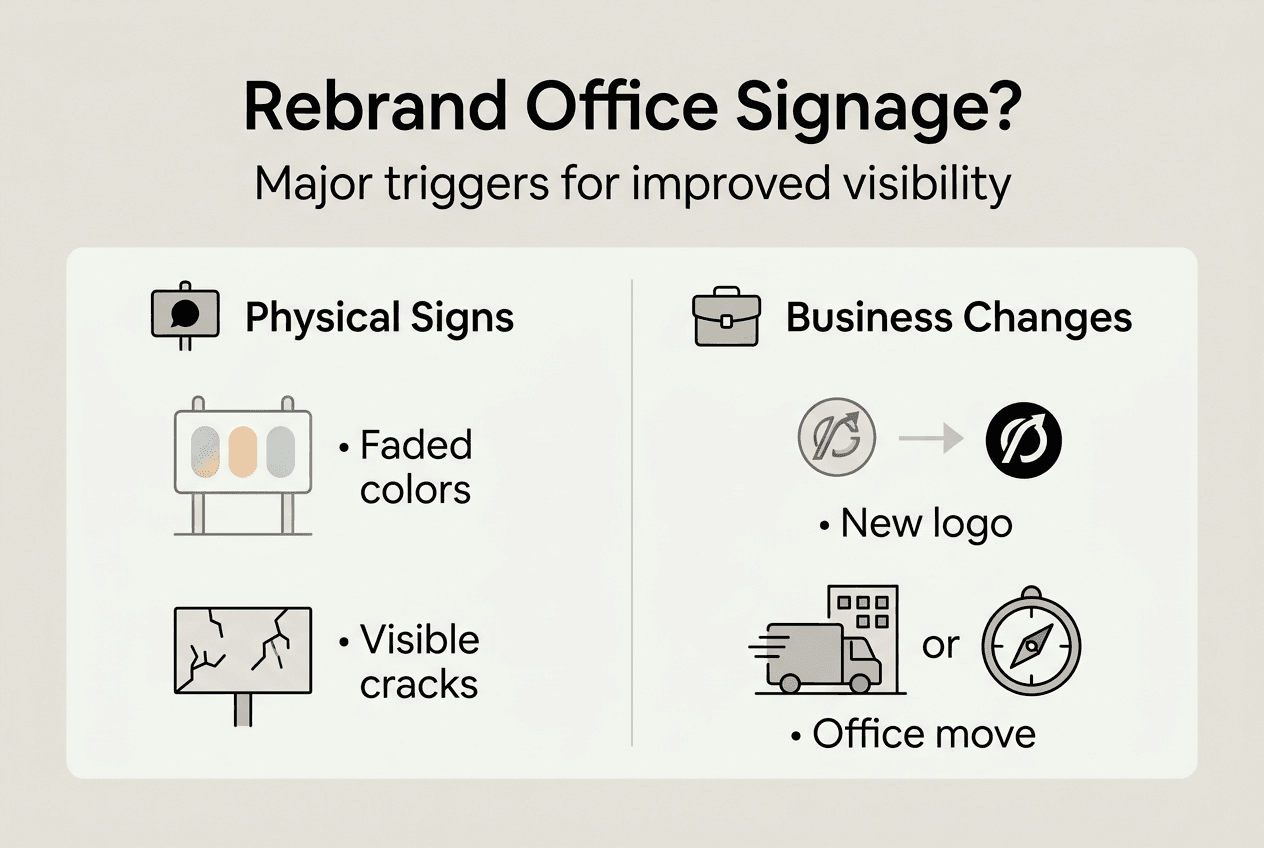
Recognising the precise moment to rebrand requires understanding both physical deterioration signals and strategic business triggers. Physical signs appear first and most obviously. When colours fade to the point where your brand palette becomes unrecognisable, when structural damage like cracks or warping appears, or when lighting elements fail and remain unrepaired, you’ve crossed the threshold where maintenance becomes inadequate and replacement becomes necessary.
Business evolution creates equally compelling triggers. Mergers, office relocations, or changes in brand identity are prime moments to consider new signage companies London partnerships for consistency and market presence. A company merger that creates a new brand identity whilst retaining old signage sends confused messages about whether the business has truly integrated or remains in transition. New target markets require signage that speaks their visual language; corporate clients expect different aesthetics than retail consumers.
Location changes present unique opportunities. Moving offices or expanding to additional premises demands fresh signage that captures attention in new environments. Each location has distinct visibility challenges, from competing signage density to varying foot traffic patterns and ambient lighting conditions. Signage that worked perfectly in a quiet suburban setting may disappear entirely on a busy London high street without significant redesign.
Performance metrics reveal hidden signage problems. Track these specific indicators:
- Declining footfall despite stable or growing online engagement suggests physical visibility issues
- Customer feedback mentioning difficulty finding your premises points to inadequate signage prominence
- Increased reliance on digital directions rather than visual wayfinding indicates signage failure
- Lower conversion rates for walk-in customers compared to pre-booked appointments may reflect signage-driven first impression problems
- Competitor comparisons showing their signage outperforming yours in visibility or modernity
Pro tip: Conduct informal street surveys by asking new customers how easily they found your premises and what caught their attention. If your signage rarely features in their answers, it’s failing its primary function regardless of its physical condition.
Key trends and planning considerations for signage rebranding in London, Essex, and Kent
Signage technology and design aesthetics evolve rapidly, creating opportunities for businesses willing to embrace current trends whilst maintaining brand authenticity. Incorporating window frosting London and illuminated signage options can boost visibility in competitive urban environments like London and Essex, where ambient light pollution and visual clutter demand solutions that actively draw attention rather than passively waiting to be noticed.
Traditional versus illuminated signage presents distinct advantages depending on your specific context:
| Signage type | Best for | Key advantages | Considerations |
|---|---|---|---|
| Traditional non-illuminated | Daytime-focused businesses, heritage settings | Lower running costs, classic aesthetic, minimal maintenance | Limited evening visibility, reduced impact in crowded areas |
| LED illuminated | Retail, hospitality, extended hours | 24-hour visibility, energy efficiency, modern appeal | Higher initial investment, requires electrical infrastructure |
| Backlit panels | Corporate offices, professional services | Sophisticated appearance, even illumination, premium feel | Installation complexity, moderate running costs |
Location-specific challenges shape effective signage choices. Dense urban centres like central London require bolder, more distinctive designs to break through visual noise, whilst suburban Essex locations may benefit from elegant simplicity that conveys professionalism without overwhelming quieter streetscapes. Kent’s mix of historic and modern commercial areas demands sensitivity to local character whilst maintaining contemporary relevance.
Planning your rebrand involves several critical considerations:
- Budget allocation across design, materials, manufacturing, installation, and ongoing maintenance
- Local council permissions and planning regulations, which vary significantly across London boroughs and between Essex and Kent authorities
- Installation timing to minimise business disruption, typically scheduling work during quieter trading periods
- Material durability suited to local weather conditions and pollution levels affecting longevity
- Brand consistency across multiple signage elements from fascia signs to window graphics
Pro tip: Review signage planning processes and explore key signage trends to understand how contemporary approaches can enhance your specific business visibility challenges before committing to designs.
Executing your office signage rebrand: steps and best practices
Successful signage rebranding follows a structured process that balances creative vision with practical execution. Begin with a comprehensive audit of existing signage, documenting physical condition, brand alignment, and performance against visibility objectives. This audit reveals not just what needs replacing but why previous signage succeeded or failed, informing smarter decisions for your rebrand.
Design development requires collaboration between your internal brand understanding and professional signage expertise. Work with designers who grasp both aesthetic principles and practical signage constraints like viewing distances, lighting conditions, and material durability. Your new signage must translate brand identity into physical form whilst remaining legible, weather-resistant, and maintainable over years of use.
Navigating permissions and regulations prevents costly delays and redesigns. London, Essex, and Kent each maintain distinct planning requirements for commercial signage, with some areas imposing strict controls on illumination, size, and materials. Submit applications early, providing detailed specifications and visual mockups that demonstrate compliance with local guidelines. Using professional shop window graphics alongside your rebrand ensures consistency, legal compliance, and maximum impact of your new office signage.
Implementation steps for seamless execution:
- Finalise designs with precise measurements, materials specifications, and installation requirements documented
- Obtain all necessary permissions before manufacturing begins to avoid wasted production costs
- Schedule installation during minimal-impact periods, coordinating with building access and trading hours
- Plan temporary signage if installation requires removing existing signs before replacements are ready
- Conduct thorough testing of illuminated elements and structural integrity before final sign-off
- Document maintenance requirements and schedule regular inspections to preserve signage condition
Ongoing maintenance extends your investment’s lifespan and preserves the professional image that justified rebranding. Establish cleaning schedules appropriate to your location’s pollution levels, typically quarterly for urban environments. Monitor illumination performance, replacing failed LED modules promptly to maintain consistent visibility. Address minor damage immediately before it escalates into structural problems requiring complete replacement.
Key maintenance practices include:
- Regular cleaning using appropriate materials that won’t damage finishes or graphics
- Prompt repair of any physical damage from weather, accidents, or vandalism
- Scheduled inspections of mounting hardware to ensure structural security
- Performance monitoring of illuminated elements with proactive replacement schedules
Pro tip: Photograph your new signage immediately after installation from multiple angles and lighting conditions. These reference images help you spot deterioration early and provide specifications for any future repairs or expansions requiring matched materials and finishes.
Enhance your business visibility with customised signage solutions
Transforming outdated signage into a powerful visibility asset requires expertise that combines design creativity, technical precision, and deep understanding of local commercial environments. PromoSigns specialises in delivering customised shop signs Barnet and comprehensive office branding London, creating solutions tailored to the specific visibility challenges facing businesses across London, Essex, and Kent. Whether you’re refreshing a single fascia sign or executing a complete rebrand across multiple locations, professional guidance ensures your investment delivers measurable improvements in customer attraction and brand perception.
Our approach begins with understanding your unique business context, competitive environment, and brand objectives before recommending solutions that balance aesthetic impact with practical durability. From illuminated LED installations that command attention on busy high streets to sophisticated corporate signage that conveys professional authority, we design, manufacture, and install signage that works as hard as you do. Discover how outdoor signs attract customers and explore our portfolio to see how strategic signage rebranding transforms business visibility and drives commercial success.
FAQ
How often should I review my office signage for a potential rebrand?
Typically every 3 to 5 years provides a sensible review cycle, though significant brand changes, relocations, or visible deterioration may require earlier action. Regular reviews help keep signage effective and aligned with current branding whilst catching maintenance issues before they become costly problems. Market changes and evolving design trends also influence optimal timing for updates.
What are the key signs that indicate my office signage needs rebranding?
Outdated designs that no longer match current branding, visible damage like fading or cracks, and reduced customer engagement all signal the need for updates. Changes in business location, market positioning, or target audience also require signage alignment. If competitors’ signage consistently outperforms yours in visibility or perceived quality, rebranding becomes commercially necessary rather than merely aesthetic preference.
How can local trends in London, Essex, and Kent affect signage choices?
Local lighting conditions, foot traffic patterns, and competitor signage density directly influence whether illuminated or traditional signs perform better in your specific location. Awareness of local aesthetic trends and planning authority preferences helps keep your signage both appealing and compliant. Urban environments typically demand bolder, more distinctive designs whilst suburban areas may benefit from elegant restraint that stands out through quality rather than size.
Do I need planning permission to rebrand my office signage?
Most signage changes require advertisement consent from local planning authorities, though exact requirements vary significantly across London boroughs and between Essex and Kent councils. Illuminated signage, size increases, or changes to listed buildings typically face stricter controls. Always consult your local authority before proceeding with manufacturing to avoid costly redesigns or enforcement action requiring removal of non-compliant signage.
What return on investment can I expect from rebranding office signage?
Businesses typically see 15% to 30% increases in walk-in enquiries following professional signage rebrands, with higher impacts in high-footfall locations where visibility directly drives customer acquisition. Improved brand perception and reduced customer confusion about business location also deliver value that’s harder to quantify but equally important. The investment pays back through sustained visibility advantages over competitors and extended periods before next replacement becomes necessary.
Recommended
- Updating Office Signage: Key Reasons and Best Practices – PromoSigns.co.uk
- Signage for Office Interiors: 2025 Guide for London Businesses – PromoSigns.co.uk
- Update Business Signage: 7 Essential Reasons UK
- Office Signage Ideas for London Businesses and Events: 2025 Trends – PromoSigns.co.uk
- How AI Automation Is Reshaping Enterprise Operations in 2026 — SimplyAI
