
Sustainable print solutions are shaking up the way businesses think about their environmental impact. Despite what most people believe, printing does not have to mean more landfill and pollution. In fact, swapping to eco-friendly printing can cut carbon emissions dramatically and some methods even use recycled materials that save millions of trees each year. Sustainable printing is less about sacrifice and more about smart innovation.
Table of Contents
- Defining Sustainable Print Solutions: What Are They?
- Core Components Of Sustainable Printing
- Environmental And Business Benefits
- The Importance Of Sustainable Print Solutions: Why Should You Care?
- Environmental Impact Reduction
- Business And Economic Advantages
- The Environmental Impact Of Traditional Printing: Understanding The Consequences
- Resource Consumption And Waste Generation
- Toxic Chemical Emissions
- Key Concepts In Sustainable Printing: Materials, Processes, And Practices
- Sustainable Printing Materials
- Eco-Friendly Printing Processes
- Practical Applications Of Sustainable Print Solutions In Various Industries
- Manufacturing And Product Development
- Architecture And Construction
Table of Contents
Quick Summary
| Takeaway | Explanation |
|---|---|
| Sustainable printing reduces environmental impact | Utilises eco-friendly materials and processes to minimise resource consumption and waste generation. |
| Transition to a circular economy is essential | Sustainable printing practices contribute to resource efficiency and lower ecological footprints compared to traditional methods. |
| Adopting green solutions enhances business reputation | Businesses that embrace sustainable practices can boost their brand image and appeal to environmentally conscious consumers. |
| Use energy-efficient equipment for cost savings | Implementing modern printing machinery can result in reduced operational costs through lower energy consumption. |
| Incorporate biodegradable materials in production | Usage of biodegradable and recycled materials is crucial for reducing the overall environmental footprint in printing processes. |
Defining Sustainable Print Solutions: What Are They?
Sustainable print solutions represent an innovative approach to printing that minimises environmental impact while maintaining high-quality output. These solutions integrate eco-conscious practices across the entire printing workflow, transforming traditional printing methods into environmentally responsible processes.
| Component | Description | Example |
|---|---|---|
| Responsible Material Selection | Use of recycled or sustainably sourced paper products | FSC-certified paper |
| Low-Impact Ink Technologies | Adoption of vegetable-based and water-soluble inks | Soy-based or water-based inks |
| Energy-Efficient Equipment | Utilisation of machinery with lower energy consumption | Modern digital printers |
| Waste Reduction Processes | Implementation of efficient workflows to minimise material waste | Digital proofing, on-demand printing |
| Circular Economy Integration | Practices supporting reuse, recycling, and end-of-life management | Closed-loop paper use |
Core Components of Sustainable Printing
At its essence, sustainable print solutions encompass several critical elements designed to reduce ecological footprints. Learn more about our eco-friendly signage solutions that demonstrate these principles in action.
The primary components include:
- Responsible Material Selection: Using recycled or sustainably sourced paper products
- Low-Impact Ink Technologies: Employing vegetable-based and water-soluble inks
- Energy-Efficient Equipment: Utilising printing machinery with reduced energy consumption
Sustainable printing practices are critical in transitioning towards a circular economy model. This approach moves beyond traditional linear production methods by emphasising resource efficiency and minimal waste generation. Businesses seeking eco-conscious output for large-scale projects can explore how large format printing London services increasingly incorporate sustainable substrates and low-VOC inks into their workflows.
Environmental and Business Benefits
Sustainable print solutions offer significant advantages for both environmental preservation and business performance. Companies adopting these practices demonstrate corporate responsibility while potentially reducing long-term operational costs.
Key benefits include reduced carbon emissions, lower waste production, improved resource management, and enhanced brand reputation among environmentally conscious consumers. By implementing sustainable printing strategies, businesses can simultaneously contribute to ecological conservation and create competitive advantages in an increasingly green-minded marketplace.
The Importance of Sustainable Print Solutions: Why Should You Care?
Sustainable print solutions are more than an environmental trend. They represent a critical strategic approach for businesses seeking to reduce ecological impact while maintaining operational excellence. Read our guide on large format printing for London businesses to understand how sustainability intersects with modern printing technologies.
Environmental Impact Reduction
The average individual contributes significantly to environmental degradation through paper consumption. Sustainable print solutions offer a proactive method to mitigate these challenges by addressing several key environmental concerns:
- Carbon Footprint Reduction: Minimising greenhouse gas emissions associated with traditional printing processes
- Resource Conservation: Preserving natural resources through responsible material selection
- Waste Management: Decreasing landfill contributions by implementing recycling and circular economy principles
Business and Economic Advantages
Beyond environmental benefits, sustainable print solutions provide substantial economic incentives for businesses. Companies adopting these practices often experience:
- Reduced operational costs through efficient resource utilisation
- Enhanced brand reputation among environmentally conscious consumers
- Potential tax incentives and government support for green initiatives
Moreover, sustainable printing is not merely about reducing negative impacts but creating positive transformative change. By integrating eco-friendly practices, businesses demonstrate corporate responsibility and adaptability in an increasingly environmentally aware marketplace. For retail businesses, commissioning vinyl sticker printing London using water-based inks and recyclable vinyl films is a straightforward first step towards greener storefront communication.
The transition towards sustainable print solutions represents a strategic investment in long-term organisational resilience and ethical business practices.
The Environmental Impact of Traditional Printing: Understanding the Consequences
Traditional printing methods have long been significant contributors to environmental degradation, creating substantial ecological challenges that extend far beyond simple paper consumption. Explore our comprehensive guide on printing formats to understand the nuanced environmental implications of different printing approaches.
Resource Consumption and Waste Generation
Conventional printing processes are resource-intensive and generate considerable environmental strain. The production of a single sheet of paper requires substantial water, energy, and raw material inputs. Traditional printing generates multiple layers of ecological impact:
- Deforestation: Consuming millions of trees annually for paper production
- Water Pollution: Chemical-intensive printing processes contaminating water systems
- Energy Inefficiency: High carbon emissions from manufacturing and printing equipment
Toxic Chemical Emissions
Traditional printing technologies rely heavily on chemical substances that pose significant environmental and health risks. Petroleum-based inks, toxic solvents, and harmful processing chemicals contribute to air and water pollution, creating long-term ecological damage.
The cumulative environmental cost of these practices extends beyond immediate production. Manufacturing processes release volatile organic compounds (VOCs), greenhouse gases, and other harmful emissions that contribute to climate change and ecosystem disruption.
By understanding these profound environmental consequences, businesses and individuals can make informed decisions about transitioning towards more sustainable printing solutions that minimise ecological harm while maintaining high-quality output.
| Aspect | Traditional Printing | Sustainable Print Solutions |
|---|---|---|
| Material Use | Virgin paper, high raw resource consumption | Recycled/sustainable materials |
| Chemical Emissions | Petroleum-based inks, VOCs released | Vegetable-based inks, reduced pollutants |
| Energy Consumption | High energy use, inefficient machinery | Energy-efficient equipment |
| Waste Generation | Significant landfill contributions | Waste reduction, recycling enforced |
| Carbon Footprint | Elevated due to production and logistics | Lowered with optimised processes |
Key Concepts in Sustainable Printing: Materials, Processes, and Practices
Sustainable printing encompasses a holistic approach to minimising environmental impact through strategic material selection, innovative processes, and responsible practices. Explore our guide to large format printing basics to understand how these principles translate into practical applications.
Sustainable Printing Materials
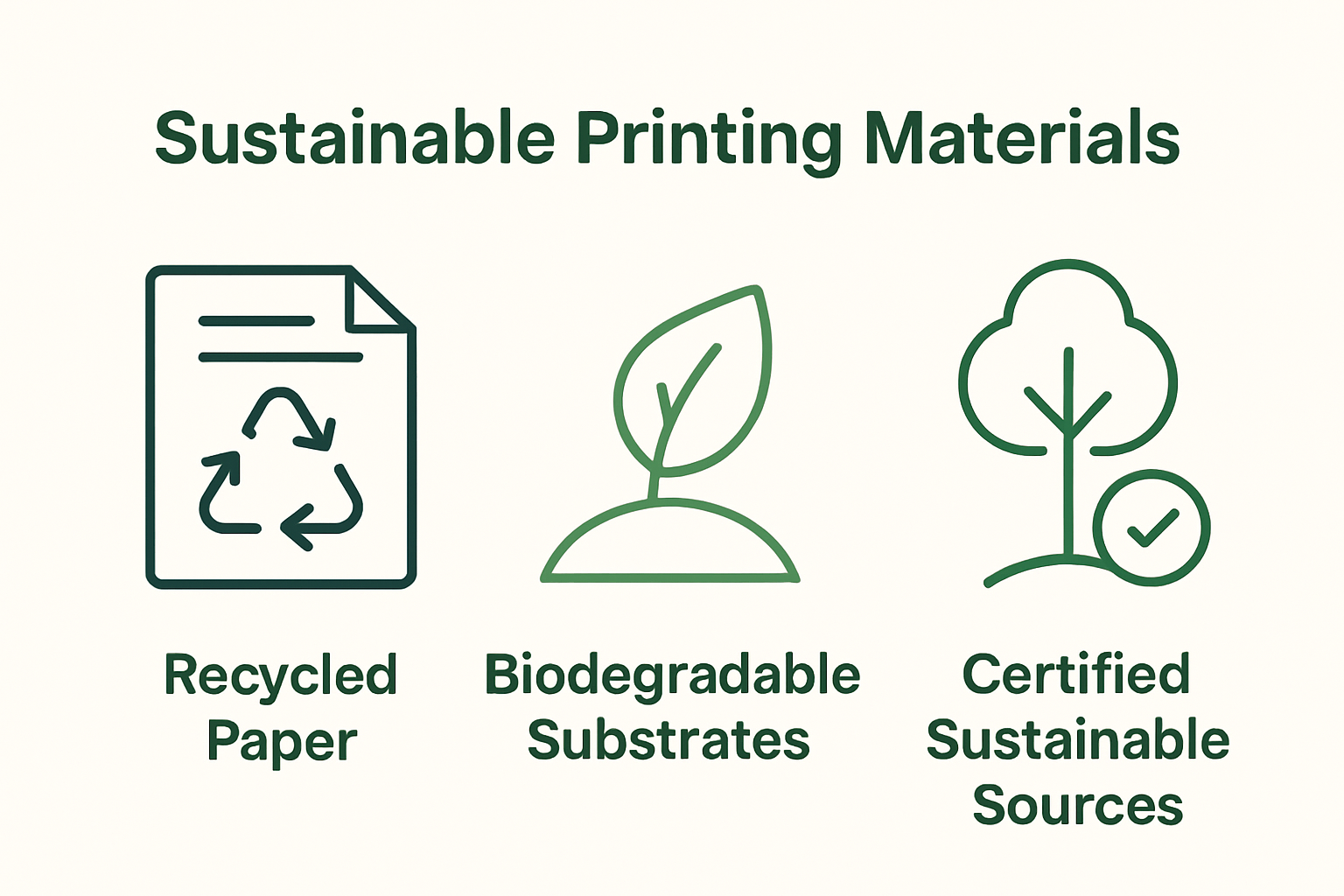
The foundation of sustainable printing lies in selecting environmentally responsible materials. This involves carefully choosing resources that reduce ecological strain:
- Recycled Paper: Utilising post-consumer waste paper to decrease virgin material consumption
- Biodegradable Substrates: Implementing materials that naturally decompose without environmental harm
- Certified Sustainable Sources: Selecting materials from responsibly managed forests and ecosystems
For businesses that rely on temporary indoor displays, foamex signs printing London suppliers are increasingly offering lightweight, recyclable board options that reduce waste at end of display life.
Eco-Friendly Printing Processes
Beyond material selection, sustainable printing focuses on transforming traditional production methods. This involves reimagining every stage of the printing workflow to minimise environmental impact. Key process innovations include:
- Implementing digital workflow technologies to reduce physical waste
- Using alcohol-free press solutions that minimise chemical emissions
- Adopting energy-efficient printing equipment with reduced carbon footprint
By integrating these advanced materials and processes, businesses can significantly reduce their environmental footprint while maintaining high-quality print outputs. The transition to sustainable printing is not just an ecological imperative but a strategic approach to modern print production that balances environmental responsibility with operational excellence.
Practical Applications of Sustainable Print Solutions in Various Industries
Sustainable print solutions are transforming multiple industries by providing environmentally responsible alternatives to traditional printing methods. Discover the top large format printing uses for businesses to understand how these innovations are being implemented across sectors.
Manufacturing and Product Development
In manufacturing, sustainable print solutions are revolutionising product design and prototyping. Companies are adopting eco-friendly approaches that significantly reduce environmental impact:
- Rapid Prototyping: Using biodegradable materials for product development
- Reduced Waste: Implementing digital design processes that minimise physical material consumption
- Circular Design: Creating products with end-of-life recyclability in mind
Architecture and Construction
The architecture and construction industries are increasingly embracing sustainable print solutions to reduce their ecological footprint. Key applications include:
- Creating environmentally friendly architectural plans and blueprints
- Developing sustainable building models using recycled and biodegradable materials
- Producing low-impact signage and informational displays for construction sites
For event-based and short-term construction site marketing, banner printing London produced on recyclable PVC or biodegradable fabric substrates offers a practical, lower-impact alternative to traditional hoarding graphics.
By integrating sustainable print solutions, industries are not just reducing environmental impact but also demonstrating corporate responsibility. These approaches enable businesses to maintain high-quality outputs while actively contributing to ecological conservation and promoting a more sustainable future across multiple sectors.
Frequently Asked Questions
What are sustainable print solutions?
Sustainable print solutions are innovative printing methods that minimise environmental impact while ensuring high-quality output by integrating eco-conscious practices throughout the printing workflow.
What are the key components of sustainable printing?
The key components include responsible material selection (such as recycled or sustainably sourced paper), low-impact ink technologies (like vegetable-based inks), and energy-efficient equipment that reduces energy consumption during the printing process.
How do sustainable print solutions benefit businesses?
Sustainable print solutions offer various benefits, including reduced operational costs, enhanced brand reputation among environmentally conscious consumers, and potential tax incentives for adopting green initiatives. These practices also contribute to environmental preservation.
What is the environmental impact of traditional printing methods?
Traditional printing methods contribute significantly to environmental degradation through resource consumption, waste generation, deforestation, water pollution, and toxic chemical emissions, which pose long-term ecological and health risks.
Recommended
- Large Format vs Small Format Printing: London 2025 Guide – PromoSigns.co.uk
- Large Format Printing Explained: Essential Guide for London Businesses 2025 – PromoSigns.co.uk
- Understanding Eco Friendly Signage Solutions – PromoSigns.co.uk
- Top Large Format Printing Uses for London Businesses 2025 – PromoSigns.co.uk
