
Table of Contents
Every year, construction accidents result in over 60,000 global worker fatalities. Safety on site relies heavily on clear communication, and that starts with effective signage. For anyone managing a construction project or working on site, understanding signage is crucial to keeping people safe, meeting legal requirements, and building trust. Knowing the key elements behind these signs can help prevent accidents and ensure everyone gets home safely.
Key Takeaways
| Point | Details |
|---|---|
| Importance of Signage | Construction site signage is essential for safety, communication, and operational efficiency, using standardized symbols and color coding. |
| Types of Signs | There are five primary types of construction signs: prohibition, mandatory action, warning, safe condition, and fire safety, each serving distinct safety and operational functions. |
| Regulatory Compliance | Adhering to international and regional legal standards is crucial for effective signage, ensuring safety and preventing legal issues. |
| Maintenance Practices | Ongoing maintenance of signage is necessary to ensure visibility and legibility, reducing the risk of safety incidents and compliance failures. |
Table of Contents
- What Is Construction Site Signage?
- Types Of Construction Site Signs
- Legal Standards And Regulatory Framework
- Materials, Design And Durability Standards
- Optimal Placement And Visibility Strategies
- Maintenance, Risks And Cost Implications
What Is Construction Site Signage?
Construction site signage is a critical communication system designed to ensure safety, provide information, and maintain operational efficiency across construction environments. These visual communication tools employ universal colour coding and standardised symbols to effectively communicate essential messages to workers, visitors, and management.
At its core, construction site signage serves multiple vital functions. These signs use specific colour schemes to convey critical information: red for prohibition and fire safety, yellow for warnings, blue for mandatory actions, and green for safe conditions and emergency information. These strategically designed signs help prevent accidents, guide personnel, and establish clear operational protocols.
The primary objectives of construction site signage include:
- Communicating potential hazards and safety requirements
- Directing personnel and visitors around the site
- Indicating mandatory personal protective equipment (PPE)
- Marking restricted or dangerous areas
- Providing emergency contact and evacuation information
By implementing comprehensive signage, construction sites transform complex environments into structured, safer workspaces. Professional advertising construction hoardings London solutions combine safety compliance with branded site presentation, helping contractors meet their legal obligations whilst projecting a professional image to the public. Our professional signage installation guide offers deeper insights into creating effective visual communication systems that protect workers and streamline site operations.
Types Of Construction Site Signs
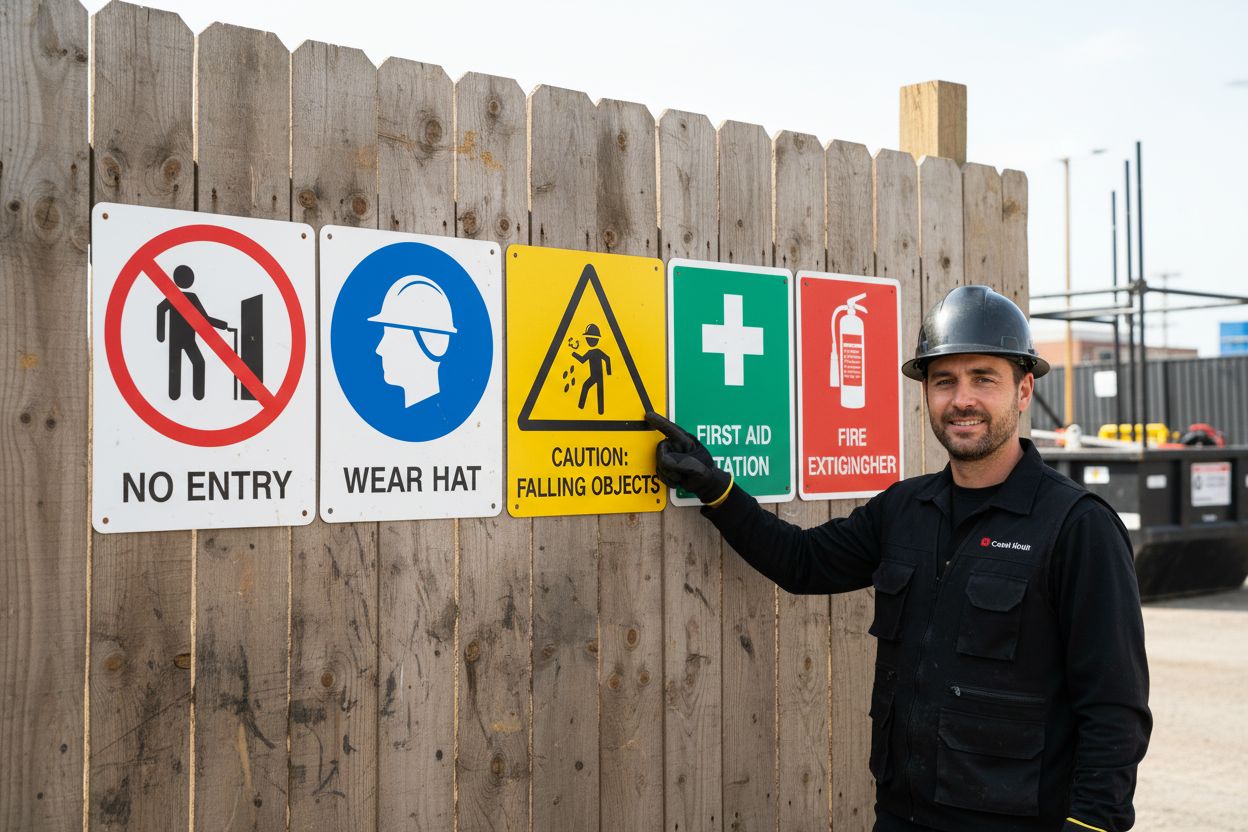
Construction site signs are a diverse and critical communication system designed to ensure safety, provide guidance, and maintain operational efficiency. These signs encompass multiple categories that address various aspects of site management and worker protection.
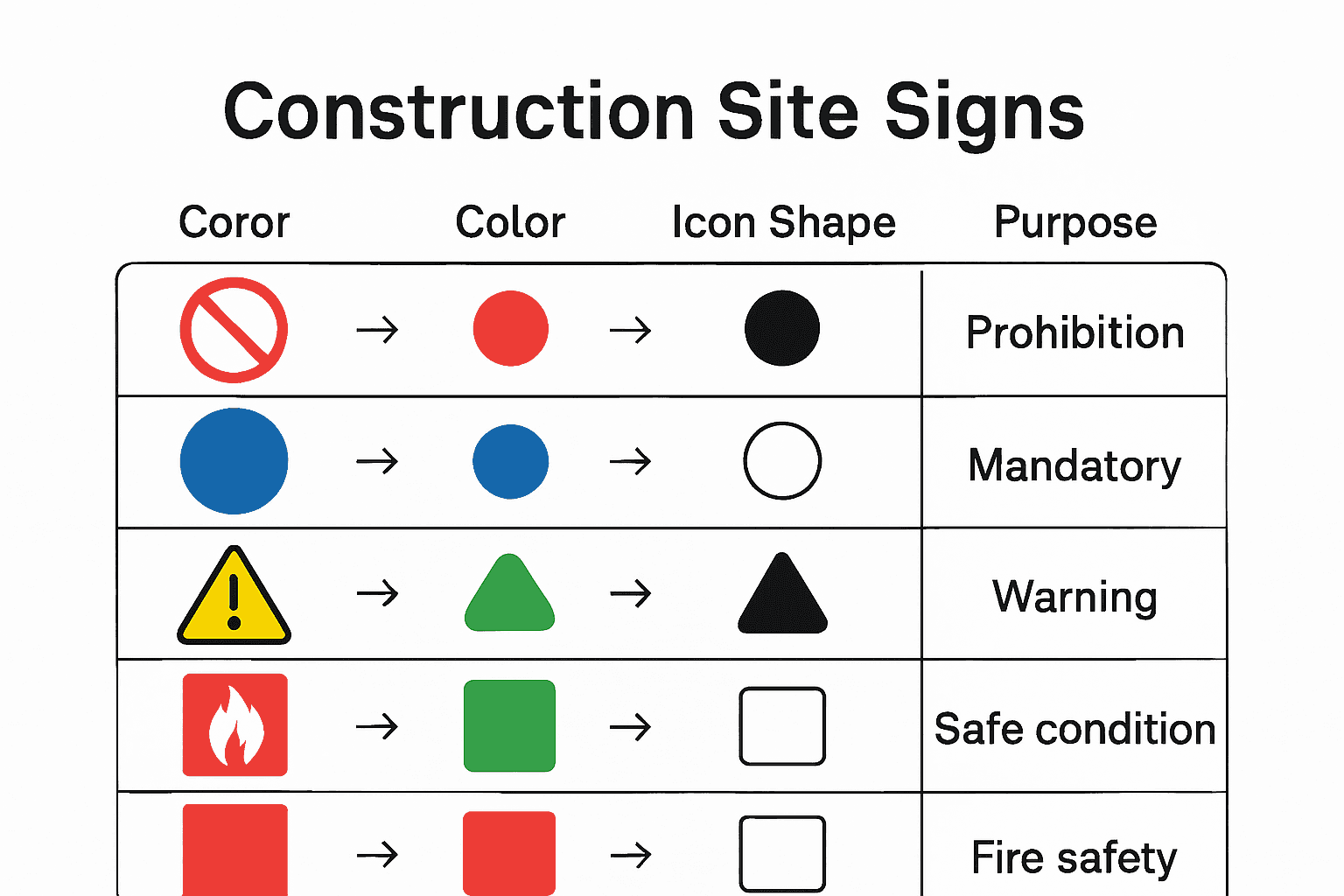
Five primary sign classifications based on their critical functions:
| Sign Type | Primary Purpose | Typical Colour |
|---|---|---|
| Prohibition Signs | Actions not allowed | Red |
| Mandatory Action Signs | Required behaviours | Blue |
| Warning Signs | Alert to hazards | Yellow |
| Safe Condition Signs | Mark safe routes & equipment | Green |
| Fire Safety Signs | Indicate fire equipment & exits | Red |
- Prohibition Signs: Indicating actions that are not permitted
- Mandatory Action Signs: Directing specific required behaviours
- Warning Signs: Alerting personnel to potential hazards
- Safe Condition Signs: Marking emergency exits and safety equipment locations
- Fire Safety Signs: Identifying fire prevention and emergency response resources
Beyond these core categories, construction sites typically deploy additional specialised signage types. These include project information boards, directional signs, regulatory compliance signs, temporary condition indicators, health and safety protocol signs, security notifications, and waste management guidance. Each sign type serves a unique purpose in creating a structured, safe, and efficiently managed construction environment.
For high-visibility outdoor applications, mesh banner printing London provides a durable, wind-resistant solution ideal for hoarding panels, site perimeter fencing and large-scale safety messaging.
Legal Standards And Regulatory Framework
Construction site signage is governed by a comprehensive framework of international and regional legal standards designed to ensure worker safety and standardised communication. The European Union has established critical guidelines through Directive 92/58/EEC, which mandates specific requirements for safety signs in workplace environments, outlining precise employer obligations and implementation protocols.
At the international level, ISO 7010 provides a universal standard for graphical safety symbols, creating a consistent visual language that transcends linguistic barriers. These standards specify exact colour codes, shapes, and design principles that enable immediate comprehension of safety messages across diverse construction sites and industrial settings.
Key regulatory requirements typically include:
- Mandatory display of specific warning and prohibition signs
- Clear visibility and strategic positioning of safety notifications
- Use of standardised colour schemes (red for prohibition, yellow for warning)
- Regular maintenance and replacement of signage
- Comprehensive risk assessment before sign implementation
For businesses navigating these complex regulatory landscapes, working with experienced signage companies London ensures your installation meets current UK planning and health and safety requirements from day one. Understanding and implementing illuminated sign regulations is also crucial. Compliance not only prevents potential legal penalties but also demonstrates a commitment to workplace safety and professional standards.
Materials, Design And Durability Standards
Construction site signage requires meticulous material selection to ensure maximum durability and effectiveness in challenging environmental conditions. These signs must withstand extreme weather, physical impacts, and continuous site transformations.
Several premier materials are recommended for construction site signage durability:
- Aluminium: Exceptionally strong and rust-resistant
- PVC: Lightweight and robust
- Dibond: Aluminium-plastic composite with superior strength
- Reflective Vinyl: Enhances visibility in low-light conditions
Design considerations go beyond material selection. Signs must incorporate high-contrast lettering, UV-resistant coatings, waterproof treatments, and secure mounting systems. These elements ensure that critical safety information remains legible and intact throughout the project’s lifecycle.
For interior site offices, welfare facilities and temporary hoardings, foamex signs printing London offers a lightweight yet rigid substrate that prints crisply and withstands the knocks of a busy site environment. Understanding materials for shop signs can provide additional insights into selecting the most appropriate signage solutions for demanding environments.
Optimal Placement And Visibility Strategies
Construction site signage demands strategic positioning to maximise safety and communication effectiveness. Effective sign placement requires careful consideration of site layout, potential hazards, and worker movement patterns.
Key strategic placement guidelines include positioning signs:
- At primary entry and exit points
- Near potential machinery hazards
- Along primary walkways and pedestrian routes
- Adjacent to chemical storage or fire risk areas
- At critical transition zones and evacuation routes
Optimal visibility is achieved by mounting signs at standard eye level (4–6 feet high), angling them for maximum readability, and using reflective materials for low-light conditions. Complex sites may require larger sign formats or repeated signage to ensure comprehensive communication.
For large-scale site-wide messaging and project branding, large format printing London delivers bold, weather-resistant graphics that maintain impact across the full perimeter of even the largest construction projects. Understanding logo placement on signage can provide additional insights into creating clear, impactful visual communication strategies that keep workers informed and protected.
Maintenance, Risks And Cost Implications
Construction site signage requires ongoing strategic maintenance to ensure safety, compliance, and operational effectiveness. Regular inspections are crucial to verify signs remain clean, legible, securely mounted, and clearly visible throughout the project lifecycle.
Key maintenance considerations involve:
- Frequent visual inspections of sign condition
- Prompt replacement of damaged or faded signage
- Updating signs to reflect current site conditions
- Ensuring mounting systems remain secure
- Cleaning signs to maintain maximum visibility
Investing in high-quality, durable signage materials significantly reduces long-term risks and potential financial implications. Substandard or neglected signs can lead to substantial penalties, safety incidents, and project delays. Best practices for maintenance of shop signs offer valuable insights into creating a comprehensive maintenance strategy that protects both worker safety and project budgets. The initial investment in robust, well-maintained signage ultimately proves more cost-effective than managing potential regulatory violations or workplace accidents.
Take Site Safety to the Next Level With Professional Signage
Have you noticed that even the most thorough construction safety plan can quickly fall apart without clear, durable signage? This guide has shown how poor placement, faded warnings, or outdated information can put staff at risk and lead to costly mistakes. Many construction managers struggle to keep signs visible, compliant, and up to date as site conditions change. These are real pain points that can seriously impact both safety and project timelines.
Why risk confusion or compliance failures when you can have expertly designed signs that last? Trust the team at PromoSigns to deliver clear, weather-resistant construction signage fitted to your site’s needs. Our experience ensures your messages are always seen and understood. Ready to keep your team protected and your project on track? Visit PromoSigns today or explore our professional signage installation guide for practical advice. Take the first step toward safer, smarter construction site management now.
Frequently Asked Questions
What are the main types of construction site signs?
The main types of construction site signs include prohibition signs, mandatory action signs, warning signs, safe condition signs, and fire safety signs. Each type serves a unique purpose related to safety and site management.
Why is it important to follow legal standards for construction site signage?
Following legal standards for construction site signage, such as those established by the European Union and ISO 7010, ensures worker safety, creates a consistent visual communication system, and helps avoid legal penalties.
What materials are best for construction site signage durability?
The best materials for construction site signage include aluminium for its strength, PVC for its lightweight robustness, Dibond for superior strength, and reflective vinyl for enhanced visibility in low-light conditions.
How can I ensure optimal placement and visibility of construction site signs?
To ensure optimal placement and visibility, position signs at key entry and exit points, near hazards, and along walkways. Signs should be mounted at eye level (4–6 feet high), angled for readability, and, when necessary, made of reflective materials to enhance visibility.
Recommended
- How to Design Building Signage: A 2025 Guide for London Businesses – PromoSigns.co.uk
- A Step-by-Step Guide to Professional Commercial Sign Installation – PromoSigns.co.uk
- Planning a Signage Project: Elevate Your Business Identity – PromoSigns.co.uk
- Shop Signage Basics 2025: Essential Tips for London Businesses – PromoSigns.co.uk
