
Many business owners believe installing signage is straightforward, but reality tells a different story. Advertisement Consent regulations and site-specific technical hurdles create layers of complexity that can derail projects and inflate budgets. This guide walks you through regulatory requirements, cost considerations, and practical strategies to ensure your retail or corporate restaurant signs installation succeeds without costly delays or compliance failures.
Table of Contents
Key takeaways
| Point | Details |
|---|---|
| Regulatory compliance | Understanding Advertisement Consent and Listed Building Consent prevents costly legal penalties and project delays. |
| Cost versus quality | Balancing installation speed with precision impacts long-term durability, with academic studies showing 10-15% cost differences over a decade. |
| Site-specific challenges | Urban constraints and heritage building requirements demand adaptive installation techniques. |
| Best practice framework | Proactive planning, early permissions, and stakeholder communication reduce risk and optimise project outcomes. |
Navigating regulatory approvals and consent
Before any sign installation begins, you must secure the correct legal permissions. In the UK, illuminated signs generally fall under Advertisement Consent rather than standard Planning Permission. This distinction matters because the application process, fees, and approval timelines differ significantly.
Advertisement Consent applies to most commercial signage visible from public areas. Non-illuminated fascia signs within specific size limits may qualify for deemed consent, meaning no formal application is required. However, illuminated signs, projecting signs, or those exceeding dimensional thresholds need explicit approval from your local planning authority.
Listed buildings add another layer of complexity. If the property is a listed building, you will need Listed Building Consent even for small or non-illuminated signage. This protects heritage fabric and architectural character, but extends approval timelines by weeks or months. Conservation areas often impose similar restrictions.
Working with professional signage companies London ensures you navigate borough-specific requirements correctly. Each local authority interprets UK sign regulations slightly differently, so early consultation is essential.
Key permissions to consider before installation:
- Advertisement Consent for illuminated or oversized signage
- Listed Building Consent for heritage properties
- Building Regulations approval for structural alterations
- Landlord or freeholder written permission
- Highways authority approval if signs overhang public roads
Pro Tip: Submit planning applications at least eight weeks before your desired installation date to accommodate consultation periods and potential revisions.
Balancing cost, speed, and installation quality
Every project manager faces the same dilemma: fast installation, low cost, or superior quality. You can prioritise two, but rarely all three simultaneously. Studies show a 10-15% cost difference over 10 years between rapid and precision approaches.
Rapid installation minimises business disruption and labour costs. Installers complete the work quickly, often sacrificing detailed preparation or using standard mounting methods. This approach suits temporary signage or budget-conscious projects where lifespan expectations are modest.
Precision installation takes longer but delivers superior durability. Installers assess substrate conditions, use bespoke fixings, and ensure weatherproofing meets manufacturer specifications. Initial costs rise by 15-25%, but maintenance requirements drop significantly over the sign’s lifetime.
When choosing your installation approach, consider:
- Expected sign lifespan and warranty requirements
- Substrate condition and structural capacity
- Weather exposure and environmental stresses
- Budget constraints versus total cost of ownership
- Business disruption tolerance during installation
Pro Tip: Calculate total cost of ownership including maintenance, energy consumption for illuminated signs, and potential replacement costs rather than focusing solely on initial installation quotes.
| Factor | Rapid Installation | Precision Installation |
|---|---|---|
| Upfront cost | Lower by 15-25% | Higher initial investment |
| Installation time | 1-2 days typical | 3-5 days typical |
| Durability | 5-7 years average | 10-15 years average |
| Maintenance needs | Higher frequency | Lower frequency |
| Weather resistance | Standard performance | Enhanced weatherproofing |
| Risk of failure | Moderate | Low |
Understanding the full sign installation process helps you evaluate installer proposals and make informed decisions. For business signs London projects, choosing the right installation method from the outset protects your long-term investment.
Overcoming site-specific technical challenges
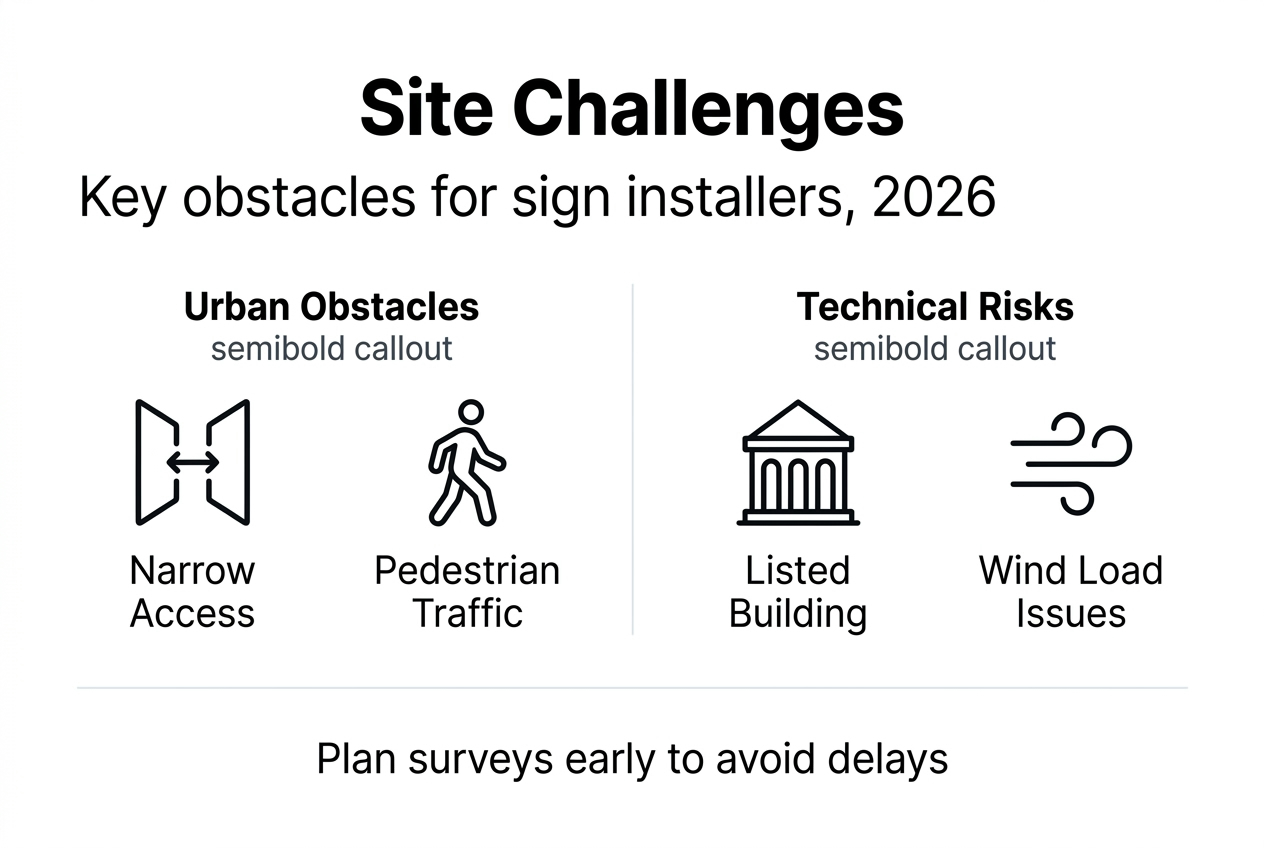
Urban environments in London, Essex, and Kent present unique physical obstacles. Constrained access, listed building fabric restrictions, and varying substrate conditions require adaptive installation techniques. Increased pressure on retail businesses makes it essential to optimise every signage investment.
Narrow pavements and pedestrian traffic limit scaffold placement. Installation teams must coordinate with local authorities for temporary road closures or pavement licences. Heritage buildings prohibit drilling into original brickwork or stonework, requiring specialist fixings that distribute load without damaging historic fabric.
Substrate variability complicates mounting decisions. Modern cladding systems, Victorian brickwork, and concrete facades each demand different fixing methods. Incorrect choices lead to sign failure, facade damage, or safety hazards.
Step-by-step problem solving for typical site hurdles:
- Conduct early site survey to identify substrate type, access constraints, and structural capacity
- Adapt installation design to accommodate discovered limitations without compromising sign functionality
- Select appropriate fixing systems matching substrate strength and environmental exposure
- Execute installation with contingency plans for unexpected conditions like hidden voids or weak materials
- Verify installation quality through post-installation inspections and load testing where required
Pro Tip: Schedule site surveys at least three weeks before installation to allow time for design modifications and obtaining any additional permissions revealed during the assessment.
Investing in quality custom signs London protects both installers and the public. Wind loading calculations, electrical safety for illuminated signs, and structural adequacy must all meet Building Regulations standards. Cutting corners on safety compromises insurance coverage and creates liability exposure.
Best practices for hassle-free sign installation projects
Successful installations follow a structured framework from initial concept through ongoing maintenance. This systematic approach minimises delays, controls costs, and ensures regulatory compliance throughout the project lifecycle.
Crucial steps for project success:
- Choose installers with demonstrable experience in your property type and local authority area
- Obtain all required permissions before ordering materials or scheduling installation dates
- Coordinate installation timing with business operations to minimise disruption
- Implement quality checks at design, manufacturing, and installation stages
- Plan maintenance schedules and document warranty obligations
| Common Pitfall | Recommended Best Practice |
|---|---|
| Rushing permission applications | Submit applications 8-12 weeks before desired installation date |
| Choosing cheapest quote without due diligence | Evaluate installer credentials, insurance, and previous project examples |
| Ignoring substrate condition | Commission structural surveys for large or heavy signage |
| Poor stakeholder communication | Establish clear communication channels with installers, landlords, and authorities |
| Neglecting maintenance planning | Create documented maintenance schedules with responsibility assignments |
| Overlooking warranty terms | Review and understand warranty coverage and claim procedures |
Pro Tip: Establish a dedicated project communication channel involving your installer, designer, property manager, and local authority planning officer to resolve issues proactively before they cause delays.
Following these practices reduces project timelines by 20-30% compared to reactive approaches. Cost overruns decrease as unexpected issues are anticipated and budgeted for. Sign longevity improves when quality standards are maintained throughout the process.
Businesses requiring large format printing London alongside installation benefit from working with a single provider who coordinates both production and fixing, eliminating hand-off delays and responsibility gaps. The UK signage regulations guide clarifies compliance requirements across different property types and locations.

Discover expert sign installation services
Navigating regulatory requirements, technical challenges, and quality considerations demands specialist expertise. Business owners in London, Essex, and Kent benefit from partnering with experienced installers who understand local authority processes and site-specific complications.
PromoSigns brings two decades of experience installing signage across retail and corporate environments. We manage permissions, adapt designs to site constraints, and deliver installations that balance speed with long-term durability. Our services cover everything from initial design consultation through ongoing maintenance support.
Explore our shop signs Barnet portfolio or discover how our shop signs Kings Cross installations demonstrate our capability with complex urban sites. Contact us today to discuss your signage requirements and receive a comprehensive project proposal.
The following table compares rapid versus precision installation methods:
| Factor | Rapid Installation | Precision Installation |
|---|---|---|
| Upfront cost | Lower by 15-25% | Higher initial investment |
| Installation time | 1-2 days typical | 3-5 days typical |
| Durability | 5-7 years average | 10-15 years average |
| Maintenance needs | Higher frequency | Lower frequency |
| Weather resistance | Standard performance | Enhanced weatherproofing |
| Risk of failure | Moderate | Low |
FAQ
What legal permissions do I need for installing a business sign?
Most commercial signage requires Advertisement Consent from your local planning authority, particularly for illuminated signs or those exceeding dimensional limits. Non-illuminated fascia signs within specific size thresholds may benefit from deemed consent, eliminating formal applications. Heritage properties demand Listed Building Consent regardless of sign size or illumination.
Check your property’s planning status and conservation area designation before proceeding. Sign permit requirements in London vary by borough, so early consultation with your local authority planning department clarifies specific requirements. Budget eight to twelve weeks for the approval process including consultation periods.
How can I prevent delays during the installation process?
Proactive planning eliminates most delays. Conduct site surveys at least three weeks before installation to identify substrate issues, access constraints, or structural concerns requiring design modifications. Confirm all permissions are granted before ordering materials or scheduling installation dates.
Maintain clear communication channels with your installer, property manager, and local authority throughout the project. Regular progress updates allow early identification of emerging issues and keep your project on track.
What factors influence the cost of sign installation?
Material quality, installation method, site conditions, and regulatory requirements all impact total project costs. Complex substrates requiring specialist fixings increase expenses by 20-40% compared to standard installations. Listed buildings and conservation areas add permission costs and potential design modifications.
Long-term durability often justifies higher initial investment. Precision installation methods cost 15-25% more upfront but reduce maintenance expenses and extend sign lifespan significantly. Obtain multiple detailed quotes comparing not just price but warranty terms, materials specifications, and project timelines to evaluate true value.
Recommended
- Sign Installation Process: A Step-by-Step Guide for 2025 Success – PromoSigns.co.uk
- Professional Sign Installation Creates Unique Signage – PromoSigns.co.uk
- A Step-by-Step Guide to Professional Commercial Sign Installation – PromoSigns.co.uk
- Master the Signage Installation Process for Businesses – PromoSigns.co.uk
- Overcome security questionnaire challenges with AI in 2026
- How to attract visitors at trade shows in 2026
