
TL;DR:
- UK pub signs have a history dating back over 2000 years, evolving from Roman vine leaves to painted heraldic symbols.
- Symbols like the Red Lion and White Hart signify loyalty, royalty, or local history, reflecting British heritage.
- Preserving traditional craftsmanship and materials in pub signage enhances authenticity, longevity, and customer attraction.
Few features of British life are as quietly extraordinary as the painted board swinging above a pub door. Most people walk past without a second glance, yet that image — whether a red lion, a white hart, or a crossed pair of keys — carries a lineage stretching back more than two thousand years. UK pub signs are among the oldest continuous forms of commercial signage in the world, and their history is inseparable from monarchy, faith, local trade, and artistic craft. For pub owners today, understanding this heritage is not simply interesting. It is a practical advantage.
Table of Contents
Key Takeaways
| Point | Details |
|---|---|
| Ancient origins | British pub signs trace their roots back to symbols used in Roman times and have evolved over centuries. |
| Symbolic language | Heraldic animals, crowns, and local icons on signs reveal a pub’s heritage and attract community interest. |
| Craftsmanship advantage | Investing in hand-painted, bespoke signs with quality materials boosts branding and longevity. |
| Preserve heritage | Restoring or updating signs with traditional methods helps pubs stand out and supports local cultural identity. |
From vine leaves to hand-painted boards: The origins and evolution of pub signage
To understand why pub signs remain such an evocative part of British culture, let us start with their origins and trace their surprising journey through the centuries.
Pub signs originated in Roman times with vine leaves or evergreen bushes hung outside tabernae to indicate wine sales. When the Romans arrived in Britain, local tavern keepers adapted this practice. Because vines did not grow readily in the British climate, ale stakes and hop poles were used instead, pointing skyward to signal that ale was available within. It is a wonderfully practical solution born from necessity.
The medieval period brought a significant shift. As literacy rates remained low across the population, pictorial signs became the primary way to identify an establishment. A landlord might hang a painted board showing a crown, a swan, or a ploughshare, and every passing traveller would understand the message without reading a single word. This visual shorthand was so effective that royal decrees were eventually issued mandating that all alehouses display a sign. Richard II’s proclamation of 1393 is one of the most cited examples, making signage a legal requirement rather than a personal choice.
By the Tudor period, pictorial boards had become far more elaborate. Heraldic imagery, drawn from the coats of arms of local nobles and the monarchy, spread rapidly. Local craftspeople competed to produce the most eye-catching and durable signs, elevating what had been a practical necessity into a genuine art form.
Here is a quick look at how materials and formats evolved over the centuries:
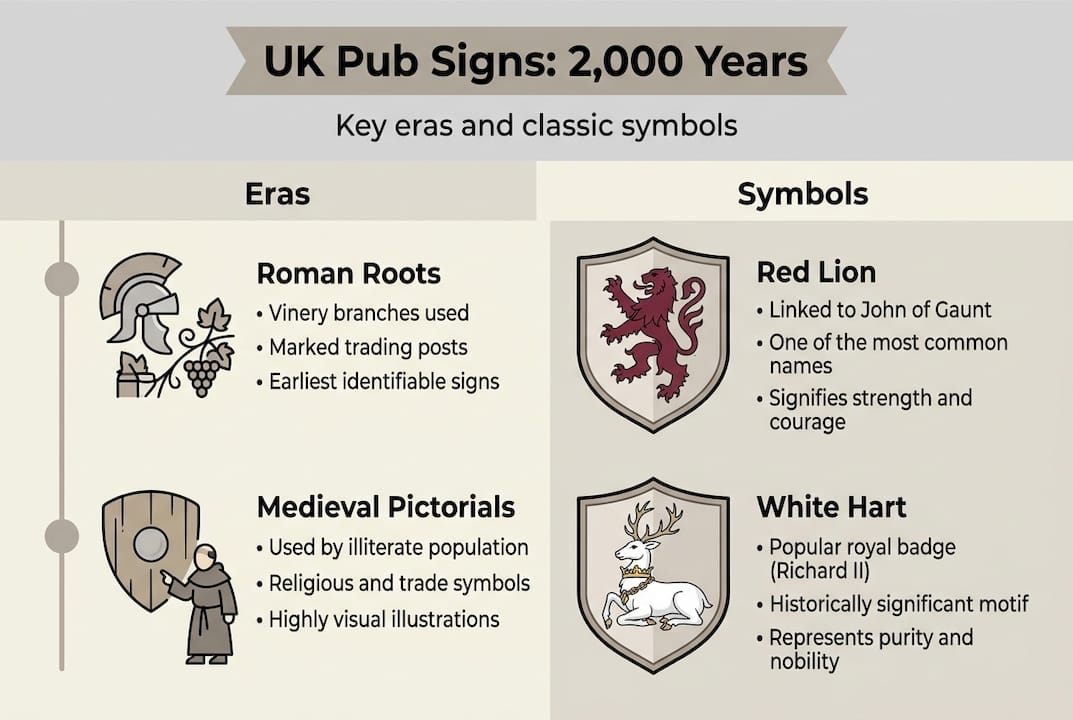
Here is a quick look at how materials and formats evolved over the centuries:
| Era | Primary material | Format |
|---|---|---|
| Roman/early medieval | Natural vegetation | Hung branches or poles |
| Medieval | Carved wood | Simple pictorial boards |
| Tudor to Georgian | Painted timber | Double-sided hanging boards |
| Victorian to present | Marine plywood, aluminium | Painted or printed panels |
Key milestones in the development of pub signs:
- Roman period: Vine leaves and bushes signal wine or ale availability
- Medieval era: Pictorial boards replace text for an illiterate population
- 1393: Royal mandate requires all alehouses to display a sign
- Tudor period: Heraldic imagery becomes widespread and elaborate
- 19th century: Professional signwriters emerge as a recognised trade
- 20th century: Marine plywood and synthetic paints extend sign lifespan
Pro Tip: If you are restoring or commissioning a new sign for an older pub, researching the original imagery associated with your establishment can give your shop signs London installation a genuine sense of place and history that customers will notice immediately.
The best signage companies London draw on this historical knowledge when advising pub clients, ensuring that new work respects and builds on the visual language that has defined British hospitality for centuries.
Decoding the symbols: The artistic language of pub signs
With the timeline established, let us explore the meanings behind pub signs. They are an artistic code that reveals much about British community, monarchy, and faith.
Common artistic elements include heraldic animals, with the Red Lion being the most popular, alongside royal symbols such as the Crown and White Hart, religious icons like the Cross Keys representing St. Peter, and local trade references. After the Reformation, many pub names shifted away from Catholic imagery to avoid controversy, leading to a wave of more neutral or trade-based names.
So why is the Red Lion so dominant? Its origins trace directly to James I of England, who in 1603 ordered the red lion of Scotland to be displayed on all public buildings. Tavern keepers, eager to demonstrate loyalty, adopted the symbol enthusiastically. Centuries later, it remains the most common pub name across England, Scotland, and Wales.
Here are some of the most recognised pub sign symbols and what they represent:
| Symbol | Origin | Meaning |
|---|---|---|
| Red Lion | Scottish heraldry, James I | Royal loyalty |
| White Hart | Richard II’s emblem | Royalist allegiance |
| Cross Keys | St. Peter’s attribute | Religious hospitality |
| The Plough | Agricultural trade | Working community |
| The Swan | Royal patronage | Nobility and elegance |
| The Bell | Church connections | Community gathering |
Beyond monarchy and religion, many signs carry deeply local stories. A pub might reference a local battle, a prominent family, or a trade that once defined the neighbourhood. This local specificity is, in many ways, the most powerful tool available to pub owners today. Your sign can immediately tell a visitor something true and distinctive about where they are.
For pub operators working in historically rich areas of London, collaborating with specialists in retail signs signage and heritage-sensitive environments is a smart way to ensure that new signage respects existing visual tradition while still standing out.
Key symbolic categories to consider for your own pub sign:
- Royal and heraldic animals: Lions, stags, bears, eagles
- Religious and civic references: Keys, mitres, anchors
- Local trades and industries: Hammers, anvils, fishing nets
- Natural landmarks: Rivers, hills, ancient trees
- Local historical figures: Portraits of mayors, benefactors, or celebrated locals
Tradition and craft: The signwriter’s art and materials through the ages
Every image and word on a pub sign is the result of keen artistic judgement and generational craft. But what does it actually take to make a great one?
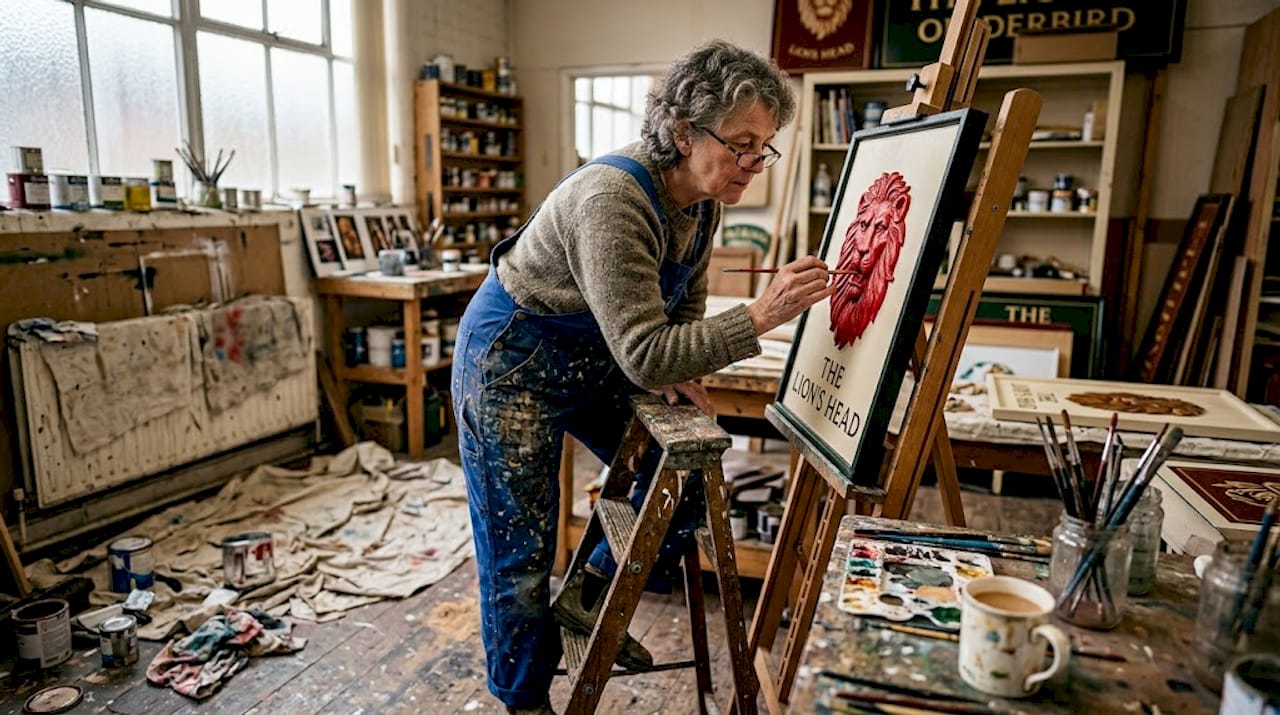
Historical signwriting was a specialised trade passed down through apprenticeships and studio traditions. Figures like Ralph Ellis, who produced over 250 signs for the Sussex brewery Henty and Constable, brought a rigorous approach to historical accuracy. Ellis sourced portraits and archive records to ensure that any person depicted on a sign was rendered faithfully. George Biles, another celebrated signwriter, was known for a subdued palette of ocean blues and greys — a style that felt both timeless and distinctly British.
Pub signs evolved from simple symbols to painted boards on marine plywood, often double-sided with different designs on each face, using vibrant colours on some and subtle blues and greys on others, with historical research underpinning the accuracy of the imagery.
The design legacy of traditional pubs has inspired a modern revival, with documentaries and workshops bringing renewed interest to traditional signwriting as a craft. The old saying among signwriters captures the stakes well:
“Paint fades, vinyl dies.”
It is a blunt but accurate summary of why traditional painted signs continue to outlast cheaper alternatives in both longevity and visual character.
How a traditional pub sign is created or restored:
- Research the history of the pub, its name, and any previous signs
- Sketch initial concepts based on period-accurate imagery and local references
- Select the board material, typically marine plywood or aluminium for outdoor durability
- Apply a base coat and allow it to cure fully before any detailed work begins
- Paint the design in layers, using brushwork to achieve depth and texture
- Apply a protective varnish to guard against UV damage and weathering
- Fit and hang with ironwork brackets that suit the period or style of the building
Pro Tip: When commissioning a new sign, ask the maker specifically about material choice. A knowledgeable signwriter will discuss board thickness, varnish grades, and bracket weight before they discuss colours.
Custom signs London specialists who understand heritage materials can guide you through every stage of this process, from substrate selection to final installation.
Challenges and preservation: Modern threats and strategies for protecting pub signage heritage
But what does the future hold for this storied tradition? As modern methods threaten traditional craft, preservation and adaptation are more critical than ever.
Modern threats from vinyl and digital signage accelerated in the 1980s, with brewery standardisation meaning that hundreds of individual pubs lost their unique, handmade signs to generic printed replacements. Heritage groups and some forward-thinking breweries have since worked to reverse this trend, collecting and restoring historic signs and supporting skilled signwriters.
For pub owners, the practical challenge is balancing authenticity with longevity. Investing in bespoke signs using weather-resistant materials such as treated timber and aluminium offers the best of both worlds. These materials hold paint well, resist warping, and can last for many decades with basic maintenance.
Key threats to traditional pub signage today:
- Cheap vinyl graphics that peel and fade within a few years
- Digital standardisation by large pub chains erasing local identity
- Weathering and neglect on older painted signs without maintenance plans
- Loss of specialist skills as fewer apprentice signwriters enter the trade
- Planning and conservation restrictions that complicate restoration in listed buildings
Strategies for pub owners looking to protect and celebrate their signage heritage:
- Choose materials rated for outdoor British weather
- Schedule annual inspections and touch-up painting before winter
- Work with signwriters who have experience in heritage or period-accurate work
- Check whether your pub is listed, as this may affect what you can display
- Plan proactively for replacement rather than emergency repair
- Combine traditional aesthetics with large format printing London techniques for elements that benefit from modern precision
Pro Tip: Documenting the history of your pub sign with photographs and written records is a valuable exercise. If restoration is ever needed, that archive becomes an invaluable reference and adds to the story you can share with customers.
Why history matters: The hidden value of embracing pub signage heritage
From our perspective, there is a tendency in the industry to treat pub signage as a practical necessity rather than a strategic asset. That is a missed opportunity. The pub owners who invest thoughtfully in the historical and artistic dimension of their signs consistently report something that goes beyond aesthetic satisfaction: they generate conversations.
A well-researched, beautifully crafted sign that references local history or genuine heraldic tradition becomes a talking point. It draws in curious visitors, encourages locals to share photographs on social media, and creates the kind of authentic brand identity that no amount of generic printed vinyl can replicate. The sign becomes part of local lore.
There is also a harder commercial reality here. Authenticity is one of the few things a local independent pub can offer that a chain cannot. A sign that genuinely tells your pub’s story, delivered through professional sign installation, is a statement of pride and permanence. It signals to every person who walks past that your establishment has roots, standards, and a story worth knowing.
Preserve your pub’s story with bespoke signage solutions
For pub owners inspired to act, here is how you can translate tradition into a vibrant visual legacy for the future.
At Promo Signs, we work with pub owners across London, Essex, and Kent to design and install bespoke pub signage that honours historical context while delivering the durability needed for British outdoor conditions. Whether you are restoring an original painted board or commissioning an entirely new design rooted in your pub’s heritage, our team brings the craft knowledge and material expertise to get it right.
We understand that your sign is far more than a label above a door. It is the first impression your pub makes, and in a competitive market, that impression carries real weight. Speak to our team about bringing your pub’s story to life with signage that combines heritage authenticity with professional installation.
Frequently asked questions
Why do so many UK pubs use the ‘Red Lion’ as a name and sign?
The ‘Red Lion’ reflects heraldic origins dating back to James I, who ordered the Scottish red lion to be displayed on all public buildings in 1603, making it a symbol of royal loyalty that landlords were quick to adopt and that has endured ever since.
What are the most durable materials for traditional pub signage?
Weather-resistant timber, marine plywood, and aluminium are the best choices, combining authenticity with the longevity needed for British outdoor conditions.
How can I restore an old pub sign or commission a new one?
Marine plywood boards with period-accurate painted designs are the traditional approach; work with an experienced signwriter who researches local heritage and uses appropriate materials to create or faithfully restore your pub’s identity.
What threats do traditional pub signs face today?
The main threats include vinyl replacements and brewery-led standardisation that began accelerating in the 1980s, alongside weathering and the declining number of trained traditional signwriters available to carry out skilled restoration.
Do traditional pub signs help to attract more customers?
Yes. Bespoke heritage-based signs increase footfall and build customer loyalty by communicating authenticity and a genuine sense of place that generic signage simply cannot replicate.
Recommended
- Signage Design Principles for London Businesses in 2025 – PromoSigns.co.uk
- Blog Archives – Page 2 of 30 – PromoSigns.co.uk
- Types of Shop Signs for London Businesses: The 2025 Guide – PromoSigns.co.uk
- Shop Signs Tower Hill | Restaurant Signs | Office Wall Signs
