
TL;DR:
- London’s street art scene features over 6,600 murals that showcase diverse styles and artistic talent. Iconic districts like Shoreditch, Camden, and Hackney Wick attract visitors seeking vibrant, meaningful urban art. Understanding legality, permits, and ways to experience the art enhances appreciation beyond casual sightseeing.
London’s street art scene is one of the most talked-about in the world, yet many visitors arrive expecting to find jaw-dropping murals on every corner, only to discover that the reality is rather more layered. Some works are commissioned masterpieces with council backing; others exist in a legal grey area and may be painted over within days. Whether you are an artist looking to contribute, an enthusiast wanting to document iconic pieces, or a tourist hoping to understand what you are seeing, this guide maps out the essential districts, clarifies the rules, and offers practical advice for getting the most from London’s extraordinary walls.
Table of Contents
Key Takeaways
| Point | Details |
|---|---|
| London is a street art hub | More than 6,600 murals and a diversity of styles make it a global destination. |
| Know before you paint | Legal status varies—Leake Street Tunnel is open, but most walls require permission. |
| Best districts mapped | Areas like Shoreditch, Camden and Brixton are must-visits for artists and fans. |
| Tours and resources help | Guided tours and Art UK’s database make discovering new works simple for all visitors. |
What makes London’s street art scene unique?
London stands apart from other European cities not simply because of the volume of work on its walls, but because of the sheer diversity of styles, the calibre of the artists involved, and the cultural weight street art carries here. This is a city where a commissioned mural can spark genuine public debate, where an unsigned paste-up can command thousands of pounds at auction, and where entire neighbourhoods have been reshaped by the presence of large-scale public art.
The scene blends several distinct forms of visual expression. You will find sanctioned murals produced as part of council-funded regeneration projects, spontaneous stencil work that appears overnight, and artist-commissioned installations that blur the boundary between gallery art and graffiti. Each type tells a different story about the city and its communities.
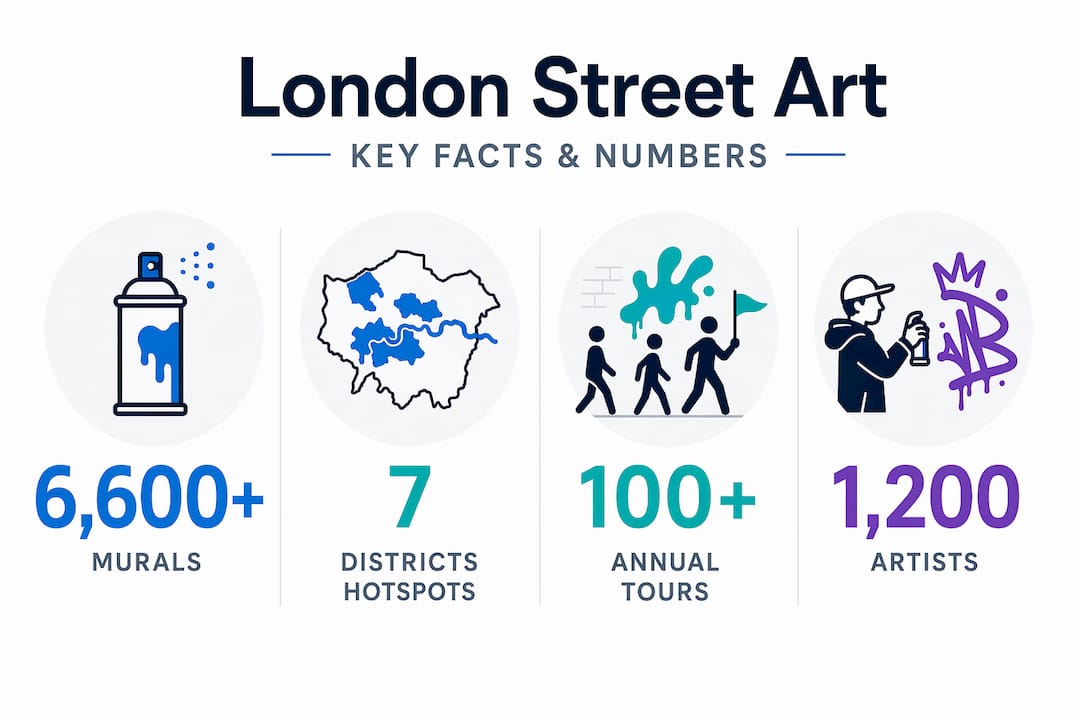
The numbers alone are striking. Over 6,600 murals have been recorded by Art UK as part of its ongoing project to digitise and catalogue wall-based artworks across the UK. That figure places London and its surrounding urban areas in a category of their own when it comes to the density and significance of public art.
“The sheer scale of recorded UK murals, surpassing 6,600 individual works, underlines just how seriously Britain takes its walls as cultural canvases.”
It is also worth noting that street art in London is treated as a serious artistic movement, not merely decoration or vandalism. Many internationally recognised artists began their careers on London’s streets before moving into commercial galleries. Understanding the best practices for outdoor art signage and display helps appreciate why some works survive for years while others disappear in days. Businesses inspired by London’s visual culture often turn to large format printing London to bring that same bold, mural-scale energy to their own walls and shopfronts.
| Feature | London street art | Typical city street art |
|---|---|---|
| Scale of recorded works | 6,600+ murals nationally | Typically hundreds |
| Artist profile | International and local talent | Predominantly local |
| Commission model | Mixed: council, commercial, independent | Mostly independent |
| Legal spaces | Multiple designated areas | Often limited |
| Cultural influence | High, gallery crossover common | Variable |
District hotspots for street art
With an understanding of street art’s importance in place, it is time to pinpoint exactly where to find London’s most vibrant wall art. The city’s art is not evenly distributed. Certain neighbourhoods have become destinations in their own right, drawing visitors from around the world specifically to see what is on the walls.
London’s key street-art viewing areas include Shoreditch and Spitalfields, Soho, Camden Town, Hackney Wick, Walthamstow, Brixton, and Whitecross Street, each offering a distinctive visual character and range of styles.
| District | Style and character | Must-see streets |
|---|---|---|
| Shoreditch | Urban, modern, high-profile commissions | Brick Lane, Bethnal Green Road |
| Camden Town | Large, colourful figurative pieces | Camden High Street, Stables Market |
| Hackney Wick | Riverside murals, experimental work | White Post Lane, Wallis Road |
| Brixton | Politically charged, community-led | Electric Avenue, Coldharbour Lane |
| Walthamstow | Emerging talent, neighbourhood focus | Hoe Street, the town centre |
| Whitecross Street | Eclectic mix, long-standing tradition | Whitecross Street itself |
Beyond the well-known circuits, several less-publicised locations reward explorers who venture off the main trail. Consider visiting:
- Peckham Rye: A growing hub with independent artist studios whose exteriors have become canvases in their own right.
- Dalston: Constantly shifting pieces that reflect the neighbourhood’s diverse cultural influences.
- Leyton: An emerging area where local artists are beginning to leave significant marks on industrial buildings.
- Tottenham: Regeneration-linked murals appearing on formerly neglected building facades.
- Waterloo and South Bank: Both sanctioned and spontaneous pieces, especially under the railway arches.
When exploring custom murals and wall graphics for your own project, the variety you see across London’s districts is a useful reference point for understanding scale, colour, and placement. Businesses that want to replicate that street-level visual impact indoors can achieve striking results with shop window graphics that draw on the same bold design principles seen across East London’s walls.
Pro Tip: Do not limit yourself to the famous Brick Lane corridor on a Saturday afternoon when crowds peak. Visit Hackney Wick on a weekday morning and combine it with a walk along the canal to Stratford for a genuinely different and less-photographed perspective on the city’s wall art.
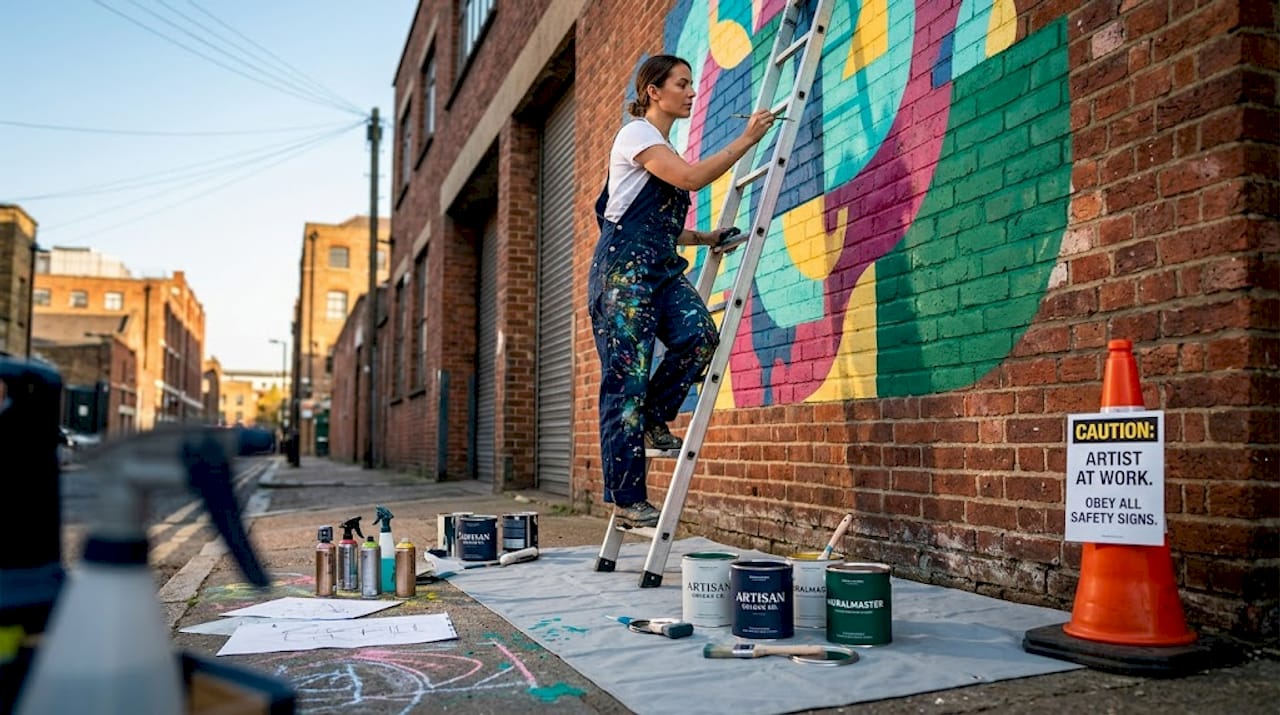
Legal and ethical guide: street art, graffiti and permissions
Once you have chosen your street art destinations, you need to understand how legality and etiquette work on London’s walls. This is arguably the most misunderstood aspect of the scene, and getting it wrong as either an artist or a visitor can create real problems.
The terminology matters here. Graffiti is typically associated with unauthorised work, while “street art” is generally considered legal when it is commissioned or has explicit permission from the property owner. The line between the two is not always visible to the naked eye, which is why context and research matter so much.
Borough-level rules add another layer of complexity. What a landowner in Newham might permit on a warehouse wall could see an artist prosecuted in a more tightly regulated area of Camden or Kensington. Local councils have their own enforcement priorities and planning guidance, meaning there is no single rule that applies across the whole of the capital.
If you want to make or contribute to art legally in London, here are the most practical routes:
- Obtain written property owner permission: Approach building owners directly with a clear proposal. Many industrial landlords, pub owners, and community organisations are open to the idea, especially if the work improves the area’s appearance.
- Join a community mural project: Several boroughs run funded programmes through arts organisations and housing associations. These are excellent entry points for artists new to the public art process.
- Use a designated legal wall: Leake Street Tunnel, sometimes called the Banksy Tunnel beneath Waterloo station, is one of London’s only spaces where artists can paint without fear of enforcement. It is constantly evolving and always worth a visit.
- Apply for a council arts grant: Some boroughs offer small grants for artists to produce publicly accessible work as part of community benefit schemes.
- Work through an established arts organisation: Groups such as the Tileyard arts collective or various East London studios can provide introductions, permissions, and project structures that make legal participation far easier.
Pro Tip: If you are visiting Leake Street Tunnel, go with an open mind about the transient nature of what you see. Work there is painted over constantly, sometimes within hours. That impermanence is the point, and experiencing it is one of the most honest introductions to street art culture you can get in London.
Understanding the sign durability tips for artists is also relevant here. Outdoor materials, weather resistance, and surface preparation all affect how long any public artwork lasts, whether sanctioned or otherwise. For developers and businesses looking to commission large-scale outdoor displays legally, advertising construction hoardings London offer a fully compliant and visually impactful way to transform blank site boundaries into bold brand statements.
How to experience street art: tours, self-guided walks and digital resources
Understanding where and how street art is created leads directly to experiencing it in the most meaningful ways. London offers multiple levels of engagement, from casual Sunday walks to deeply researched, artist-led explorations.
Here are the most effective ways to engage with the scene:
- Guided tours with local artists: Several well-reviewed options are guided by practising artists who can explain the context, history, and significance of individual pieces in real time. These tours typically last two to three hours and cover Shoreditch and Brick Lane.
- Self-guided district walks: Armed with a downloaded map or the Art UK grid, you can plan a half-day walk through any of the key districts. Shoreditch alone can occupy a full morning if you explore the side streets and alleyways thoroughly.
- Art UK’s digital mural database: With over 6,600 murals catalogued, the Art UK platform allows you to search by location, artist, and style. It is an invaluable planning tool and a way of verifying whether a specific work is still in place before making a journey.
- Instagram and community photography groups: Several London-based accounts document new pieces as they appear, often within hours of completion. Following a handful of active street-art photographers gives you a near real-time view of what is happening on the city’s walls.
- Art walks combined with gallery visits: Many East London galleries show work by artists who are also active on the streets. Combining a gallery visit with an outdoor walk gives you a fuller picture of individual artists’ practices and how their public and private work relate.
Knowing about bespoke mural signage options can be genuinely useful if you are inspired by what you see and want to bring that same visual energy into a commercial or community space. Similarly, understanding outdoor art lighting tips can help you appreciate why some murals look dramatically different in evening light compared to midday sun. Retailers inspired by street art aesthetics often explore vinyl sticker printing London as a cost-effective way to layer bold graphics across their shopfront surfaces.
Key statistic: Art UK’s mural recording project has catalogued more than 6,600 wall-based artworks across the UK, making it the most comprehensive publicly accessible record of the country’s public art heritage.
The deeper meaning: why London’s street art matters now
After seeing how to experience the art for yourself, it is worth stepping back to consider what it all means in a wider context. London’s street art scene is frequently reduced to its most photogenic moments, filtered, hashtagged, and repurposed as a backdrop for social media content. That surface reading misses almost everything that makes the scene genuinely significant.
What casual visitors rarely see is the process behind any major mural. A large-scale commissioned piece on a Hackney Wick warehouse wall is typically the result of weeks of negotiation between an artist, a property owner, sometimes a local authority, and occasionally a community group. There are sketches, revisions, material costs, access arrangements, and legal sign-offs before a single spray can is uncapped. The spontaneous energy that makes these works feel alive belies the considerable effort and dialogue behind them.
The legal grey area that characterises parts of the scene is not simply a nuisance to be managed. It is actually one of the creative engines of street art’s evolution. Artists working without permission take real risks, and that risk informs the urgency and intensity of the work. When the rules are removed entirely, as in designated legal spaces, the work sometimes loses a dimension of tension. The best street art in London exists in the productive space between sanctioned and unsanctioned, and understanding that tension is what separates informed appreciation from tourist consumption.
There is also a place-making argument that is frequently underestimated. Academic research and urban planning professionals increasingly recognise that high-quality public art raises the perceived value of a neighbourhood, attracts independent businesses, and creates the kind of distinctive identity that no amount of generic development can manufacture. Areas like Shoreditch and Brixton have street art baked into their brand identity in a way that influences property investment, footfall, and community pride simultaneously. Businesses in these areas that invest in quality shop signs London benefit directly from the footfall and brand cachet that street art culture generates around them.
The long-term value of London’s street art lies not in any single iconic piece but in the ongoing public dialogue it sustains. These walls are not museums. They change, they argue with each other, and they reflect the city’s shifting preoccupations in ways that permanent public sculpture rarely can. That responsiveness is exactly what makes London’s walls worth paying attention to.
Bring street-level impact to your business or project
Inspired by the visual energy you have seen on London’s streets? Whether you are a business owner looking to make a statement, an arts organisation commissioning a new installation, or a property developer wanting to add genuine character to a space, the principles behind great street art translate directly into high-impact commercial design.
At PromoSigns, we specialise in producing bespoke custom wall murals and large-format graphics that bring the boldness of street art into retail, hospitality, and corporate environments. Our end-to-end service covers design, material selection, manufacture, and professional installation across London, Essex, and Kent. If you want to turn a blank wall into a powerful brand statement, our team can help you achieve exactly that. Explore our full range of outdoor signs and get in touch for a bespoke quote tailored to your project.
Frequently asked questions
Is street art legal everywhere in London?
No, most street art is only legal if it is commissioned, has explicit property owner permission, or is created in a designated space. Leake Street Tunnel is one of the few locations where painting is permitted without police enforcement risk, while most other locations require formal permission from the property owner or commissioning body.
What is the best area for street art in London?
Shoreditch and Hackney Wick are among the most celebrated destinations for vibrant, high-quality work, but Soho, Camden Town, and Brixton also offer impressive and distinctive displays.
How can I find up-to-date murals and artworks?
Use Art UK’s digital mural map to search, filter, and plan your visits based on recorded wall-based artworks across London. The platform is regularly updated and is the most authoritative publicly accessible catalogue of UK public art.
Are there guided tours focused on street art in London?
Yes, several companies and practising artists offer dedicated guided tours, with East London walks consistently among the most popular and highly rated.
Recommended
- Sign Permits in London: Complete Compliance Guide – PromoSigns.co.uk
- Wall Graphics London | Custom Wall Vinyl & Murals Printing
- Outdoor Signage Best Practices for London Businesses 2025 – PromoSigns.co.uk
- Shop Graphics Inspiration Ideas for 2025: London Guide – PromoSigns.co.uk
