
TL;DR:
- Effective workplace branding involves integrating visual identity elements throughout the office environment to reinforce company values and create a cohesive impression for employees and clients. Using visual tools like wall graphics, privacy films, and signage, combined with internal brand alignment frameworks, strengthens employee engagement and long-term perception. Quick, flexible branding updates without structural changes can significantly improve office credibility and brand expression over time.
Effective workplace branding is defined as the deliberate embedding of your company’s visual identity throughout the physical office environment to reinforce values, shape employee behaviour, and impress clients from the moment they walk through the door. The best branding tips for offices go far beyond hanging a logo on a reception wall. They treat every surface, from glass partitions to meeting room doors, as an opportunity to communicate who you are and what you stand for. Tools such as vinyl wall wraps, 3D lettering, privacy films, and storytelling wall graphics give office managers and business owners tangible, fast-to-install options that create genuine impact. When physical branding aligns with internal culture frameworks, the result is a workplace that feels consistent, credible, and worth working in.
Table of Contents
Which branding elements best communicate your company values?
Physical branding elements are the most direct way to translate abstract company values into daily, visible reminders. The right combination of office signage and graphics turns a generic workspace into a branded environment that employees and clients read instinctively.
The most effective elements to consider include:
- Environmental wall graphics and wraps: Large-format wall graphics carry brand colours, typography, and messaging across entire surfaces. They work particularly well in reception areas, corridors, and collaborative spaces where dwell time is high.
- Privacy films on glass partitions: Functional privacy films on glass conference rooms can also serve as prime branding storytelling real estate, using custom gradients or typography tied to company history. They serve a practical purpose while doubling as a brand communication tool.
- Storytelling walls and milestone displays: Dedicated walls that document company history, client wins, or founding values give employees a sense of belonging and give visitors an immediate narrative to engage with.
- 3D lettering and reception signage: Dimensional letters in brand materials create a premium first impression. They signal investment, permanence, and professionalism in a way that flat print cannot replicate.
- ADA-compliant room signage: Synchronised tactile signage that matches your brand’s typography, material, and colour scheme creates a cohesive and polished professional image throughout the building.
Consistency across all these touchpoints is what separates effective workplace branding from a collection of decorative choices. When your reception sign, meeting room films, and wayfinding all share the same typeface and colour palette, the office reads as a single, considered brand statement.
Pro Tip: When specifying privacy films for glass partitions, brief your supplier to match the opacity level and gradient direction to your brand guidelines. A mismatched film undermines the cohesion of everything around it.
How can internal brand alignment frameworks improve employee engagement?
Visual branding alone does not create a branded culture. Internal brand alignment is the practice of connecting employees to the values that physical branding communicates, making those values lived rather than displayed. The greatest risk to brand credibility is the promise-reality gap where physical office branding does not reflect actual employee experience. Leadership behaviour under pressure is what confirms brand values to employees, not the wall graphics.
A structured approach to internal alignment works best when it follows a clear sequence:
- Leadership narration of brand decisions. Leaders should explain major decisions through the lens of brand values. When a business chooses to invest in a new office fit-out, framing that decision around culture and client experience reinforces what the brand stands for.
- Structured onboarding with real customer stories. Leading frameworks recommend 30-day onboarding incorporating 3–5 real customer stories that illustrate brand values in practice. This gives new employees a concrete understanding of what the brand means, not just what it looks like.
- Role-specific brand moment mapping. Each team member should be able to identify the moments in their daily work where they directly embody the brand. A receptionist’s greeting, a project manager’s client update, and a designer’s presentation all carry brand weight.
- Brand confidence surveys. Regular internal surveys measure how clearly employees understand and feel connected to the brand. These metrics reveal where alignment is strong and where messaging has become noise.
- Consistent internal brand voice. The best internal branding systems provide flexible frameworks that allow different departments to express themselves while maintaining a consistent brand voice. Fragmentation occurs when teams are left to interpret the brand independently without a shared framework.
This approach is particularly valuable for distributed or hybrid teams, where internal brand infrastructure and leadership narration significantly improve brand consistency when physical proximity is limited.
What are the quickest ways to update office branding without renovation?
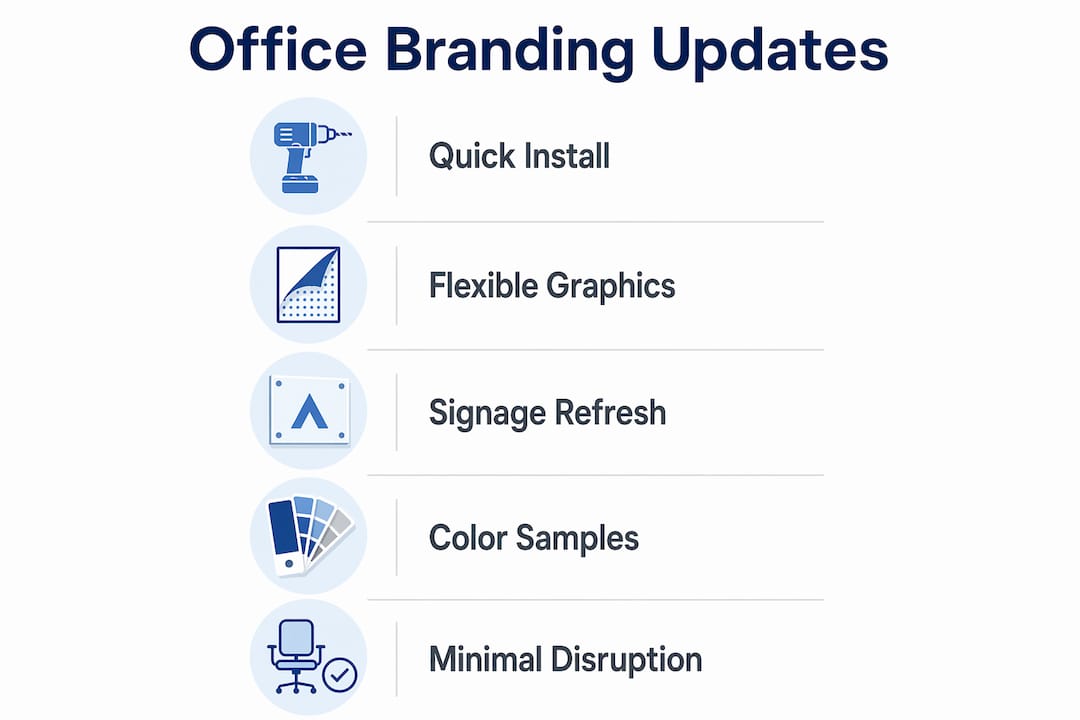
Many of the most effective branding ideas for offices require no structural work at all. The table below compares common quick-update methods by installation time, flexibility, and typical use case.
| Method | Typical Installation Time | Flexibility | Best Use Case |
|---|---|---|---|
| Logo pattern on door glass | Under 30 minutes | High (removable) | Reception, meeting rooms |
| Privacy film with brand graphics | Under 30 minutes | High (removable) | Glass partitions, conference rooms |
| Removable vinyl wall graphic | 1–3 hours | High (repositionable) | Feature walls, corridors |
| Refurbished fascia signage | Half day | Medium | Reception desk, entrance |
| 3D lettering installation | Half to full day | Low (permanent) | Reception, boardroom |
Simple glass branding elements such as logo patterns on door glass or privacy films can be installed in under 30 minutes, creating immediate high-impact results without major disruption. That speed matters enormously for occupied offices where downtime is not an option.
Removable vinyl graphics and privacy films can be updated or replaced easily, offering flexibility for evolving brand stories and quick refreshes without structural changes. This makes them the most practical starting point for any office manager working within a budget or a lease that restricts permanent alterations.
Refurbishing existing signage is another underused option. Replacing the face of an existing reception sign with updated typography and colour costs a fraction of a full replacement and can modernise a space significantly. When planning any update, align physical signage with your digital brand assets. Your office typography should match your website and marketing materials precisely. Inconsistency between physical and digital brand expressions is one of the most common and most visible mistakes in office branding.
Pro Tip: Before ordering any vinyl or film, request a physical sample in your brand’s Pantone or RAL colour reference. Screen colours and print colours differ. A sample prevents costly reprints.
How does consistent office branding affect long-term employee and client perception?
Office branding must be treated as a long-term brand asset that shapes daily employee perception and client trust, rather than a one-off aesthetic decision. The physical environment is the most persistent brand communication channel you have. Employees spend more time in your office than they do reading your website or seeing your advertising.
“A branded office environment supports recruitment, reinforces company culture, aids retention, and converts the physical workspace into a valuable, working brand asset.” — Highway 85 Productions
Cohesive visual identity across all office touchpoints correlates directly with employee pride and engagement. When the space around you reflects a clear, considered identity, it signals that the organisation is serious about its values. That signal matters during recruitment. Candidates who visit a well-branded office before accepting a role arrive with a stronger sense of what they are joining.
Client perception follows the same logic. A polished, consistent office environment communicates competence before a single word is spoken. Conversely, disconnected branding increases internal noise and reduces clarity among employees, and clients pick up on that fragmentation too. Mismatched signage, outdated graphics, and inconsistent colour use all erode the credibility that your marketing budget works to build.
The long-term consequence of fragmented branding is a diluted culture. When different floors, departments, or meeting rooms feel visually disconnected, employees lose a shared sense of identity. Reviewing your office signage planning process as part of a wider brand audit is the most direct way to identify and close those gaps before they compound.
What we have learned from branding offices across london
Most office managers treat branding as a final layer applied after the fit-out is complete. That approach is understandable, but it is the single most common reason office branding feels superficial. Integrating brand elements into the initial design brief, influencing joinery, spatial flow, and signage choices, produces a more durable and cost-effective result than applying vinyl and graphics to a finished space.
The second mistake is assuming that physical branding does its job independently. It does not. The walls can carry your values perfectly, but if leadership behaviour contradicts those values under pressure, employees notice the gap immediately. Physical branding amplifies culture. It does not create it.
What I have found works consistently is a phased approach. Start with the highest-visibility surfaces: reception, main corridor, and meeting room glass. Get those right, and the rest of the office follows a clear visual logic. Avoid the temptation to brand every surface at once. Overbranded spaces feel cluttered and lose the impact of each individual element.
Flexibility matters too. Removable films and vinyl graphics allow you to evolve your brand story as the business grows without committing to permanent installations that become outdated. Build that flexibility into your specification from the start, and you will save significantly on future updates.
Measure the impact. A simple internal survey before and after a branding refresh will tell you more about its effect on employee engagement than any visual audit. The numbers will also make the case for future investment far more convincingly than photographs alone.
— Promo
How Promosigns can help you brand your office space
If you are ready to put these strategies into practice, Promosigns designs, manufactures, and installs bespoke office branding solutions across London, Essex, and Kent. From custom vinyl wall graphics and privacy films to 3D reception lettering and interior signage, every product is produced to your exact brand specifications.

Fast installation options mean minimal disruption to your working day, and the Promosigns team works directly with office managers and business owners to develop a cohesive visual plan from brief to installation. Whether you need a single reception sign or a full office rebrand, explore the range of interior signs for London offices or browse custom office wall signs to find the right solution for your space. Get in touch with Promosigns to discuss your project.
FAQ
What is office branding and why does it matter?
Office branding is the deliberate use of visual identity elements, including signage, graphics, and colour, throughout a workplace to reinforce company values and shape employee and client perception. A well-branded office supports recruitment, retention, and client trust.
How quickly can you install office branding elements?
Simple branding elements such as logo patterns on door glass or privacy films can be installed in under 30 minutes, making them practical for occupied offices with no tolerance for downtime.
What is the difference between visual branding and internal brand alignment?
Visual branding refers to the physical elements you see in an office, while internal brand alignment ensures employees understand and live the values those elements represent. Both are required for branding to have a genuine cultural impact.
How often should office branding be updated?
Office branding should be reviewed whenever the company undergoes a visual identity change, a significant growth phase, or a shift in values. Removable vinyl graphics make incremental updates straightforward and cost-effective without structural work.
Which office branding elements deliver the best return?
Privacy films, wall graphics, and reception signage consistently deliver strong returns because they are visible to every employee and visitor daily. Aligning these with ADA-compliant room signage in matching typography and materials creates a cohesive, professional environment at relatively low cost.
Recommended
- Essential exhibition branding tips for unforgettable impact – PromoSigns.co.uk
- Understanding Office Branding with Signs for Your Business – PromoSigns.co.uk
- Updating Office Signage: Key Reasons and Best Practices – PromoSigns.co.uk
- Interior Branding Graphics: Transforming London Businesses in 2025 – PromoSigns.co.uk
