
TL;DR:
- Sign illumination methods include front-lit, halo-lit, and back-lit panel techniques, each offering distinct visual effects and applications. Proper selection depends on location, ambient light, and brand message, with planning permissions and technical details influencing compliance and performance. Businesses that treat lighting as a crucial specification achieve better results and longer-lasting signs.
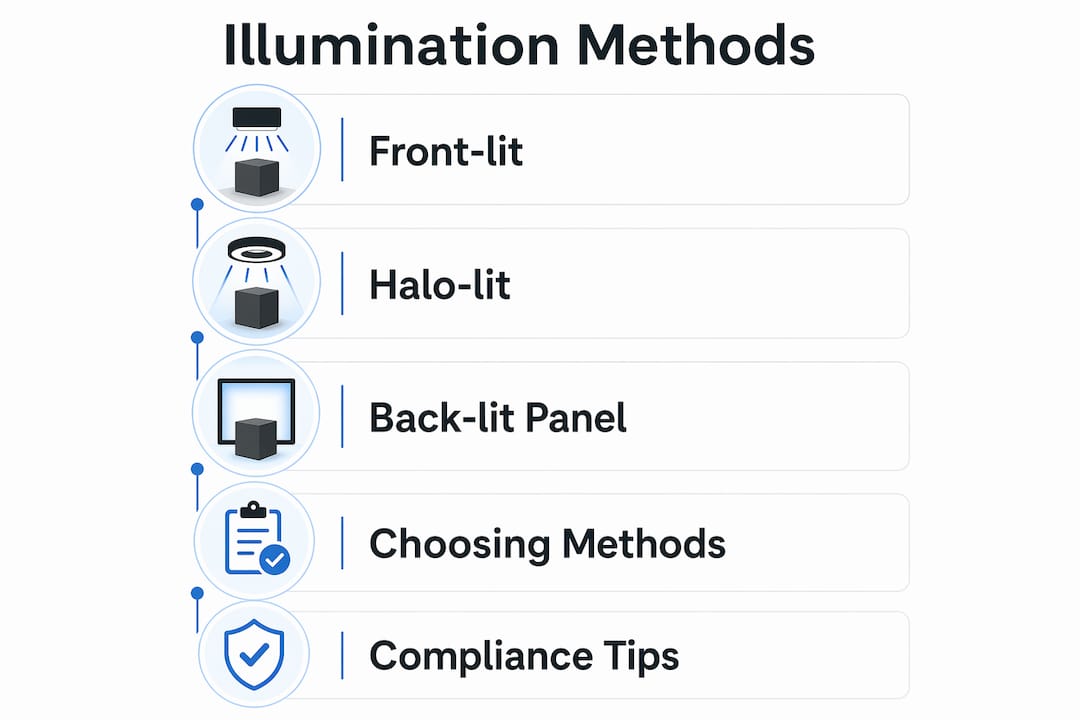
Sign illumination methods refer to the techniques used to integrate lighting into signage, producing distinct visual effects that increase visibility and reinforce brand identity. The three principal approaches in commercial signage are front-lit, halo-lit, and back-lit panel illumination. Each method suits different environments, budgets, and brand tones. For business owners and property developers across London, Essex, and Kent, choosing the right approach is not simply an aesthetic decision. It directly affects how far your sign reads, how your brand is perceived, and whether your installation complies with UK planning requirements.
Table of Contents
What are the main sign illumination methods and how do they differ?
Sign illumination methods fall into three primary categories, each producing a fundamentally different visual result. Understanding those differences is the starting point for any well-specified illuminated sign.

Front-lit illumination places LEDs behind a translucent face on each letter or panel. Light shines directly outward through the face, producing strong, high-contrast visibility. This method suits retail fascias, fast-food outlets, and any business that needs maximum legibility from a distance.
Halo-lit illumination (also called backlit) positions LEDs behind solid-faced letters, projecting light onto the wall behind them. The result is a soft glow surrounding each letter rather than a lit face. This technique conveys quality and restraint, making it popular with hotels, boutiques, and professional services firms.
Back-lit panel illumination distributes light evenly across a translucent panel surface. Menus, directories, and wayfinding boards favour this approach because it prioritises surface readability over decorative effect.
Combined illumination pairs front-lit and halo-lit effects in a single sign. The letter face is lit and a halo glow appears simultaneously. This delivers the highest visual impact but also the highest cost and engineering complexity.
| Method | Visual effect | Best application | Relative cost |
|---|---|---|---|
| Front-lit | Bold, direct face glow | Retail, food and beverage, forecourts | Low to medium |
| Halo-lit | Soft glow behind letters | Hotels, boutiques, professional offices | Medium |
| Back-lit panel | Even surface illumination | Menus, directories, wayfinding | Low to medium |
| Combined | Bold face plus halo glow | Premium retail, flagship locations | High |
- Front-lit channel letters are the most widely installed type in UK high streets.
- Halo-lit letters require a flat, uniform wall surface to produce a consistent glow.
- Back-lit panels are the most straightforward to maintain and replace.
- Combined signs require precise engineering and are best specified by an experienced manufacturer.
How to choose the right lighting method based on location
Matching illumination to ambient light conditions is more important than simply adding brightness. A halo-lit sign that looks refined in a dimly lit boutique corridor can appear almost invisible on a bright, south-facing high street in summer.
The viewing distance rule gives you a reliable starting point. Letter height and viewing distance follow a ratio of approximately 1 inch of letter height per 10 feet of viewing distance. A sign read from 50 feet away needs letters at least 5 inches tall. LED brightness must then be calibrated to match that scale, or the sign will appear washed out in daylight or uncomfortably glaring at night.
Consider these location factors before specifying any illumination type:
- Indoor malls and atriums: Ambient light is controlled and moderate. Halo-lit and back-lit panel signs both perform well. Front-lit signs can feel overpowering in enclosed retail environments.
- Shaded outdoor locations: Reduced natural light means lower brightness LEDs suffice. Halo-lit signs read clearly without appearing harsh.
- Street-facing façades with high ambient light: Front-lit signs with higher-output LEDs are the reliable choice. Halo-lit signs may not cut through daytime glare.
- High-glare or south-facing walls: Diffusion films on front-lit faces reduce hotspots and produce a more even glow across the letter face.
- Conservation areas and residential proximity: Lower luminance outputs are required. Dimming controls and photocell sensors help meet planning conditions automatically.
Pro Tip: Visit your site at three different times: early morning, midday, and after dark. Photograph the fascia at each visit. The images will show you exactly how much ambient light your sign must compete with, and they provide useful evidence when briefing a signage manufacturer.
Technical and design considerations for compliant illuminated signs
Letter visibility depends on construction details such as mounting depth, face design, and spacing, not on LED brightness alone. A well-specified LED module can still produce an uneven result if the letter depth is too shallow or the return height is inconsistent.
For halo-lit signs, the gap between the letter back and the wall surface is critical. Halo-lit installation requires precise mounting spacing to maintain a consistent glow. Uneven gaps produce irregular brightness bands around letters. Manufacturers use full-scale mounting templates and calibrated spacers to control this gap during installation.
Electrical components deserve equal attention. Wiring faults cause the majority of unlit letter problems in the field, not LED failure. Using wiring diagrams and testing each circuit before final fixing prevents the most common post-installation faults. Power supplies and LED drivers must be rated for the total load of the sign, with a safety margin built in.
UK planning and advertisement consent
UK illuminated signage is subject to Advertisement Consent when it exceeds certain size or luminance thresholds. The rules differ for conservation areas and areas of special advertisement control, where restrictions are considerably tighter.
| Sign size | Maximum luminance | Notes |
|---|---|---|
| Up to 10 sqm | 600 cd/m² | Standard Advertisement Consent threshold |
| Conservation areas | Lower limits apply | Consent required in most cases |
| Flashing or moving light | Generally refused | Static illumination only in most zones |
Obtaining Advertisement Consent requires scaled drawings, elevations, and full illumination specifications submitted to the local planning authority. Preparing these documents early in the design process avoids delays and costly revisions.
Ambient light sensors and dimming schedules automate brightness adjustments to keep signs within permitted luminance limits at night. Technologies such as photocells and curfew lockouts satisfy ILP and Outsmart Code standards without requiring manual intervention.
Pro Tip: Request a luminance calculation from your signage manufacturer before submitting your planning application. A figure expressed in candelas per square metre gives the planning officer exactly what they need and removes the most common reason for information requests that delay consent.
How illumination style supports brand positioning
The lighting method you choose communicates something about your brand before a customer reads a single word. Front-lit signs project bold, direct confidence. Halo-lit signs suggest quality and restraint. Back-lit panels read as functional and clean. Choosing the wrong method for your brand tone is a common and avoidable mistake.
Combined front-lit and halo-lit signs deliver both bold readability and elegant ambience but require precise engineering and carry higher costs. They suit flagship retail locations, luxury hospitality brands, and property developments where the sign itself is part of the architectural statement.
Here is how each method aligns with common business types:
- Front-lit: Supermarkets, pharmacies, fast-food chains, car dealerships, and any business where legibility at speed is the priority.
- Halo-lit: Boutique hotels, law firms, financial services offices, independent restaurants, and premium retail brands.
- Back-lit panel: Café menu boards, hospital wayfinding, airport directories, and retail point-of-sale displays.
- Combined: Flagship department stores, luxury hotel entrances, high-end residential developments, and premium leisure venues.
Budget is a real constraint for most businesses. Front-lit and back-lit panel signs offer the best return for businesses where visibility is the primary goal. Halo-lit signs cost more to install correctly but deliver a finish that is difficult to replicate with other methods. The advantages of illuminated signage extend well beyond aesthetics: a well-lit sign works around the clock, increasing footfall during evening trading hours without any additional marketing spend.
What experience has taught us about illuminated signage
After working on illuminated sign projects across London, Essex, and Kent, the pattern that stands out most clearly is this: the businesses that get the best results are the ones that treat illumination as a specification decision, not an afterthought.
The most common mistake is selecting a lighting method based on what looks appealing in a photograph, without accounting for the actual wall surface, ambient light levels, or planning constraints at the specific site. A halo-lit sign that photographs beautifully on a smooth, dark render can look patchy and dim on a textured brick façade with an uneven surface. The physics of the halo gap simply does not forgive poor wall preparation.
The second mistake is underestimating the electrical specification. Consistent brightness and avoiding flicker require proper installation and ongoing checks. A sign that flickers within six months of installation is almost always a driver or wiring issue, not an LED failure. Specifying quality drivers from the outset costs less than a call-out repair.
On the planning side, the businesses that move fastest are those that engage with Advertisement Consent requirements before the sign is designed, not after. Submitting a luminance specification alongside your application removes the most common reason for delays. The UK planning process for illuminated signs is manageable when you approach it with the right documentation prepared in advance.
LED technology has also changed what is achievable at the lower end of the budget. Modules that were considered premium five years ago are now standard, and the energy savings are significant. The decision is no longer whether to use LEDs but which configuration and control system best suits the site.
— Promo
Illuminated signage from Promosigns
Promosigns designs, manufactures, and installs bespoke illuminated signs for retail, hospitality, and commercial property clients across London, Essex, and Kent. Whether you need a front-lit fascia for a high street shop or a halo-lit entrance sign for a premium development, the team works with you from initial specification through to installation and compliance documentation.

Every project starts with a site assessment and a detailed brief covering viewing distance, ambient light conditions, and planning requirements. Promosigns handles Advertisement Consent drawings and luminance calculations as part of the service, so your project moves forward without delays. Browse the full range of outdoor illuminated sign options or get in touch directly to discuss your requirements. For businesses in north London, the team also provides tailored shop sign solutions in Barnet with fast turnaround times and professional fitting.
FAQ
What are the three main sign illumination methods?
The three main methods are front-lit, halo-lit, and back-lit panel illumination. Front-lit shines light through a translucent face, halo-lit projects a glow behind solid letters, and back-lit panels distribute light evenly across a surface.
Do illuminated signs need planning permission in the UK?
UK illuminated signs typically require Advertisement Consent when they exceed size or luminance thresholds, such as 600 cd/m² for signs up to 10 sqm. Conservation areas and special control zones have stricter requirements.
Which illumination method is best for outdoor signs?
Front-lit illumination is the most reliable choice for outdoor signs on bright, street-facing façades because it produces the strongest contrast against high ambient light. Halo-lit signs work well in shaded or lower-light outdoor settings.
How do I calculate the right letter size for my sign?
The standard rule is approximately 1 inch of letter height per 10 feet of viewing distance. A sign read from 60 feet away needs letters at least 6 inches tall to remain legible.
What causes unlit letters in an illuminated sign?
Unlit letters are most commonly caused by wiring faults or driver failures rather than LED failure. Thorough testing of each circuit during installation and using quality-rated power supplies prevents the majority of these faults.
Recommended
- Illuminated Signs Explained: A 2025 Guide for London Businesses – PromoSigns.co.uk
- How Lighting Affects Signage: Essential Guide for Businesses 2025 – PromoSigns.co.uk
- How to Design Illuminated Signs for Shops and Businesses – PromoSigns.co.uk
- Sign Lighting Options 2026: 80% Energy Savings with LEDs – PromoSigns.co.uk
