
TL;DR:
- Building brand awareness in London requires combining digital marketing, local search optimization, and physical signage. Targeting specific boroughs with consistent messaging and integrated strategies improves recognition and trust. AI-driven search emphasizes entity clarity and local authority, while physical signs reinforce daily passive exposure at no ongoing cost.
Brand awareness is defined as the degree to which your target audience recognises and recalls your business without being prompted. For London businesses, increasing brand awareness means cutting through one of the most competitive urban markets in the world, where digital advertising accounts for 75% of total ad market spend and consumer attention is fragmented across dozens of channels. The standard industry term for this discipline is “brand recognition strategy,” and it combines digital marketing, local search optimisation, and physical visibility into a single, coordinated effort. Businesses that get this right build measurable trust, and effective brand awareness drives 70% more consumer trust for UK SMEs.
Table of Contents
Which strategies most effectively increase brand awareness in London?
The most effective strategies for building brand visibility in London combine consistent digital presence with targeted local messaging. London’s market is dense, fast-moving, and unforgiving of vague positioning. Businesses that win attention here do so through clarity, repetition, and channel discipline.
The strongest tactics for brand recognition in 2026 include:
- Social media consistency. Posting 3–5 times per week across your core platforms maintains algorithmic visibility and satisfies AI indexing requirements that now influence search recommendations. Quality matters more than volume, but volume still matters.
- Influencer and podcast marketing. Influencer marketing budgets are rising for 70% of London brands, and podcast advertising grew 43% between 2024 and 2026. These channels build trust through association and reach audiences that ignore display ads.
- Clear brand storytelling. Vague messaging is the single most common reason London SMEs fail to convert awareness into recall. Your brand story must answer one question immediately: why you, in this neighbourhood, for this customer?
- Physical signage. A well-placed, well-designed shop front sign works around the clock. It reinforces your brand identity to every pedestrian and driver who passes, building familiarity through repeated exposure without any ongoing media spend.
Pro Tip: Treat your brand message like a postcode. The more specific it is, the more precisely it reaches the right person. A generic “quality service in London” claim is invisible. “Bespoke Italian coffee in Bermondsey since 2018” is memorable.
Integrated strategies that coordinate SEO, paid media, and content marketing outperform siloed approaches for London businesses. Running social media independently of your local SEO and signage means each channel works at a fraction of its potential.

How does hyper-local marketing improve brand recognition for London businesses?
London is a mosaic of micro-markets, and treating it as a single audience is a strategic error. Shoreditch, Putney, and Barnet have different demographics, spending habits, and search behaviours. A brand that speaks to all of London simultaneously often resonates with none of it.
Hyper-local marketing works by matching your messaging to the specific borough or neighbourhood where your customers actually live and search. The practical steps are straightforward:
- Audit your current geographic targeting. Identify which boroughs generate the most enquiries, footfall, or online conversions. Start there, not with the whole city.
- Create borough-specific content. Write blog posts, landing pages, and social content that reference local landmarks, events, and community issues. Generic content ranks poorly and converts worse.
- Optimise your Google Business Profile for your exact location. Google Business Profile is the highest ROI asset for local visibility. An incomplete profile with inconsistent name, address, and phone number details is a direct cause of lost rankings.
- Build citations on borough-level platforms. Directories specific to your area carry more local authority than generic national listings. Hyper-local SEO success depends on rich, location-specific content and comprehensive citation profiles, not just geo-tags.
- Target long-tail, location-specific keywords. A search for “private GP Peckham” converts at a higher rate than “private GP London” because the intent is sharper and the competition is lower. The same logic applies to every service category.
The table below shows how hyper-local targeting compares to broad city-wide targeting across key performance dimensions:
| Dimension | City-wide targeting | Borough-level targeting |
|---|---|---|
| Search competition | Very high | Moderate to low |
| Conversion intent | Low to moderate | High |
| Content relevance | Generic | Specific and trusted |
| Cost per click | Higher | Lower |
| Community trust | Weak | Strong |
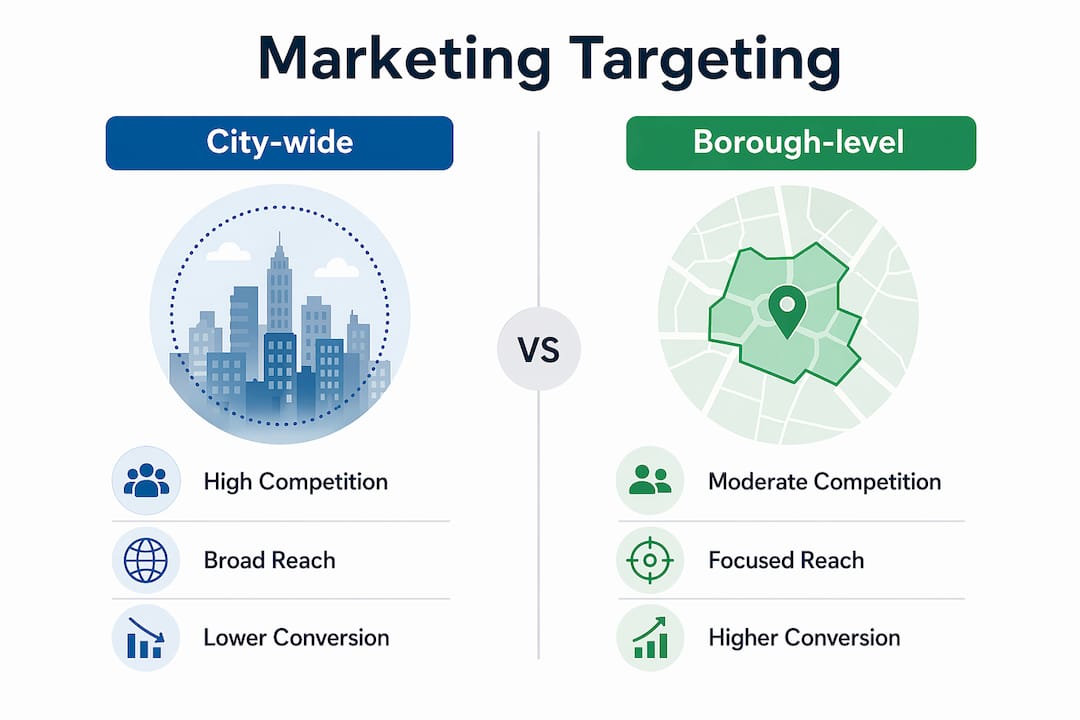
Consistent, clear brand messaging combined with a strong review presence on platforms like Google Reviews builds local authority that compounds over time. Reviews are not optional extras. They are a primary trust signal for both human buyers and AI search systems.
What impact does AI-driven search have on brand awareness strategies in London?
AI-driven search has changed the rules of discovery for London businesses. Tools like Google AI Overviews and ChatGPT now act as intermediaries between a customer’s question and your business. AI systems cross-reference multiple platforms and prefer consistent, clearly structured data. If your business information conflicts across platforms, AI systems exclude you from recommendations entirely.
The key adaptations for AI search visibility are:
- Entity clarity. Your business name, category, location, and services must be described identically across your website, Google Business Profile, social media profiles, and third-party directories. AI search engines evaluate entity clarity as a primary ranking signal.
- Third-party authority signals. Reviews, press mentions, and citations from trusted local sources tell AI systems that your business is credible. A business with 200 consistent, recent Google Reviews outranks a competitor with 20 mixed reviews, regardless of website quality.
- Structured content. Use clear headings, concise answers, and FAQ formats on your website. AI systems extract and surface content that directly answers questions. Dense, unstructured paragraphs are harder to index and cite.
- Consistent NAP data. Name, address, and phone number must match exactly across every platform. A single discrepancy, such as “St.” versus “Street,” is enough to create confusion in AI indexing.
Pro Tip: Most London businesses have not adapted to AI search. Early adopters who establish entity clarity now will compound that advantage as AI-driven discovery grows. This is the single most underused opportunity in London local marketing right now.
45% of London agencies use AI content generation to maintain posting consistency. The volume of AI-generated content online is rising sharply. Authentic storytelling and genuine community engagement are what differentiate brands in AI-driven marketing from the growing noise of automated content.
Which digital and physical branding methods best boost brand visibility for London SMEs?
The most effective approach combines digital channels with physical branding, treating them as a single system rather than separate budgets. Each reinforces the other.
| Channel | Growth trend | Best use for London SMEs |
|---|---|---|
| Video advertising | Rising; outspends static banners | Brand storytelling, product demos |
| Podcast advertising | Up 43% since 2024 | Niche audience trust-building |
| Retail media | Fastest-growing segment, up 25% YoY | Point-of-purchase brand reinforcement |
| Google Business Profile | Highest local ROI | Local pack rankings and reviews |
| Physical signage | Permanent, zero ongoing cost | Daily brand impressions at street level |
Physical signage deserves particular attention because it is the only branding channel with no recurring cost after installation. A bespoke shop front sign in a high-footfall area generates thousands of brand impressions every day. LED illuminated signs extend that impact into evening hours, which is critical for hospitality and retail businesses. Vehicle graphics turn every delivery or site visit into a mobile brand impression across multiple boroughs simultaneously.
The most effective London SMEs integrate their Google Business Profile with their offline branding. Your signage colours, fonts, and logo must match your digital profiles exactly. Inconsistency between physical and digital brand presentation creates subconscious doubt in customers who encounter your brand across both channels.
How to measure and sustain brand awareness growth in London
Measuring brand awareness requires tracking both direct and indirect signals. Direct metrics tell you what is happening. Indirect signals tell you why.
The key performance indicators for brand visibility in London include:
- Direct branded search volume. Track how often people search your business name directly in Google Search Console. Rising branded search volume is the clearest signal that awareness is growing.
- Local pack rankings. Monitor your position in Google’s local map pack for your primary borough-level keywords. Rankings here are driven by Google Business Profile completeness, review velocity, and citation consistency.
- AI search appearances. Search for your business category in Google AI Overviews and ChatGPT. If you do not appear, your entity clarity or third-party authority needs work.
- Review growth rate. Track the number and recency of reviews on Google Reviews. A steady flow of recent reviews signals active customer engagement to both human buyers and AI systems.
- Social media reach and saves. Reach measures exposure. Saves and shares measure genuine interest. Focus on saves as a proxy for content quality.
SMEs should prioritise fundamentals like local search dominance, email marketing, and consistent content rather than chasing costly trends. Consistency over 12 months outperforms any single campaign. Brand equity in London is built through repetition, not bursts.
What I have learned about building brand presence in London
Working with London businesses across retail, hospitality, and corporate sectors, the pattern is consistent. The businesses that grow their brand recognition fastest are not the ones with the biggest budgets. They are the ones with the clearest message and the most consistent execution.
The most common mistake I see is trying to be visible everywhere before being credible somewhere. A business that dominates one borough, owns its Google Business Profile, and has 150 strong reviews will outperform a competitor spending three times as much on city-wide digital ads with no local anchor.
Physical signage is consistently underestimated in digital-first marketing conversations. A well-designed fascia sign or set of 3D letters on a busy London street builds brand familiarity in a way that no digital ad can replicate. People walk past it every day. They remember it without trying to. That passive familiarity is exactly what brand awareness is supposed to create, and it costs nothing after the initial installation.
The businesses that struggle are those that treat digital and physical branding as separate decisions. They are not. Your sign, your Google profile, your social content, and your review presence are all one brand. When they align, the effect multiplies. When they conflict, the effect cancels.
— Promo
How Promosigns supports your London brand visibility
Promosigns designs, manufactures, and installs bespoke signage for London businesses that want their physical presence to match the quality of their digital brand. From illuminated fascia signs in Barnet to shop front signs in Old Street, every sign we produce is built to maximise street-level visibility and reinforce brand identity consistently.

Physical signage is a permanent brand asset. Unlike paid media, it works every hour of every day without ongoing spend. Promosigns offers a full end-to-end service covering design, manufacture, and professional installation across London, Essex, and Kent. Whether you need outdoor signs to attract customers or interior branding for your workspace, our team delivers durable, high-impact solutions with fast turnaround times. Contact Promosigns to discuss your requirements and get a bespoke quote for your London location.
FAQ
What is brand awareness and why does it matter for London businesses?
Brand awareness is the extent to which customers recognise and recall your business. For London businesses, higher awareness directly increases consumer trust and drives more inbound enquiries from both digital and physical channels.
How many times per week should a London business post on social media?
Posting 3–5 times per week is the recommended frequency for maintaining algorithmic visibility and satisfying AI indexing requirements. Consistency matters more than individual post performance.
What is hyper-local SEO and how does it help London brands?
Hyper-local SEO targets specific boroughs or neighbourhoods rather than broad city-wide terms. It delivers higher conversion rates because the search intent is more specific and the competition is lower.
How does AI search affect brand visibility in London?
AI search tools like Google AI Overviews evaluate entity clarity and consistency across platforms. Businesses with consistent name, address, phone number, and service descriptions across all platforms are significantly more likely to appear in AI-generated recommendations.
Does physical signage still contribute to brand awareness in London?
Physical signage generates daily brand impressions at zero recurring cost after installation. In high-footfall London locations, a well-designed sign builds passive familiarity that digital advertising cannot replicate.
Recommended
- Signage and Brand Recognition: Boost Your London Business in 2025 – PromoSigns.co.uk
- Site branding essentials: boost sales 25% in London – PromoSigns.co.uk
- Interior Branding Graphics: Transforming London Businesses in 2025 – PromoSigns.co.uk
- Why Signage Matters in 2025: Essential for London Businesses – PromoSigns.co.uk
