
TL;DR:
- Poor signage design and placement can significantly reduce customer footfall and damage brand perception. Conducting professional site surveys and choosing appropriate materials and lighting can prevent costly mistakes and ensure long-lasting, effective signs. Regular maintenance and adherence to permissions enhance signage durability and legality, supporting ongoing business success.
The most common DIY shop sign mistakes are poor legibility, content overload, wrong placement, unsuitable materials, missing lighting, ignored permissions, and neglected maintenance. Each one costs you footfall. Here is a quick-reference list with a one-line remedy for each, followed by detailed guidance on every point.
The ten most common errors at a glance:
- Poor legibility — use a clean sans-serif at a minimum character height of 25mm per metre of read distance
- Content overload — one headline, one supporting line, one call to action; cut everything else
- Bad placement — walk your approach routes and confirm the sign is visible before you fix it
- Wrong materials — match substrate to intended lifespan: Correx for temporary (1–2 years outdoors), Foamex for short-to-medium-term (2–5 years), Dibond for durable fascia (5–10+ years), or aluminium for heavy-duty long-term use (10+ years)
- No lighting — if you trade after dark, illumination is not optional; LED options suit most budgets
- Ignoring permissions — check advertisement consent requirements before manufacture, not after
- Skipping maintenance — schedule a quarterly visual check and an annual fixings inspection
- Poor colour use — high contrast between text and background is non-negotiable for daylight readability
- Inconsistent branding — match fonts, colours and logo treatment to your other brand materials exactly
- Wrong measurements — measure the fascia opening, not the overall wall, and allow for fixings clearance
Pro Tip: Book a site survey before you order anything. Promosigns offers professional site surveys across London, Essex and Kent — a 30-minute visit prevents the most expensive mistakes on this list.
Table of Contents
1. Poor legibility ruins signs that look good on screen
Legibility beats design flourishes every time. A sign that looks beautiful in a design file but uses a condensed script font at large character height is unreadable from the pavement. The rule of thumb used across the UK signage industry is a minimum character height proportional to the read distance for a stationary viewer; for passing vehicles, increase that significantly.

Contrast matters as much as size. Dark text on a dark background, or pale text on a white substrate, collapses in bright daylight or at dusk. Aim for a strong tonal difference between your text colour and background colour. Avoid all-caps for body copy — it reduces word-shape recognition and slows reading speed. Tight letter-spacing (tracking) compounds the problem on smaller signs.
Font pitfalls to avoid: overly decorative scripts, ultra-thin stroke weights, and condensed typefaces with low x-height. When your message is simple enough, a well-placed pictogram often outperforms words at distance. For detailed guidance on what makes a sign genuinely visible, the Promosigns resource on great shop sign design covers the technical standards in full.
Pro Tip: Print your design at actual size and pin it to the wall. Step back to your typical customer approach distance and assess it honestly — screen previews are misleading.
2. Content overload is one of the most damaging DIY sign errors
Fewer words deliver stronger impact. A sign carrying your trading name, a one-line descriptor, and a single call to action will outperform one listing every product, every social handle, and three promotional offers. Customers read a sign in under two seconds while walking past; hierarchy and brevity are what make those two seconds count.
A practical content hierarchy looks like this:
- Headline: your business name or primary offer (largest, highest contrast)
- Supporting line: what you do or your key differentiator (secondary size)
- Call to action: a phone number, URL, or “open now” indicator (smallest, but still legible)
Proofreading is where many DIY projects fall apart. Read the copy aloud, check for common confusions (your/you’re, it’s/its, opening hours formatted inconsistently), and always test a printed mock-up at scale before committing to manufacture. A spelling error on a permanent fascia sign is expensive to correct and immediately undermines customer trust. For additional quality-control checks on printed signage, the Promosigns guide on common banner printing mistakes applies equally to shop signs.
3. Wrong placement means your sign works against you
A well-placed sign is visible from your normal customer approach lines. That sounds obvious, but placement failures — signs hidden by canopies, set too high, or blocked by vegetation — are among the most common reasons otherwise well-designed signs fail to attract customers.
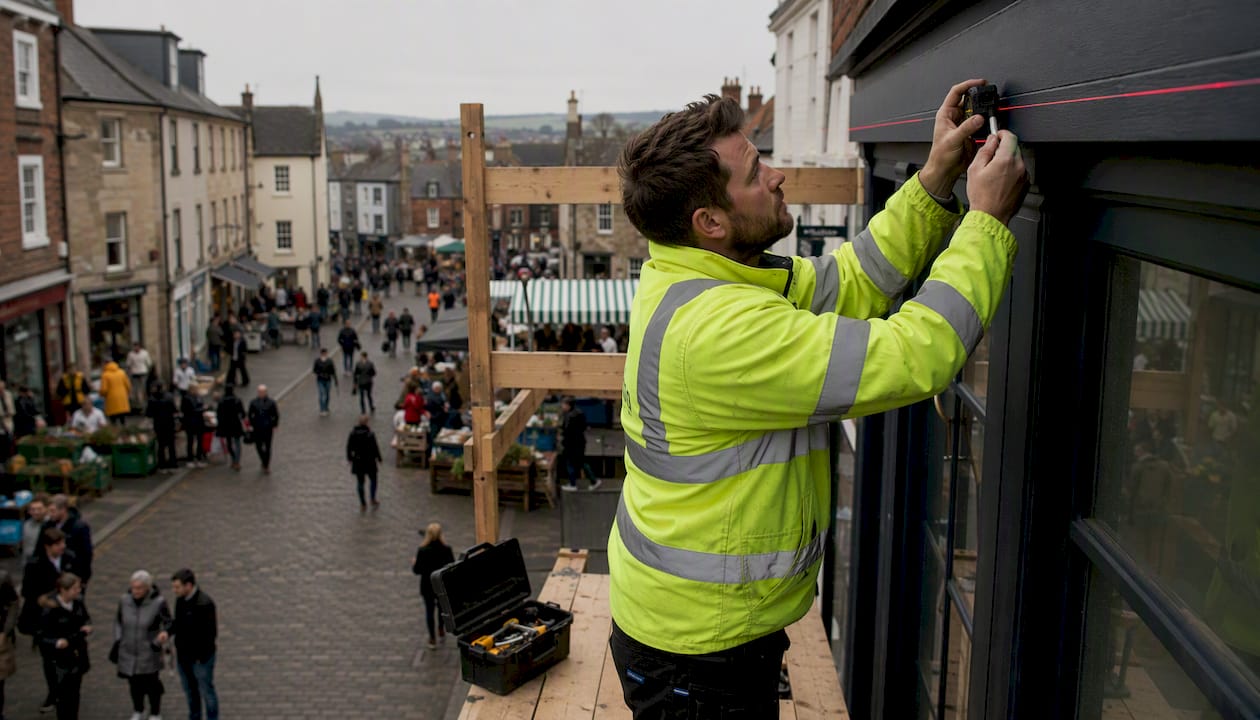
Carry out a simple site survey before you order. Walk the approach on foot from both directions, note any obstructions (street furniture, trees, neighbouring signage, awnings), and record the angles at which your fascia is visible. If you drive past, check visibility from the road. Do this at different times of day: morning light from the east and afternoon sun from the west can wash out a sign that looks fine at noon.
A cardboard mock-up at the intended size, held in position by a helper, is the fastest way to confirm placement before you spend money on manufacture. Check that the sign remains visible when your door is open, when a delivery vehicle is parked outside, and when your own awning or blind is deployed.
4. Wrong materials shorten sign life and waste your budget
Pick the substrate that matches your intended lifespan. Material choice strongly affects longevity: Correx suits temporary applications and typically lasts 1–2 years outdoors; Foamex is a medium-term option at 2–5 years; Dibond and aluminium are the long-term choices, rated at 5–10+ years and 10+ years respectively.
UK weather adds specific pressures. UV exposure fades unprotected prints, rain infiltrates poorly sealed edges, and wind loading stresses fixings on large panels. Aluminium and stainless steel offer high corrosion resistance and are well suited to heavy-duty exterior use. Acrylic is popular for illuminated signs but needs careful fixing design — it expands significantly more than aluminium with temperature change, so fixings must allow for movement or the panel will crack.
| Material | Typical outdoor lifespan | Best use |
|---|---|---|
| Correx | 1–2 years | Temporary, event, or construction signage |
| Foamex | 2–5 years | Short-to-medium-term exterior signs |
| Dibond (ACM) | 5–10+ years | Durable fascia and exterior signs |
| Aluminium | 10+ years | Long-term exterior and heavy-duty signage |
| Acrylic | 5–10 years (grade dependent) | Illuminated signs, interior and sheltered exterior |
For a full breakdown of substrate options suited to UK conditions, the Promosigns guide to materials for shop signs covers specification in detail.
5. No lighting means your sign stops working at dusk
If you trade in the evening or your premises are on a dim street, illumination is not a nice-to-have. An unlit sign after dark is effectively invisible, and the customers who would have found you simply walk past. The advantages of illuminated signage extend well beyond aesthetics — a lit sign works around the clock.
Common illumination options for shop signs:
- External spotlights — low cost, easy to retrofit, suits most fascia materials
- Halo-lit (reverse-lit) letters — LED modules behind 3D letters create a premium glow effect
- Backlit trays — a lightbox panel with translucent face; suits logos and full-colour graphics
- LED channel letters — individual illuminated letters, high visibility, long LED lifespan
- LED modules on flat signs — cost-effective uplighting or downlighting for existing signs
Illuminated signage requires an electrical supply and periodic maintenance. LED modules reduce service frequency compared with older fluorescent systems, but still need periodic checks for failed modules and moisture ingress. Safety matters too: advertisements that dazzle drivers or pedestrians near junctions or crossings can be refused or subject to enforcement action. Keep luminance appropriate to the location.
Maintenance tip: Clean the face of illuminated signs every six months and check for failed LED modules annually. Moisture ingress at unsealed edges is the most common cause of premature failure.
6. Ignoring permissions can lead to enforcement and removal costs
Many shop fascia signs are covered by “deemed consent” under UK planning rules, meaning no formal application is required. However, size, illumination or location can trigger the need for express Advertisement Consent from your local planning authority. The threshold is lower than most business owners expect.
Signs larger than approximately 0.3 square metres, or any illuminated sign, commonly require a formal application. Conservation areas and listed buildings add further restrictions: in those cases you may need both Listed Building Consent and express Advertisement Consent. Displaying an unauthorised advertisement is a criminal offence under The Town and Country Planning (Control of Advertisements) (England) Regulations 2007 and can result in enforcement notices, removal costs, and prosecution.
Permission checklist before manufacture:
- Check your local planning authority’s website for advertisement consent requirements
- Confirm your lease permits external signage changes (landlord consent is separate from planning consent)
- Identify whether your building or street is in a conservation area or area of special control
- Measure your proposed sign and confirm it falls within permitted thresholds — or apply for consent
Pro Tip: A simple call to your local planning authority’s duty officer takes 10 minutes and can confirm whether your sign needs consent. Do it before you order, not after installation.
7. Neglecting maintenance erodes trust faster than a poor design
A faded, peeling, or damaged sign signals to customers that the business behind it is not well run. Schedule three-point checks and stick to them.
- Quarterly visual check — look for UV fade, delamination, loose fixings, and any damage from impact or weather. Check that copy is still accurate (opening hours, phone numbers, seasonal offers).
- Annual clean and fixings inspection — wash the sign face with a mild detergent and soft cloth; inspect all fixings for corrosion or movement; check sealant around edges for cracking.
- Content review — update any outdated information. An incorrect phone number or old opening hours on a permanent sign actively drives customers away.
Repair versus replace decisions come down to substrate condition. Surface UV fade on a Foamex sign after three or four years is usually a replace decision, not a repair one. Loose fixings on an aluminium sign are a repair. For illuminated signs, the Promosigns illuminated signage maintenance guide gives a step-by-step schedule. Budget a modest annual amount for cleaning materials and minor repairs; a full replacement every five to ten years for most exterior substrates is a reasonable planning assumption.
8. Poor colour use undermines readability and brand recognition
Colour choice affects legibility before it affects aesthetics. The most readable combinations in outdoor conditions are dark text on a light background, or light text on a dark background, with strong tonal contrast. Mid-tone text on a mid-tone background fails in bright sunlight and at dusk, regardless of how well the colours complement each other on screen.
Beyond contrast, colour consistency across all your brand touchpoints matters. If your sign uses a slightly different shade of your brand colour than your window graphics, your website, or your packaging, the cumulative effect is a brand that looks unpolished. Specify colours using Pantone references or precise CMYK/RGB values and share those values with every supplier. For guidance on cohesive shopfront branding, the Promosigns resource on improving shopfront appeal addresses colour and consistency in detail.
9. Inconsistent branding across your shopfront undermines credibility
Your fascia sign, window graphics, door graphics, and any projecting sign should read as a single, coherent identity. When each element uses a different font, a slightly different logo version, or an inconsistent colour palette, the shopfront looks assembled rather than designed. Customers notice this, even if they cannot articulate why.
The fix is straightforward: create a one-page brand reference sheet listing your exact font names, colour values, logo file versions, and minimum clear-space rules. Share it with every supplier before any artwork is produced. This takes an hour to create and prevents years of inconsistency. For a broader look at how signage reinforces brand identity, the Promosigns guide on enhancing branding with signage is worth reading before you brief any supplier.
10. Ignoring weather conditions shortens sign life significantly
UK weather is not extreme by global standards, but it is persistent. UV radiation fades unprotected prints year-round; rain infiltrates poorly sealed edges and causes delamination; wind loading on large flat panels stresses fixings, particularly on exposed high streets. Selecting the wrong fixings or ignoring wind loading can cause structural failure — a risk that goes beyond aesthetics.
Protective finishes extend lifespan considerably. UV-laminated print faces resist fading; sealed edges on ACM panels prevent moisture ingress; stainless steel or hot-dip galvanised fixings resist corrosion in coastal or urban environments. If your premises face south or west, UV exposure is higher and a premium laminate is worth the additional cost. For material recommendations specific to UK conditions, the Promosigns guide to outdoor business sign materials covers the options clearly.
11. Incorrect measurements cause costly remakes
Measure the fascia opening, not the overall wall. This is the single most common measurement error Promosigns encounters on new enquiries. The fascia opening is the usable space between architectural features, drainage pipes, window frames, and any structural returns. Order a sign to the overall wall dimension and it will not fit.
Always measure width and height at multiple points — fascias are rarely perfectly square. Note the depth of any return edges if you are ordering a tray sign. Record the wall substrate (brick, render, timber, steel) because it determines fixing type. Photograph the fascia from directly in front and at both approach angles. A professional site survey eliminates all of these variables, but if you are measuring yourself, measure twice, photograph everything, and confirm dimensions with your sign maker before artwork is finalised.
12. Skipping a site survey leads to avoidable installation problems
A professional site survey prevents most of the mistakes on this list. The checklist a competent installer works through covers: approach-line visibility, fascia measurements and substrate condition, fixing type and wind loading assessment, power supply routing for illuminated signs, access requirements, and permission status. Professional installers document surveys with photos, measured elevations, substrate tests and a schedule of fixings — that paperwork also reduces disputes with landlords and supports consent applications.
Safety red flags that should stop a DIY installation: listed building constraints requiring specialist consent, any electrical work for illuminated signs (which must be carried out by a qualified electrician), and high-level access requiring scaffolding or a mobile elevated work platform. These are not situations where a ladder and a willing friend are adequate. A professional installer brings certified fixings, a warranty on workmanship, and completion photographs that protect you if questions arise later.
Pro Tip: Request a site survey before you commit to a design. Promosigns carries out surveys across London, Essex and Kent and the findings often change the brief in ways that save money and prevent enforcement issues.
13. Pre-install checklist: confirm these before you fit anything
Use this checklist on the day of installation. Print it or keep it on your phone.
- [ ] Measure the fascia opening at three points (top, middle, bottom) and confirm the sign dimensions match
- [ ] Photograph the mounting surface and confirm the substrate matches the fixing specification
- [ ] Confirm landlord or property manager permission is in writing
- [ ] Verify advertisement consent status (deemed or express) with your local planning authority
- [ ] Check for buried services (cables, pipes) behind the fixing points using a detector
- [ ] Arrange a second person to assist with lifting and positioning
- [ ] Confirm opening hours, phone number, and all copy are correct on the final artwork proof
- [ ] Have the correct fixings, drill bits, and sealant for the wall substrate on site
- [ ] Check weather forecast — do not install in high winds or heavy rain
- [ ] Photograph the completed installation from both approach directions
What Promosigns sees on real jobs across London, Essex and Kent
The mistakes that come up most consistently on Promosigns jobs are wrong fixings for the substrate, signs ordered to the wrong dimensions, and illuminated signs installed without advertisement consent. Each one is avoidable with a 30-minute site survey, yet each one generates a repeat spend — either to correct the installation or to deal with an enforcement notice.
The business impact is real. A sign fixed with incorrect anchors into a rendered wall can pull free within months, creating a safety hazard and a repair bill. A sign installed without consent in a conservation area can attract an enforcement notice requiring removal at the owner’s cost, plus the expense of a retrospective application that may not succeed. These are not edge cases; they are routine findings on jobs where the client has attempted a DIY approach without professional input.
If any of the following apply to your project, a professional site survey is the right starting point: your building is listed or in a conservation area, your sign will be illuminated, the fascia is above ground-floor level, or you are unsure of the wall substrate. For everything else, the checklist in Section 13 gives you a solid foundation.
Promosigns: site surveys, bespoke manufacture and professional installation
Promosigns offers an end-to-end service for UK shopkeepers who want signage that works from day one. The process starts with a professional site survey covering approach-line visibility, fascia measurements, substrate assessment, fixing specification, and permission status. From there, Promosigns handles bespoke manufacture and certified installation, with workmanship backed by a guarantee and completion photographs provided as standard.
For small business owners who have read this guide and recognise one or more of these mistakes in their current signage, the practical next step is a survey rather than a remake. Getting the brief right before manufacture saves time, money, and the frustration of a sign that does not perform. Promosigns serves clients across London, Essex and Kent, with particular experience in shop signs across London and high-footfall retail environments. To request a site survey or get a quote for your project, contact Promosigns directly for bespoke advice tailored to your premises.
Recommended
- 7 Common Shop Signage Errors and How to Avoid Them – PromoSigns.co.uk
- 7 Common Shop Signage Errors Every Business Should Avoid – PromoSigns.co.uk
- Shop Signage Basics 2025: Essential Tips for London Businesses – PromoSigns.co.uk
- How to Design Shop Signs: Expert Tips for 2025 – PromoSigns.co.uk
