
Yes, pavement signs increase footfall when they carry one clear message, are placed in a legal, unobstructed spot, and get refreshed regularly. Around 76% of consumers say signage has drawn them into a shop they hadn’t planned to visit, and on-premises signage can lift sales by a mid-single-digit percentage. The practical next step is simple: run a single message for two weeks and count what changes.
Table of Contents
How pavement signs influence footfall and pavement signs effectiveness
Pavement signs work because they intercept decisions, not intentions. Someone walking past your shop with no plan to stop is different from someone browsing your website. The sign has to win them over in the two or three seconds their eyes are on it, which is why proximity and timing matter more than cleverness.
Three mechanisms explain most of a sign’s pulling power:
- Impulse capture — passers-by nearby are physically close to acting, so a well-timed prompt converts intention into a step through the door.
- The reading window — most pedestrians glance at a sign for roughly two to three seconds, so anything beyond one headline and one offer gets missed entirely.
- Complementing digital reach — social posts and search ads build awareness before someone leaves home; the pavement sign catches them once they’re already on the street, which is a different job altogether.
That combination is why pavement signage effectiveness tends to outperform expectations for businesses that treat it as the final nudge, not the whole campaign.
What does the evidence say about pavement advertising success?
The numbers: 76% of consumers have entered a shop because of its signage, and on-premises signs can lift sales by a mid-single-digit percentage, according to industry research summarised by Displaysense.
That figure covers signage broadly, but pavement signs sit closest to the point of purchase, which is usually where the strongest impulse effect happens. On cost, the comparison is straightforward: a well-made sign lasting several years typically works out cheaper per day than even modest local digital ad spend, with no recurring platform fees. Results still vary by footfall volume, sector (a coffee shop sees faster payback than a solicitor’s office), and how often the message changes. A sign left untouched for a year rarely performs like one refreshed weekly.
Which type of pavement sign suits your business?
The format matters as much as the message. Choosing badly means fighting the weather, the council, or your own customers’ attention span.
- A-frame/sandwich boards — the workhorse for daily high-street trade; easy to reposition and swap messages on.
- Poster or snap-frame signs — best for photographic, branded campaigns where image quality carries the message.
- Chalkboards — cheap to run and ideal for offers that change daily, though less durable in heavy rain.
- Weighted or water-fillable bases — essential on exposed or windy sites where a lightweight board becomes a hazard.
Cafés and restaurants often rotate between chalkboard and A-frame depending on the offer; retailers with a single strong campaign lean towards snap-frames.
Design rules that make a sign work in under three seconds
Good design is not decoration, it’s triage: what does the eye need to see first, second, and not at all?
- One idea only. A sign trying to say three things says nothing. Pick the single strongest offer or message.
- Big, high-contrast type. Dark text on light background (or vice versa) reads fastest; letters should be tall enough to read from across the pavement, not just up close.
- Clear hierarchy. Headline first, offer second, call to action last. Someone should absorb the gist without reading every word.
- Simple, repeatable templates. “Today only,” “2-for-1 until Friday,” or a directional arrow to the entrance all work because they ask for one action.
Pro Tip: Test creative cheaply before committing. Print two versions of the same offer with different headlines, swap them daily for a fortnight, and note which one pulls more people through the door before you order a permanent board.
Where can you legally place a pavement sign in the UK?
Placement rules exist because a badly sited board is a trip hazard as much as a marketing tool. Get this wrong and the council can simply remove your sign.
- Private land (your own forecourt) generally needs no licence, though local advertisement rules can still apply.
- Public highway placement usually needs a pavement licence, with fees currently capped at £500 for new applications and a public consultation period built into the process.
- Keep a clear pedestrian route — licence conditions typically require unobstructed access for wheelchairs and pushchairs.
- Avoid junctions and sightlines — local planning authorities assess public safety and amenity before granting consent, and a sign blocking a driver’s view of pedestrians is an easy refusal.
Promosigns covers the practical side of safe placement in detail on its signage safety guide, worth reading alongside the official guidance before you order anything permanent.
How do you measure whether your sign is working?
Guesswork is the enemy of good signage. A few low-cost checks tell you fast whether a message earns its spot on the pavement.
- Set a baseline. Count footfall or till transactions for a normal week before changing anything.
- Run a two-week A/B test. Swap one variable, headline, offer, or placement, and compare against the baseline.
- Track with something simple. A staff tally, a unique discount code, a QR code, or just asking “did you see the sign outside?” at the till all work.
- Set a realistic benchmark. A noticeable uptick in enquiries or walk-ins within the test window suggests the message is pulling; no change after two weeks means it’s time to try another angle.
What materials and maintenance keep a sign effective for years?
Durability and effectiveness are the same problem viewed from different angles: a faded, wobbling sign persuades nobody. Powder-coated steel or aluminium frames handle UK weather far better than untreated wood or thin plastic, resisting rust and warping through a typical British winter. Stability matters just as much as the frame. Sandbags or water-fillable bases stop a sign becoming a hazard on windy high streets, and bringing portable boards indoors overnight extends their working life considerably. A short weekly check, wipe the surface, tighten fixings, inspect the base, catches most problems before they become replacement costs. For a deeper look at material choices and expected lifespans, Promosigns has a dedicated guide on outdoor signage durability.
Common mistakes that quietly kill pavement sign performance
Most underperforming signs fail for the same handful of reasons, and each is fixable without a new board.
- Cluttered copy. Three offers and a logo crammed onto one panel means nobody reads any of it.
- Low contrast or small type. If you have to squint at arm’s length, a pedestrian walking past at pace has no chance.
- Stagnant messaging. The same board for six months stops registering with regulars entirely.
- Poor placement. Tucked behind a lamppost or set back from the main walking line loses most of the passing audience.
- Ignoring licence requirements. A confiscated sign generates zero footfall and a fine.
The fix in each case is usually the same: simplify the message, reposition the board, and refresh it on a schedule rather than waiting until it looks tired.
How do seasons and weather change pavement sign visibility?
British weather is not a footnote here, it’s a design constraint. A sign strategy that ignores the seasons loses effectiveness for months at a time without anyone noticing why footfall dipped.
Winter brings shorter daylight hours, which means a sign relying purely on print contrast loses impact after 4pm. Reflective or light-coloured backgrounds hold up better under streetlighting than dark, moody designs that look smart in a portfolio but vanish at dusk. Rain and wind are the bigger enemy: waterlogged card boards warp within days, and a lightweight A-frame without a weighted base becomes both illegible and dangerous in a gust. Weighted or water-fillable bases, already worth using year-round, become non-negotiable between October and March.
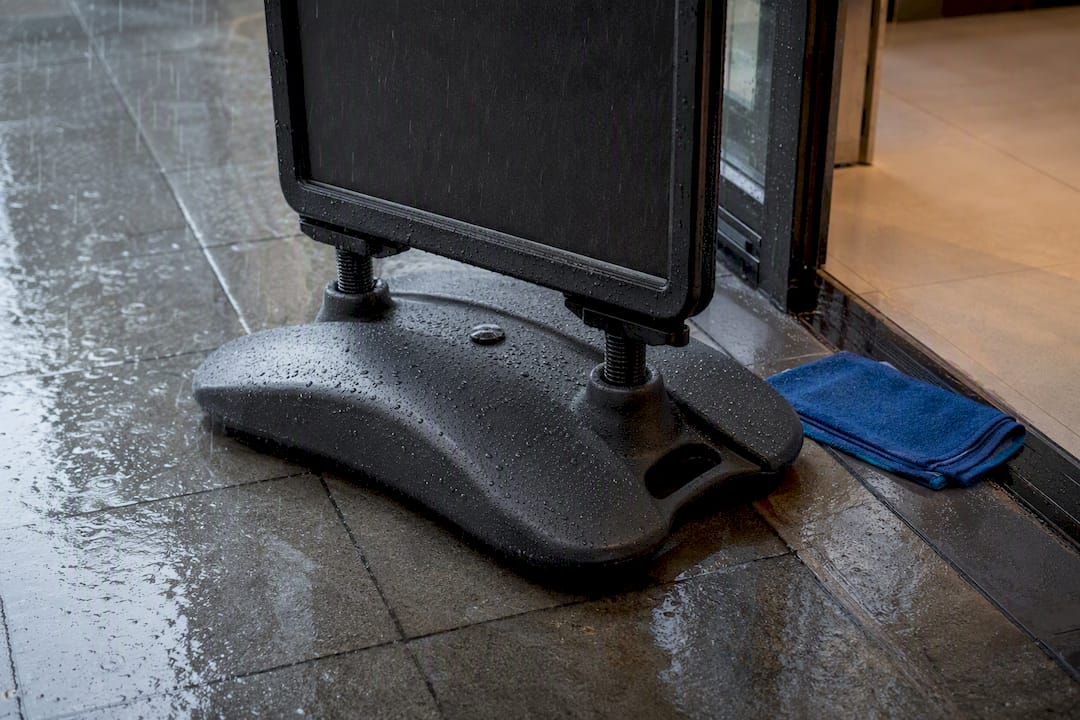
Summer changes the problem entirely. Longer daylight and higher footfall (particularly near hospitality venues with outdoor seating) mean more eyes on your sign, but also more competition from other boards, market stalls, and street furniture. Bright sunlight can wash out low-contrast designs, so darker text on a matte, non-reflective surface reads better at midday than glossy, high-shine finishes.
The practical takeaway: treat your sign’s message and materials as seasonal, not fixed. A summer offer board might not need weatherproofing as much as a winter one needs both illumination-friendly design and a stable, storm-resistant base.
What other rules beyond pavement licences should you know about?
Pavement licences cover the ground itself, but the sign’s content and structure sit under separate rules that catch businesses out more often than the licence does.
Advertisement consent is the main one. Many small, wall-mounted, or temporary signs qualify for deemed consent, meaning no formal application is needed provided size, projection, and position stay within set limits. Step outside those limits, a sign that’s too large, illuminated, or projecting too far, and express consent from the local planning authority becomes necessary. Illuminated pavement signs, increasingly popular for evening trade, almost always fall into this stricter category.
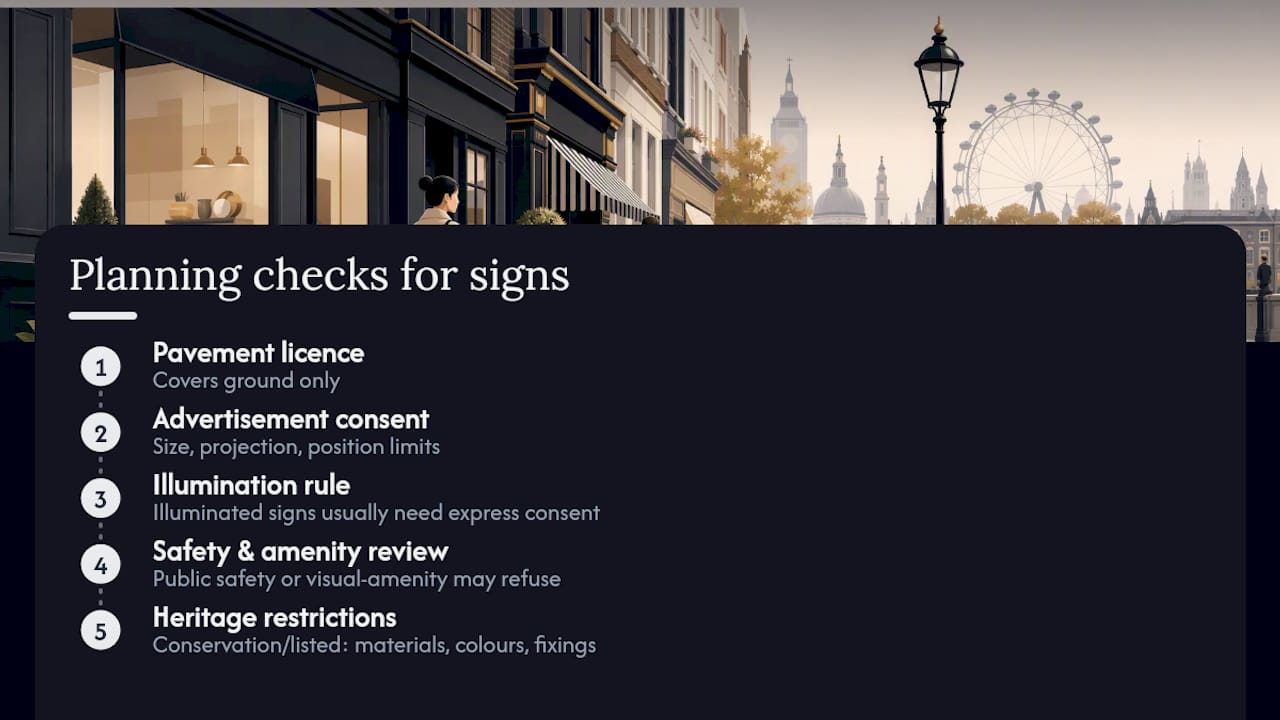
Local planning authorities also weigh public safety and visual amenity independently of the licence process, meaning a sign can technically hold a valid pavement licence and still be refused or ordered removed if it’s judged to create a hazard or clash with a conservation area’s character. Conservation areas and listed building frontages often carry additional restrictions on sign materials, colours, and fixings, so a design that works fine on an ordinary high street might need adjusting for a heritage parade. Promosigns outlines these planning considerations in more depth on its outdoor signage regulations page, a useful check before finalising artwork for a listed or conservation frontage.
A note from Promosigns on what actually moves the needle
Most guides treat pavement signs as an afterthought next to digital marketing. That’s backwards for a London high street, where a well-placed sign still does something no ad campaign can: catch someone mid-decision, three feet from your door. The businesses that get the most from theirs treat the sign as a live, evolving asset, not a one-off purchase, checking placement, refreshing copy, and rebuilding when a board starts looking tired.
— Promo
How Promosigns builds pavement signs that pull people in
Promosigns is the practical alternative to guessing your way through sign design, cutting straight to a board built for your specific pavement, footfall pattern, and message rather than a generic template. The team designs, manufactures, and installs signage sized and finished for how people actually walk past your shop.
A pavement sign project with Promosigns typically covers:
- Design tailored to your storefront layout and typical viewing distance
- Weather-resistant materials suited to your site’s exposure
- Manufacturing and professional installation with fast turnaround
- Guidance on placement that keeps you within local safety and compliance expectations
If your current sign is looking tired or you’re weighing up your first one, explore how outdoor signage can attract customers to your business, or get in touch for a quote if you’re trading around Kings Cross, Putney, or elsewhere in London.
Sources
- Gov
- Do pavement signs still work in 2026? UK retailer guide — Displaysense
- The best pavement signs for UK businesses — George & Willy
Recommended
- Signage and Brand Recognition: Boost Your London Business in 2025
- Signage Design Principles for London Businesses in 2025
- Maximising Footfall with Signage in London
- 7 Creative Signage Ideas 2025: London Retail Guide
