
Illuminated signs are the secret weapon behind many of the most unforgettable shopfronts in London. People walk past hundreds of businesses every week but only a handful truly stand out, and it is often the signage that does the trick. Shockingly, well-designed illuminated signs can increase retail foot traffic by up to 30 percent, yet most shops settle for dull, outdated boards that blend into the background. The real secret is that with the right design, your sign does far more than glow in the dark—it becomes a round-the-clock magnet for new customers.
Table of Contents
Table of Contents
- Choosing The Right Illuminated Sign Type
- Design Principles For Visibility And Impact
- Compliance With London Regulations And Safety
- Practical Tips For Installation And Maintenance
Quick Summary
| Takeaway | Explanation |
|---|---|
| Select the Right Sign Type | Choose an illuminated sign that aligns with your brand identity and business context for optimal visibility. |
| Focus on Color and Contrast | Use high-contrast colour combinations to enhance readability and emotional impact for viewers. |
| Ensure Regulatory Compliance | Adhere to local regulations regarding signage placement and electrical safety to avoid legal issues. |
| Prioritise Installation Expertise | Employ professional installers to guarantee proper setup and minimise safety risks during sign placement. |
| Implement Regular Maintenance | Schedule systematic inspections and upkeep to ensure optimal performance and longevity of your illuminated sign. |
Choosing the Right Illuminated Sign Type
Selecting the appropriate illuminated sign for your business requires careful consideration of multiple factors that impact visibility, brand representation, and overall effectiveness. The right sign type can transform your storefront from ordinary to extraordinary, capturing potential customers’ attention and communicating your brand’s personality.
Understanding Sign Illumination Techniques
Illuminated signs come in various configurations, each offering unique advantages for different business environments. According to guidelines from the National Park Service, businesses must consider multiple illumination approaches to achieve optimal visual impact.
To help you determine the best illumination technique for your shop or business, here is a comparison of external and internal sign illumination, highlighting their main features and ideal usage contexts:
| Illumination Technique | Key Features | Best For |
|---|---|---|
| External Illumination | Light projected onto sign from external sources | Traditional or heritage-style buildings |
| Creates dramatic effect, elegant shadows | Preserving architectural aesthetics | |
| Highlights sign details | Businesses in conservation areas | |
| Internal Illumination | Lights embedded within sign (often LED technology) | Modern storefronts |
| Consistent, vibrant glow; visible day and night | Retailers needing high visibility | |
| Energy-efficient with advanced LEDs | Environments requiring 24-hour impact |
External illumination involves mounting external light sources that highlight the sign, creating a dramatic effect where light is projected onto the sign’s surface. This method works exceptionally well for traditional or heritage-style buildings where preserving architectural aesthetics is crucial. The soft, indirect lighting can create elegant shadows and highlight intricate sign details.
Internal illumination, conversely, involves embedding lights within the sign structure. LED technology has revolutionised this approach, allowing for vibrant, energy-efficient signage that glows from within. These signs are particularly effective for modern storefronts, providing consistent brightness and remarkable visibility during day and night hours.
Matching Sign Type to Business Context
Choosing the right illuminated sign is not just about aesthetics but strategic communication. Different business types require tailored signage solutions that reflect their brand identity and functional needs.
Retail establishments often benefit from bright, dynamic signs that attract foot traffic. Restaurants might prefer warmer, more inviting illumination that creates an welcoming atmosphere. Professional services like law firms or consulting offices typically opt for more understated, sophisticated lighting that conveys reliability and expertise.
Consider factors such as:
- Visibility: Ensure your sign is readable from various distances and angles
- Energy Efficiency: Modern LED options significantly reduce electricity consumption
- Durability: Select materials and lighting technologies that withstand local weather conditions
For businesses seeking comprehensive guidance on illuminated signage options, our detailed LED signage guide provides in-depth insights into making the most strategic choice for your specific requirements.
The technological landscape of illuminated signs continues to evolve, offering businesses unprecedented opportunities to create memorable visual identities. Whether you choose external flood lighting, channel letter signs, or advanced LED displays, the key is selecting a solution that authentically represents your brand while maximising visibility and engagement.
Remember that an illuminated sign is more than just a way to display your business name—it’s a powerful marketing tool that operates 24 hours a day, communicating your brand’s essence to potential customers even when your physical location is closed.
Design Principles for Visibility and Impact
Designing an illuminated sign that captures attention and communicates your brand effectively requires a strategic approach blending visual science, design principles, and marketing psychology. The goal is not merely to create a sign but to craft a visual communication tool that speaks directly to potential customers.
Colour and Contrast Fundamentals
Colour selection plays a critical role in sign visibility and emotional impact. According to research from the Rochester Institute of Technology, high contrast between lettering and background is paramount for legibility. This means selecting colour combinations that create sharp visual separation.
White or yellow lettering against deep blue or black backgrounds often provides exceptional readability. Similarly, dark text on light backgrounds can create striking visual hierarchy. Professional designers recommend avoiding overly complex colour schemes that might confuse viewers or reduce sign comprehension.
The Federal Highway Administration’s visibility research emphasizes that luminance levels significantly impact sign recognition. Businesses should aim for uniform illumination that maintains consistent brightness across different times of day and environmental conditions.
Typography and Spatial Design
Choosing the right typography is crucial for effective signage. Sans serif fonts typically offer superior readability, especially when viewed from a distance. Letter height, spacing, and stroke width dramatically influence how quickly viewers can process information.
For businesses seeking expert guidance on creating impactful signage, our comprehensive design principles guide provides in-depth insights into professional design strategies.
Spatial considerations are equally important. Signs must be sized proportionally to their viewing environment. A sign that looks perfect up close might become illegible when viewed from a typical pedestrian or vehicular distance. Professional designers recommend creating mockups and testing visibility from multiple perspectives.
Technical Considerations for Maximum Impact
Beyond aesthetic elements, technical specifications dramatically influence sign effectiveness. LED technology offers unprecedented opportunities for dynamic, energy-efficient illumination. Modern LED signs can adjust brightness automatically, ensuring optimal visibility during different lighting conditions.
Key technical considerations include:
- Luminous Efficiency: Select lighting systems that provide maximum brightness with minimal energy consumption
- Weather Resistance: Choose materials and technologies that withstand environmental challenges
- Maintenance Requirements: Consider long-term durability and ease of repair
Remember that an exceptional illuminated sign functions as a 24-hour marketing asset. It communicates your brand’s personality, professionalism, and unique value proposition even when your physical location is closed. Investing time and resources in thoughtful design pays dividends through increased visibility and customer engagement.
Ultimately, successful illuminated signage is an art form that balances technical precision with creative expression, transforming a simple business identifier into a powerful communication tool.
Compliance with London Regulations and Safety
Illuminated signs represent more than aesthetic marketing tools they are complex installations requiring strict adherence to regulatory standards and safety protocols. Businesses must navigate a complex landscape of legal requirements to ensure their signage is not only visually compelling but also fully compliant with local London regulations.
Navigating Planning and Advertisement Regulations
The London Plan 2021 provides comprehensive guidelines governing public realm design and advertisement placement. These regulations aim to maintain visual harmony, prevent urban clutter, and ensure signs integrate seamlessly with their architectural surroundings.
Key regulatory considerations include:
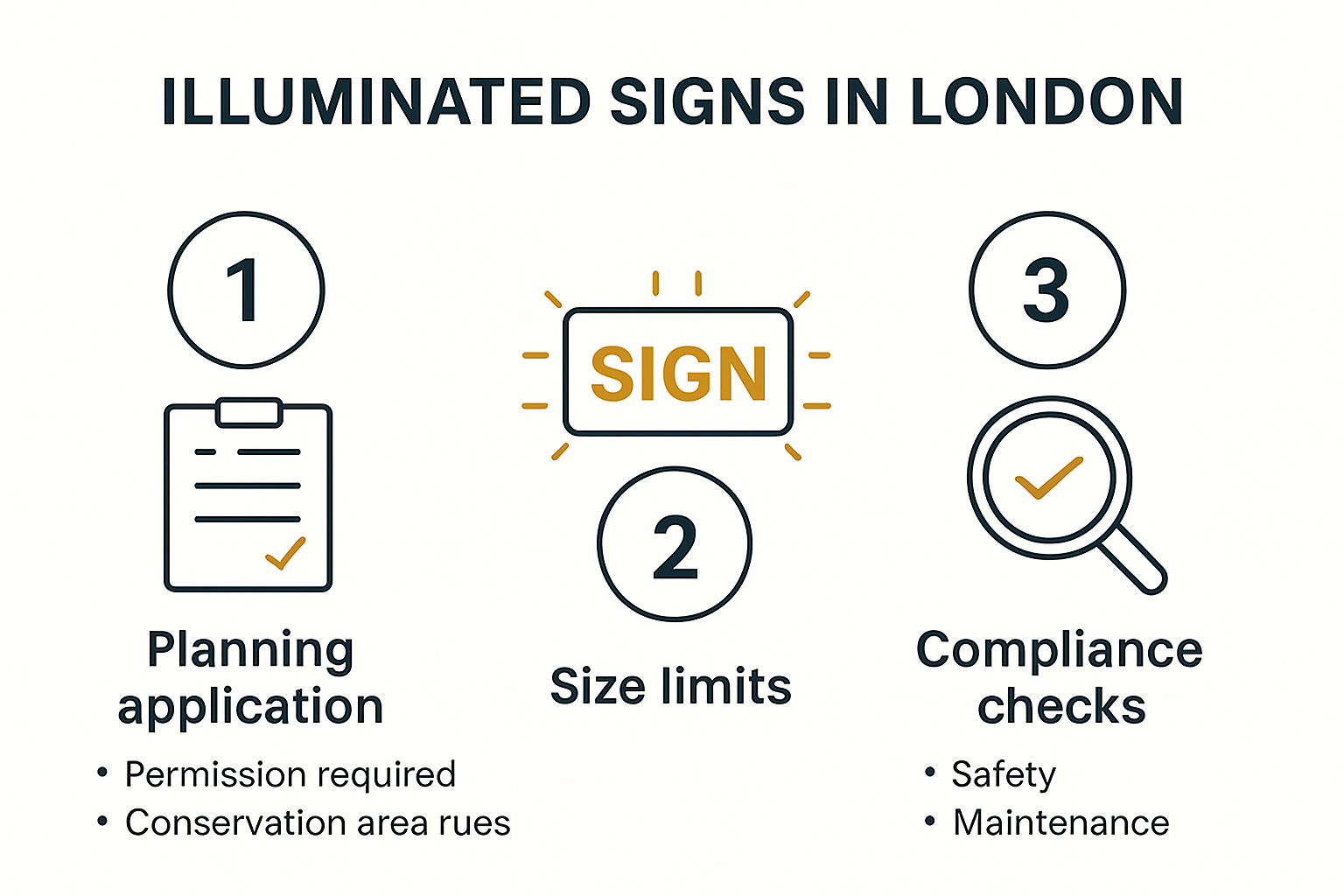
- Planning Permission: Certain sign types require explicit consent from local borough councils
- Conservation Areas: Additional restrictions apply for businesses located in historic or architecturally significant zones
- Size and Projection: Specific measurements dictate how far signs can extend from building facades
For businesses seeking comprehensive guidance through this complex regulatory environment, our detailed compliance guide offers expert insights into navigating legal requirements effectively.
Electrical Safety and Technical Standards
Beyond visual design, illuminated signs must meet rigorous electrical safety standards. The Institution of Engineering and Technology (IET) provides detailed regulations concerning electrical installations for commercial signage.
Critical electrical safety considerations include:
- Ingress Protection Ratings: Ensuring signs can withstand environmental conditions
- Electrical Circuit Protection: Implementing appropriate circuit breakers and residual current devices
- Earthing and Insulation: Preventing electrical hazards through proper installation techniques
Professional sign manufacturers must demonstrate compliance with BS 7671 wiring regulations, which outline comprehensive safety requirements for electrical installations. This involves using approved materials, implementing proper earthing mechanisms, and ensuring signs can withstand temperature variations and potential moisture exposure.
Risk Assessment and Ongoing Maintenance
Compliance is not a one-time achievement but an ongoing commitment. Regular risk assessments and maintenance checks are crucial for maintaining sign safety and regulatory adherence. Businesses should implement systematic inspection protocols that evaluate:
- Structural integrity of mounting systems
- Electrical connection stability
- Illumination consistency
- Weather damage potential
- Potential public interaction risks
Insurance providers often require documented evidence of regular maintenance and compliance checks. Professional sign installation services can provide comprehensive maintenance packages that ensure continuous regulatory adherence and minimise potential liability risks.
Ultimately, compliance represents a critical investment in public safety and professional reputation. By prioritising regulatory standards, businesses demonstrate their commitment to quality, safety, and responsible urban design. A well-designed, compliant illuminated sign communicates not just a brand message but also a commitment to professional excellence and community standards.
Practical Tips for Installation and Maintenance
Successful illuminated signage extends far beyond initial design and creation. Proper installation and ongoing maintenance are critical factors that determine the longevity, performance, and visual appeal of your business sign. Understanding the nuanced approaches to professional installation and systematic maintenance can significantly impact your signage investment.
Professional Installation Considerations
Installation represents a complex process requiring precision, technical expertise, and careful planning. Professional installers must consider multiple factors to ensure safe, secure, and visually optimal sign placement.
Structural assessment forms the foundation of successful installation. This involves thoroughly examining the mounting surface, understanding load-bearing capacities, and selecting appropriate fixing methods. Factors such as wall material, environmental conditions, and potential wind resistance must be meticulously evaluated.
Electrical integration demands equal attention. Proper routing of electrical cables, ensuring adequate protection from environmental elements, and implementing robust connection mechanisms are crucial. Qualified electrical technicians should always handle complex wiring requirements to maintain safety standards and prevent potential electrical hazards.
For businesses seeking comprehensive guidance through this intricate process, our expert installation strategies guide provides detailed insights into best practices.
Systematic Maintenance Protocols
Regular maintenance is not an optional extra but a critical investment in preserving your signage’s performance and visual appeal. A structured maintenance approach involves systematic inspections, proactive repairs, and strategic interventions.
Key maintenance considerations include:
- Cleaning Protocols: Develop a regular cleaning schedule using appropriate non-abrasive materials
- Electrical Component Checks: Inspect wiring, connections, and illumination systems quarterly
- Structural Integrity Assessment: Examine mounting hardware, sign brackets, and potential wear points
- Colour and Finish Preservation: Monitor potential fading, discolouration, or surface degradation
Regular and systematic maintenance is essential for ensuring the performance, safety, and longevity of your illuminated sign. The following table summarises key maintenance tasks and their purposes:
| Maintenance Task | Purpose |
|---|---|
| Cleaning Protocols | Maintain visual clarity, remove dirt without damaging finish |
| Electrical Component Checks | Ensure safe operation, prevent electrical failures |
| Structural Integrity Assessment | Check stability of mountings and brackets |
| Colour and Finish Preservation | Prevent fading, discolouration and surface degradation |
| Weather Damage Inspection | Identify issues caused by environmental exposure |
Technological advancements have introduced sophisticated diagnostic tools that enable more precise maintenance. Thermal imaging cameras can detect potential electrical issues, while specialised cleaning solutions help maintain sign surfaces without causing damage.
Seasonal and Environmental Adaptations
Illuminated signs must withstand diverse environmental challenges. Different seasons and weather conditions impose unique stress on signage systems, necessitating adaptive maintenance strategies.
In regions experiencing significant temperature variations, materials expand and contract. This thermal movement can stress mounting points and electrical connections. Professional installers recommend using flexible mounting systems and high-quality, temperature-resistant materials to mitigate these challenges.
Moisture management represents another critical maintenance consideration. Proper sealing, strategic ventilation, and corrosion-resistant materials help protect electrical components and prevent long-term degradation.
Additionally, businesses should consider periodic professional assessments. Expert technicians can provide comprehensive evaluations, identifying potential issues before they escalate into costly repairs. These assessments might include detailed electrical testing, structural analysis, and recommendations for potential upgrades or modifications.
Ultimately, viewing sign maintenance as an ongoing commitment rather than a reactive process ensures your illuminated signage remains a powerful, professional representation of your business brand. Investing time and resources in systematic maintenance protects your visual communication asset and demonstrates a commitment to quality and professionalism.

Frequently Asked Questions
What are the different types of illuminated signs available for businesses?
Illuminated signs primarily fall into two categories: external illumination, where light is projected onto the sign from outside sources, and internal illumination, which includes lights embedded within the sign. Each type offers unique advantages, suitable for various business contexts.
How can colour and contrast impact the visibility of an illuminated sign?
High contrast between the sign lettering and background significantly enhances readability. For example, using white or yellow text on a dark background can create optimal visibility. Selecting colours that complement your brand while ensuring strong contrast is essential for effective illuminated signage.
What are the key factors to consider when designing an illuminated sign for a retail establishment?
When designing a sign for retail, consider visibility, energy efficiency, and durability. The sign should be readable from various distances and angles, utilise modern LED technology for energy saving, and be constructed of materials that can withstand local weather conditions.
What legal regulations should I consider for illuminated signage in London?
In London, businesses must comply with the London Plan 2021 which encompasses planning permission, especially for signs in conservation areas. It is essential to check size restrictions, projection limits, and ensure that safety standards are met to avoid potential legal issues.
Bring Your Signage Vision to Life with Professional Expertise
If you are tired of your shopfront blending into the background and want to transform it into a 24-hour magnet for customers, you are not alone. Many businesses struggle with dull signage that fails to showcase their brand or meet London’s strict compliance standards. As you have learned, the right illuminated sign design combines bold colour, clever contrast and absolute attention to technical details like LED illumination and electrical safety. But getting from idea to finished sign can feel overwhelming when you want bespoke impact and guaranteed compliance.

Let our team make the process simple and stress-free. As a leading signage company, we design, produce and install custom illuminated shop signs for businesses across London, Essex and Kent. Our specialists bring your vision to life with expert guidance at every stage, from creative LED solutions to installation that meets all regulations. Visit PromoSigns to discover why so many successful retailers trust us to craft unforgettable illuminated signs. If you are ready for your business to stand out day and night, contact us today for a free consultation.
Recommended
- How Lighting Affects Signage: Essential Guide for Businesses 2025 – PromoSigns.co.uk
- Effective Use of Lighting in Shop Signs for London Businesses 2025 – PromoSigns.co.uk
- Illuminated Signs Explained: A 2025 Guide for London Businesses – PromoSigns.co.uk
- What Is Illuminated Signage? 2025 Guide for London Businesses – PromoSigns.co.uk
