
What transforms a casual passer-by into a loyal customer can often come down to one critical detail: shop signage. For London retail owners and property developers, the right signage is more than decoration. Effective signs are a strategic tool, guiding movement, shaping brand identity, and driving visibility. By focusing on optimised signage, you can harness proven design and placement techniques to attract attention, enhance navigation, and promote lasting engagement with your business.
Table of Contents
Defining Optimised Signage for Foot Traffic
Signage plays a pivotal role in guiding customer movement and creating visual communication within commercial environments. Optimised signage goes beyond mere visual presentation, representing a strategic approach to capturing attention, directing foot traffic, and enhancing brand visibility across urban landscapes.
At its core, optimised signage involves creating visual communication tools that are not just aesthetically pleasing but functionally intelligent. These signs must accomplish multiple objectives simultaneously:
- Attract potential customer attention
- Provide clear directional information
- Communicate brand identity
- Enhance spatial navigation
- Create psychological visual cues
The principles of effective road signage design translate directly into retail and commercial environments. Just as road signs must be visible, recognisable, and intuitive, business signage requires similar ergonomic considerations.
Visibility remains the fundamental criterion for optimised signage. This involves strategic placement, appropriate sizing, high-contrast colour schemes, and thoughtful design that considers viewer perspective and environmental context. Professional signage designers understand that signs are not just informational tools but critical elements of spatial communication.
Signs communicate before words are read – they create an immediate visual narrative about your business.
Key technical considerations for optimising signage include understanding human visual perception, accounting for different viewing distances, and creating designs that function effectively under varied lighting conditions. These elements transform signage from a simple directional tool into a sophisticated communication medium.
Pro tip: Position your primary signage at eye level and ensure it has a clean, uncluttered design that allows instant comprehension within 2-3 seconds of viewing.
Major Signage Types for Retail Locations
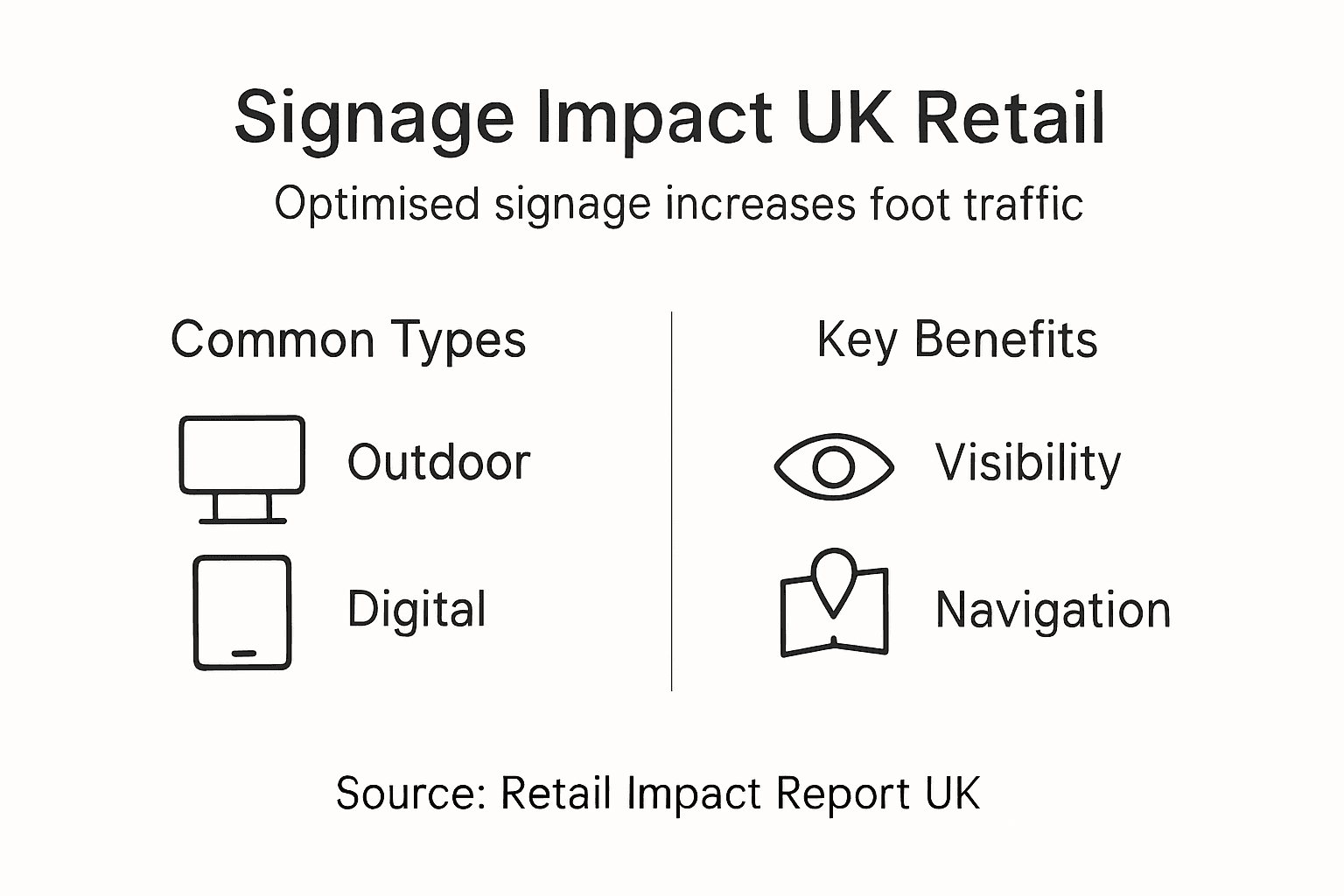
Retail environments demand sophisticated signage strategies that effectively communicate brand messages and guide customer behaviour. Retail signage systems can be comprehensively categorised into four primary types, each serving unique strategic purposes within commercial spaces.
The four fundamental signage categories include:
- Outdoor Signage: Attracts initial customer attention
- Interior Signage: Guides customer navigation
- Promotional Signage: Drives sales and highlights offers
- Digital Signage: Enables dynamic, interactive communication
Outdoor Signage represents the critical first point of customer engagement. These signs include storefront displays, pavement signs, and exterior banners designed to capture pedestrian attention and communicate brand identity. Effective outdoor signage must be visually striking, readable from a distance, and aligned with the business’s visual branding.
Interior signage plays a crucial role in customer experience, transforming retail spaces into intuitive, navigable environments. These signs include wayfinding markers, product category indicators, pricing displays, and directional information that help customers efficiently move through the store and locate desired products.
The right signage transforms a physical space from a mere location into an immersive brand experience.
Promotional signage represents a dynamic sales tool, strategically placed to highlight special offers, seasonal promotions, and impulse purchase opportunities. These signs must be visually compelling, concise, and positioned to maximise customer engagement at critical decision-making points within the retail environment.
Digital signage introduces a modern, flexible dimension to retail communication. These interactive displays allow businesses to rapidly update content, showcase dynamic product information, and create engaging visual narratives that traditional static signage cannot achieve.
Pro tip: Coordinate your signage colour scheme and design language across all types to create a cohesive, professional brand presentation that guides and delights customers.
Here’s a quick overview of how each retail signage type influences customer experience:
| Signage Type | Primary Business Effect | Typical Location | Key Benefit |
|---|---|---|---|
| Outdoor Signage | Drives initial attraction | Shopfront, pavement | Boosts foot traffic |
| Interior Signage | Improves store navigation | Product zones, aisles | Enhances customer efficiency |
| Promotional Signage | Stimulates impulse sales | Entry points, special areas | Increases transaction value |
| Digital Signage | Engages via dynamic content | Feature walls, checkout | Modernises brand impression |
Key Elements of Effective Signage Design
Crafting impactful signage requires a strategic approach that balances visual communication with functional design principles. Effective signage design combines multiple critical elements to create a compelling visual message that attracts, informs, and guides viewers.
The fundamental design elements that make signage truly effective include:
- Colour Contrast: Ensures readability and visual impact
- Typography: Supports message clarity and legibility
- Size and Placement: Optimises visibility from intended viewing distances
- Material Selection: Ensures durability and environmental resilience
- Visual Hierarchy: Guides viewer attention strategically
Colour Contrast represents the foundational visual element of signage design. High-contrast colour combinations dramatically improve readability, ensuring that text and graphics stand out against their background. Professional designers typically use complementary colour schemes that align with brand identity while maximising visual perception.
Typography plays a crucial role in communication effectiveness. The selected font must balance aesthetic appeal with absolute legibility, considering factors like letter spacing, font weight, and character shape. Complex or overly stylised typefaces can compromise message comprehension, particularly when viewed from a distance.
Signage design is a silent communicator that speaks volumes about your brand’s professionalism and attention to detail.
Practical considerations extend beyond pure visual design. Signage must withstand environmental challenges, selecting materials that resist weathering, maintain colour integrity, and provide long-term durability. Factors like UV resistance, moisture protection, and structural stability become paramount in creating signs that maintain their impact over time.
Placement and viewing context dramatically influence design decisions. Signs must be sized appropriately for their intended viewing distance, with clear legibility and visual clarity that communicates instantly. This requires understanding viewing angles, potential visual obstructions, and the specific environment where the sign will be displayed.

Pro tip: Test your signage design by viewing it from multiple distances and angles, ensuring it remains clear and impactful in real-world conditions.
Compare major signage design elements and their direct impact on business effectiveness:
| Design Element | Direct Business Impact | Common Implementation Example |
|---|---|---|
| Colour Contrast | Improves visibility | Light text on dark backgrounds |
| Typography | Boosts readability | Large, sans-serif typefaces |
| Size & Placement | Maximises audience reach | At eye level, suitable proportions |
| Material Selection | Promotes durability | Waterproof acrylic, metal signage |
| Visual Hierarchy | Guides attention behaviour | Bold headlines, subtle supporting text |
UK Regulations and Compliance Requirements
Navigating the complex landscape of signage regulations requires a comprehensive understanding of multiple legal frameworks that govern commercial visual communication in the United Kingdom. Signage compliance guidelines encompass a range of legal considerations spanning planning permissions, safety standards, and local authority requirements.
Key regulatory areas businesses must consider include:
- Planning Permission: Restrictions on external signage placement
- Health and Safety: Visibility and structural integrity standards
- Advertising Regulations: Limitations on content and placement
- Conservation Area Restrictions: Special rules for heritage zones
- Accessibility Guidelines: Ensuring signage meets inclusivity standards
Planning permissions represent a critical initial hurdle for businesses installing external signage. Local authorities typically enforce strict guidelines regarding sign size, positioning, and visual impact, particularly in conservation areas or historic districts. These regulations aim to preserve architectural character while maintaining urban aesthetic standards.
Health and safety regulations mandate specific technical requirements for signage design and installation. Businesses must ensure signs are structurally sound, securely mounted, and pose no risk to public safety. This includes considerations such as wind resistance, material durability, and potential hazards like potential falling or obstruction risks.
Compliance is not just a legal requirement, but a fundamental aspect of responsible business communication.
Advertising standards impose additional constraints on signage content and presentation. The Advertising Standards Authority (ASA) provides comprehensive guidelines governing promotional materials, ensuring truthfulness, decency, and social responsibility in commercial communication.
Accessibility represents an increasingly important regulatory consideration. Signage must comply with disability discrimination legislation, ensuring visual communication is comprehensible and navigable for individuals with diverse perceptual abilities.
Pro tip: Always consult local planning authorities and obtain written confirmation of signage compliance before final installation to avoid potential legal complications.
Strategic Placement to Maximise Footfall
Successful retail environments leverage strategic signage placement as a critical tool for guiding customer movement and maximising potential sales opportunities. Effective retail signage strategies transform physical spaces into intuitive, navigable landscapes that naturally draw customers through deliberate visual communication.
Key strategic placement zones include:
- Storefront Entrance: First point of visual engagement
- Window Displays: Teaser for interior offerings
- Customer Journey Points: Navigation and decision triggers
- High-Traffic Intersections: Maximum visibility zones
- Checkout Areas: Final engagement opportunities
Storefront signage acts as the crucial initial communication point, creating an immediate visual narrative that either attracts or repels potential customers. Positioning signs at eye level with clear, compelling messaging ensures maximum visibility and instant comprehension, transforming passive pedestrian traffic into active store interest.
Interior signage requires equally strategic considerations. Signs must be positioned to create natural customer flow, reducing cognitive friction and guiding shoppers seamlessly through product zones. This involves understanding spatial psychology and creating intuitive visual pathways that feel organic and unforced.
Intelligent signage placement is about creating a silent conversation with your customers, guiding them effortlessly through your retail environment.
Digital and analogue signage can work synergistically when placed thoughtfully. Interactive digital displays positioned at key decision points can provide additional product information, while traditional signage maintains core navigational functions. The key is creating a harmonious visual communication ecosystem.
Environmental context dramatically influences sign effectiveness. Factors like natural light, architectural features, and pedestrian traffic patterns must be carefully considered when determining optimal sign placement. Signs that work brilliantly in one location might become ineffective when moved just a few metres.
Pro tip: Conduct periodic walk-throughs of your retail space, observing customer navigation patterns and adjusting signage placement to create the most intuitive, frictionless shopping experience.
Frequent Mistakes Reducing Signage Impact
Signage effectiveness can be dramatically undermined by common design and implementation errors that many businesses unknowingly perpetuate. Common shop signage errors represent critical challenges that can significantly diminish foot traffic and brand perception.
Key mistakes businesses frequently make include:
- Overcrowded Design: Cluttering signs with excessive information
- Poor Colour Choices: Using low-contrast or visually jarring colour schemes
- Inappropriate Sizing: Creating signs too small or disproportionate
- Inconsistent Branding: Misaligning signage with core brand identity
- Neglecting Visibility: Positioning signs in low-traffic or obscured areas
Overcrowded Design represents a fundamental error in signage communication. Many businesses attempt to communicate too much information simultaneously, creating visual noise that overwhelms potential customers. Effective signage requires ruthless editing, focusing on a single, clear message that can be comprehended within seconds.
Colour selection plays a crucial psychological role in signage impact. Poorly chosen colour schemes can render signs illegible or unappealing, actively deterring potential customers. Professional designers understand the nuanced psychology of colour, selecting palettes that not only align with brand identity but also maximise visual clarity and emotional resonance.
Less is more: Your sign should whisper compelling information, not scream confusion.
Size and placement interact dynamically to determine signage effectiveness. Signs that are too small become invisible, while oversized signs can appear aggressive or unprofessional. The optimal approach involves carefully calibrating sign dimensions to their specific environment, viewing distance, and intended communication purpose.
Branding inconsistency can subtly undermine business credibility. Signs that deviate from established visual guidelines create a sense of dissonance, suggesting organisational lack of attention to detail. Consistency across all visual communication channels builds trust and reinforces brand recognition.
Pro tip: Regularly photograph your signage from multiple perspectives and distances, critically assessing its clarity, visibility, and communicative power as though you were a potential customer encountering it for the first time.
Transform Your Shopfront with Optimised Signage Solutions
Navigating the challenges of attracting foot traffic and guiding customers seamlessly through your retail space requires strategic, visually striking signage. This article highlights the importance of clear, well-placed signs that not only capture attention but also build brand trust and enhance customer experience. If you struggle with overcrowded designs, poor visibility, or mismatched branding, these common pitfalls can hurt your sales potential.
At Promo Signs, we specialise in creating bespoke signage tailored to your specific footfall goals and environment. From illuminated shop front signs to expertly designed interior wayfinding graphics, we ensure your signage communicates clearly and professionally. Our dedicated team handles everything from design and manufacture to fast, reliable installation across London, Essex, and Kent.

Ready to maximise your store’s impact with signage that guides and captivates effortlessly Visit Promo Signs today to start your customised signage project See how our high-quality solutions can bring your brand to life and boost customer engagement Don’t wait because great signage turns passers-by into loyal customers now
Frequently Asked Questions
What is optimised signage?
Optimised signage refers to strategically designed visual communication tools that enhance brand visibility, attract foot traffic, and guide customer navigation within commercial spaces.
How can colour contrast improve signage effectiveness?
High colour contrast ensures readability and visual impact, making it easier for potential customers to quickly understand the message conveyed by the signage.
What are the major types of signage for retail environments?
The major types of retail signage include outdoor signage for attracting customers, interior signage for navigation, promotional signage for driving sales, and digital signage for dynamic communication.
What common mistakes should be avoided in signage design?
Common mistakes include overcrowded designs, poor colour choices, inappropriate sizing, inconsistent branding, and neglecting visibility. Each can significantly diminish the impact of signage on foot traffic.
Recommended
- Signage Size Guidelines 2025: The Essential Guide for London Businesses – PromoSigns.co.uk
- Graphic Design Tips for Signage: 2025 Guide for London Businesses – PromoSigns.co.uk
- Top Storefront Sign Visibility Tips for London Businesses 2025 – PromoSigns.co.uk
- Signage Design Principles for London Businesses in 2025 – PromoSigns.co.uk
- Is Your Website Costing You Customers? What a Modern Redesign Should Include
- 7 Common Website Usability Issues and How to Fix Them
