
Signage refurbishment delivers cost-effective restoration, appearance enhancement, functionality improvement, and extended operational life through systematic assessment, selective repair, component replacement, and professional execution. Strategic refurbishment investment maximizes existing infrastructure value, defers replacement expenditure, maintains brand presentation, and upgrades technology while preserving structural foundations through informed specification and expert craftsmanship.
This comprehensive guide explores signage refurbishment approaches, covering condition assessment, restoration techniques, component replacement, technology upgrades, regulatory compliance, cost analysis, and decision frameworks that enable businesses to optimize signage performance through targeted intervention rather than complete reconstruction.

Here is a quick reference for how different sign materials may require tailored care during refurbishment:
| Material Type | Cleaning Precautions | Recommended Products |
|---|---|---|
| Aluminium | Avoid abrasive tools | Mild detergent, soft cloth |
| Acrylic/Plastic | Prevent surface clouding | Special plastic cleaner |
| Painted Metal | Do not use harsh solvents | Gentle soap, microfibre cloth |
| Glass | Avoid scratching, streaking | Glass cleaner, soft squeegee |
Table of Contents
Why Consider Refurbishment?
Cost Advantages
Capital Preservation: Extending existing investment vs. replacement:
Cost Comparison:
Complete Replacement:
- Restaurant signage production: £8,000
- Installation labor: £1,500
- Disposal/removal: £300
- Planning consent (if required): £132
- Total: £9,932
Strategic Refurbishment:
- Professional cleaning/preparation: £300
- New vinyl graphics: £500
- LED module replacement: £1,200
- Repaint frame/trim: £400
- Installation labor: £600
- Total: £3,000
Saving: £6,932 (70% cost reduction)
ROI Analysis:
- Investment: £3,000 refurbishment
- Extended life: 7-10 years additional
- Replacement deferral value: £10,000-£15,000 (future cost, inflation-adjusted)
- Return: 233-400% (deferred replacement value vs. refurbishment cost)
Environmental Benefits
Sustainability Impact: Reduced waste and resource consumption:
Environmental Metrics:
Material Waste Avoided:
- Aluminum/steel: 50-200kg typical fascia (recycling energy-intensive, virgin resource conservation)
- Acrylic/plastics: 20-80kg (petrochemical-based, landfill reduction, pollution prevention)
- Electronics: 5-15kg LED/electrical (hazardous waste, rare earth elements, recycling challenges)
- Total waste diverted: 75-295kg per installation (landfill avoidance, resource preservation)
Carbon Footprint:
- New production emissions: 500-2,000kg CO₂e (manufacturing, transportation, material extraction)
- Refurbishment emissions: 100-400kg CO₂e (component production, transportation, installation)
- Reduction: 60-80% (carbon savings, environmental responsibility, corporate sustainability)
Circular Economy:
- Component reuse (structural preservation, resource optimization, waste minimization)
- Material extension (lifecycle maximization, embodied energy retention, value preservation)
- Responsible disposal (recyclable components only, proper handling, environmental protection)
Heritage Preservation
Historic Signage: Character and authenticity retention:
Conservation Scenarios:
Listed Buildings:
- Original signage significance (architectural contribution, historical value, cultural heritage)
- Regulatory requirement (Listed Building Consent difficulty, preservation obligation, heritage protection)
- Authentic restoration (traditional methods, period-appropriate materials, craftsmanship respect)
- Character retention (patina preservation, aging celebration, authenticity maintenance)
Conservation Areas:
- Traditional appearance (neighborhood character, historical continuity, visual harmony)
- Planning approval (restoration favored over replacement, heritage sensitivity, regulatory preference)
- Craft techniques (hand-painting, gilding, traditional joinery, artisan execution)
Brand Heritage:
- Established identity (long-standing recognition, community familiarity, market presence)
- Customer attachment (nostalgia value, loyalty connection, emotional resonance)
- Historical significance (landmark status, local identity, cultural contribution)
Example: Traditional hand-painted Sign makers fascia (50+ years):
- Replacement cost: £15,000+ (heritage replication, artisan craftsmanship, premium materials)
- Restoration cost: £3,500 (surface preparation, repainting, gilding renewal, protective coating)
- Saving: £11,500 + heritage authenticity preserved
Condition Assessment
Systematic Evaluation
Professional Inspection: Determining refurbishment viability:
Structural Integrity:
Critical Assessment:
- Frame stability (corrosion severity, structural soundness, load-bearing capacity)
- Mounting security (fixing integrity, substrate condition, safety verification)
- Material soundness (cracking, warping, delamination, structural compromise)
- Weather sealing (gasket condition, water ingress evidence, protective integrity)
Refurbishment Viable:
- Surface corrosion only (cosmetic, treatable, protective coating renewal)
- Secure mounting (stable fixings, sound substrate, safety maintained)
- Structurally sound materials (no cracking, minimal warping, integrity preserved)
Replacement Necessary:
- Deep corrosion (structural compromise, safety risk, integrity loss)
- Mounting failure (loose fixings, substrate damage, hazard creation)
- Material failure (extensive cracking, severe warping, collapse risk)
Component Analysis
Element-by-Element: Targeted intervention identification:
Assessment Checklist:
Frame/Structure:
- Condition: Excellent/Good/Fair/Poor (structural rating, safety classification)
- Action: Clean/Repaint/Repair/Replace (intervention requirement, cost implication)
- Cost: £200-£2,000 (scope-dependent, complexity-variable)
Face Panels:
- Condition: Clear/Yellowed/Cracked/Failed (optical quality, appearance assessment)
- Action: Clean/Polish/Replace (restoration potential, aesthetic requirement)
- Cost: £400-£3,000 (size, material-dependent)
Graphics:
- Condition: Vibrant/Faded/Peeling/Missing (brand presentation, professional appearance)
- Action: Clean/Refresh/Replace (cosmetic requirement, marketing necessity)
- Cost: £300-£2,000 (complexity, size-dependent)
Illumination:
- Condition: Full/Partial/Failed/None (functionality status, visibility impact)
- Action: Repair/Upgrade/Replace (performance requirement, technology opportunity)
- Cost: £500-£5,000 (system complexity, technology choice)
Electrical:
- Condition: Safe/Degraded/Hazardous (compliance status, safety priority)
- Action: Test/Repair/Replace/Upgrade (regulatory requirement, liability management)
- Cost: £300-£2,500 (system extent, certification requirement)
Refurbishment Techniques
Cleaning and Surface Preparation
Foundation Process: Critical for adhesion and appearance:
Professional Cleaning:
Process:
- Dust/debris removal (dry brushing, compressed air, surface clearing)
- Detergent wash (degreasing, dirt dissolution, preparation initiation)
- High-pressure rinse (contaminant removal, surface cleaning, preparation completion)
- Degreasing (isopropyl alcohol, silicone removal, adhesion assurance)
- Surface inspection (contamination verification, quality confirmation, approval)
Cost: £200-£800 (size, accessibility-dependent)
Critical Areas:
- Frame crevices (hidden contamination, corrosion harboring, detail attention)
- Seal channels (gasket preparation, weatherproofing renewal, longevity assurance)
- Electrical compartments (dust removal, connection cleaning, safety maintenance)
- Mounting points (fixing inspection, structural verification, security confirmation)
Repainting/Refinishing
Protective Coating Renewal: Appearance and weather protection:
Metal Surfaces:
Process:
- Surface preparation (cleaning, rust removal, profile creation)
- Rust treatment (converter application, corrosion neutralization, prevention)
- Primer application (adhesion promotion, corrosion protection, base preparation)
- Top coat (2-3 layers, color accuracy, weather resistance, UV protection)
- Clear coat (optional: gloss enhancement, additional protection, appearance optimization)
Materials:
- Powder coating (factory quality, superior durability, professional finish: £400-£1,200 typical)
- Automotive paint (high-quality, color-matching, DIY-possible: £200-£600)
- Industrial enamel (weather-resistant, cost-effective, adequate performance: £150-£400)
Lifespan Extension: 7-12 years (maintenance deferral, appearance preservation, protection renewal)
Timber Elements:
Process:
- Stripping (old finish removal, surface exposure, damage assessment)
- Sanding (smooth preparation, profile refinement, quality foundation)
- Repairs (filler application, rot treatment, structural restoration)
- Primer/sealer (moisture protection, adhesion preparation, base coating)
- Stain/paint (color application, aesthetic achievement, protection)
- Protective coating (varnish/oil, weather resistance, longevity enhancement)
Cost: £300-£1,500 (size, complexity, condition-dependent)
Graphic Replacement
Visual Refresh: Brand presentation renewal:
Vinyl Graphics: Most cost-effective approach:
Process:
- Old vinyl removal (heat application, careful peeling, adhesive dissolution)
- Adhesive residue cleaning (solvent application, surface restoration, preparation)
- Surface preparation (degreasing, inspection, approval)
- New vinyl application (professional installation, bubble-free, alignment precision)
Cost: £300-£2,000 (size, complexity-dependent) Timeline: 3-7 days (design approval, production, installation)
Repainting: Traditional approach for heritage:
Process:
- Surface preparation (cleaning, sanding, priming, foundation quality)
- Base coat application (solid color, uniform coverage, professional execution)
- Letter/design painting (hand-painted or stenciled, precision, craftsmanship)
- Gilding (optional: gold leaf, premium appearance, heritage technique)
- Protective varnish (UV-resistant, weather protection, longevity assurance)
Cost: £800-£5,000 (complexity, craftsmanship, materials-dependent) Timeline: 2-4 weeks (preparation, execution, curing, quality assurance)
Component Replacement
Selective Upgrades: Targeted improvement:
LED Conversion: Fluorescent to LED upgrade:
Benefits:
- Energy saving: 70-80% reduction (operational cost decrease, environmental benefit)
- Brightness improvement: 30-50% increase (visibility enhancement, competitive parity)
- Lifespan extension: 5× longer (maintenance reduction, reliability improvement)
- Even illumination: No dark spots (professional appearance, quality enhancement)
Process:
- Remove fluorescent tubes/ballasts (obsolete technology elimination, disposal)
- Install LED drivers/modules (modern technology, standardized components, efficiency)
- Rewiring (if necessary: optimization, safety improvement, code compliance)
- Testing/certification (electrical safety, performance verification, regulatory compliance)
Cost: £500-£3,000 (size, complexity-dependent) Payback: 2-4 years (energy savings, maintenance reduction, combined benefit)
Acrylic Face Replacement: Clarity restoration:
Triggers:
- Yellowing (UV degradation, appearance compromise, brand inconsistency)
- Cracking (material failure, water ingress, structural weakness)
- Scratching (vandalism, maintenance damage, professional appearance loss)
Process:
- Remove old panels (careful extraction, damage avoidance, reusable component preservation)
- Template creation (precise dimensions, mounting verification, fit assurance)
- New acrylic fabrication (UV-stable formulation, appropriate thickness, quality material)
- Installation (seal replacement, secure mounting, weatherproofing)
Cost: £400-£3,000 (size, thickness, specification-dependent) Lifespan: 10-15 years (extended service, clarity retention, investment protection)
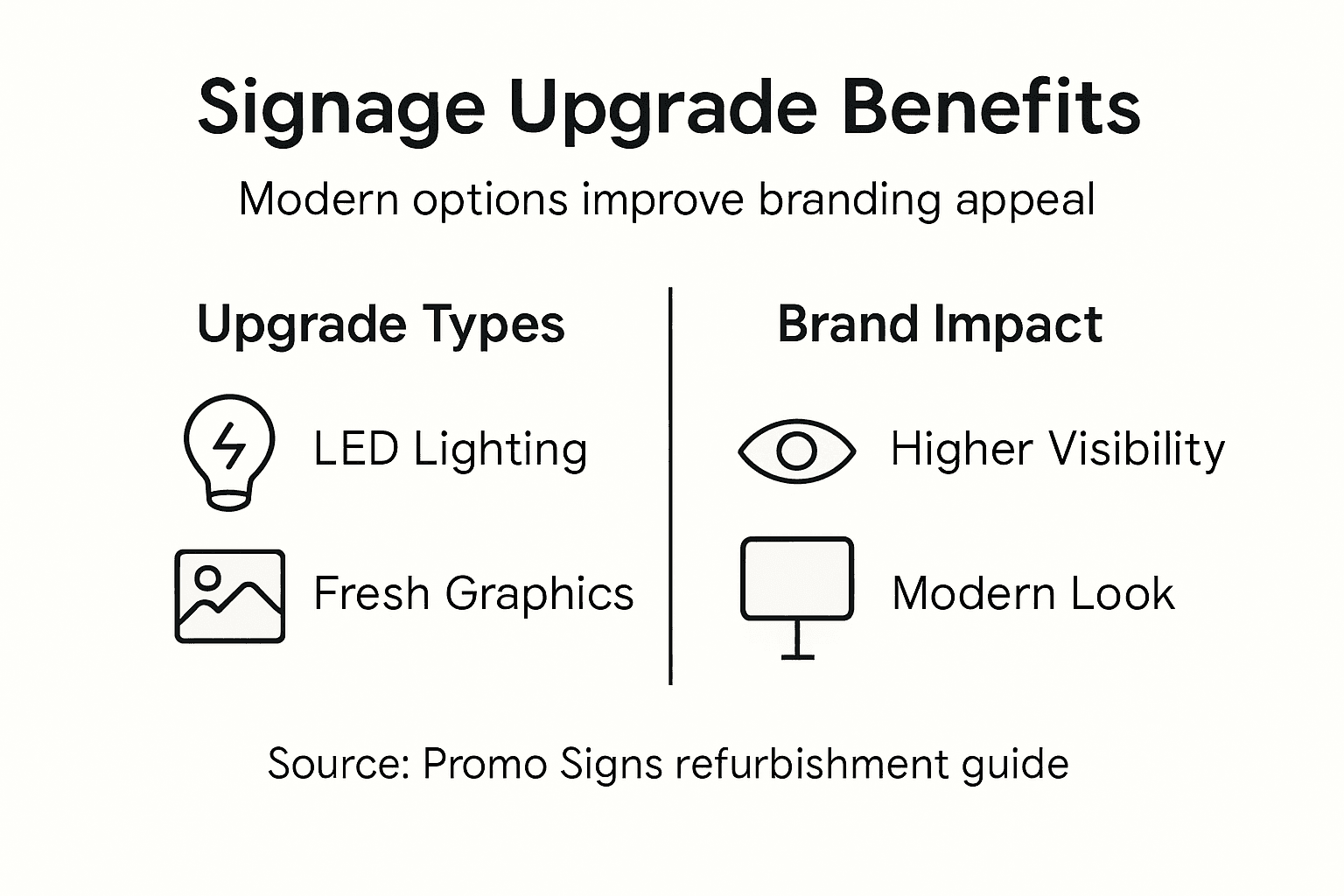
This table summarises major signage upgrade choices and how they impact your brand:
| Upgrade Option | Key Benefit | Brand Impact |
|---|---|---|
| LED Illumination | Energy efficiency, vibrant look | Modern, eye-catching style |
| New Graphics Design | Improved legibility, relevance | Strong, contemporary appeal |
| Dimensional Lettering | Enhanced depth, premium effect | Luxurious, professional feel |
| Colour-Changing LEDs | Dynamic visual engagement | Memorable brand experience |
Top tip: Consider requesting a digital mockup of your proposed sign design to visualise how new graphics and illumination will look before final implementation.
Technology Upgrades
Digital Integration
Hybrid Approach: Combining traditional + digital:
Strategy:
- Retain permanent elements (frame, structure, brand identity, heritage preservation)
- Add digital panel (screen integration, dynamic content, contemporary capability)
- Maintain flexibility (content updates, promotional messaging, market responsiveness)
Example: Traditional fascia refurbishment + digital addition:
- Frame restoration: £1,200 (cleaning, repainting, structural renewal)
- Logo panel retention: £400 (cleaning, protective coating, preservation)
- Digital screen addition: £3,500 (32″ outdoor-rated, weatherproof housing, installation)
- Electrical upgrade: £800 (capacity increase, smart control, network provision)
- Total: £5,900 (vs. £15,000+ complete replacement with digital integration)
Smart Controls
Automation Addition: Operational optimization:
Features:
- Photocell dimming (daylight response, energy saving, automatic adjustment)
- Timer control (operating hours, scheduled operation, consistency)
- Remote management (cloud-based, multi-location, centralized control)
- Weather sensors (storm shutdown, temperature compensation, protection)
Benefits:
- Energy savings: 20-40% additional (intelligent operation, waste elimination)
- Maintenance reduction: Automated monitoring (fault detection, proactive intervention, downtime minimization)
- Regulatory compliance: Brightness control (neighbor amenity, planning conditions, responsible operation)
Cost: £500-£2,500 (system complexity, features-dependent)
Regulatory Compliance
Planning Considerations
Like-for-Like Restoration: Deemed consent retention:
Criteria:
- Same size/smaller (no enlargement, existing footprint, minimal change)
- Same position (established location, precedent existence, approval continuity)
- Similar appearance (character maintenance, neighborhood harmony, visual consistency)
- Same illumination type (static replacement, comparable brightness, amenity preservation)
Generally Acceptable:
- Repainting same colors (appearance maintenance, brand continuity, cosmetic renewal)
- Vinyl graphic replacement (content update, design refresh, marketing evolution)
- LED upgrade (like-for-like technology, efficiency improvement, contemporary standard)
Requires Consent:
- Size increase (enlargement, visibility enhancement, impact change)
- Position change (relocation, mounting alteration, sightline modification)
- Illumination addition (non-lit to lit, amenity impact, scrutiny requirement)
- Character change (style transformation, material alteration, appearance evolution)
Conservation Areas/Listed Buildings: Always consult planning/conservation officer (enhanced control, heritage sensitivity, approval necessity)
Electrical Safety
Part P Compliance: Regulatory requirement for electrical work:
Requirements:
- Qualified electrician (competent person scheme, certification capability, liability protection)
- Electrical testing (safety verification, performance confirmation, documentation)
- Certification (compliance evidence, building control notification, legal protection)
- RCD protection (shock prevention, safety requirement, code compliance)
Work Requiring Certification:
- LED conversion (circuit modification, load change, electrical alteration)
- Driver replacement (component electrical, system impact, safety critical)
- Control system addition (new circuits, automation, integration)
- Any rewiring (cable replacement, capacity increase, code upgrade)
Decision Framework
Refurbish vs. Replace
Evaluation Criteria:
Refurbishment Appropriate: ✓ Structure sound (stable frame, secure mounting, integrity maintained) ✓ Location established (planning precedent, approved position, acceptance) ✓ Budget limited (capital constraints, cash flow priority, cost sensitivity) ✓ Heritage value (historical significance, character preservation, authenticity) ✓ Recent installation (5-10 years, premature failure, warranty consideration) ✓ Selective issues (isolated problems, component-specific, targeted solution)
Replacement Necessary: ✗ Structural failure (safety risk, collapse potential, liability exposure) ✗ Complete obsolescence (technology outdated, appearance dated, competitive disadvantage) ✗ Extensive damage (multiple failures, comprehensive issues, cost escalation) ✗ Regulatory non-compliance (irremediable, fundamental design, approval impossibility) ✗ Business rebranding (complete identity change, market repositioning, fresh start) ✗ Size inadequate (visibility insufficient, growth requirement, market evolution)
Cost-Benefit Analysis
Economic Evaluation:
Simple Payback: Refurbishment cost ÷ Annual replacement deferral value
Example:
- Refurbishment: £3,000
- Replacement cost (deferred): £10,000
- Extended life: 7 years
- Annual value: £1,428
- Payback: 2.1 years (economic justification, rapid recovery, value demonstration)
Lifecycle Comparison:
15-Year Period:
Replace Now:
- New signage: £10,000 (Year 0)
- Replacement 2: £11,000 (Year 12, inflation-adjusted)
- Total: £21,000
Refurbish + Later Replace:
- Refurbishment: £3,000 (Year 0)
- Replacement: £12,000 (Year 8, deferred, inflation-adjusted)
- Total: £15,000
Saving: £6,000 (29% cost reduction)
Professional vs. DIY
Skills Assessment
Professional Services: Expert execution benefits:
Advantages:
- Quality assurance (experience, expertise, proven results, professional standards)
- Warranty coverage (work guarantee, defect correction, accountability, protection)
- Efficiency (rapid execution, minimal disruption, coordinated trades, project management)
- Safety compliance (height work, electrical, Part P, liability coverage, insurance)
- Tools/equipment (specialized, professional-grade, appropriate, efficient)
Recommended for:
- Electrical work (mandatory: Part P compliance, certification requirement, safety critical)
- Height work (scaffolding, cherry picker, fall protection, specialist training)
- Structural repairs (engineering knowledge, liability risk, safety paramount)
- Large-scale projects (complexity, coordination, quality assurance, predictable outcome)
DIY Opportunities: Cost-saving potential:
Suitable Tasks:
- Basic cleaning (ground-level access, simple equipment, straightforward process)
- Vinyl removal (heat gun, patience, careful execution, achievable quality)
- Painting (preparation critical, skill-dependent, aesthetic impact, cost-effective)
- Simple graphic application (small areas, straightforward designs, careful attention)
Risks:
- Quality compromise (amateur execution, appearance impact, professional credibility)
- Safety hazards (height work, electrical, injury potential, liability exposure)
- Warranty invalidation (manufacturer disclaimers, coverage loss, unprotected investment)
- Time consumption (learning curve, inefficiency, opportunity cost, frustration)
Conclusion
Signage refurbishment delivers cost-effective restoration, appearance enhancement, functionality improvement, and environmental responsibility through systematic assessment, selective intervention, component replacement, and professional execution. From simple cleaning and repainting through comprehensive LED upgrades and digital integration, strategic refurbishment maximizes existing infrastructure value while deferring replacement expenditure and maintaining brand presentation.
Success requires comprehensive condition assessment, informed decision-making, appropriate technique selection, regulatory compliance verification, and professional execution where necessary that transforms aging signage into refreshed marketing assets delivering extended operational life. Whether restoring heritage Shop Front Signs, upgrading Custom Signs illumination, or enhancing Illuminated Signs technology, refurbishment represents intelligent capital management delivering 70%+ cost savings while preserving structural investment.
For businesses seeking optimal refurbishment outcomes, partnering with experienced specialists ensures access to condition assessment expertise, restoration technique knowledge, component sourcing capabilities, and installation quality that maximizes refurbishment value while protecting long-term signage investment through informed intervention and expert craftsmanship.
Recommended
- The Modern Age Visual Displays For Branding – PromoSigns.co.uk
- Signage Design Principles for London Businesses in 2025 – PromoSigns.co.uk
- Signage for Interior Designers: Trends and Solutions 2025 – PromoSigns.co.uk
- LED vs. Traditional Storefront Signage: Which is Right for You? – PromoSigns.co.uk
- Wooden Home Decor: Buy Custom Decor of the Highest Quality Crawoo.c…
- DIY Garden Decoration Ideas for a Budget-Friendly Makeover – Lushy Gardens
