
For short-term promotions, events, and seasonal campaigns, removable signs are the practical choice. For shopfronts, long-term wayfinding, and brand identity, permanent signs deliver better value over time. Before you order either, check your planning consent and commercial lease terms — both can override your preference regardless of what you have already paid for.
Three rapid indicators to help you decide now:
-
Short-term duration — go removable; Correx panels and vinyl graphics are cost-effective and quick to produce.
-
Multi-year brand marker — go permanent; Dibond, aluminium, or illuminated fascia signage will serve you far longer and look the part.
-
Legal or lease status unknown — pause and check with your landlord before ordering anything.
Table of Contents
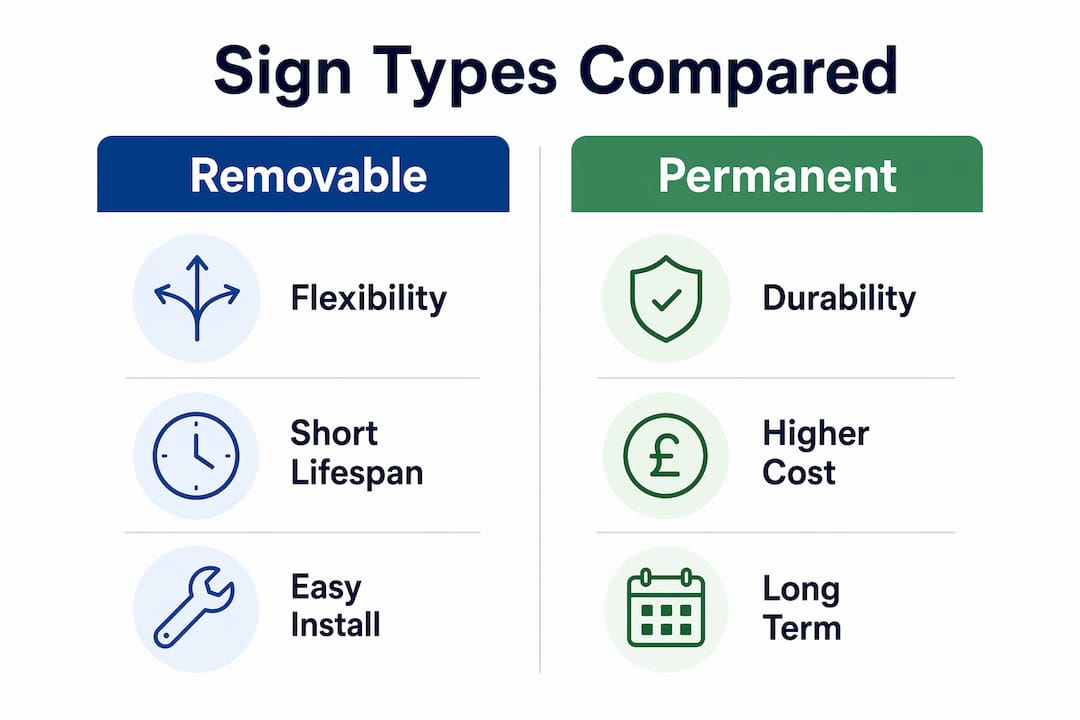
How do removable and permanent signs compare side by side?
| Dimension | Removable signs | Permanent signs |
|---|---|---|
| Best for | Events, seasonal promotions, pop-ups, temporary wayfinding | Shopfronts, long-term wayfinding, corporate branding, safety signage |
| Typical lifespan | 1–5 years depending on material | 5–10+ years |
| Typical cost | Lower upfront; higher cost per year if replaced frequently | Higher upfront; lower cost per year over full lifespan |
| Installation complexity | Low to medium; often self-install or one-person fit | Medium to high; usually requires professional installation |
| Removability / reusability | High; designed for removal with minimal surface damage | Low; removal often damages substrate or requires specialist work |
| Planning & lease risk (UK) | Lower risk, but landlord approval may still be required | Higher risk; illuminated or large external signs usually need express consent |
| Branding impact | Effective for urgency and offers; can erode perceived permanence if overused | Supports long-term brand recognition and professional credibility |
| Environmental / recyclability | Correx and vinyl have limited recyclability; some reusable systems available | Aluminium and Dibond are highly recyclable; longer lifespan reduces waste |
Typical materials at a glance:
- Removable: Correx (fluted polypropylene), self-adhesive vinyl, PVC banners, Foamex for short-term indoor use
- Permanent: Dibond (aluminium composite), solid aluminium, powder-coated steel, acrylic, LED-illuminated fabricated letters
Common use cases:
- Retail seasonal sale graphics, event wayfinding, trade show displays, construction site hoardings (removable)
- Shop fascia signs, regulatory safety notices, corporate reception branding, external illuminated signs (permanent)
When are removable signs the better choice?
Removable signage earns its place when speed, flexibility, and low commitment matter more than longevity. A pop-up retailer running a six-week residency, a hospitality venue promoting a limited menu, or an event organiser directing visitors around a venue all need temporary signage options that go up fast and come down cleanly.
Retail and hospitality specialists note that temporary signs drive short-term footfall effectively for seasonal sales and time-limited campaigns. The key is treating them as campaign tools, not substitutes for permanent branding.
Sector examples:
- Retail: seasonal window vinyls, sale banners, promotional A-boards
- Hospitality: pop-up menu boards, event directional signs, limited-offer window graphics
- Events and exhibitions: pull-up banners, Correx directional panels, printed backdrops
- Property: for-sale boards, open-house directional signs, construction hoarding graphics
Practical pros and cons:
- Pros: lower upfront cost, fast turnaround (often 24–72 hours for standard prints), portable, reusable with care
- Cons: shorter lifespan, potential for appearance drift if artwork is not refreshed, and a risk of looking temporary when permanence is what customers expect
Pro Tip: When storing reusable Correx or foam board panels, keep them flat, away from direct sunlight, and in a dry environment. Warped or faded panels undermine the brand consistency you worked to build. Promosigns’ guide to temporary project signage covers mounting systems and storage best practice in detail.
When are permanent signs the right investment?
Permanent signage justifies its higher upfront cost when the sign needs to work every day, in all weathers, for years. A shopfront fascia, an illuminated LED sign, a fire-exit notice, or a corporate reception wall all fall into this category. The Health and Safety (Safety Signs and Signals) Regulations 1996 mandate permanent fixtures for fire exits, first aid points, and other persistent workplace hazards — there is no compliant temporary alternative for those.
Material choice determines how long a permanent sign actually lasts. The table below shows typical outdoor lifespans by material:
| Material | Typical outdoor lifespan | Recommended use |
|---|---|---|
| Correx | 1–2 years | Short-term outdoor, construction sites |
| Foamex | 2–5 years | Indoor and short-term semi-permanent |
| Dibond | 5–10+ years | Shopfronts, external fascia, wayfinding |
| Aluminium | 10+ years | Long-term external, safety, regulatory |
| Acrylic | Indoor recommended | Reception, interior branding, retail |
A well-maintained Dibond fascia or aluminium sign will outlast several rounds of Correx replacements, making the per-year cost considerably lower. Illuminated signs add visibility after dark and can increase footfall significantly — the advantages of illuminated signage extend well beyond aesthetics, supporting wayfinding and brand recall around the clock.
High-value permanent sign use cases:
- Shopfront fascia and 3D lettering for retail and hospitality
- External illuminated signs for visibility in low-light conditions
- Long-term wayfinding for office parks, hospitals, and retail centres
- Regulatory and safety signage required by law
- Corporate interior branding for reception areas and boardrooms
Professional installation and a manufacturer’s warranty are standard expectations for permanent signage. Routine cleaning and annual fixing inspections keep a permanent sign performing well throughout its lifespan, lowering the total cost of ownership compared with repeated short-term replacements.
UK checklist: planning permission, advertising consent, and commercial lease steps
UK planning rules and commercial lease terms are the two areas most likely to catch business owners off guard. Getting both right before installation avoids forced removals, fines, and landlord disputes.
Step-by-step planning checklist:
- Confirm whether your sign needs express consent or falls under deemed consent. Many non-illuminated signs have deemed consent, but size, height, and location restrictions apply.
- Check illumination rules. Fully illuminated external signs almost always require express consent from your local planning authority.
- Identify whether your premises are in a conservation area or a listed building — additional restrictions apply in both cases.
- Contact your local highways authority if you are considering tourism or directional brown signs on public roads.
- Submit an express consent application where required, allowing sufficient lead time before your planned installation date.
Commercial lease checklist:
- Read your lease carefully for any clause requiring landlord approval before installing signage.
- Obtain written landlord consent before ordering, even for signs you consider removable. Planning permission does not equal the right to install — landlords commonly retain independent control.
- Confirm the approved fixing method with your landlord; some leases prohibit fixings that penetrate the building fabric.
Red flags to watch for:
- Illuminated external signs ordered without express consent
- Fixings that penetrate or damage the building fabric without landlord approval
- Proceeding with installation after a landlord has not yet responded
Pro Tip: Ask Promosigns to advise on fixings that avoid lease breaches and to support your planning or express-consent application. Experienced local installers understand the common installation challenges specific to London commercial properties.
How does your sign choice affect brand image and customer perception?
Consistent permanent signage builds long-term brand recognition. Customers associate a well-maintained, professionally installed fascia with stability and quality. Temporary signs are highly effective for driving urgency and footfall during campaigns, but over-reliance on them in place of permanent branding can erode perceived professionalism over time.
Design principles that apply to both sign types:
- Use a minimum 70mm letter height for pedestrian viewing at 10 metres; increase proportionally for vehicle traffic.
- Maintain a contrast ratio of at least 3:1 between text and background for legibility.
- Match temporary artwork to your permanent brand palette, typeface, and logo to avoid cognitive dissonance.
- Consider window graphics as a bridge between removable and permanent — they can be updated seasonally while maintaining a consistent brand frame.
Visibility checklist:
- Confirm sightlines from both pedestrian and vehicle approaches before finalising sign dimensions.
- Assess whether illumination is needed for evening visibility.
- Check accessibility: high-contrast, clearly legible signs serve all customers, including those with visual impairments.
Pro Tip: When running a temporary campaign alongside permanent signage, brief your designer to use the same colour values and typeface as your shopfront. Mismatched temporary graphics undermine the credibility your permanent sign works to build.
What do removable and permanent signs typically cost, and how long do they take?
Permanent signs cost more upfront but usually deliver a lower cost per year over their full lifespan. Removable signs are cheaper to produce but need replacing more frequently, and cumulative costs can add up over time.
Typical cost bands (UK, 2026):
- Printed Correx panel (A1, single-sided): budget range
- Foamex indoor board (A1): low to mid range
- Dibond fascia panel (custom size): mid to upper range
- Illuminated LED trough or built-up letters: upper range, reflecting fabrication and installation
Exact pricing depends on size, quantity, finish, and installation requirements. Promosigns provides bespoke quotes based on a site survey.
Typical lead times:
- Standard removable prints (Correx, vinyl, banners): typically a few days
- Semi-permanent boards and Foamex: usually one to two weeks
- Bespoke permanent fabrication (Dibond fascia, 3D letters): several weeks
- Illuminated and LED signs: longer lead times that include consent processes
Maintenance checklist:
- Clean permanent signs every 3–6 months with a mild detergent and soft cloth.
- Inspect fixings annually for corrosion or loosening, particularly after winter.
- Service LED modules and drivers per manufacturer guidance; refer to Promosigns’ illuminated sign maintenance guide for a step-by-step schedule.
- Rotate or refresh temporary assets before visible fading or warping occurs.
One-page decision checklist and questions to ask your sign maker
Before you call a supplier, work through these questions. They will sharpen your brief and help you spot a supplier who genuinely understands your needs.
Your decision checklist:
- How long does the sign need to be in place? Under 3 months points to removable; over 12 months points to permanent.
- What is your total budget, including installation and any planning fees?
- What are the visibility requirements — pedestrian, vehicle, or both? Day and night?
- Do you have a material preference, or do you need guidance on outdoor sign materials?
- Are there installation constraints (listed building, conservation area, landlord restrictions)?
- What are your planning and lease obligations?
- Do you have environmental or recyclability goals that should influence material choice?
Questions to ask your sign maker:
- What is the expected lifespan of this sign in our specific location and climate?
- What fixings will you use, and will they damage the building fabric or breach our lease?
- What warranty do you offer on materials and installation?
- What are your lead times for production and installation?
- Can you advise on or manage the planning consent application?
- What recycling or reuse options exist at end of life?
- Do you cover our location — London, Essex, or Kent?
Red flags from a supplier:
- Unable to confirm whether planning consent is needed
- No installation warranty offered
- Vague or absent maintenance guidance after handover
How Promosigns approaches the removable vs permanent decision
At Promosigns, the starting point is always solution fit. Temporary signage makes sense when a campaign demands agility — a retail promotion, an exhibition stand, a construction hoarding. Permanent signage is the right investment when a business needs long-term brand continuity, regulatory compliance, or the kind of professional presence that builds customer trust from the pavement.
Our service scope covers the full journey: design, fabrication, professional installation, and ongoing maintenance for clients across London, Essex, and Kent. We handle planning applications and landlord liaison where required, and we advise on fixings that protect both the building fabric and the lease. Typical turnaround for removable prints is 24–72 hours; bespoke permanent fabrication runs 2–6 weeks depending on complexity. Every installation comes with a clear handover and warranty, so you know exactly what to expect.
Promosigns can handle your signage from survey to installation
Whether you need a fast-turnaround Correx panel for next week’s event or a bespoke illuminated fascia for your shopfront, Promosigns delivers end-to-end signage across London, Essex, and Kent. We combine local installation expertise with in-house design and fabrication, so you get a single point of contact from brief to sign-off.
Our services include bespoke shop front signs, LED illuminated signs, temporary exhibition displays, window graphics, and hoardings. We use non-damage fixing methods where leases require it, and we support clients through planning and express-consent applications. Every project includes a free site survey so the specification is right before production begins.
Contact Promosigns today for a free quote and site survey — and get the right sign, installed correctly, the first time.
Recommended
- Durable sign materials: the complete UK buyer’s guide – PromoSigns.co.uk
- Understanding Temporary vs Permanent Signage for Your Business – PromoSigns.co.uk
- Flexible sign materials: the UK business guide – PromoSigns.co.uk
- Weatherproof outdoor signs: the complete UK guide – PromoSigns.co.uk
