

Shop signage in London does much more than announce your business. Businesses that ignore planning permissions and sign regulations risk fines and enforced removal, with over 70% of new signs in certain boroughs facing regulatory issues each year. You might think the right design is just about grabbing attention on a busy street, but focusing solely on looks can actually be a costly mistake. The real advantage comes from understanding just how closely design, compliance, and careful material choice are woven together, and how easily the smallest oversight can turn a winning sign into a waste of money.
Table of Contents
Table of Contents
- Understanding Shop Signage Basics And Types
- Key Shop Signage Design Principles
- Regulations And Compliance For London Businesses
- Tips For Choosing And Maintaining Shop Signage
Quick Summary
| Takeaway | Explanation |
|---|---|
| Prioritise Compliance | Understand the regulatory landscape for shop signage in London, including planning permissions and safety standards to avoid penalties and ensure visual harmony with the surroundings. |
| Focus on Design Principles | Leverage typography, colour psychology, and spatial design to create effective signage that captures attention and conveys brand identity clearly. |
| Select Durable Materials | Choose materials that withstand environmental challenges while maintaining visual appeal, such as aluminum, treated wood, and acrylic. |
| Implement Regular Maintenance | Establish systematic upgrades and inspections, including quarterly checks and cleaning protocols, to ensure signage remains effective and visually appealing over time. |
Understanding Shop Signage Basics and Types
Shop signage represents the visual communication cornerstone for businesses, serving as a critical interface between commercial spaces and potential customers. These visual markers do more than simply identify a business location they communicate brand identity, attract customer attention, and provide essential information about products and services.
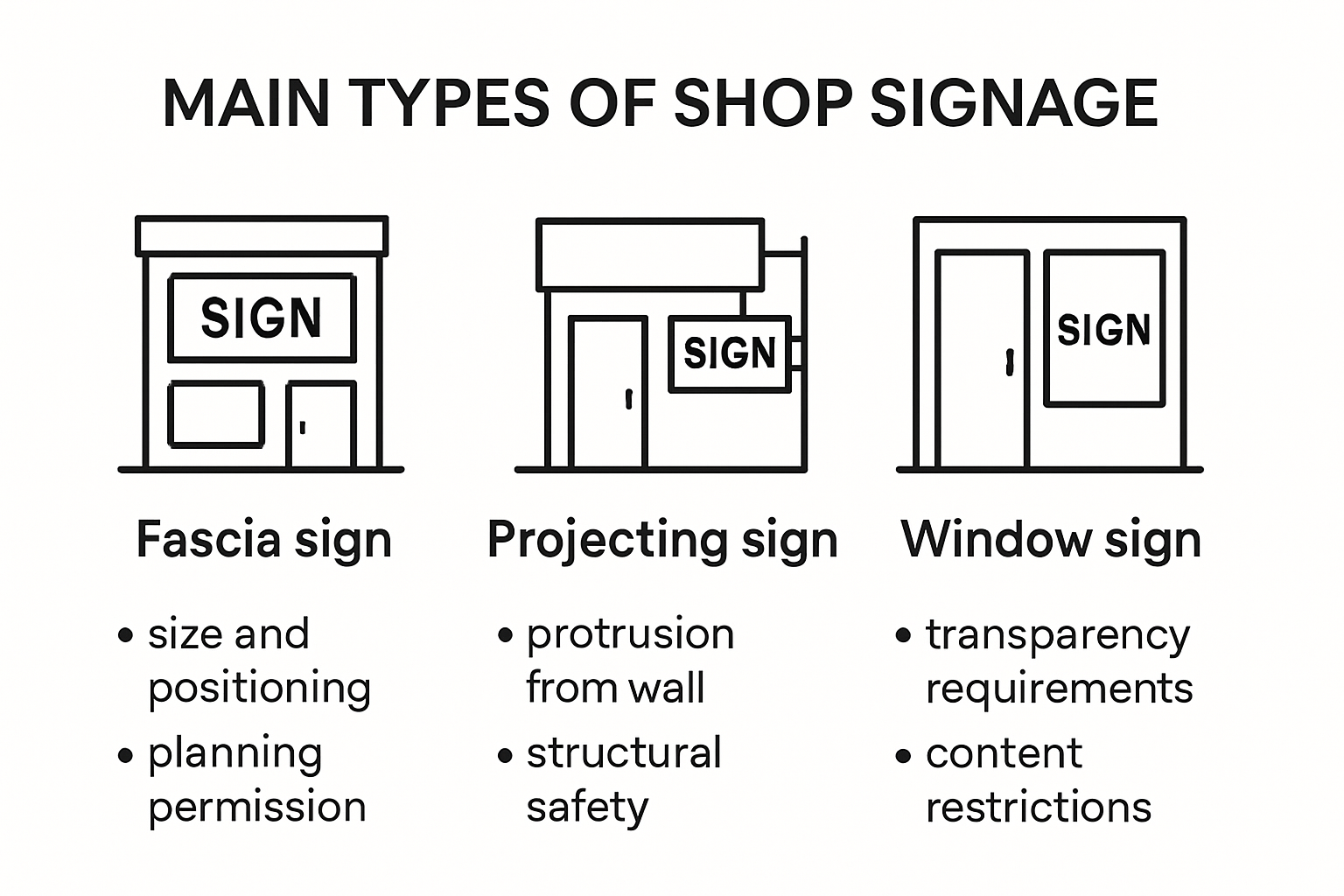
Types of Shop Signage
Shop signage encompasses a diverse range of design and functional approaches. According to the UK government’s guide on outdoor advertisements, businesses must navigate specific regulatory requirements when designing and displaying signs.
Fascia Signs: These horizontal signs typically run across the shopfront, displaying the business name and logo. They represent the primary identification method for most commercial establishments. Positioning and design must align with local planning guidelines, ensuring visual harmony with the surrounding architectural context.
Projecting Signs: These signs extend perpendicular from the building facade, offering visibility from multiple angles. Manchester City Council’s Shopfront Design Guide recommends careful consideration of projection distance and height to maintain streetscape aesthetics.
Regulatory Considerations
Signage regulations in the UK are stringent and vary depending on location and sign characteristics. Illuminated Signs: Fully illuminated signs invariably require express planning consent. Non-illuminated signs might qualify for deemed consent, subject to specific size and placement constraints.
Key regulatory aspects include:
- Maximum Projection: Signs must not extend excessively from the building line
- Minimum Clearance: A standard 2.4-meter ground clearance is typically required
- Size Proportionality: Sign dimensions must be proportional to the shopfront
Design and Strategic Placement
Effective shop signage transcends mere compliance. It represents a strategic communication tool that combines aesthetic appeal with functional information delivery. Businesses must consider visibility, readability, and brand consistency when designing signs.
Material selection plays a crucial role. Options range from traditional painted signs to modern digital displays, each offering unique advantages. Durability, maintenance requirements, and alignment with brand identity should guide material choices.
Color psychology becomes paramount in sign design. Colour selections can evoke specific emotional responses and attract target demographic groups. Contrast, legibility, and visual hierarchy are fundamental principles that transform a simple sign into a powerful marketing instrument.
Signage represents more than a regulatory requirement it is a sophisticated communication medium that bridges business identity and public perception. Successful implementation requires a nuanced understanding of design principles, legal frameworks, and strategic communication techniques.
Key Shop Signage Design Principles
Designing effective shop signage requires a strategic approach that balances aesthetic appeal with functional communication. Every visual element must work harmoniously to capture attention, convey brand identity, and provide clear information to potential customers.
Typography and Readability
Typography forms the cornerstone of successful signage design. According to Universal Design guidelines, businesses should prioritize clear, legible fonts that can be easily read from various distances.
Key typographic principles include:
- Font Selection: Opt for sans-serif fonts like Helvetica or Tahoma, which offer superior readability
- Text Sizing: Ensure letters are proportionate to viewing distance
- Case Usage: Mix upper and lower case letters for enhanced comprehension
Professional designers recommend creating a visual hierarchy that guides the viewer’s eye naturally across the sign, emphasizing critical information through strategic font sizing and weight.
Color Psychology and Contrast
Color selection transcends aesthetic preference it serves as a powerful communication tool. Research from design experts highlights the critical importance of color contrast and psychological impact.
Effective color strategies involve:
- High Contrast Combinations: Utilize color pairings that maximize readability (e.g., black text on white background)
- Brand Alignment: Select colors that reflect your brand’s personality and emotional resonance
- Environmental Considerations: Account for lighting conditions and surrounding visual contexts
Color can dramatically influence customer perception, with different hues triggering specific emotional responses and attracting particular demographic groups.
Spatial Design and Information Hierarchy
Successful signage design demands thoughtful spatial arrangement. Professional designers recommend maintaining approximately 40% content to 60% negative space, ensuring visual breathing room that prevents cognitive overload.
Key spatial design principles include:
- Simplicity: Avoid cluttering signs with excessive information
- White Space: Utilize negative space to enhance readability
- Strategic Placement: Position critical information prominently
For businesses seeking comprehensive guidance, our detailed guide on creating impactful shop signs offers in-depth insights into transforming signage from mere identification to powerful marketing tools.
Ultimately, shop signage represents more than a regulatory requirement. It is a sophisticated communication medium that bridges business identity and public perception, requiring a nuanced understanding of design principles, visual psychology, and strategic communication techniques.
Regulations and Compliance for London Businesses

Shop signage regulations represent a complex landscape of legal requirements that businesses must carefully navigate. These regulations aim to balance aesthetic considerations, public safety, and urban visual coherence while protecting business interests and community standards.
Planning and Permission Requirements
Businesses must obtain specific permissions before installing or modifying shop signage. According to the UK government’s planning guidelines, different types of signs require varying levels of consent.
Key permission categories include:
- Advertisement Consent: Required for most commercial signage visible from public spaces
- Planning Permission: Necessary for significant structural changes or illuminated signs
- Conservation Area Restrictions: Additional constraints for businesses in historically sensitive locations
Local authorities often have specific design guidelines that businesses must follow. These regulations ensure signs complement the architectural character of the surrounding environment and maintain visual harmony.
Safety and Visibility Standards
The Health and Safety (Safety Signs and Signals) Regulations 1996 establish critical requirements for signage visibility and comprehension. Safety signs must be clear, standardized, and easily understood, regardless of language barriers.
Critical safety considerations include:
- Illumination Requirements: Ensuring signs are visible during low-light conditions
- Placement Guidelines: Maintaining clear sightlines and preventing obstruction
- Material Safety: Using non-reflective materials to prevent visual distractions
Businesses must also consider accessibility, ensuring signs are readable for individuals with visual impairments or those viewing from different angles.
Compliance and Enforcement
Non-compliance with signage regulations can result in significant penalties. Local councils have the authority to issue enforcement notices requiring businesses to remove or modify non-compliant signs.
Potential consequences of regulatory violations include:
- Immediate Removal Orders: Councils can demand sign removal at business expense
- Financial Penalties: Fines for continued non-compliance
- Retrospective Application Fees: Additional costs for obtaining delayed permissions
For businesses seeking comprehensive guidance, our detailed retail signage compliance guide provides an in-depth overview of current regulatory requirements.
Successful navigation of signage regulations requires proactive engagement with local planning authorities, thorough understanding of legal requirements, and a commitment to maintaining professional standards. Businesses that prioritize compliance not only avoid potential penalties but also contribute to the visual integrity of their local commercial environment.
Tips for Choosing and Maintaining Shop Signage
Selecting and maintaining effective shop signage requires strategic decision-making that goes beyond aesthetic considerations. Business owners must balance visual appeal, durability, functionality, and compliance to create signage that attracts customers and represents their brand effectively.
Material Selection and Durability
According to design experts, material choice plays a critical role in signage longevity and performance. Businesses should prioritize materials that withstand environmental challenges while maintaining visual integrity.
Recommended materials include:
- Aluminum: Lightweight, corrosion-resistant, ideal for outdoor applications
- Treated Wood: Provides classic aesthetic with proper weatherproofing
- Acrylic: Offers versatility and modern appearance
- Composite Materials: Combine durability with design flexibility
Factors to consider during material selection include local climate conditions, potential exposure to sunlight, humidity, and temperature fluctuations. Professional consultation can help businesses make informed choices that balance aesthetic preferences with practical requirements.
Here’s a summary table comparing the main shop signage material options, including their key advantages and considerations:
| Material | Key Advantages | Considerations |
|---|---|---|
| Aluminium | Lightweight, corrosion-resistant, durable | Can look industrial, cost varies |
| Treated Wood | Classic look, customisable, weatherproofed | Needs maintenance, susceptible to rot |
| Acrylic | Modern, versatile, weather resistant | Scratches easily, less sturdy |
| Composite Materials | High durability, flexible designs | More expensive, may require special installation |
Design and Visibility Considerations
Uniform Safety Signs research emphasizes the importance of maintaining clear, legible signage that remains effective over time.
Key design principles involve:
- Font Selection: Use sans-serif fonts for maximum readability
- Color Contrast: Implement high-contrast color schemes
- Size Proportions: Ensure text and graphics are appropriately scaled
- Viewing Distance: Design signs readable from expected customer distances
Businesses seeking comprehensive guidance can explore our detailed sign selection guide for more in-depth strategies.
Maintenance and Ongoing Care
Regular maintenance ensures signage remains an effective marketing tool. Businesses should implement systematic inspection and care protocols to preserve sign quality and visual appeal.
Below is a checklist table to help keep track of recommended signage maintenance activities and their suggested frequency:
| Maintenance Activity | Suggested Frequency | Status/Notes |
|---|---|---|
| Visual Inspection for Damage | Quarterly | |
| Cleaning (Material-Appropriate) | Quarterly | |
| Repair of Damage/Fading | As Needed | |
| Professional Assessment | Annually |
Potential maintenance challenges vary by material and environmental exposure. Aluminum signs might require different care compared to wooden or acrylic alternatives. Understanding these nuances helps businesses protect their signage investment.
Ultimately, shop signage represents more than a functional requirement. It serves as a critical communication interface between businesses and potential customers, reflecting brand identity, professionalism, and attention to detail. Thoughtful selection, design, and maintenance transform signage from a mere identification marker into a powerful marketing asset.
Frequently Asked Questions
What are the different types of shop signage?
Shop signage includes various forms such as fascia signs, which display the business name on the shopfront, and projecting signs, which extend from the building for better visibility. Each type serves specific functions and must comply with local regulations.
Do I need permission to put up shop signage in London?
Yes, you typically need to obtain planning permission or advertisement consent before installing shop signage in London, particularly if the signage is illuminated or makes structural changes to the building. It’s essential to check with your local authority for specific requirements.
How can I ensure my shop signage meets regulatory compliance?
To ensure compliance, you should familiarise yourself with local signage regulations regarding size, placement, and illumination. Contacting your local council for guidance and possibly hiring a professional designer can help ensure your signage meets all necessary standards.
What materials are best for durable shop signage?
It is advisable to use materials such as aluminium, treated wood, or acrylic, which are known for their durability and weather resistance. The choice of material should also consider the local climate and aesthetic preferences to ensure longevity and visual appeal.
Ready to Make Your Shop Stand Out and Stay Compliant?
Struggling to navigate the maze of planning permissions or worried that the wrong signage could cost your business dearly? The article you have just read highlights the common pain points faced by London businesses: confusing shop signage regulations, the risk of unexpected fines, and the challenge of creating signs that are visually powerful and fully compliant. We understand that choosing the right design, material, and placement is about more than just appearance. It is about protecting your investment and building lasting visibility for your brand.

Take charge of your shop’s success today. Our team at PromoSigns expertly delivers custom shop signage solutions that cover everything from initial design to professional installation. We help you tick every box for compliance, visibility, and style, providing peace of mind and an unbeatable first impression. Discover how we can help your London business avoid costly mistakes and maximise your signage impact by visiting our main website. If you are looking for even more practical tips on selecting the right sign, read our guide on how to choose the right commercial sign for your business. Don’t wait until regulations change or your old sign lets you down make the move now for signage that truly works for you.
Recommended
- Retail Sign Design Tips 2025: Essential Guide for London Businesses – PromoSigns.co.uk
- Types of Shop Signs for London Businesses: The 2025 Guide – PromoSigns.co.uk
- Top Storefront Sign Visibility Tips for London Businesses 2025 – PromoSigns.co.uk
- Signage Design Principles for London Businesses in 2025 – PromoSigns.co.uk
- Creating a Brand for Small Businesses: A 2025 Step-by-Step Guide | Ibrandmedia
- Local Business Branding: Stand Out with These Proven Strategies | 12AM Agency
