

Shop signage is more than just a business label these days. Well-designed exterior signage can boost brand visibility by up to 50 percent, showing just how powerful a first impression can be. You might think it’s all about flashy digital displays capturing attention in 2025. Actually, the quiet transformation comes from combining timeless design principles with new tech and sustainability, creating signs that do much more than simply point the way.
Table of Contents
Table of Contents
- Main Types Of Shop Signage Explained
- Choosing The Right Signage For Your Business
- Creative Shop Signage Ideas For London Companies
Quick Summary
| Takeaway | Explanation |
|---|---|
| Effective Exterior Signage Boosts Visibility | Well-designed exterior signs can increase brand visibility by up to 50%, making them critical for attracting potential customers and enhancing brand perception. |
| Interior Signage Enhances Customer Experience | Well-placed interior signage can improve customer satisfaction and reduce navigation confusion by up to 40%, guiding customers and reinforcing brand identity. |
| Digital Signage Offers Dynamic Communication | Digital signage enables real-time updates and engaging visual content, making it essential for modern business communication strategies. |
| Align Signage with Brand Identity | Understanding your brand and target audience is crucial for effective signage; businesses that align signage with brand personality can see engagement rates increase by up to 35%. |
| Incorporate Sustainability and Technology | Integrating eco-friendly materials and advanced technology in signage not only reduces environmental impact but also appeals to a growing segment of environmentally conscious consumers. |
Main Types of Shop Signage Explained
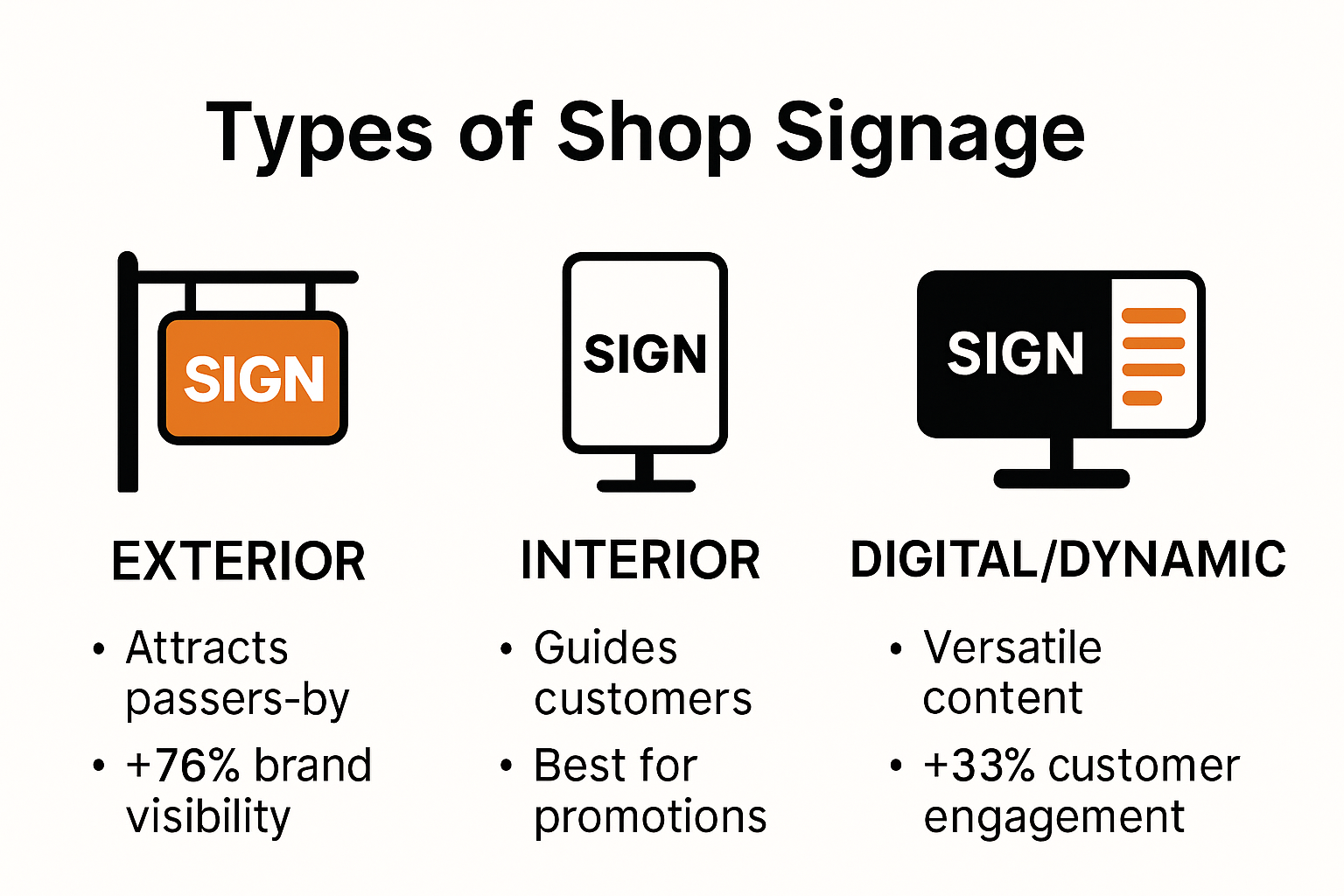
Shop signage represents a critical communication tool for businesses seeking to attract customers, convey brand identity, and drive commercial success. Understanding the primary types of shop signage enables business owners to make strategic visual communication choices that can significantly impact their brand perception and customer engagement.
To help you quickly compare the main types of shop signage discussed, the following table summarises their main features and benefits:
| Signage Type | Key Features | Main Benefits |
|---|---|---|
| Exterior Signage | Storefront, pylon, monument signs; highly visible; brand presentation | Boosts visibility (up to 50%), attracts foot traffic |
| Interior Signage | Wayfinding, directories, info displays; brand reinforcement | Enhances navigation, satisfaction (+40%); branding |
| Digital/Dynamic Signage | LED displays, interactive touchpoints; real-time updates, flexibility | Engages, adapts instantly, offers data insights |
Exterior Signage: Your Business’s First Visual Impression
Exterior signage serves as the critical first point of contact between a business and potential customers. Learn more about strategic shop sign design for maximum impact. These signs are strategically positioned to capture attention, communicate brand identity, and provide essential information about the business. According to research from the Sign Research Foundation, well-designed exterior signs can increase brand visibility by up to 50% and significantly influence customer perceptions.
Key elements of effective exterior signage include storefront signs, pylon signs, and monument signs. Each type offers unique advantages in terms of visibility and aesthetic appeal. Storefront signs typically feature the business name, logo, and core messaging, while pylon signs are excellent for businesses located in complex commercial areas, providing clear directional guidance from a distance.
Interior Signage: Enhancing Customer Navigation and Experience

Interior signage plays a crucial role in guiding customers through physical spaces, reinforcing brand identity, and creating a cohesive customer experience. According to a study by Cornell University’s hospitality research team, well-designed interior signage can improve customer satisfaction and reduce navigation confusion by up to 40%.
This category encompasses wayfinding markers, reception area signs, directories, and informational displays. These signs serve multiple purposes: helping customers navigate complex spaces, communicating important information, and maintaining a consistent brand aesthetic. From simple directional signs to complex digital displays, interior signage transforms a mere physical space into an intuitive, branded environment.
Digital and Dynamic Signage: The Future of Visual Communication
Digital signage represents the cutting edge of business visual communication. Gartner Research predicts that digital signage will become an essential marketing tool for businesses across various sectors. These technology-driven signs offer unprecedented flexibility, allowing real-time content updates, interactive experiences, and dynamic visual presentations.
LED displays, digital screens, and interactive touchpoints enable businesses to create engaging, responsive visual communications. Unlike traditional static signs, digital signage can showcase multiple messages, promote time-sensitive offers, and adapt instantly to changing business needs. This dynamic approach not only captures attention more effectively but also provides valuable data insights about customer interactions and engagement.
Choosing the right type of shop signage requires careful consideration of business objectives, target audience, and brand identity. Each signage type offers unique advantages, and the most successful businesses integrate multiple approaches to create a comprehensive visual communication strategy that resonates with their customers and stands out in competitive markets.
Choosing the Right Signage for Your Business
Selecting the optimal signage for a business is a strategic decision that extends far beyond mere visual aesthetics. It represents a critical communication tool that directly impacts brand perception, customer attraction, and overall commercial success. Explore expert insights on commercial signage selection to make an informed decision.
Understanding Your Business Identity and Target Audience
The foundation of effective signage selection lies in a deep understanding of your business identity and target demographic. According to Harvard Business Review’s marketing research, businesses that align their signage with their brand personality experience up to 35% higher customer engagement rates. This means carefully considering factors such as colour psychology, typography, and visual design that resonate with your specific market segment.
For retail businesses, the signage must communicate brand values instantaneously. A luxury boutique might opt for elegant, minimalist signage with metallic accents, while a creative agency could choose bold, dynamic designs that showcase innovation. The key is creating a visual language that speaks directly to your ideal customer, making them feel immediately connected to your brand.
Practical Considerations and Technical Specifications
Beyond aesthetic considerations, selecting the right signage involves numerous technical and practical elements. Research from the International Sign Association highlights that successful signage integrates multiple functional requirements. This includes assessing location visibility, compliance with local regulations, durability against environmental conditions, and potential maintenance costs.
Consider factors such as illumination requirements, material sustainability, and installation complexities. LED technologies offer energy efficiency and longer lifespans, while materials like aluminium provide weather resistance and modern aesthetics. Businesses must also evaluate the sign’s visibility during different times of day and from various viewing angles, ensuring maximum impact and information clarity.
Technology and Future-Proofing Your Signage Strategy
Modern signage strategies increasingly incorporate technological innovations that provide greater flexibility and interactivity. Gartner’s technology research predicts that digital and smart signage solutions will dominate business communication strategies by 2026. These advanced systems allow real-time content updates, interactive customer experiences, and data-driven insights into customer engagement.
Digital signage platforms enable businesses to adapt their messaging instantly, track customer interactions, and create more personalized communication experiences. QR code integration, touch-screen capabilities, and AI-driven content recommendations represent the cutting edge of signage technology. For businesses looking to stay competitive, investing in adaptable, technology-enabled signage solutions is no longer optional but essential.
Ultimately, choosing the right signage is a nuanced process that requires balancing aesthetic appeal, brand identity, practical functionality, and technological innovation. Businesses that approach signage as a strategic communication tool rather than a mere decorative element will create more impactful, memorable brand experiences that drive customer engagement and commercial success.
The following table summarises practical and technical factors to consider when choosing signage, as outlined in the article:
| Consideration | Why It’s Important | Example/Note |
|---|---|---|
| Location Visibility | Maximises exposure and effectiveness | Storefront facing busy street |
| Compliance/Regulations | Ensures legal installation and use | Meets council signage codes |
| Durability/Weather Resistance | Withstands environmental conditions | Aluminium for outdoor use |
| Maintenance Requirements | Influences ongoing costs and sign longevity | LED signs need less frequent bulb changes |
| Illumination Needs | Impacts visibility at different times | LED illumination for 24/7 visibility |
| Material Sustainability | Appeals to eco-conscious consumers, lowers impact | Recycled wood or composites |
| Installation Complexity | Affects project cost and disruption | Lightweight signs easier to install |
Creative Shop Signage Ideas for London Companies
In the competitive landscape of London’s commercial environment, innovative signage has become a critical differentiator for businesses seeking to capture attention and communicate their unique brand identity. Explore cutting-edge signage design strategies that can transform your storefront’s visual appeal.
Embracing Minimalist and Bold Design Aesthetics
Contemporary signage design in London is gravitating towards minimalist yet impactful visual communication. According to Design Week’s 2025 Trend Report, businesses are increasingly adopting clean typography, monochromatic colour schemes, and negative space to create memorable visual experiences. This approach not only enhances readability but also communicates a sense of sophistication and confidence.
The key to successful minimalist signage lies in strategic simplification. Designers are focusing on essential brand elements, using typography as a primary design component. Sans-serif fonts, geometric shapes, and limited colour palettes allow businesses to convey complex brand narratives through seemingly simple visual compositions. For instance, a tech startup might use a sleek, lowercase logotype in muted greys, while an artisan bakery could opt for hand-drawn, organic letterforms in warm, earthy tones.
Sustainable and Technology-Integrated Signage Solutions
London companies are at the forefront of integrating sustainability and technological innovation into their signage strategies. Research from the UK Green Business Council indicates that businesses implementing eco-friendly signage solutions can improve brand perception and attract environmentally conscious consumers.
Innovative approaches include using recycled materials like reclaimed wood, aluminium, and biodegradable composites for sign construction. LED technologies with low energy consumption are replacing traditional illumination methods, reducing carbon footprints while providing superior visibility. Interactive digital displays with touch-screen capabilities and QR code integrations are transforming static signage into dynamic communication platforms. These technological enhancements allow businesses to update content in real-time, track customer interactions, and create more personalized engagement experiences.
Contextual and Location-Specific Design Strategies
Successful signage in London requires a nuanced understanding of local architectural aesthetics and neighbourhood characteristics. The London Design Festival’s Urban Signage Report emphasizes the importance of creating signs that complement their surrounding environment while maintaining a distinctive brand identity.
This approach might involve incorporating historical architectural elements for businesses in heritage districts, using materials and design languages that resonate with local architectural styles. A boutique in Shoreditch might employ industrial-style metalwork and exposed typography, while a shop in Notting Hill could utilize delicate, ornate lettering that echoes the area’s Victorian heritage. The goal is to create signage that feels both innovative and intrinsically connected to its immediate urban context.
Creative signage is more than a visual marker it is a strategic communication tool that encapsulates a brand’s essence, attracts potential customers, and creates memorable urban experiences. By blending technological innovation, sustainable practices, and thoughtful design, London companies can transform their signage from mere functional necessity to powerful brand storytelling platforms.
Frequently Asked Questions
What are the main types of shop signage?
The main types of shop signage include exterior signage, interior signage, and digital/dynamic signage. Each type serves a unique purpose: exterior signage attracts customers, interior signage enhances navigation and the customer experience, and digital signage offers dynamic communication.
How can exterior signage boost my business?
Well-designed exterior signage can increase brand visibility by up to 50%, making it crucial for attracting potential customers and enhancing brand perception. It serves as the first visual impression and can significantly influence customers’ decisions to enter your shop.
What role does interior signage play in a retail environment?
Interior signage is vital for guiding customers through your space, reducing navigation confusion by up to 40%, and reinforcing your brand identity. It includes wayfinding markers, directories, and informational displays, enhancing the overall customer experience.
How can I choose the right signage for my business?
Choosing the right signage involves understanding your business identity and target audience, considering practical elements like location visibility and durability, and incorporating technology for a modern approach. Aligning your signage strategy with your brand personality is essential for maximizing customer engagement.
Transform Your 2025 Shopfront Into a Customer Magnet
Are you facing the challenge of standing out in a saturated market or struggling with signage that fails to communicate your unique brand identity? The article you’ve just read highlights how modern business success in 2025 depends on more than just having a sign above the door. You need exterior signage that makes a powerful first impression, interior signs that effortlessly guide and reassure customers, and digital solutions that adapt to your changing needs. Outdated or poorly designed signage can cost you valuable foot traffic and leave customers unsure about your offering.

At PromoSigns, we specialise in creating shop signage that goes beyond the basics. Our team designs, produces and installs bespoke signs for businesses across London, Essex and Kent. Whether you want illuminated shop signs, eye-catching exterior branding, or dynamic digital displays, we help you put your best face forward. Discover how professional signage can make your shop the first choice in your area by visiting our shop signage solutions. Take action now to secure your competitive edge for 2025.
Recommended
- What Makes A Great Shop Sign – PromoSigns.co.uk
- Types of Shop Signs for London Businesses: The 2025 Guide – PromoSigns.co.uk
- 9 Key Types of Retail Signage That Can Transform Your Store
- Pop Up Shop Sign Strategies for London Businesses 2025 – PromoSigns.co.uk
- Retail Sign Design Tips 2025: Essential Guide for London Businesses – PromoSigns.co.uk
- The Modern Age Visual Displays For Branding – PromoSigns.co.uk
