
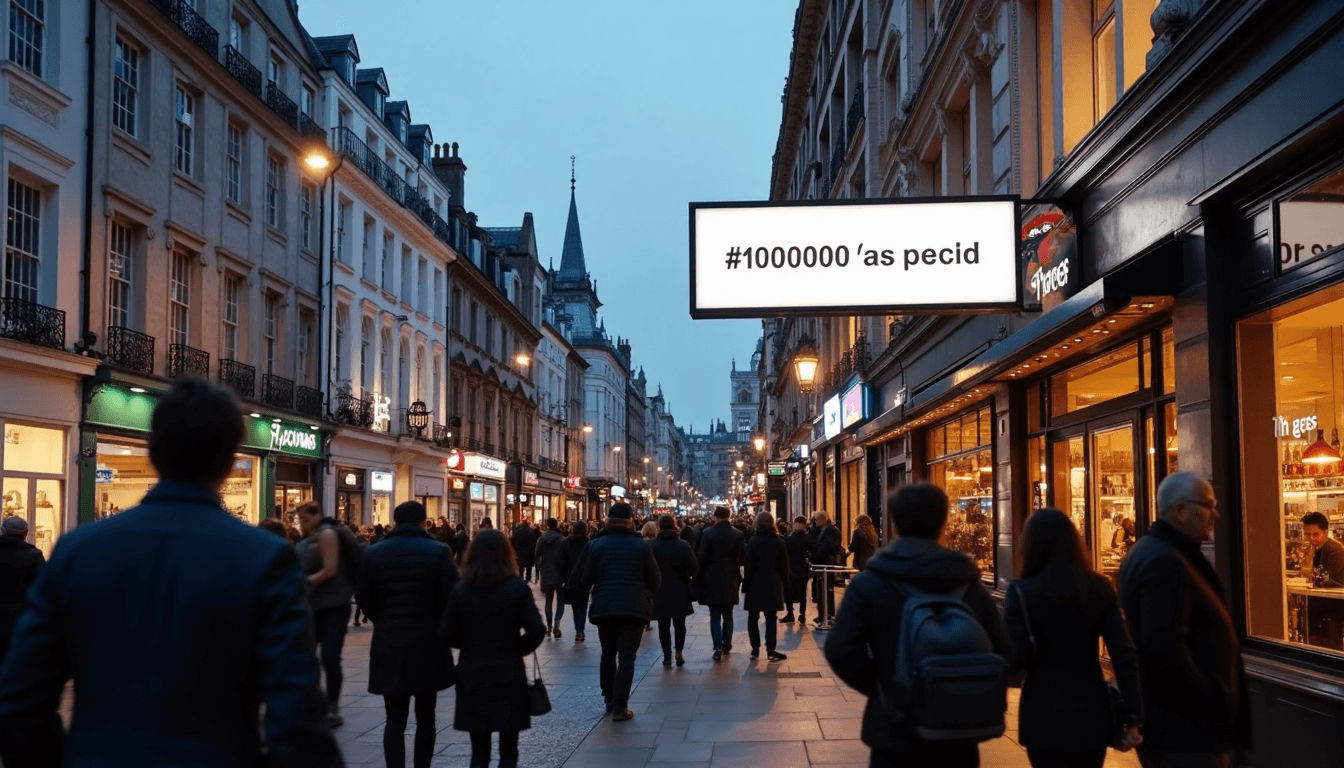
Projecting signs are rapidly changing the way London businesses get noticed on busy high streets. Surprising as it sounds, positive contrast signs with light text on dark backgrounds can be up to 37 percent more legible than negative contrast versions. Most people think that just any bold sign will do the trick. The truth is, the real secret to street visibility lies in the design details—tiny tweaks that decide whether shoppers spot your business or stroll right past.
Table of Contents
Table of Contents
- How Projecting Signs Boost Street Visibility
- Driving Customer Engagement With Projecting Signs
- Customisation Options For Different Business Types
- Practical Considerations: Installation And Maintenance
Quick Summary
| Takeaway | Explanation |
|---|---|
| Projecting signs enhance visibility | Perpendicular signage offers significant visibility advantages in urban environments, making it easier for pedestrians to notice a business from multiple angles. |
| Emotional connections drive engagement | Well-designed projecting signs can evoke curiosity and interest, acting as brand ambassadors that create immediate emotional connections with potential customers. |
| Tailored designs are essential | Different industries require custom approaches to projecting signs that reflect their unique branding and operational needs, using design elements that appeal to target audiences. |
| Compliance and maintenance matter | Adhering to local regulations and implementing a proactive maintenance strategy are crucial for the long-term effectiveness and safety of projecting signs. |
| Professional installation is key | Proper installation considers multiple technical factors, ensuring that projecting signs are securely mounted and function effectively over time. |
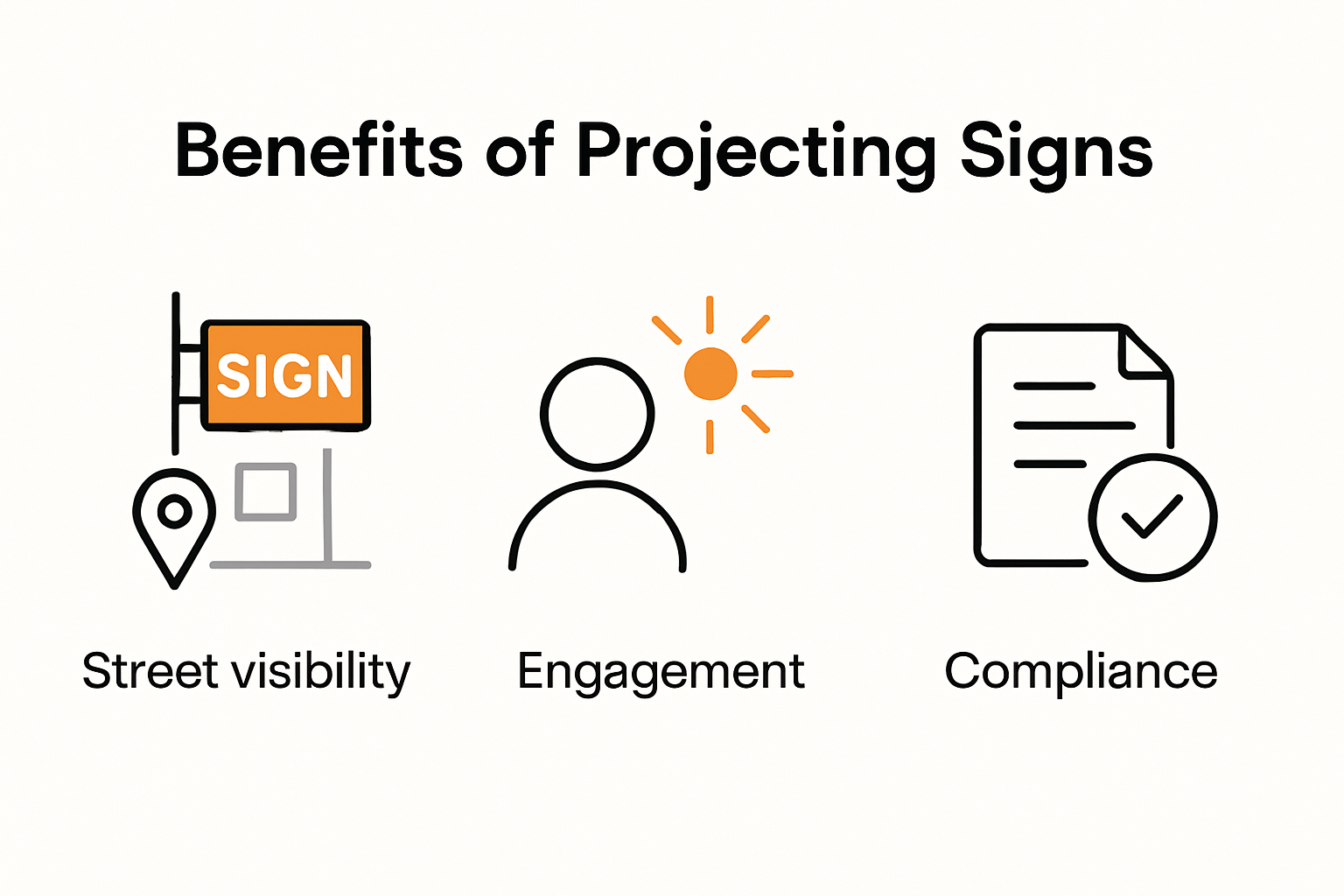
How Projecting Signs Boost Street Visibility
In the competitive urban business environment, street visibility can make or break a company’s success. Projecting signs offer a strategic solution for businesses seeking to capture attention and draw potential customers. Learn more about projecting sign fundamentals to understand their transformative potential.
Visual Impact and Positioning Advantages
Perpendicular signs create a remarkable visibility advantage compared to traditional flat signage. Research from architectural visibility studies demonstrates that these signs are significantly more detectable from multiple angles. By extending outward from a building’s facade, projecting signs break the visual monotony of street landscapes, instantly drawing pedestrian attention.

The strategic positioning allows businesses to communicate their brand presence even when storefronts are crowded or obstructed. Pedestrians approaching from different directions can easily spot a well-designed projecting sign, creating multiple opportunities for visual engagement. This omnidirectional visibility is particularly crucial in dense urban environments like London, where competition for visual real estate is intense.
Design Considerations for Maximum Visibility
Not all projecting signs are created equal. Visibility research indicates that sign design plays a critical role in effective street communication. Symbol-based projections, for instance, can be detected at lower contrast levels compared to text-based designs. This means businesses must carefully consider graphic elements, colour contrast, and overall visual composition.
Optimal projecting signs incorporate high-contrast colour schemes that stand out against architectural backgrounds. Legibility studies reveal that positive contrast signs – featuring light text on dark backgrounds – significantly outperform negative contrast alternatives. This principle ensures that even at a distance, the sign’s message remains clear and comprehensible.
Businesses investing in projecting signs are not just purchasing a marketing tool but creating a three-dimensional brand statement. These signs transform static architectural surfaces into dynamic communication platforms, extending brand visibility beyond traditional marketing boundaries. By understanding and implementing strategic design principles, companies can leverage projecting signs as powerful street-level marketing assets that capture attention, communicate identity, and ultimately drive customer engagement.
To clarify the differences and benefits, the table below compares positive and negative contrast sign designs as described in legibility studies:
| Contrast Type | Description | Legibility Performance |
|---|---|---|
| Positive Contrast | Light text on dark background | Up to 37% more legible |
| Negative Contrast | Dark text on light background | Less legible |
| Symbol-Based Projection | Use of symbols/graphics | Detected at lower contrast |
| Text-Based Projection | Use of words/letters | Requires higher contrast |
Driving Customer Engagement with Projecting Signs
In the contemporary business environment, customer engagement transcends traditional marketing approaches. Projecting signs emerge as powerful tools that transform passive visual spaces into interactive brand experiences. Explore our comprehensive guide to projecting sign strategies to unlock their full engagement potential.
Creating Emotional Connections Through Visual Design
Research on servicescape design demonstrates that physical environmental elements dramatically influence customer perceptions and behaviors. Projecting signs serve as more than mere informational markers they are sophisticated communication platforms that establish immediate emotional connections with potential customers. By strategically crafting visual narratives through sign design, businesses can evoke curiosity, provoke interest, and create memorable brand interactions.
The psychological impact of visual stimuli cannot be understated. A well-designed projecting sign acts as a silent ambassador, communicating brand personality, values, and unique identity within seconds of visual contact. Colour psychology, typography, and graphic elements work harmoniously to trigger specific emotional responses that can transform casual observers into engaged potential customers.
Interactive Visual Communication Strategies
Visual content research highlights the critical role of advertising appearance in generating positive customer responses. Projecting signs represent an innovative approach to interactive visual communication, offering businesses unprecedented opportunities to stand out in crowded urban environments.
Effective projecting signs go beyond static presentation. They incorporate dynamic design elements that invite interaction and spark imagination. Consider innovative approaches such as modular designs that can be periodically updated, illuminated elements that change appearance throughout the day, or signs that incorporate local cultural references. These strategies transform projecting signs from simple informational tools into engaging brand experiences that resonate with target audiences.
Businesses investing in sophisticated projecting sign design are essentially creating three-dimensional marketing platforms. These signs do more than announce a business they tell a story, create an emotional connection, and invite potential customers to become part of a broader brand narrative. By understanding the nuanced power of visual communication, companies can leverage projecting signs as strategic assets that drive customer engagement, foster brand loyalty, and ultimately contribute to long-term business success.
Customisation Options for Different Business Types
Business signage is not a one-size-fits-all solution. Different industries and business types require unique approaches to projecting signs that reflect their brand identity, operational needs, and target audience. Discover tailored signage solutions for your business to unlock your brand’s visual potential.
Cultural and Contextual Design Considerations
Cross-cultural research on visual navigation reveals that sign design preferences vary dramatically across different cultural contexts. This insight is crucial for businesses operating in diverse urban environments like London, where cultural nuance can significantly impact visual communication effectiveness.
Restaurants and hospitality businesses might opt for warm, inviting colour schemes and organic shapes that suggest comfort and welcome. Conversely, tech startups may prefer sleek, minimalist designs with bold typography that communicates innovation and efficiency. The key is understanding how visual elements can be strategically manipulated to communicate a business’s unique value proposition.
Industry-Specific Signage Strategies
Research on business appearance demonstrates a direct correlation between sign quality and business performance. Different sectors require distinct customisation approaches:
- Retail Businesses: Dynamic, eye-catching signs that showcase product range and create visual excitement.
- Professional Services: Elegant, understated designs that communicate reliability and expertise.
- Creative Industries: Experimental designs that demonstrate innovation and artistic sensibility.
The following table summarises how different industries approach projecting sign design and their key focus elements:
| Industry | Design Approach | Key Elements |
|---|---|---|
| Retail | Dynamic, eye-catching | Product range, visual excitement |
| Professional Services | Elegant, understated | Reliability, expertise |
| Creative Industries | Experimental, innovative | Artistic sensibility, innovation |
| Hospitality | Warm, inviting | Comfort, welcoming atmosphere |
| Tech Startups | Sleek, minimalist | Bold typography, efficiency |
Technical Considerations for Effective Customisation
Design principle research emphasizes the critical role of contrast and readability in sign design. Customisation is not just about aesthetic preferences but also about creating functional visual communication tools.
Technical customisation options include material selection, illumination techniques, three-dimensional elements, and interactive components. A legal firm might choose bronze lettering on a matte background to convey gravitas, while a modern cafe could incorporate dynamic LED elements that change throughout the day.
Successful projecting sign customisation requires a holistic approach that balances brand identity, functional communication, and visual appeal. By understanding the unique requirements of different business types and leveraging sophisticated design principles, companies can create projecting signs that are not just markers, but powerful brand ambassadors that communicate their essence at a glance.
Practical Considerations: Installation and Maintenance
Successful projecting sign implementation extends far beyond design creativity. Professional installation and strategic maintenance are critical components that determine the long-term effectiveness and safety of business signage. Learn about our comprehensive installation services to ensure optimal sign performance.
Legal and Safety Compliance
Professional signage guidelines emphasize the critical importance of adhering to local regulations and building codes during sign installation. Businesses must navigate complex legal requirements that vary depending on location, building type, and sign characteristics. Failure to comply can result in significant financial penalties and potential forced removal of signage.
The Health & Safety at Work Act imposes strict requirements on businesses regarding external fixtures. Projecting signs must be securely mounted, regularly inspected, and maintained to prevent potential hazards. This means understanding structural load-bearing capacities, wind resistance, and material durability specific to urban environments.
Maintenance Strategies for Long-Term Performance
Signage maintenance research reveals that proactive maintenance strategies can significantly extend sign lifespan and preserve brand perception. A comprehensive maintenance plan should include:
- Regular Visual Inspections: Quarterly assessments of structural integrity and aesthetic condition
- Cleaning Protocols: Specialized cleaning techniques for different sign materials
- Damage Prevention: Timely repairs of minor wear to prevent escalation
Below is a table outlining essential maintenance activities for projecting signs and their recommended frequency:
| Maintenance Activity | Description | Recommended Frequency |
|---|---|---|
| Visual Inspection | Assess structure and appearance | Quarterly |
| Cleaning | Use appropriate methods for sign materials | As needed, at least biannually |
| Repair Minor Damage | Fix chips, cracks, or loose fittings | Promptly, as issues arise |
| Electrical Check (if lit) | Test and maintain lighting components | Twice per year |
| Secure Mounting Check | Ensure brackets and fasteners are safe | Quarterly |
Technical Installation Considerations
Professional installation involves multiple technical considerations beyond simple mounting. Factors such as building facade composition, local weather patterns, and electrical requirements play crucial roles in successful sign implementation. Professionals must assess wind load, potential vibration, and thermal expansion to ensure sign stability.
Electrical components for illuminated signs require specialized knowledge. This includes understanding voltage requirements, weatherproofing techniques, and energy efficiency considerations. Proper electrical installation not only ensures safety but also contributes to the sign’s long-term performance and operational cost-effectiveness.
Ultimately, projecting signs represent a significant investment in a business’s visual identity. By prioritizing professional installation and implementing rigorous maintenance protocols, companies can transform these signs from mere marketing tools into enduring brand assets that communicate professionalism, reliability, and attention to detail. The initial investment in quality installation and ongoing maintenance pays dividends through enhanced brand perception and extended sign functionality.
Frequently Asked Questions
What are the benefits of using projecting signs for businesses in London?
Projecting signs enhance street visibility by allowing businesses to be noticed from multiple angles, making them ideal for crowded urban environments. They also create emotional connections with customers through engaging visual design.
How can I ensure my projecting sign is compliant with local regulations?
It is essential to consult local authorities and adhere to building codes and safety regulations during the installation of projecting signs. Professional signage companies can assist with compliance and legal requirements.
What design elements should I consider for an effective projecting sign?
To maximise impact, consider using high-contrast colour schemes, clear typography, and eye-catching graphics. Positive contrast—light text on a dark background—improves legibility significantly.
How often should I maintain my projecting sign?
Regular maintenance is crucial for the longevity of your sign. Schedule visual inspections every three months, along with cleaning and prompt repairs as needed to ensure optimal performance and appearance.
Take Your London Business to the Next Level with Expert Projecting Signs
Have you noticed that even stunning shopfronts can get lost in London’s crowded streets? The article highlights just how crucial projecting signs and perpendicular visibility are for brands facing fierce competition for attention. Whether you struggle with low footfall or worry your business is simply not being seen, our custom projecting signs at PromoSigns are designed to help.

Do not let your message fade into the background. We specialise in bold, high-contrast signage that turns passing glances into new customers. Book a free consultation today through PromoSigns and discover how professional design, precision installation and proactive maintenance solutions can give your business the visibility boost it needs right now. Your next customer could walk by unless you act today.
Recommended Articles
- What is a Projecting Sign? Guide for UK Businesses 2025 – PromoSigns.co.uk
- Illuminated Shop Sign Benefits for London Businesses 2025 – PromoSigns.co.uk
- Illuminated Signs Explained: A 2025 Guide for London Businesses – PromoSigns.co.uk
- Office Signage Ideas for London Businesses and Events: 2025 Trends – PromoSigns.co.uk
- What Is Illuminated Signage? 2025 Guide for London Businesses – PromoSigns.co.uk
- Signage and Brand Recognition: Boost Your London Business in 2025 – PromoSigns.co.uk
