
Large format printing is set to shape the way London businesses stand out in 2025. You might think banners and billboards have reached their peak, but the numbers tell a different story. The market is projected to grow at 5% every year until 2030 driven by fresh demand for bold and sustainable visual solutions. Turns out it is not just new inks and fancy machines pushing boundaries. The real surprise lies in how automation and AI are helping businesses meet speed and quality demands faster than ever.
Table of Contents
Table of Contents
- What Is Large Format Printing In 2025?
- Key Uses For London Businesses And Events
- Choosing The Right Materials And Finishes
- How To Prepare Files For Large Format Printing
Quick Summary
| Takeaway | Explanation |
|---|---|
| Large format printing grows rapidly. | The market is projected to expand at a rate of 5% annually until 2030, driven by demand for versatile visual solutions. |
| Use high-quality materials for prints. | The choice of substrates impacts durability, visual appeal, and environmental sustainability, making material selection vital for effective communications. |
| Prepare files at adequate resolutions. | Print files should generally have a resolution of 150-600 dpi for optimal clarity, significantly affecting the final output quality. |
| Understand colour modes crucial for printing. | Correct colour management is essential—use CMYK profiles for printing to ensure colour accuracy and consistency in output. |
| Leverage technological innovations for efficiency. | Automation and AI in large format printing help streamline processes, reduce errors, and meet faster turnaround demands efficiently. |
What Is Large Format Printing in 2025?
Large format printing represents a sophisticated printing technology that enables businesses to produce high-quality visual communications on significantly larger media formats compared to traditional printing methods. As we approach 2025, this technology has evolved into a critical marketing and communication tool for businesses seeking impactful visual solutions.
Defining Large Format Printing in the Modern Era
Large format printing refers to digital printing techniques capable of producing oversized graphics and documents typically ranging from 18 to 100 inches in width. Learn more about advanced printing technologies reveals that these printers utilise advanced inkjet or toner-based technologies to create crisp, detailed images on various substrates including vinyl, canvas, fabric, and specialised papers.
According to global market research, the large format printing market is projected to grow at a compound annual growth rate of 5.0% through 2030. This growth is driven by technological advancements and shifting consumer preferences towards more versatile and high-quality visual communication solutions.
Technological Innovations Transforming Large Format Printing
The landscape of large format printing in 2025 is characterised by several key technological innovations. Automation and artificial intelligence are playing increasingly significant roles in streamlining production processes. Industry analysis indicates that 59% of print businesses anticipate increased customer demand for faster turnarounds, with workflow automation software minimising errors and reducing production time.
Moreover, environmental considerations are becoming paramount. Over 85% of customers now prioritise environmentally responsible solutions, driving the adoption of water-based inks, recyclable substrates, and energy-efficient printing processes. This shift reflects a broader commitment to sustainable business practices and reduced environmental impact.
The versatility of large format printing makes it an essential tool for various business applications. From eye-catching marketing materials and trade show graphics to architectural plans, vehicle wraps, and interior design elements, these printing technologies offer unprecedented flexibility. Businesses can now create high-impact visual communications that were previously impossible or prohibitively expensive.
As we move through 2025, large format printing continues to break boundaries. It represents more than just a printing technique it is a powerful medium for visual storytelling, brand communication, and creative expression. The convergence of technological innovation, environmental consciousness, and creative potential positions large format printing as a critical resource for forward-thinking businesses seeking to make a lasting visual impact.
Key Uses for London Businesses and Events
Large format printing has become a versatile and powerful tool for London businesses and event organisers, offering dynamic solutions across multiple sectors. As visual communication continues to evolve, these printing technologies provide organisations with innovative ways to capture attention, convey messages, and create memorable brand experiences.
Marketing and Promotional Materials
For London businesses, large format printing serves as a critical marketing mechanism. Explore advanced printing solutions reveals that companies are increasingly using oversized graphics to stand out in competitive markets. Retail businesses utilise large format prints for window displays, creating immersive visual narratives that attract potential customers. Restaurants and cafes deploy large-scale menu boards and wall graphics that transform interior spaces, while corporate offices use branded wall murals to communicate company culture and values.
According to research from ResearchGate, large displays significantly enhance audience engagement, making them crucial for public-facing businesses seeking to make immediate visual impact.
Event Signage and Exhibition Graphics
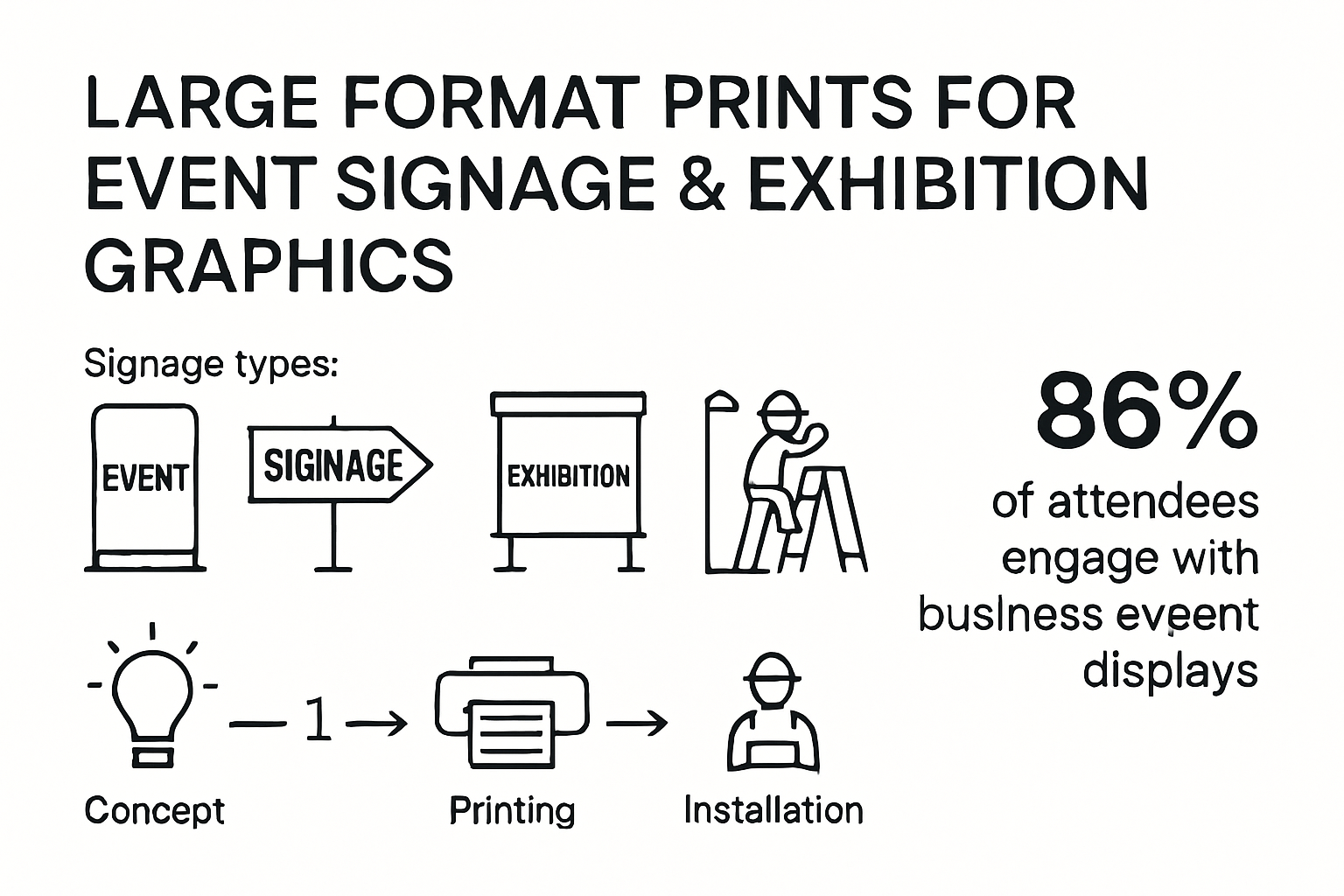
Event organisers in London have discovered the transformative power of large format printing. Trade shows, conferences, and exhibitions rely heavily on high-quality, eye-catching graphics to draw attendees and communicate complex information quickly. Architectural firms, construction companies, and design studios use large format prints to showcase project renderings, presenting intricate details with stunning clarity.
Event signage strategies demonstrate how businesses can leverage these printing technologies to create immersive environments. From directional signage to massive backdrop displays, large format printing enables event organisers to craft comprehensive visual experiences that guide, inform, and inspire attendees.
Specialised Business Applications
Beyond traditional marketing, large format printing offers innovative solutions across diverse industries. Interior designers use high-resolution wall coverings to transform spaces, while real estate agencies create impressive property marketing materials. Educational institutions produce interactive learning displays, and museums craft engaging exhibition graphics.
Technical industries like architecture and engineering benefit from large format printing’s ability to produce detailed blueprints, site plans, and technical diagrams. Precision and scale are critical in these fields, and modern large format printers deliver exceptional quality that meets professional standards.
As London continues to be a hub of creativity and innovation, large format printing represents more than just a communication tool. It is a medium for storytelling, brand expression, and visual communication that transcends traditional boundaries. Businesses that embrace these technologies position themselves at the forefront of visual marketing and communication strategies.
Choosing the Right Materials and Finishes
Selecting the appropriate materials and finishes is crucial for successful large format printing, directly impacting the visual quality, durability, and overall effectiveness of printed communications. In 2025, businesses have an unprecedented range of options that balance aesthetic appeal, environmental considerations, and practical performance.
Material Selection Strategies
The choice of printing substrate depends on multiple factors including intended use, environmental conditions, and desired visual impact. Vinyl remains a popular choice for outdoor signage due to its weather resistance and versatility. Explore professional printing material options reveals that businesses are increasingly considering sustainable alternatives like recycled polyester and biodegradable materials.
According to material science research, modern printing substrates now offer enhanced durability and performance characteristics. Fabric-based materials have gained significant traction, providing lightweight, wrinkle-resistant options for indoor displays and exhibition graphics. Canvas, polyester blends, and tension fabrics offer crisp image reproduction with minimal environmental footprint.
Below is a summary table of popular large format printing materials and their primary uses and benefits to help businesses assess which substrates best fit their needs.
| Material | Typical Application | Key Benefits |
|---|---|---|
| Vinyl | Outdoor signage | Weather-resistant, versatile |
| Fabric/Tension | Indoor displays, exhibitions | Lightweight, wrinkle-resistant, eco-friendly |
| Canvas | Art prints, wall murals | High image quality, professional look |
| Recycled Polyester | Eco-conscious signage | Sustainable, durable |
| Specialised Paper | Posters, backdrops | Crisp detail, cost-effective |
| Biodegradable Substrates | Short-term signage | Reduced environmental impact |
Finish and Coating Technologies
Finishes play a critical role in protecting and enhancing printed materials. Businesses can choose from a range of coating technologies that provide specific benefits. Matte finishes reduce glare and work exceptionally well in brightly lit environments, while glossy finishes offer vibrant color saturation and a premium appearance.
UV-resistant coatings have become essential for outdoor applications, protecting prints from sun damage and color degradation. Water-resistant and scratch-resistant finishes extend the lifespan of printed materials, making them suitable for high-traffic areas and challenging environmental conditions. Some advanced coatings now incorporate antimicrobial properties, an emerging trend particularly relevant for healthcare and public space signage.
Environmental and Performance Considerations
Modern large format printing increasingly prioritises sustainability without compromising quality. Eco-friendly water-based inks, recyclable substrates, and energy-efficient printing processes are becoming standard. Businesses are recognising that material choices impact not just visual communication but also their environmental credentials.
Performance metrics such as fade resistance, tear strength, and adaptability to different mounting surfaces are crucial considerations. Professional print providers now offer comprehensive material consultations, helping businesses select substrates that align with specific project requirements. From flame-retardant materials for event spaces to UV-stable prints for outdoor advertising, the range of specialised materials continues to expand.
Choosing the right materials and finishes is a nuanced process that requires understanding project goals, environmental conditions, and desired aesthetic outcomes. As printing technologies advance, businesses have more opportunities than ever to create impactful, durable, and sustainable visual communications that effectively represent their brand and message.
How to Prepare Files for Large Format Printing
Preparing files for large format printing requires precision, technical understanding, and attention to detail. In 2025, businesses must navigate increasingly sophisticated digital workflows to ensure optimal print quality and professional results.
File Resolution and Image Quality
Image resolution is paramount for large format printing. Discover professional file preparation techniques highlights that professional print files should be prepared at a minimum resolution of 150 dots per inch (dpi) for optimal clarity. For most large format projects, designers recommend a resolution between 300-600 dpi, depending on the viewing distance and intended application.
According to digital printing standards, vector graphics are preferable for large format printing as they can be scaled infinitely without losing quality. Raster images, while acceptable, require careful preparation to prevent pixelation and quality degradation when enlarged.
The following table summarises recommended file resolutions and image types based on the guidance and intended application mentioned in the article.
| File Type | Recommended Resolution (dpi) | Best For | Notes |
|---|---|---|---|
| Vector Graphics | N/A (scalable) | All print sizes | No quality loss when scaling |
| Raster Images | 150–300 (close view) | Posters, displays | Use higher dpi for closer viewing distances |
| Raster Images | 80–150 (distance view) | Billboards, banners | Lower dpi acceptable if viewed from afar |
| General Print | 300–600 | Quality graphics | Use upper range for maximum sharpness |
File Formats and Colour Management
Choosing the correct file format is crucial for successful large format printing. Professional print providers typically recommend using uncompressed file formats that preserve image integrity. Preferred formats include:
- TIFF: Lossless format ideal for high-quality photographic prints
- PDF/X: Industry standard for professional print production
- AI or EPS: Vector formats that maintain crisp edges and scalability
- PNG: Suitable for graphics with transparent backgrounds
Colour management represents another critical aspect of file preparation. Businesses must understand the difference between RGB and CMYK colour modes. While digital screens use RGB, professional printing requires CMYK colour profiles to ensure accurate colour reproduction. Colour calibration between design software and print equipment helps maintain consistent and predictable results.
Technical Considerations and Workflow Optimization
Modern large format printing workflows demand sophisticated file preparation strategies. Designers should consider bleed areas, crop marks, and safe zones when creating print-ready files. Typically, a 3-5mm bleed is recommended to prevent white edges and ensure full coverage during trimming.
Additionally, embedding or outlining fonts prevents potential formatting issues during print production. Professional designers recommend converting text to vector paths or providing original font files to print providers. Embedding high-resolution colour profiles and using professional design software like Adobe Creative Suite can significantly improve print outcomes.
As digital technologies evolve, artificial intelligence and automated preflight checking tools are becoming increasingly sophisticated. These technologies can instantly detect potential file issues, reducing errors and streamlining the print production process.
Successful large format printing in 2025 requires a meticulous approach to file preparation. By understanding technical requirements, maintaining high-quality source materials, and collaborating closely with professional print providers, businesses can transform digital designs into stunning visual communications that capture attention and convey messages effectively.
Frequently Asked Questions
What is large format printing?
Large format printing refers to digital printing techniques used to produce oversized graphics typically ranging from 18 to 100 inches in width. This technology is essential for creating high-impact visual communications for businesses.
What are the most common applications of large format printing for London businesses?
London businesses commonly use large format printing for marketing materials, event signage, exhibition graphics, and specialised applications such as architectural plans and vehicle wraps.
How should files be prepared for large format printing?
Files for large format printing should be prepared with a resolution of at least 150-600 dpi, depending on the viewing distance. Professional formats like TIFF and PDF/X are recommended, and colour management should utilise CMYK profiles for accuracy.
What are the key materials used in large format printing?
Common materials include vinyl for outdoor signage, fabric for indoor displays, canvas for art prints, and eco-friendly options like recycled polyester. The choice of material impacts durability, visual appeal, and environmental sustainability.
Ready to Make Your Brand Unmissable in 2025?
Struggling with the challenge of producing visually stunning and durable signage that truly sets your business apart? This guide has shown just how vital high-quality large format printing and the right materials are for standing out in busy London streets. If you find the technical details and environmental considerations overwhelming, you are not alone. Many business owners feel pressure to make every display count, but lack the expert support needed to turn creative ideas into eye-catching results.

You deserve signage that inspires attention and converts interest into real business. At PromoSigns, we offer end-to-end support for design, production and installation of custom shop signs and large format graphics across London, Essex and Kent. Discover how our large format printing solutions transform your brand presence. Contact our team today to secure a free consultation and see how quick, efficient, and sustainable your next project can be. Do not wait until your competitors catch up—act now to give your business the edge it deserves.
Recommended
- Large Format Printing Explained: Essential Guide for London Businesses 2025 – PromoSigns.co.uk
- Top Large Format Printing Uses for London Businesses 2025 – PromoSigns.co.uk
- Large Format vs Small Format Printing: London 2025 Guide – PromoSigns.co.uk
- What Is Vinyl Printing? 2025 Guide for London Businesses – PromoSigns.co.uk
