
Outdated shop signs can quietly erode your customer base, with worn signage reducing foot traffic by up to 25% according to retail visibility studies. Many UK retail and hospitality owners overlook this critical first impression, unaware that faded graphics, broken lighting, or outdated designs actively repel potential customers. This comprehensive guide walks you through the legal requirements, assessment processes, practical updating methods, and maintenance strategies needed to transform tired signage into a powerful visibility asset that drives engagement and sales.
| Point | Details |
|---|---|
| Consent and planning | Ensure you obtain Advertisement Consent for signs over 0.3 square metres or when illuminated, and check conservation area and listed building rules to avoid penalties. |
| Pre update assessment | Conduct a thorough assessment of the sign’s condition and local regulations to decide whether refurbishment, retrofit or full replacement is most cost effective. |
| Update options | Choose among LED retrofits, refurbishment or full replacement to improve visibility and engagement. |
| Ongoing maintenance | Regular maintenance extends the longevity and performance of updated shop signs. |
| Grant eligibility | Investigate potential grants or funding for signs on listed buildings or within conservation areas. |
Table of Contents
Understanding legal and planning requirements before updating your shop sign
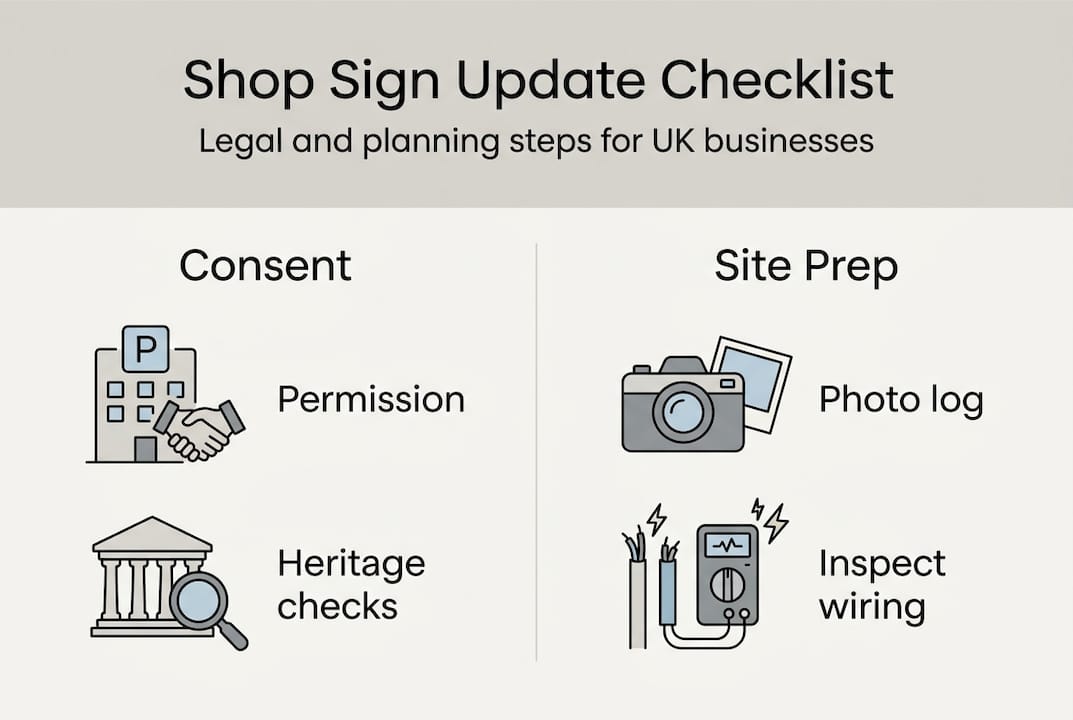
Navigating UK signage regulations prevents costly mistakes that could derail your update project. Advertisement Consent becomes mandatory for signs exceeding 0.3 square metres or any illuminated signage, with significantly stricter requirements in conservation areas and on listed buildings. Non-compliance carries serious consequences, including fines reaching £2,500 and enforcement notices requiring immediate removal.
Small non-illuminated fascia signs may qualify for deemed consent, bypassing formal applications if they meet specific criteria regarding size, projection, and location. However, this exemption disappears entirely in conservation areas, where even minor changes often require full planning permission. Listed buildings face the most stringent controls, with both Advertisement Consent and Listed Building Consent potentially required for any external alterations.
Local councils maintain varying interpretations of national regulations, making direct consultation essential before committing to design changes. Some authorities impose additional restrictions on colours, materials, or illumination levels to preserve local character. Working with professional signage companies London protects your investment and ensures your updated sign remains compliant long term.
“Proper planning permission research saved our restaurant from a £1,800 fine when we discovered our conservation area location required approval for LED lighting changes we initially assumed were exempt.”
Key regulatory checkpoints include:
- Verify your building’s listing status through the National Heritage List for England
- Confirm whether your location falls within a conservation area boundary
- Measure existing signage dimensions to determine consent requirements
- Review local council design guidelines for shopfront improvements
- Consider signage safety requirements for structural mounting and electrical installations
Building Control approval may additionally apply if structural modifications affect load-bearing elements or electrical work requires certification. The interaction between planning, building, and advertisement regulations creates complexity that professional signage companies navigate routinely, potentially saving weeks of application delays.
Preparing your old shop sign for updating: assessment and planning
Thorough assessment identifies whether refurbishment, retrofit, or replacement delivers the best return on your investment. Start by examining your existing sign’s structural condition, checking for rust on metal frames, rot in wooden components, and cracks in acrylic or polycarbonate faces. Clean the surface thoroughly to reveal the true state of graphics and identify areas where paint has faded beyond simple touch-up repair.
Older buildings present unique challenges, with weight restrictions limiting heavy modern signage systems and fixings potentially unable to support additional load from LED lighting modules. Listed properties face even tighter constraints, where preserving original architectural features takes precedence over contemporary branding desires. Document these limitations early to avoid designing solutions that planning officers will reject.
Financial support can significantly offset update costs, with grants available in certain UK locations for businesses improving shopfronts in town centres or on listed buildings. Eligibility criteria vary by council, typically favouring heritage-sensitive designs and businesses contributing to high street revitalisation. Research your local authority’s economic development programmes, as many maintain shopfront improvement schemes with application windows opening annually.
Your decision matrix should weigh these factors:
- Current sign condition: structural integrity versus cosmetic damage only
- Budget constraints: full replacement costs versus incremental improvements
- Energy efficiency goals: potential savings from LED conversion
- Planning restrictions: limitations imposed by building status or location
- Timeline urgency: lead times for custom manufacturing versus quick refurbishment
| Assessment factor | Refurbishment suitable | Replacement recommended |
|---|---|---|
| Structural condition | Minor surface damage, solid frame | Severe rust, rot, or structural failure |
| Graphics quality | Faded but intact lettering | Peeling, cracked, or missing elements |
| Lighting system | Functional fluorescent tubes | Failed neon or obsolete components |
| Energy efficiency | Acceptable running costs | High electricity consumption |
| Brand alignment | Logo still current | Complete rebrand needed |
Pro Tip: Photograph your existing sign from multiple angles and distances, including close-ups of damage areas. These images prove invaluable when consulting signage suppliers and support planning applications by demonstrating the current condition requiring improvement.
Understanding the different custom signs London options available helps you select the most appropriate solution for your specific location and customer base. Factor planning permission timelines into your project schedule, as applications can take eight weeks or longer in conservation areas, with Listed Building Consent adding further delays.

Turiu visą tekstą. Analizuoju:
External linkai šalintini:
planningportal.co.uk❌erewash.gov.uk❌ (labai specifinis vietinės valdžios puslapis)firstliteled.co.uk❌ (konkurento puslapis!)blinksigns.com❌ (konkurento puslapis!)
5 nauji internal linkai pagal straipsnio temą (shop signs, LED, refurbishment, retail):
- shop signs London →
https://promosigns.co.uk/shop-signs-london/ - business signs London →
https://promosigns.co.uk/business-signs-london/ - signage companies London →
https://promosigns.co.uk/signage-companies-london/ - foamex signs printing London →
https://promosigns.co.uk/foamex-signs-printing-london/ - custom signs London →
https://promosigns.co.uk/custom-signs-london/
Štai visas pataisytas tekstas:
Outdated shop signs can quietly erode your customer base, with worn signage reducing foot traffic by up to 25% according to retail visibility studies. Many UK retail and hospitality owners overlook this critical first impression, unaware that faded graphics, broken lighting, or outdated designs actively repel potential customers. This comprehensive guide walks you through the legal requirements, assessment processes, practical updating methods, and maintenance strategies needed to transform tired signage into a powerful visibility asset that drives engagement and sales.
Key Takeaways
| Point | Details |
|---|---|
| Consent and planning | Ensure you obtain Advertisement Consent for signs over 0.3 square metres or when illuminated, and check conservation area and listed building rules to avoid penalties. |
| Pre update assessment | Conduct a thorough assessment of the sign’s condition and local regulations to decide whether refurbishment, retrofit or full replacement is most cost effective. |
| Update options | Choose among LED retrofits, refurbishment or full replacement to improve visibility and engagement. |
| Ongoing maintenance | Regular maintenance extends the longevity and performance of updated shop signs. |
| Grant eligibility | Investigate potential grants or funding for signs on listed buildings or within conservation areas. |
Understanding legal and planning requirements before updating your shop sign
Navigating UK signage regulations prevents costly mistakes that could derail your update project. Advertisement Consent becomes mandatory for signs exceeding 0.3 square metres or any illuminated signage, with significantly stricter requirements in conservation areas and on listed buildings. Non-compliance carries serious consequences, including fines reaching £2,500 and enforcement notices requiring immediate removal.
Small non-illuminated fascia signs may qualify for deemed consent, bypassing formal applications if they meet specific criteria regarding size, projection, and location. However, this exemption disappears entirely in conservation areas, where even minor changes often require full planning permission. Listed buildings face the most stringent controls, with both Advertisement Consent and Listed Building Consent potentially required for any external alterations.
Local councils maintain varying interpretations of national regulations, making direct consultation essential before committing to design changes. Some authorities impose additional restrictions on colours, materials, or illumination levels to preserve local character. Working with professional signage companies London protects your investment and ensures your updated sign remains compliant long term.
“Proper planning permission research saved our restaurant from a £1,800 fine when we discovered our conservation area location required approval for LED lighting changes we initially assumed were exempt.”
Key regulatory checkpoints include:
- Verify your building’s listing status through the National Heritage List for England
- Confirm whether your location falls within a conservation area boundary
- Measure existing signage dimensions to determine consent requirements
- Review local council design guidelines for shopfront improvements
- Consider signage safety requirements for structural mounting and electrical installations
Building Control approval may additionally apply if structural modifications affect load-bearing elements or electrical work requires certification. The interaction between planning, building, and advertisement regulations creates complexity that professional signage companies navigate routinely, potentially saving weeks of application delays.
Preparing your old shop sign for updating: assessment and planning
Thorough assessment identifies whether refurbishment, retrofit, or replacement delivers the best return on your investment. Start by examining your existing sign’s structural condition, checking for rust on metal frames, rot in wooden components, and cracks in acrylic or polycarbonate faces. Clean the surface thoroughly to reveal the true state of graphics and identify areas where paint has faded beyond simple touch-up repair.
Older buildings present unique challenges, with weight restrictions limiting heavy modern signage systems and fixings potentially unable to support additional load from LED lighting modules. Listed properties face even tighter constraints, where preserving original architectural features takes precedence over contemporary branding desires. Document these limitations early to avoid designing solutions that planning officers will reject.
Financial support can significantly offset update costs, with grants available in certain UK locations for businesses improving shopfronts in town centres or on listed buildings. Eligibility criteria vary by council, typically favouring heritage-sensitive designs and businesses contributing to high street revitalisation. Research your local authority’s economic development programmes, as many maintain shopfront improvement schemes with application windows opening annually.
Your decision matrix should weigh these factors:
- Current sign condition: structural integrity versus cosmetic damage only
- Budget constraints: full replacement costs versus incremental improvements
- Energy efficiency goals: potential savings from LED conversion
- Planning restrictions: limitations imposed by building status or location
- Timeline urgency: lead times for custom manufacturing versus quick refurbishment
| Assessment factor | Refurbishment suitable | Replacement recommended |
|---|---|---|
| Structural condition | Minor surface damage, solid frame | Severe rust, rot, or structural failure |
| Graphics quality | Faded but intact lettering | Peeling, cracked, or missing elements |
| Lighting system | Functional fluorescent tubes | Failed neon or obsolete components |
| Energy efficiency | Acceptable running costs | High electricity consumption |
| Brand alignment | Logo still current | Complete rebrand needed |
Pro Tip: Photograph your existing sign from multiple angles and distances, including close-ups of damage areas. These images prove invaluable when consulting signage suppliers and support planning applications by demonstrating the current condition requiring improvement.
Understanding the different custom signs London options available helps you select the most appropriate solution for your specific location and customer base. Factor planning permission timelines into your project schedule, as applications can take eight weeks or longer in conservation areas, with Listed Building Consent adding further delays.
Step-by-step guide to updating and refurbishing your old shop sign
Executing your shop sign update methodically ensures professional results that enhance visibility without compromising compliance. The following sequence optimises efficiency whilst minimising business disruption during the transformation process.
- Deep clean the existing sign using appropriate cleaning solutions for your sign material, removing years of accumulated grime, pollution residue, and biological growth. Pressure washing works well for robust materials but risks damaging delicate graphics or forcing water into sealed lighting compartments. Test cleaning products on inconspicuous areas first to avoid discolouration or surface damage.
- Inspect and tighten all mounting hardware, replacing corroded bolts, brackets, or fixings that compromise structural security. Check wall anchors for pull-out, particularly on older masonry where pointing may have deteriorated. This preventive maintenance avoids catastrophic failures that could cause injury or property damage.
- Remove damaged components systematically, documenting the disassembly process with photographs to guide reassembly. Salvage reusable elements like frames or backing boards if structurally sound. Dispose of hazardous materials like old neon tubes or fluorescent ballasts through licensed waste carriers to comply with environmental regulations.
- Apply surface repairs and repainting to refresh tired fascias, using exterior-grade paints formulated for your substrate material. Multiple thin coats deliver superior durability compared to single heavy applications. Allow proper curing time before reinstalling graphics or lighting components.
- Install LED retrofit kits to modernise illumination, with LED conversions offering 70-80% energy savings compared to fluorescent or neon predecessors whilst dramatically improving brightness and colour consistency. Retrofit modules fit existing sign cabinets, eliminating the expense of complete replacement whilst delivering contemporary performance.
- Apply new vinyl graphics or repaint lettering using high-contrast colour schemes that maximise daytime readability and evening illumination effectiveness. Consider how your design performs under different lighting conditions, as colours that appear vibrant in daylight may lose impact when backlit.
- Test illumination thoroughly before final installation, checking for even light distribution, hotspots, or dark zones that compromise legibility. Programme LED systems for optimal brightness levels that attract attention without causing light pollution complaints from neighbours.
- Conduct final safety checks ensuring all electrical connections meet current regulations, mounting hardware exceeds load requirements, and no sharp edges or protruding elements present injury risks.
Pro Tip: Schedule installation work during quieter trading periods to minimise customer disruption. Many signage companies offer out-of-hours fitting services, completing work overnight so your refreshed sign greets customers when you open.
| Assessment factor | Refurbishment suitable | Replacement recommended |
|---|---|---|
| Structural condition | Minor surface damage, solid frame | Severe rust, rot, or structural failure |
| Graphics quality | Faded but intact lettering | Peeling, cracked, or missing elements |
| Lighting system | Functional fluorescent tubes | Failed neon or obsolete components |
| Energy efficiency | Acceptable running costs | High electricity consumption |
| Brand alignment | Logo still current | Complete rebrand needed |
Our business signs London service covers all update methods from LED retrofits through to complete replacement, ensuring your signage delivers maximum impact whilst respecting architectural context and planning constraints.
| Update method | Cost range | Lifespan extension | Energy savings | Best for |
|---|---|---|---|---|
| Deep clean and repaint | £200-£600 | 2-3 years | None | Structurally sound signs with minor wear |
| LED retrofit | £800-£2,500 | 5-7 years | 70-80% | Functional cabinets with outdated lighting |
| Partial replacement | £1,500-£4,000 | 7-10 years | 70-80% | Mixed condition requiring selective renewal |
| Complete replacement | £3,000-£8,000+ | 10-15 years | 80%+ | Severe deterioration or total rebrand |
Maintaining your updated shop sign for longevity and compliance
Regular maintenance protects your signage investment and prevents the gradual deterioration that necessitated this update project. Establishing systematic inspection routines catches minor issues before they escalate into expensive repairs or compliance violations that attract enforcement attention.
Implement this maintenance schedule: monthly cleaning, quarterly fastener checks, and bi-monthly graphic inspections. Monthly cleaning removes atmospheric pollutants and biological growth that degrade materials and reduce illumination effectiveness. Quarterly fastener inspections identify loosening bolts or brackets before they compromise structural integrity. Bi-monthly graphic assessments detect early signs of fading, peeling, or damage requiring intervention.
DIY maintenance handles straightforward tasks like cleaning and visual inspections, but electrical repairs and structural modifications demand professional expertise. Attempting amateur electrical work on illuminated signs risks personal injury, fire hazards, and insurance invalidation. Similarly, structural repairs affecting mounting systems require engineering knowledge to maintain safety margins.
Maintenance documentation serves multiple purposes beyond operational management. Inspection records demonstrate due diligence if accidents occur, support insurance claims for damage, and provide evidence of ongoing compliance with planning conditions. Some local authorities require periodic condition reports for signs in sensitive locations, making systematic record keeping essential.
“Our maintenance log proved invaluable when a storm damaged our fascia sign. The insurance assessor accepted our claim immediately because we could demonstrate proper upkeep and provide dated photographs showing the sign’s pre-damage condition.”
Key maintenance activities include:
- Clean sign faces monthly using appropriate products for your material type
- Inspect LED modules quarterly for failed diodes or colour shifting
- Check electrical connections annually for corrosion or loose terminals
- Verify mounting security after severe weather events
- Update graphics promptly when fading becomes noticeable
- Monitor surrounding vegetation to prevent obstruction or moisture damage
Neglected maintenance accelerates deterioration, potentially triggering enforcement action if signs become unsafe or unsightly. Councils possess powers to serve maintenance notices requiring repairs within specified timeframes, with non-compliance leading to prosecution. Proactive care avoids these complications whilst preserving the visibility improvements your update achieved.
Foamex signs printing London are among the most durable and low-maintenance options available, offering excellent longevity when properly cared for. Following comprehensive shop sign maintenance tips protects both traditional and modern signage systems from premature failure.
Explore professional signage solutions to revitalise your shop front
Transforming tired shop signs London into powerful visibility assets requires expertise spanning design, regulations, manufacturing, and installation. Professional signage specialists navigate complex planning requirements, recommend optimal solutions for your specific circumstances, and deliver installations that comply with all relevant standards. They assist with Advertisement Consent applications, ensuring documentation meets local authority expectations and addresses potential objections proactively.
Expert maintenance services extend sign lifespan through systematic care programmes tailored to your signage type and location exposure. These services identify developing issues during routine inspections, preventing minor problems from escalating into major failures. Comprehensive shop sign maintenance tips ensure your investment continues delivering results for years to come.
Frequently Asked Questions
What size of shop sign requires planning permission in the UK?
Signs exceeding 0.3 square metres or any illuminated signage typically require Advertisement Consent under UK planning regulations. Smaller non-illuminated fascia signs may qualify for deemed consent if they meet specific criteria, but conservation areas and listed buildings face stricter requirements regardless of size. Always consult your local planning authority before proceeding with any signage changes.
Can I retrofit LED lighting to an old fluorescent shop sign?
Yes, LED retrofit kits specifically designed for existing sign cabinets allow you to modernise illumination without complete replacement. These systems deliver 70-80% energy savings whilst improving brightness and colour consistency. Ensure your existing cabinet structure can accommodate the retrofit components and that electrical connections meet current regulations.
Are there grants available for updating shop signs in conservation areas?
Some UK local authorities offer shopfront improvement grants for businesses in town centres, conservation areas, or on listed buildings. Eligibility criteria vary by council, typically favouring heritage-sensitive designs that enhance local character. Contact your local authority’s economic development or planning department to enquire about available schemes and application deadlines.
How often should I maintain my shop sign to avoid damage?
Professional maintenance protocols recommend monthly cleaning, quarterly fastener inspections, and bi-monthly graphic assessments. This schedule catches minor issues before they escalate whilst preserving your sign’s appearance and structural integrity. Increase inspection frequency in coastal or industrial locations where atmospheric conditions accelerate deterioration.
What are the risks of updating a listed building’s shop sign without consent?
Unauthorised alterations to listed building signage can result in enforcement action requiring restoration to the previous state, fines up to £20,000, and potential criminal prosecution for serious breaches. Listed Building Consent and Advertisement Consent may both be required, with applications assessed against heritage impact criteria. Always obtain necessary permissions before commencing work on listed properties.
Recommended
- What Makes A Great Shop Sign – PromoSigns.co.uk
- How to Update Business Signage: Complete Step-by-Step UK
- Blog Archives – PromoSigns.co.uk
- How to Improve Shopfront Appeal with Impactful Signage – PromoSigns.co.uk
