
Sustainable event signage has a reputation problem. Many event organisers and corporate clients still assume that choosing eco-friendly materials means accepting dull visuals, limited formats, or unreliable print quality. That assumption is outdated. Modern sustainable signage combines striking, on-brand graphics with responsible materials that reduce waste and satisfy increasingly demanding stakeholder expectations. Whether you are planning a trade exhibition, corporate conference, or outdoor festival, this guide walks you through the materials, design strategies, and practical steps to deliver signage that looks exceptional and stands up to scrutiny on environmental grounds.
Table of Contents
Key Takeaways
| Point | Details |
|---|---|
| Sustainability is now a must | Eco-friendly signage is expected at modern UK events for both ethical and regulatory reasons. |
| Range of material choices | Event organisers have access to recycled, biodegradable, and reusable options for standout signs. |
| No compromise on branding | Advanced printing ensures sustainable signs can be as impactful as traditional alternatives. |
| Plan from the outset | Early decisions on materials, suppliers, and reuse strategies maximise event sustainability. |
Why eco-friendly signage matters for events
The event industry generates a significant volume of waste, and signage is one of the most visible contributors. Banners, pop-up displays, and printed boards are often used once and sent straight to landfill. Event sustainability pressures are growing across the UK, with clients, venues, and regulators all raising expectations around responsible procurement and waste reduction.
Events are responsible for significant waste, and organisers are under pressure to reduce single-use materials. This is not simply an ethical position. It reflects a fundamental shift in how corporate clients and attendees evaluate events. Sustainability credentials are now a competitive differentiator.
Consider what is at stake for your brand:
- Reputation: Clients and sponsors increasingly audit the environmental performance of events they associate with.
- Regulation: UK procurement guidelines and local authority event permits are incorporating sustainability requirements.
- Attendee expectations: Surveys consistently show that event attendees notice and respond positively to visible green credentials.
- Cost: Reusable and recyclable signage systems reduce long-term spend on materials and disposal.
“Sustainability is no longer a nice-to-have for event organisers. It is a baseline expectation from clients, venues, and attendees alike.”
Exploring eco-friendly event graphics London options early in your planning process allows you to build green credentials into the event from the ground up, rather than retrofitting them as an afterthought. The earlier sustainability is factored into your signage brief, the more cost-effective and visually coherent the result will be. Waiting until the final stages of event planning limits your material choices and forces rushed decisions that often result in compromise.
The reputational argument is particularly compelling for corporate clients. A company that invests in a premium exhibition stand but uses single-use PVC banners sends a mixed message. Aligning every element of your event presence with your stated values is now part of professional event management.
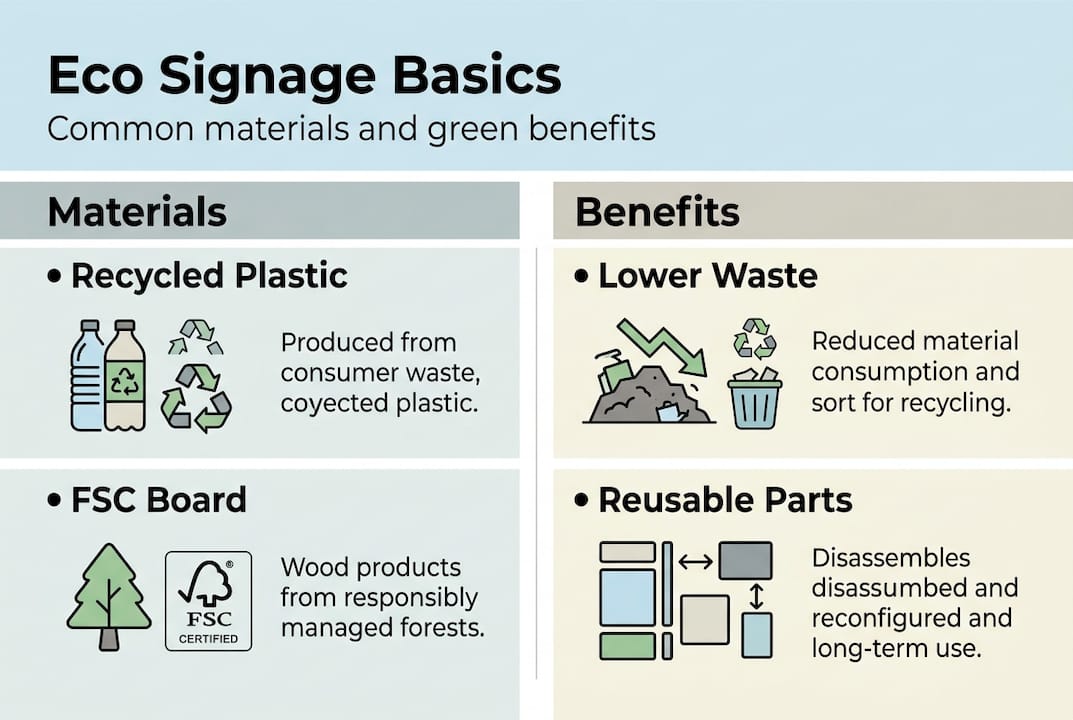
Eco-friendly signage options include recycled plastics, FSC-certified boards, and biodegradable fabrics, each suited to different event contexts. Here is a comparison of the leading substrates:

| Material | Best use | Recyclable | Biodegradable | Durability |
|---|---|---|---|---|
| FSC-certified foamboard | Indoor exhibitions | Yes | Partial | Medium |
| Recycled PET fabric | Pull-up banners, backdrops | Yes | No | High |
| Biodegradable paper board | Short-term displays | Partial | Yes | Low |
| Corrugated recycled board | Directional signage | Yes | Partial | Medium |
| Bamboo composite | Feature displays | Yes | Yes | High |
Turiu visą tekstą. Analizuoju:
External linkai šalintini:
eventindustrynews.com❌pulsemerch.com❌ (visiškai nesusijęs — Utah merch puslapis!)
5 nauji internal linkai pagal straipsnio temą (events, exhibition, banners, large format, mesh):
- exhibition stands London →
https://promosigns.co.uk/exhibition-stands-london/ - event graphics London →
https://promosigns.co.uk/event-graphics-london/ - banner printing London →
https://promosigns.co.uk/banner-printing-london/ - large format printing London →
https://promosigns.co.uk/large-format-printing-london/ - mesh banner printing London →
https://promosigns.co.uk/mesh-banner-printing-london/
Štai visas pataisytas tekstas:
Sustainable event signage has a reputation problem. Many event organisers and corporate clients still assume that choosing eco-friendly materials means accepting dull visuals, limited formats, or unreliable print quality. That assumption is outdated. Modern sustainable signage combines striking, on-brand graphics with responsible materials that reduce waste and satisfy increasingly demanding stakeholder expectations. Whether you are planning a trade exhibition, corporate conference, or outdoor festival, this guide walks you through the materials, design strategies, and practical steps to deliver signage that looks exceptional and stands up to scrutiny on environmental grounds.
Key Takeaways
| Point | Details |
|---|---|
| Sustainability is now a must | Eco-friendly signage is expected at modern UK events for both ethical and regulatory reasons. |
| Range of material choices | Event organisers have access to recycled, biodegradable, and reusable options for standout signs. |
| No compromise on branding | Advanced printing ensures sustainable signs can be as impactful as traditional alternatives. |
| Plan from the outset | Early decisions on materials, suppliers, and reuse strategies maximise event sustainability. |
Why eco-friendly signage matters for events
The event industry generates a significant volume of waste, and signage is one of the most visible contributors. Banners, pop-up displays, and printed boards are often used once and sent straight to landfill. Event sustainability pressures are growing across the UK, with clients, venues, and regulators all raising expectations around responsible procurement and waste reduction.
Events are responsible for significant waste, and organisers are under pressure to reduce single-use materials. This is not simply an ethical position. It reflects a fundamental shift in how corporate clients and attendees evaluate events. Sustainability credentials are now a competitive differentiator.
Consider what is at stake for your brand:
- Reputation: Clients and sponsors increasingly audit the environmental performance of events they associate with.
- Regulation: UK procurement guidelines and local authority event permits are incorporating sustainability requirements.
- Attendee expectations: Surveys consistently show that event attendees notice and respond positively to visible green credentials.
- Cost: Reusable and recyclable signage systems reduce long-term spend on materials and disposal.
“Sustainability is no longer a nice-to-have for event organisers. It is a baseline expectation from clients, venues, and attendees alike.”
Exploring eco-friendly Shop signs London options early in your planning process allows you to build green credentials into the event from the ground up, rather than retrofitting them as an afterthought. The earlier sustainability is factored into your signage brief, the more cost-effective and visually coherent the result will be. Waiting until the final stages of event planning limits your material choices and forces rushed decisions that often result in compromise.
The reputational argument is particularly compelling for corporate clients. A company that invests in a premium exhibition stand but uses single-use PVC banners sends a mixed message. Aligning every element of your event presence with your stated values is now part of professional event management.
Exploring materials: what makes signage eco-friendly?
With a clear understanding of why eco-friendly signage matters, focus now turns to the materials that make signs truly sustainable. Not all green claims are equal. The most credible sustainable materials share three core characteristics: they are sourced responsibly, they can be recycled or composted at end of life, and their production process minimises harmful emissions.
Eco-friendly signage options include recycled plastics, FSC-certified boards, and biodegradable fabrics, each suited to different event contexts. Here is a comparison of the leading substrates:
| Material | Best use | Recyclable | Biodegradable | Durability |
|---|---|---|---|---|
| FSC-certified foamboard | Indoor exhibitions | Yes | Partial | Medium |
| Recycled PET fabric | Pull-up banners, backdrops | Yes | No | High |
| Biodegradable paper board | Short-term displays | Partial | Yes | Low |
| Corrugated recycled board | Directional signage | Yes | Partial | Medium |
| Bamboo composite | Feature displays | Yes | Yes | High |
Key factors to consider when selecting materials:
- Reusability: Can the substrate withstand multiple events without degrading?
- Print compatibility: Does the material accept high-quality digital print without off-gassing harmful chemicals?
- Weight: Lighter materials reduce transport emissions, which matters for large-scale events.
- Certification: Look for FSC, PEFC, or ISO 14001 accreditation from your supplier.
Pro Tip: Ask your signage provider for a material data sheet before confirming your order. This confirms recyclability, sourcing credentials, and any chemical treatments applied during manufacturing.
Keeping pace with signage trends for events also means being aware of newer product technologies. Recycled ocean plastics are now available as a substrate for rigid signage panels, and water-based UV inks have largely replaced solvent-based alternatives in professional print environments. These advances mean that choosing sustainable large format printing London materials no longer requires accepting a lower standard of finish.
Designing for impact: how to balance sustainability and branding
Once materials are selected, it is vital to ensure your signage delivers strong visual messaging and brand consistency. Modern printing technologies enable vivid, on-brand graphics on recycled and reusable materials, so there is no need to compromise on colour accuracy, resolution, or finish quality.
Here are the five most effective approaches for designing high-impact sustainable signage:
- Use modular systems. Modular display frames allow you to swap printed panels between events while retaining the structural components. This reduces waste and gives you flexibility to update messaging without replacing the entire display.
- Prioritise bold, simple graphics. Eco-materials sometimes have a slightly different surface texture to standard PVC. Strong, clean design compensates for any subtle surface variation and actually tends to perform better at distance.
- Choose fabric over rigid boards where possible. Fabric displays are lighter, fold compactly for transport, and are easier to recycle. They also photograph well, which matters for social media coverage of your event.
- Specify water-based inks. These deliver excellent colour vibrancy on most sustainable substrates and eliminate the chemical concerns associated with solvent printing.
- Plan for reuse from the brief stage. Avoid event-specific dates or one-off messaging on large format pieces. Keeping copy evergreen means the same signage can serve multiple events.
Pro Tip: When briefing your signage provider, share your brand guidelines alongside your sustainability requirements. A good provider will identify which eco-materials best match your colour palette and finish preferences before production begins.
Following signage best practices also means thinking about the full lifecycle of each piece. A well-designed sustainable display that is stored and reused three times has a fraction of the environmental footprint of a single-use equivalent, even if the initial material is not perfectly green. Combining smart event signage design with reuse planning is where the real environmental gains are made.
| Design approach | Environmental benefit | Visual impact |
|---|---|---|
| Modular frame systems | Reduces structural waste | High |
| Fabric backdrops | Lightweight, recyclable | Very high |
| Water-based ink printing | Lower chemical emissions | High |
| Evergreen copy strategy | Enables multi-event reuse | Neutral |
Best practices and pitfalls: implementing eco-friendly signage at your next event
The visual and environmental impact of your signage depends as much on execution as design choices. Planning ahead is the single most important factor. Reusable signage systems are cost-effective for recurring events and help cut waste significantly, but only if they are specified and procured with reuse in mind from the outset.
Here is a practical checklist for choosing event signage that meets both your visual and sustainability goals:
- Brief your signage supplier on your green targets before discussing formats or materials.
- Request material certifications and end-of-life disposal guidance in writing.
- Avoid mixing materials in a single sign unit, as composite products are harder to recycle.
- Specify storage solutions for reusable displays so they remain in good condition between events.
- Confirm whether your supplier offers a take-back scheme for used signage.
- Compare banner printing London versus poster formats for each application, as the right format affects both impact and waste.
The most common pitfalls are predictable but easy to avoid. Ordering signage with event-specific dates locks you into single use. Choosing the cheapest substrate without checking recyclability undermines your green credentials. Failing to arrange collection and recycling at the event itself means even well-intentioned choices end up in general waste.
“The greenest sign is the one you use again. Reuse is more powerful than any material choice.”
Working with WRAP event sustainability guidance can help you build a robust waste reduction plan for your event signage. WRAP provides practical frameworks for closing the loop on materials, including signage, and their resources are freely available to UK event organisers.
Pro Tip: After each event, photograph and catalogue your reusable signage assets. A simple inventory makes it far easier to plan future events around existing stock rather than ordering from scratch.
Our perspective: the hidden power of sustainable event signage
We have worked with enough event organisers and corporate clients to know that sustainable signage is often treated as a compliance exercise rather than a creative opportunity. That is a missed opportunity. In our experience, the constraints imposed by eco-materials frequently push designers and clients toward bolder, cleaner solutions that outperform conventional signage on visual impact.
There is also a commercial argument that rarely gets made clearly enough. Clients and attendees now actively look for visible green credentials at events. A well-executed sustainable display does not just reduce waste. It communicates values, builds trust, and generates the kind of positive attention that a standard PVC banner never will.
The shift toward futureproof exhibition stands London strategies is accelerating. Event organisers who build long-term relationships with signage providers who understand sustainability will consistently outperform those who treat each event as a one-off procurement exercise. Small, consistent improvements in material choices and reuse planning compound into significant environmental and financial gains over time.
Ready to elevate your next event with sustainable signage?
If this guide has given you a clearer picture of what sustainable event signage can achieve, the next step is working with a team that can deliver it. At PromoSigns, we specialise in bespoke, high-impact signage for exhibitions, corporate events, and brand activations across London, Essex, and Kent.
Our range of eco-friendly signage solutions includes recycled fabric displays, FSC-certified boards, and modular exhibition systems designed for reuse. From initial brief to professional installation, we manage the full process so you can focus on delivering an outstanding event. We also offer mesh banner printing London for outdoor events where lightweight, wind-resistant materials are essential. Explore our custom exhibition signage range or get in touch to discuss your specific requirements with our team.
Frequently asked questions
What materials are considered eco-friendly for event signage?
Common eco-friendly materials include recycled and biodegradable substrates such as recycled plastics, FSC-certified paperboards, and biodegradable fabrics. Each suits different event formats and durability requirements.
How can event organisers ensure signage is fully recyclable?
Choose single-material signs, avoid lamination, and work with suppliers who follow best practices in recyclable signage, including providing a take-back or recycling scheme at end of life.
Are eco-friendly signs more expensive than traditional signage?
Eco-signs can cost slightly more upfront, but reusable signage systems are cost-effective for recurring events and often save money through reduced disposal fees and lower repeat-order costs.
Do sustainable signage options restrict design and branding choices?
Modern eco-materials and vivid on-brand graphics are fully compatible, with current print technologies delivering excellent colour accuracy and finish quality on recycled and reusable substrates.
What is the best way to dispose of event signage after an event?
Reuse signage wherever possible across future events, or return it to your supplier under a take-back scheme for responsible recycling rather than sending it to general waste.
Recommended
- Complete Guide to Eco-Friendly Signage Options – PromoSigns.co.uk
- Complete Guide to Sustainable Signage Solutions – PromoSigns.co.uk
- Understanding Eco Friendly Signage Solutions – PromoSigns.co.uk
- 7 Essential Signage Trends for Events Every Organizer Needs – PromoSigns.co.uk
- Event merch ideas that boost brand recall by 40% in Utah 2026
