
Your shopfront is working around the clock, whether you intend it to or not. For London retail and hospitality businesses, professional site branding is one of the most direct levers available to drive footfall, build recognition, and increase revenue. Signage upgrades yield over 10% sales increases, and yet many business owners still treat their signs as an afterthought. This guide covers the core design principles, London-specific compliance requirements, sustainable options, and measurable impact of strong site branding, so you leave with practical knowledge and a clear path forward.
Table of Contents
Key Takeaways
| Point | Details |
|---|---|
| Branding essentials | Colour, typography, material, and illumination must reinforce your identity and ensure visibility. |
| Design for London | Prioritise bold, legible signage and council compliance for busy streets and special zones. |
| Sustainability matters | Eco-friendly materials and digital signage boost both reputation and customer engagement. |
| Measure impact | Track your signage’s effect with KPIs like sales lift, footfall, and dwell time for ongoing success. |
What are site branding essentials?
Site branding refers to the complete visual identity your business presents at its physical location. It goes far beyond a single sign above the door. For London retail and hospitality owners, it encompasses every touchpoint a customer encounters before they even step inside, and it shapes their first impression within seconds.
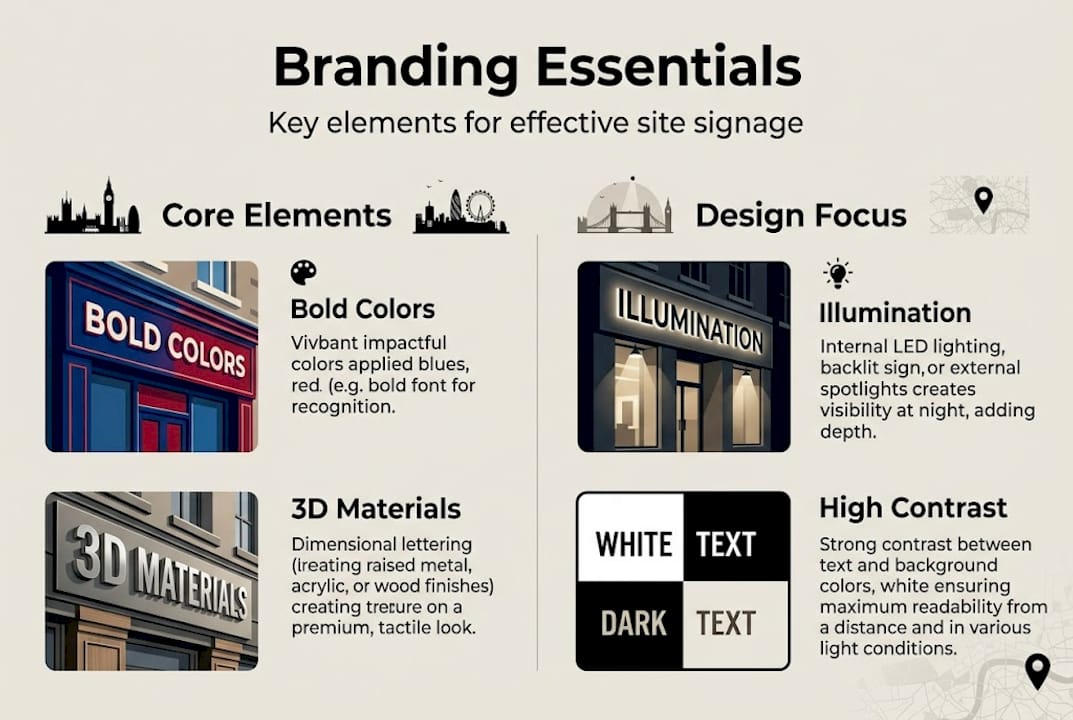
The foundational elements of effective site branding include:
- Colour: Bold, consistent brand colours that are instantly recognisable and visible from a distance
- Typography: Clean, legible fonts, ideally sans-serif, with high contrast against the background
- Material: The physical substrate of your signage, whether aluminium, acrylic, timber, or brushed steel, communicates quality and durability
- Illumination: Backlit, halo-lit, or LED-illuminated signs extend visibility into evening hours and poor weather conditions
- Negative space: The deliberate use of empty space around text and graphics to improve readability and visual impact
Core mechanics include bold brand colours, 3D materials, illumination, and clear typography with high contrast, all working together as a unified system rather than isolated elements.
The visual branding components that make up a complete site include shop signs London fascia signs, window vinyls, awnings, projecting signs, and digital displays. Each plays a distinct role. Fascia signs establish your primary identity. Window vinyls communicate offers and hours. Digital displays allow real-time messaging.
A useful rule of thumb for legibility: allow 1 inch of letter height for every 10 feet of viewing distance. At 3 seconds, that is roughly the time a passing pedestrian or driver has to register your sign. If your message cannot be read in that window, it is not working hard enough. Exploring the custom sign design process in detail can help you understand how these decisions are made professionally.
| Signage element | Primary function | Best for |
|---|---|---|
| Fascia sign | Brand identity | All retail and hospitality |
| Window vinyl | Promotions and information | Cafés, salons, boutiques |
| 3D letters | Premium brand presence | Restaurants, hotels |
| Digital display | Real-time content | High-footfall locations |
| Illuminated sign | Night-time visibility | Bars, late-night retail |
Design principles for high-impact signage
Once essentials are understood, it is crucial to look deeper into proven design principles for London. The capital’s streets are visually noisy. You are competing with dozens of other businesses, street furniture, and digital advertising. Standing out requires deliberate, structured decisions.
Here are the key principles to follow:
- Prioritise contrast: Dark text on a light background, or vice versa, is the single most effective way to ensure legibility at speed
- Use negative space deliberately: Cramming too much information onto a sign reduces impact. Less is consistently more
- Choose clean fonts: Decorative typefaces may look attractive in isolation but fail at distance. Stick to bold, geometric sans-serif options
- Optimise letter height: Use the 1 inch per 10 feet rule as your baseline and scale up for high-speed viewing environments
- Plan for illumination early: Lighting is not an add-on. It should be integrated into the design from the outset
In London high streets, prioritise visibility with bold, illuminated retail signs signage because legibility and contrast are what achieve 3-second readability in busy environments. The data supports this investment. Digital signage can boost sales by 25 to 32% with a return on investment typically achieved within 12 to 18 months.
| Letter height | Legible viewing distance |
|---|---|
| 50mm | 5 metres |
| 100mm | 10 metres |
| 200mm | 20 metres |
| 300mm | 30 metres |
For businesses in conservation areas or listed buildings, design choices become more constrained. Certain materials, illumination types, and fixing methods may be restricted. Phased installations and sympathetic colour palettes are often required. Understanding how to design building signage within these constraints is essential before committing to any design.
Pro Tip: Create two or three design variants and test them with a small group of your target customers before committing to manufacture. Ask specifically whether they can read the sign clearly and what impression it gives. Their responses will often surprise you and save costly revisions later. You should also consider lighting outdoor signage as a core part of the design brief, not a finishing touch.
| Signage element | Primary function | Best for |
|---|---|---|
| Fascia sign | Brand identity | All retail and hospitality |
| Window vinyl | Promotions and information | Cafés, salons, boutiques |
| 3D letters | Premium brand presence | Restaurants, hotels |
| Digital display | Real-time content | High-footfall locations |
| Illuminated sign | Night-time visibility | Bars, late-night retail |
Compliance and installation in London
With your design outlined, the next step is to ensure your site branding is legally compliant and properly installed. This is where many businesses encounter unexpected delays and costs, particularly in a city as regulated as London.
The major compliance steps include:
- Planning permission: Most externally visible signs require advertisement consent from your local borough council
- Listed building consent: Any changes to a listed building, including signage, require a separate application
- Accessibility requirements: Signs must meet legibility standards for partially sighted individuals in certain contexts
- Landlord approval: If you are a tenant, your lease may require written consent from the building owner before any signage changes
- Building regulations: Structural fixings and electrical connections for illuminated signs must comply with relevant standards
Understanding sign permit compliance is not optional. It is the foundation of any successful installation. Listed buildings require phased installs and extensive permissions, and failures in this process can cause significant delays and added costs that undermine your entire project budget.
Conservation areas across London, including parts of Covent Garden, Notting Hill, and the City, have specific design codes that govern acceptable sign types, materials, and illumination. Always check with your local planning authority before finalising any design.
Installation logistics in London require careful planning. High-footfall locations may necessitate overnight or weekend working to avoid disruption. Scaffolding or cherry picker access must be booked well in advance. Ongoing maintenance access should be factored into the installation design from the start.
You can find detailed guidance on permit requirements for signage and a broader overview of signage regulations in London to help you navigate the process with confidence.
Pro Tip: Begin the permissions process at least 8 to 12 weeks before your planned installation date. Council processing times vary considerably across London boroughs, and submitting early gives you room to respond to any requests for additional information without delaying your launch.
| Letter height | Legible viewing distance |
|---|---|
| 50mm | 5 metres |
| 100mm | 10 metres |
| 200mm | 20 metres |
| 300mm | 30 metres |
Sustainable and future-proof signage solutions
Looking beyond compliance, London businesses must consider the long-term impact of sustainable and digital signage. Consumer expectations around environmental responsibility are rising steadily, and your signage choices are increasingly part of that conversation.
Why sustainability matters in signage:
- Customers actively notice and respond positively to eco-conscious brand choices
- Regulatory pressure on materials and energy consumption is increasing across the UK
- Sustainable materials often offer superior longevity, reducing total cost of ownership
- Eco-friendly signage supports broader corporate social responsibility messaging
Popular sustainable materials include reclaimed timber, powder-coated steel, recycled acrylic, and water-based inks for vinyl sticker printing London graphics. Eco-materials like reclaimed wood appeal to sustainability-minded customers, and digital signage offers real-time updates alongside high recall rates that static signs simply cannot match.
The digital versus static decision deserves careful thought. Static signs have lower upfront costs and require no ongoing power or content management. Digital signs carry higher initial investment but deliver flexibility, measurability, and the ability to respond to trading conditions in real time. For high-footfall London locations, the ROI case for digital is strong.
Future-proofing your signage investment means thinking in modular terms. Systems that allow individual panels or components to be updated without replacing the entire installation save significant cost over time. A rebrand or seasonal refresh becomes a straightforward swap rather than a full project.
Explore eco-friendly signage options and sustainable signage solutions to understand what is available within your budget. You can also find practical guidance on understanding eco-friendly signage to make informed material choices.
Pro Tip: If you invest in digital signage, connect it to a simple analytics tool that tracks dwell time or footfall alongside your sales data. Even basic correlation analysis will show you which content drives results and allow you to optimise your messaging over time.
Our unique perspective on site branding in London
After working with hundreds of London retail and hospitality businesses, we have observed a consistent pattern. The businesses that invest most heavily in aesthetics, choosing premium materials and striking designs, do not always achieve the best outcomes. The ones that succeed treat site branding as a system, not a single decision.
The uncomfortable truth is that a beautifully designed sign installed without the correct permissions, or one that cannot be read from the pavement, is a wasted investment. We see this regularly. Owners focus on how their sign looks in a design mockup and underestimate how it performs in the real environment, in rain, at night, from a moving bus.
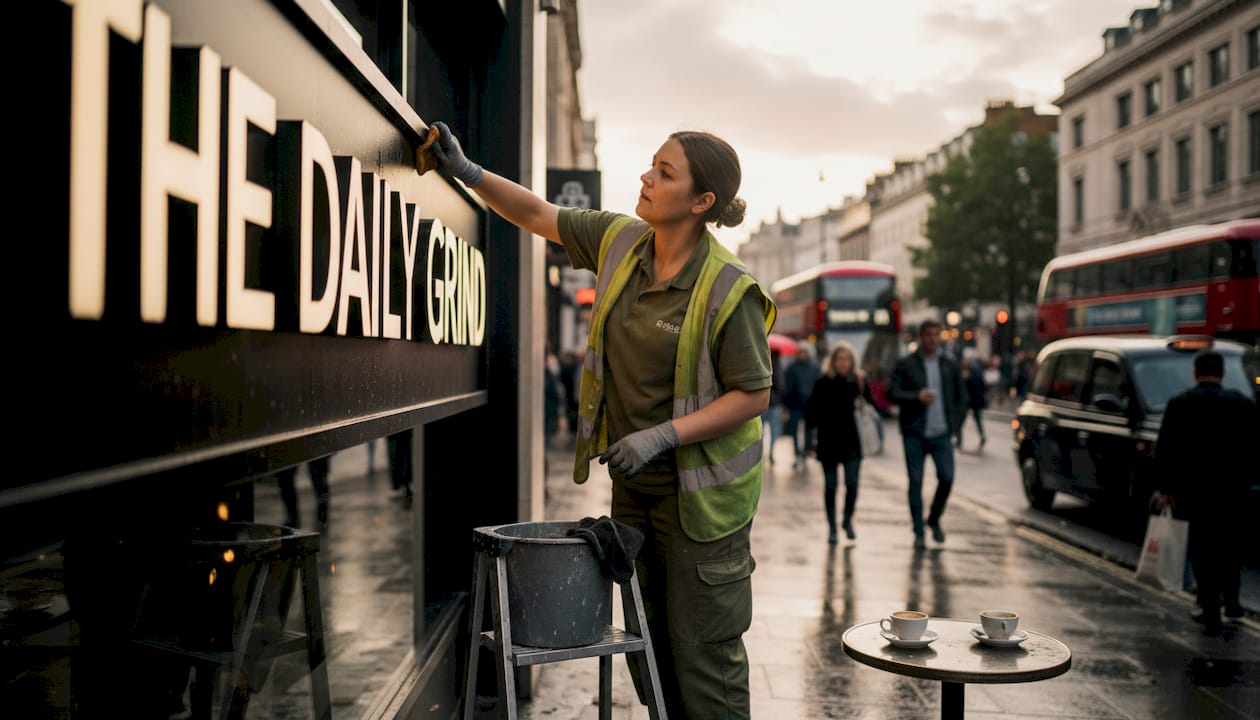
Maintenance is another area that is consistently underestimated. A sign that looked sharp at installation but is now faded, flickering, or dirty does more harm than no sign at all. It signals neglect. Build a maintenance schedule into your signage budget from day one.
Most owners also underinvest in digital and updatable signage formats, which represents a genuine missed opportunity. Adding shop awnings London and shop window graphics as part of a complete branding system is where we see the strongest long-term results. Prioritise the total customer journey, not just the sign above the door.
Next steps: upgrade your site branding with proven solutions
If you are ready to take action, trusted support and expertise are available. We work with London retail and hospitality businesses every day to deliver signage that performs from day one, on time, on budget, and fully compliant.
Browse our guide to customer-attracting outdoor signs for practical inspiration across a wide range of business types. If visibility after dark is a priority, discover the advantages of illuminated signage and how LED technology can transform your frontage. Our team is ready to discuss your specific requirements and deliver a tailored solution that makes your business impossible to miss.
Frequently asked questions
How much does professional site branding signage cost in London?
Costs vary widely depending on size, materials, and whether illumination is included, but digital signage achieves ROI in 12 to 18 months through measurable sales uplifts that offset the higher initial investment.
What permissions are needed for new shop signage in London?
Most London sites require advertisement consent from the local borough council, and listed buildings require phased installs and extensive permissions, meaning that failing to secure the correct approvals can cause costly and time-consuming delays.
Can sustainable signage really attract more customers?
Yes. Eco-materials appeal to sustainability-minded customers and reinforce a positive brand image that resonates with a growing segment of London shoppers who actively favour businesses with visible environmental commitments.
Is digital signage better than traditional signs for retail in London?
Digital signage can boost sales by 25 to 32% and delivers real-time messaging flexibility that static signs cannot match, making it particularly effective in high-footfall London locations where trading conditions change frequently.
Recommended
- Signage and Brand Recognition: Boost Your London Business in 2025 – PromoSigns.co.uk
- Interior Branding Graphics: Transforming London Businesses in 2025 – PromoSigns.co.uk
- Why Signage Matters in 2025: Essential for London Businesses – PromoSigns.co.uk
- Branding with Exterior Signs: Boost Business Visibility – PromoSigns.co.uk
- Strategic Website Design for Established SMEs & Growing Businesses | LOOM Brand Designs
