
TL;DR:
- Weatherproof outdoor signs are designed to withstand rain, wind, UV radiation, and temperature fluctuations without losing quality. Selecting the right materials, such as aluminum composite or marine-grade stainless steel, ensures durability aligned with site conditions. Proper maintenance and specifying appropriate IP ratings extend sign lifespan and performance across various UK environments.
Weatherproof outdoor signs are defined as exterior signage built to resist rain, wind, UV radiation, and temperature fluctuation without losing structural integrity or visual clarity. For business owners and event organisers across the UK, where weather shifts from bright sunshine to driving rain within hours, the right sign is not a cosmetic choice. It is a functional one. Choosing the wrong material or protection rating means faded graphics, warped panels, and a brand that looks neglected within months. This guide covers the best weatherproof signage materials, the IP ratings that matter, how to maintain your signs, and how to match every decision to your specific site conditions.
Table of Contents
What materials are best for weatherproof outdoor signs?
The material your sign is made from determines how long it lasts, how it looks after two winters, and how much maintenance it demands. Five materials consistently outperform the rest for exterior use in the UK.
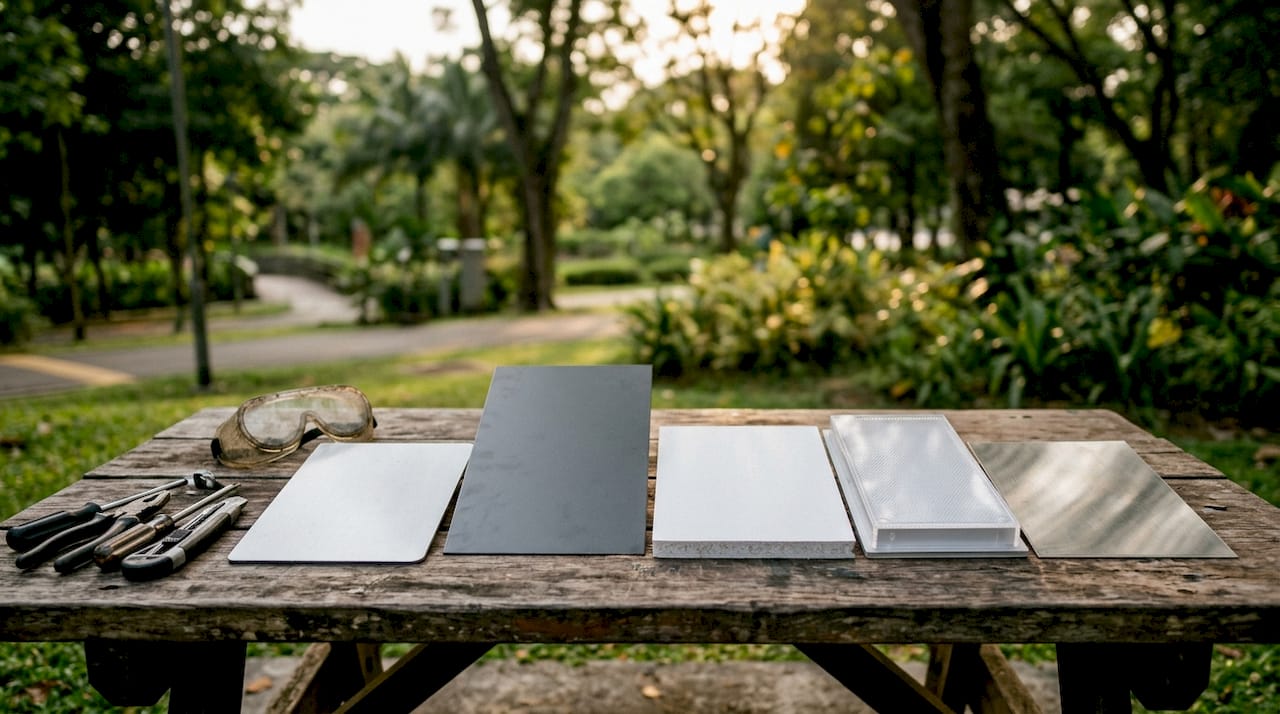
Aluminium composite (ACM) is the most widely used substrate for flat outdoor signs. It combines a polyethylene core with aluminium skins, giving it a low weight and excellent resistance to warping. Powder-coated aluminium resists rust in wet or salty environments, making it a far more practical choice than timber, which requires ongoing treatment and repainting to stay presentable.
Powder-coated mild steel suits applications where rigidity and impact resistance matter more than weight. The powder coating bonds to the metal surface and creates a hard shell that resists chipping, scratching, and corrosion. It performs well on high-traffic retail frontages and construction hoardings where signs take physical knocks.
Foamed PVC is a lightweight, cost-effective option for sheltered locations. PVC-based signs suit close viewing and low-traffic-speed locations, which makes them popular for pavement signs, menu boards under canopies, and window surrounds. They are not suited to fully exposed, high-wind positions.
Polycarbonate is the preferred material for illuminated sign faces. It transmits light evenly, resists impact far better than acrylic, and holds up against UV degradation when treated with a UV-stabilised coating. LED-lit fascia signs and lightbox panels almost always use polycarbonate for this reason.
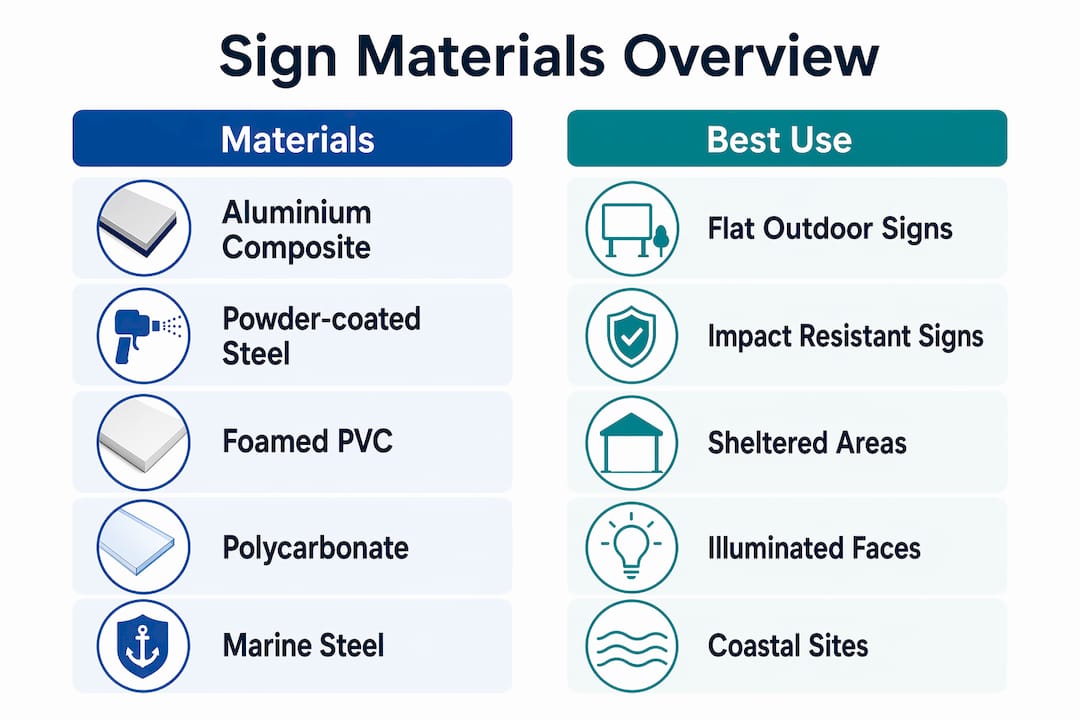
Marine-grade (316) stainless steel is the correct choice for coastal locations. 316 stainless steel resists salt damage and tea-staining near the coast, where standard steel corrodes visibly within a year. It costs more upfront, but the long-term saving on replacement and maintenance is significant.
| Material | Best use case | Key strength | Limitation |
|---|---|---|---|
| Aluminium composite (ACM) | Flat fascia and panel signs | Lightweight, rust-resistant | Not suited to high-impact zones |
| Powder-coated steel | Hoardings, frames, brackets | Rigid, impact-resistant | Heavier than ACM |
| Foamed PVC | Sheltered menus, pavement signs | Low cost, easy to cut | Degrades in prolonged UV exposure |
| Polycarbonate | Illuminated sign faces | Impact-resistant, light-transmitting | Higher cost than acrylic |
| Marine-grade stainless steel | Coastal and waterfront sites | Salt and corrosion resistant | Premium price point |
Pro Tip: If your site is within two miles of the coast, specify 316 stainless steel for any metal components, including fixings and brackets. Standard A2 stainless will show rust staining within 18 months in salt-laden air.
What do IP ratings mean for outdoor signage?
IP stands for Ingress Protection, and it is the international standard that defines how well an enclosure resists solid particles and liquids. For illuminated and digital outdoor signs, the IP rating is the single most important specification to check before purchasing.
The rating uses two digits. The first digit covers protection against solid particles such as dust. The second covers liquids. A rating of IP65, for example, means the enclosure is fully dust-tight and protected against low-pressure water jets from any direction.
Here is how the three most relevant ratings compare for signage:
- IP65: Protects against low-pressure water jets and dust. Suitable for general outdoor use in sheltered or moderately exposed positions. Adequate for most UK town-centre retail signs.
- IP66: Recommended for heavy rain or high-pressure washdowns. The stronger seal makes it the correct choice for exposed coastal sites, petrol forecourts, and food-service exteriors where signs are regularly hosed down.
- IP67: Protects against temporary immersion in water up to one metre for 30 minutes. Relevant for ground-level signs in flood-prone areas or signs installed near water features.
Choosing between IP65 and IP66 is not just about rainfall. Waterproof signage uses gasket systems, corrosion-resistant materials, and thermal management to handle condensation and temperature swings. A sign that passes IP65 testing in a factory may still fail prematurely outdoors if the gasket degrades or the enclosure is not thermally managed. Always ask your supplier for the specific sealing method used, not just the headline rating.
For most UK business owners, IP65 covers standard outdoor fascia signs. If your site faces a main road, a seafront, or a car wash environment, specify IP66 as a minimum.
How to maintain and clean weatherproof signs to extend their life
Maintenance is the most overlooked factor in sign longevity. A well-chosen sign on the right material will still fade, crack, or delaminate prematurely if it is cleaned incorrectly or left uninspected for years.
The single most damaging thing you can do to a weatherproof sign is clean it with the wrong product. Harsh chemicals and abrasive scrubbing damage protective layers, leading to premature fading and embrittlement. Solvent-based cleaners strip the UV-protective coating from polycarbonate and vinyl graphics, leaving the substrate exposed to sun damage. Once that coating is gone, you cannot restore it without replacing the panel.
Gentle, non-chloride cleaners preserve UV protective layers and extend sign life considerably. A mild washing-up liquid diluted in warm water, applied with a soft microfibre cloth, is sufficient for most routine cleans. Rinse with clean water and allow to dry naturally.
A practical maintenance schedule for most UK business signs looks like this:
- Monthly: Wipe down with a damp microfibre cloth to remove traffic film, bird deposits, and general grime.
- Quarterly: Inspect fixings, brackets, and seals for corrosion or loosening. Check for any delamination at panel edges.
- Annually: Full clean with a mild detergent solution. Inspect electrical connections on illuminated signs. Check for UV yellowing on polycarbonate faces.
- After severe weather: Check for impact damage, water ingress in illuminated signs, and any movement in mounting hardware.
For coastal and high-pollution sites, increase the frequency of monthly cleans to fortnightly. Salt deposits and industrial particulates accelerate surface degradation faster than rainfall alone.
Pro Tip: For illuminated signs, follow the cleaning guidance for illuminated signs before touching any electrical components. Always isolate the power supply before cleaning the sign face or inspecting internal fittings.
How to choose the right sign for your location and business
Selecting the best weather-resistant sign for your site requires more than picking a material from a list. You need to assess four variables: climate exposure, wind load, solar intensity, and how often the sign message will change.
-
Assess your climate exposure. A sign on a sheltered side street in central London faces very different conditions from one on an exposed seafront in Southend or a hilltop retail park in Kent. Salt air, prevailing wind direction, and average rainfall all affect material choice. Use your outdoor signage selection guide to map these factors before specifying a substrate.
-
Calculate wind load requirements. Large signs act as sails. A 2-metre-wide panel on an exposed wall can generate significant lateral force in a 50mph gust. Aluminium composite panels on concealed fixing systems handle wind load better than face-fixed timber or foam PVC boards. Your installer should calculate wind load based on sign size, height, and local wind speed data.
-
Consider solar intensity and UV exposure. South-facing signs in open locations receive the highest UV dose. Vinyl graphics on south-facing walls fade faster than those on north-facing walls. Specify UV-laminated print and UV-stabilised substrates for any sign in direct, prolonged sunlight.
-
Match the sign to your message frequency. If your messaging changes seasonally, a printed aluminium panel is expensive to replace repeatedly. A lightbox with interchangeable graphic inserts, or a digital illuminated display, gives you flexibility without reprinting the entire sign structure each time.
-
Plan for professional installation. The best material specification fails if the fixings corrode or the mounting method is wrong for the substrate. Stainless steel fixings, correctly rated for the environment, are non-negotiable for long-lasting exterior signs. Professional installation also ensures the sign meets any planning or building regulations relevant to your location.
| Factor | Low-risk scenario | High-risk scenario | Recommended action |
|---|---|---|---|
| Salt exposure | Inland town centre | Coastal or estuary site | Specify 316 stainless fixings and ACM or marine steel |
| Wind load | Sheltered courtyard | Exposed rooftop or hilltop | Structural calculation required; use concealed fixings |
| UV exposure | North-facing wall | South-facing open site | UV-laminated print; UV-stabilised substrate |
| Message frequency | Permanent branding | Seasonal promotions | Lightbox with interchangeable inserts or digital display |
What I have learned from specifying outdoor signs across the UK
Business owners often treat “weatherproof” as a binary quality. Either a sign is weatherproof or it is not. The reality is more specific than that. A sign that performs perfectly in a sheltered Shoreditch courtyard will fail within two years on a windswept retail park in Dartford. The material performance must match the site conditions, not just the budget.
The second thing I see consistently is neglected maintenance. Clients invest in quality materials and professional installation, then leave the sign untouched for three years. Gentle, routine cleaning prevents more degradation than any expensive repair job. A fortnightly wipe-down costs nothing and adds years to a sign’s life.
The trend I find most significant right now is the shift towards illuminated and digital weatherproof signs. LED-lit fascia signs with IP65 or IP66-rated enclosures give businesses visibility at night and in low-light conditions, without sacrificing durability. For businesses on busy roads or in evening-trade locations, the return on that investment is clear. The key is specifying the right IP rating and enclosure design from the outset, not retrofitting protection after the first flood.
— Promo
Promosigns: bespoke weatherproof signage for UK businesses
Promosigns designs, manufactures, and installs custom outdoor signs for retail, hospitality, and corporate clients across London, Essex, and Kent. Every sign is specified for its environment, from sheltered town-centre fascias to exposed coastal hoardings.

Whether you need a powder-coated aluminium panel for a shop front, a polycarbonate lightbox rated to IP66, or a full exterior branding package for a new site, Promosigns delivers end-to-end service from design through to professional installation. Our team works with your site conditions, planning requirements, and brand guidelines to produce durable, visually impactful signage that performs year-round. Contact Promosigns for a consultation on your next exterior sign project.
FAQ
What makes a sign truly weatherproof?
A weatherproof sign uses materials and coatings that resist moisture, UV radiation, wind, and temperature change without degrading. The combination of substrate, protective coating, and correct IP-rated enclosure determines real-world performance.
What is the best material for outdoor signs in the UK?
Aluminium composite (ACM) is the most practical choice for most UK outdoor signs, offering low weight, rust resistance, and a long service life. For coastal sites, marine-grade 316 stainless steel is the correct specification.
What IP rating do I need for an outdoor illuminated sign?
IP65 is the minimum for general outdoor illuminated signs. For exposed coastal sites, forecourts, or locations subject to pressure washing, specify IP66 for stronger protection against water ingress.
How often should I clean my outdoor sign?
Clean most outdoor signs monthly with a mild, non-chloride detergent and a soft microfibre cloth. Coastal and high-pollution sites benefit from fortnightly cleaning to prevent salt and particulate build-up from degrading the surface.
Can I use foamed PVC for an outdoor sign?
Foamed PVC suits sheltered, close-viewing locations such as pavement signs under canopies or menus beside entrances. It is not suitable for fully exposed, high-wind positions or locations with prolonged direct sunlight.
Recommended
- Outdoor vs Indoor Signage: Authoritative Complete Guide – PromoSigns.co.uk
- Durable sign materials: the complete UK buyer’s guide – PromoSigns.co.uk
- How to Light Outdoor Signs for Maximum Night-Time Impact – PromoSigns.co.uk
- Outdoor Signage Regulations UK (2026) – Planning & Compliance
